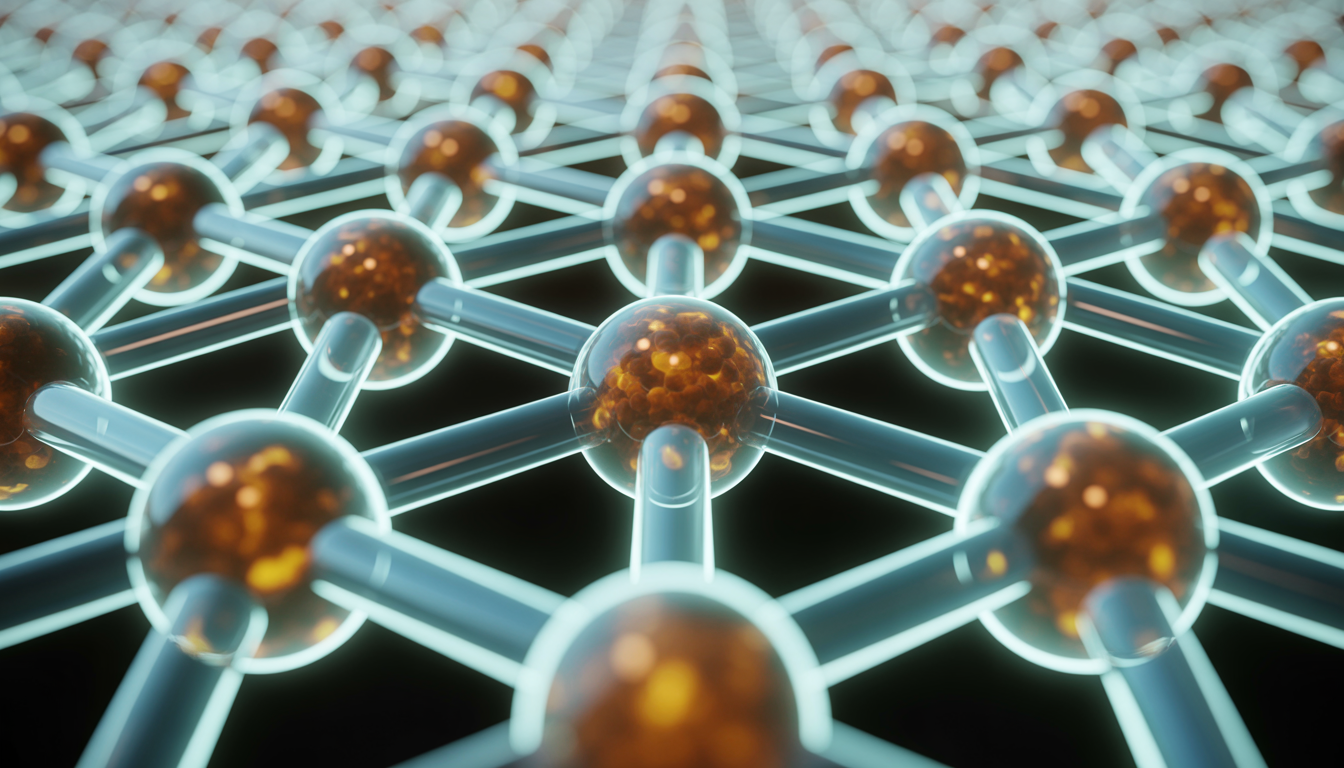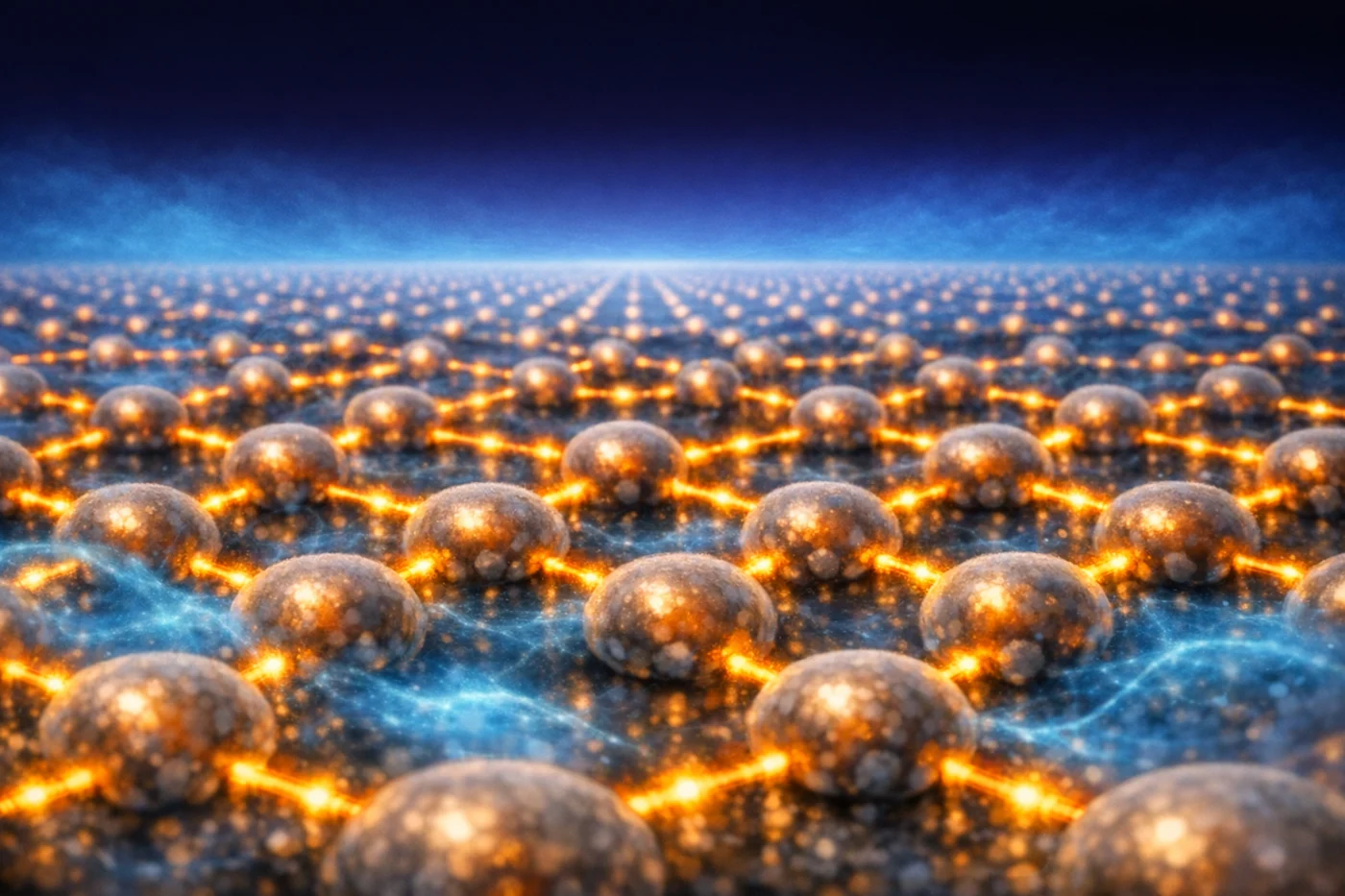
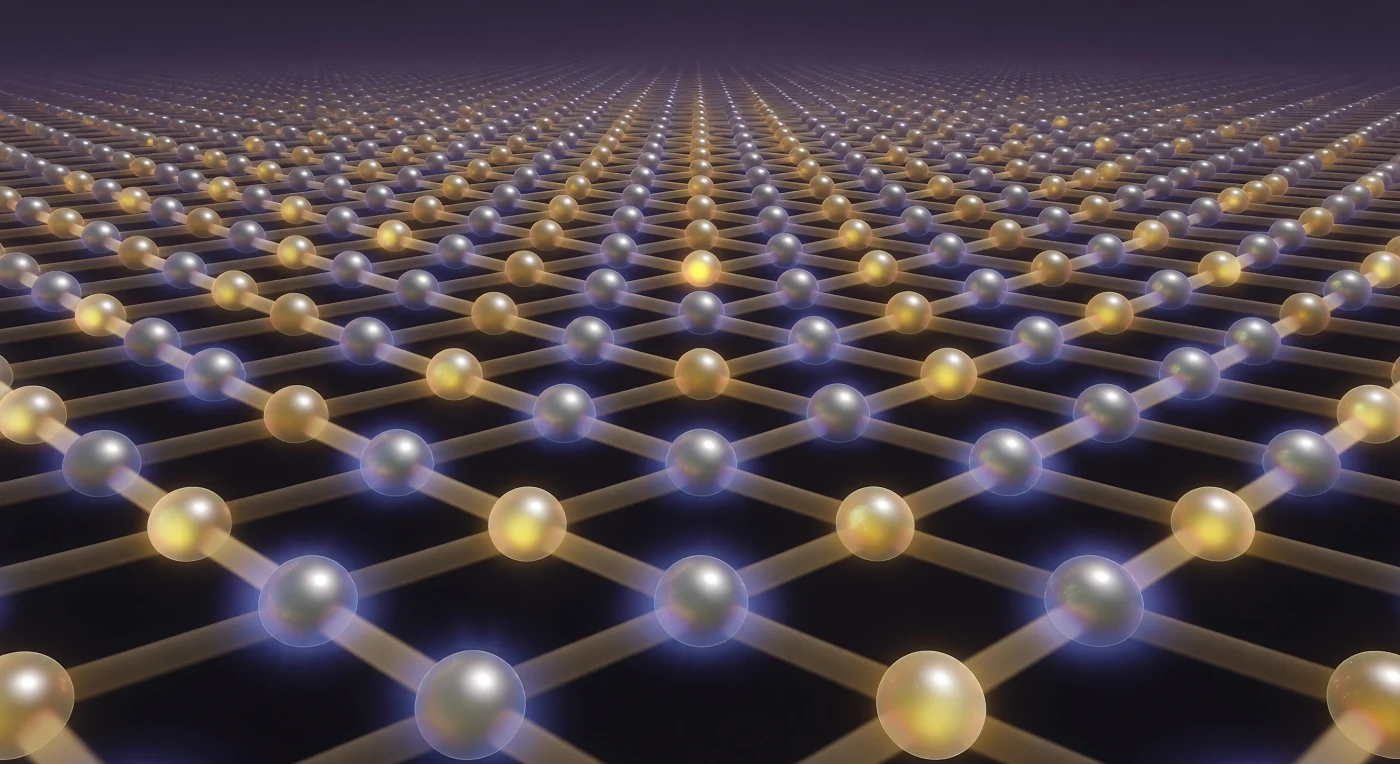
Stretching in every direction to a geometry-ruled horizon, an infinite graphene lattice fills your visual field like the floor of some vast crystalline cathedral, each warm amber-gray carbon atom resolved into its own layered sphere of electron density, dense at the nuclear core and softening outward through translucent shells to a faint chalky van der Waals halo where one atom's territory blurs into its neighbor's. Every node locks into six equidistant partners with hypnotic, defect-free precision, and between each adjacent pair a luminous covalent bond ridge glows like a taut filament of heated iron wire — amber shading to pale gold at its midpoint — all bonds burning with identical intensity because perfect aromatic delocalization grants none of them the distinction of single or double character. Hovering above and below this nuclear skeleton, twin diaphanous sheets of π-electron density drift like bioluminescent fog, electric blue tinged with soft cyan, trembling almost imperceptibly with quantum zero-point fluctuation and casting their cool, sourceless glow upward into the space where you float. The entire scene is self-lit by this electron density alone — no shadows form, no directional light intrudes — only a gentle omnidirectional luminescence that makes each glowing sphere, each bond filament, each wisp of π-cloud read with jewel-like clarity against the surrounding deep-indigo void, while the hexagonal grid recedes in perfect foreshortening until the lattice spacing shrinks below resolution and the horizon dissolves into a continuous amber shimmer at the edge of perception.
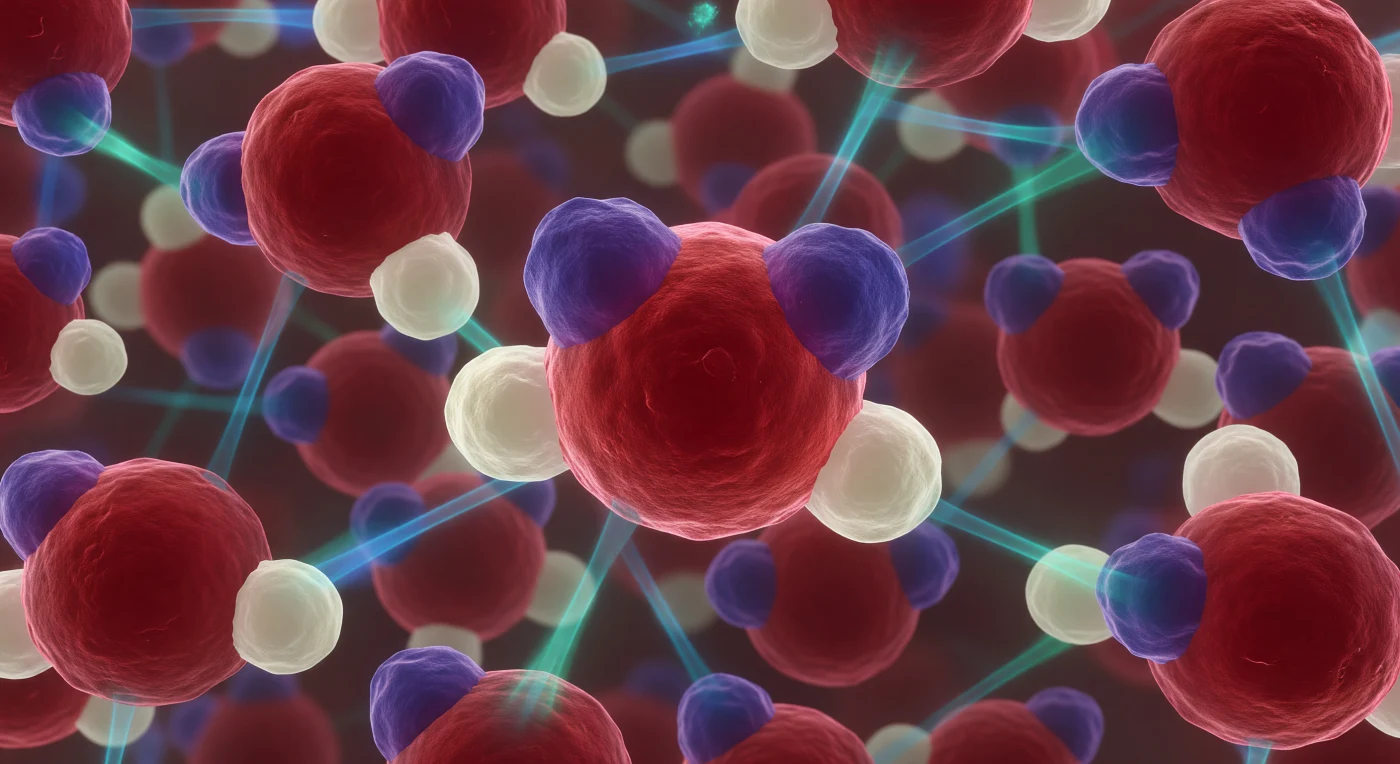
You are suspended inside a living labyrinth with no walls and no exit, pressed on every side by enormous crimson spheres — the oxygen cores of water molecules — each one easily filling your entire field of view before another shoulder its way into frame. Each oxygen carries twin violet-indigo lobes of lone-pair electron density jutting outward like shadowed hoods, pulsing with a deep aubergine glow that shifts as neighboring molecules drift and rotate, while on the opposite face two cream-white hydrogen nodules flare outward at their fixed 104.5° angle, catching the ambient chemical radiance like pale lanterns held at arm's length. Between molecules, gossamer filaments of cyan-turquoise light snap into existence and dissolve again within a picosecond — hydrogen bonds, each one a transient corridor of shared electron density bridging one molecule's hydrogen nodule to a neighboring oxygen's lone-pair lobe, their edges dissolving into diffuse fog where quantum probability fades back into nothing. This is liquid water at 300 K in its truest interior reality: the hydrogen-bond network is not a stable lattice but a continuously reweaving turbulence, each molecule simultaneously donor and acceptor, rotating and translating in all directions at once, the entire crowd heaving and reshuffling so that no two consecutive moments are alike — garnet shadows pooling in the voids, cool cyan streaks flaring where bonds momentarily hold, and a faint lavender haze of electron-density halos merging in the middle distance into a glowing, breathing, structureless press of matter that has no floor, no ceiling, and no stillness anywhere.
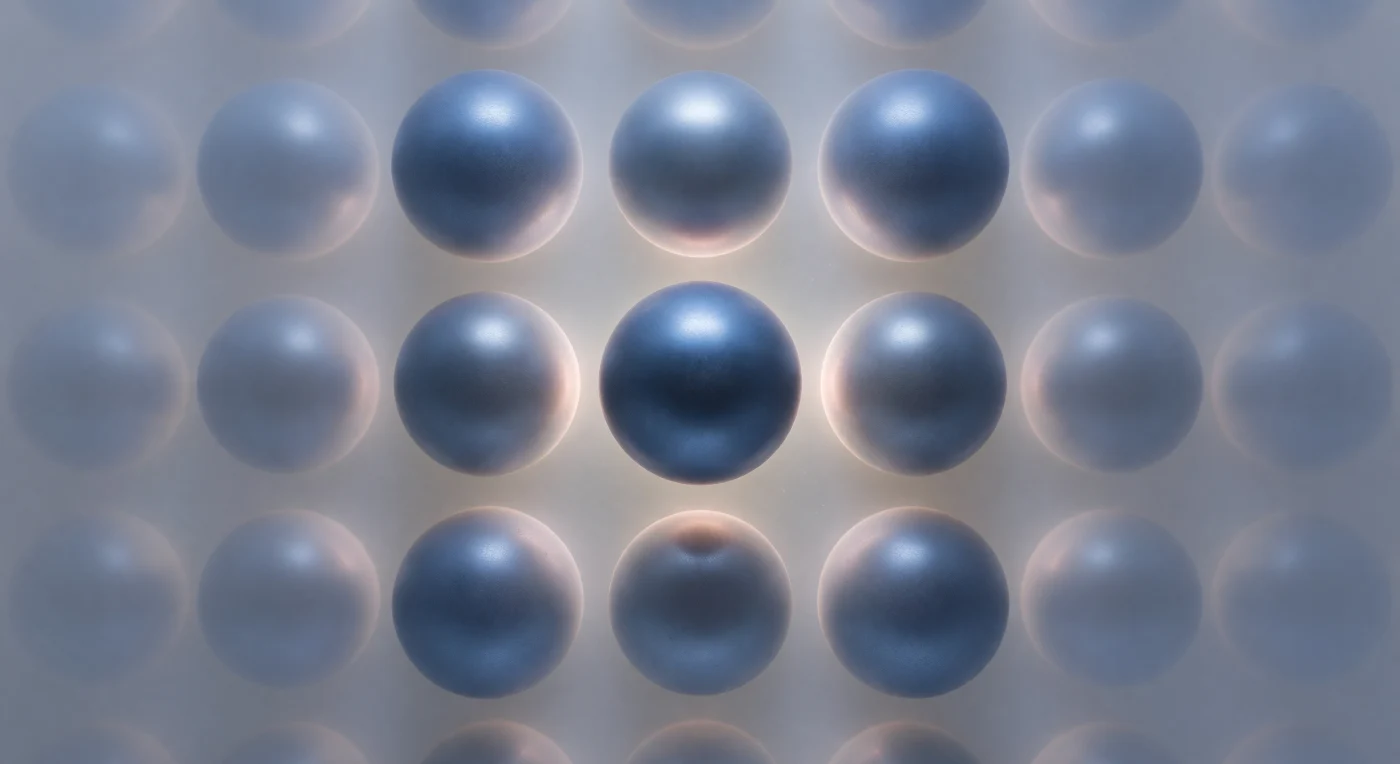
You find yourself suspended at the geometric center of a body-centered cubic iron unit cell chilled to four kelvin, surrounded by eight colossal steel-blue iron spheres anchored at the cube corners while a ninth presses close behind you — their polished, indigo-tinged surfaces dominating your peripheral vision the way cliff faces close in around a canyon floor. Between every nucleus stretches the metallic electron sea, a delocalized silver-gray luminescence that fills all interstitial space with cold, sourceless phosphorescence, brightest in the narrow throats between nearest-neighbor atoms where conduction electron density marginally concentrates into soft pewter coronae. Each iron sphere carries a barely perceptible rose-copper blush near its surface — the optical signature of long-range ferromagnetic order, where exchange coupling has aligned the 3d electron spins of millions of successive unit cells into a single magnetic domain, staining the electron gas with something between heat and color. Looking outward along any cardinal axis, the BCC motif repeats with absolute crystalline fidelity into deep perspective, rank after rank of iron cores receding into the luminous gray fog until individual spheres dissolve into a uniform phosphorescent continuum — the whole structure locked in profound arrested stillness, every atom frozen into its equilibrium lattice position with zero thermal energy left to drive a single quantum of vibration.
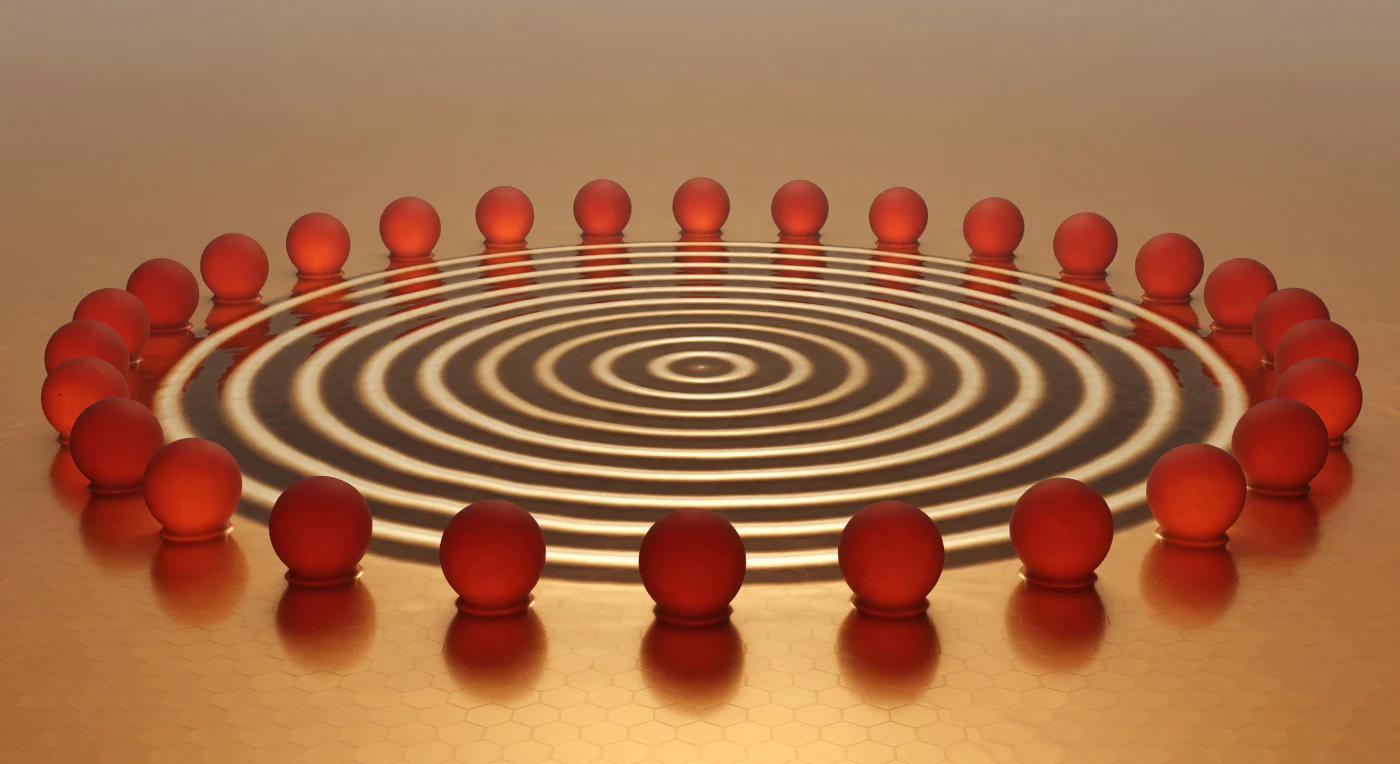
You stand at the rim of a vast circular amphitheater sunk into a burnished amber plain, looking inward across a copper-gold Cu(111) surface where forty-eight iron adatoms rise as rust-red monolithic pillars forming a perfect palisade — their rounded flanks glowing with the dense inner warmth of heated iron, their bases kissed by shallow reflections from the hexagonally corrugated lattice below. Inside the corral, the copper floor is transformed: concentric rings of quantum mechanical standing waves ripple outward from a central bright node, alternating between ivory-gold crests of constructive electron density and deep umber troughs where the surface probability is depleted, each ring separated by roughly eight ångströms — approximately the spacing of a few iron atoms laid side by side. This is the quantum corral, assembled atom by atom using a scanning tunneling microscope tip by Crommie, Lutz, and Eigler at IBM in 1993, the first direct demonstration that individual electrons confined within an atomically precise boundary obey the same standing-wave mathematics as sound trapped inside a drum. The electron density isosurfaces are sharp as polished glass, illuminated not by any external light source but by the self-luminous glow of probability itself — a cathedral whose walls are made of wavefunction, whose architecture is enforced by the Schrödinger equation alone, and whose interior radiates a sacred geometric precision that feels simultaneously microscopic and monumental.
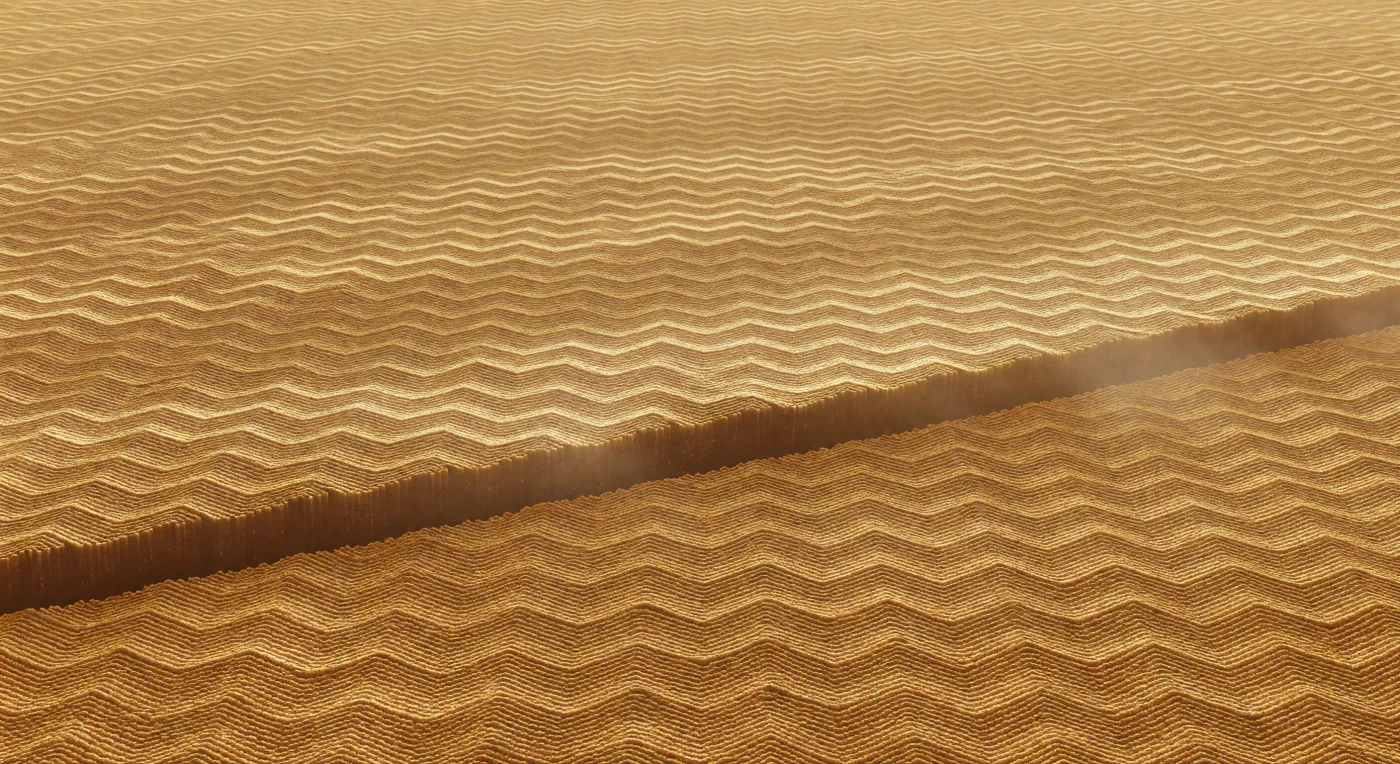
The viewer floats above a vast, precisely ordered plain of gold atoms, each one a softly glowing amber dome nestled with geometric inevitability against its six neighbors, their overlapping electron density halos merging into a continuous, self-luminous topaz sea that stretches without interruption in every direction. Across this close-packed hexagonal field, long sinuous ridges trace the famous herringbone reconstruction of the Au(111) surface — a spontaneous structural rearrangement in which the topmost gold atoms compress slightly along one direction, forcing the crystal to relieve that lateral stress by partitioning itself into alternating face-centered cubic and hexagonal close-packed stacking domains separated by soliton walls that undulate across the surface like slow dunes frozen mid-drift. These domain boundaries rise by a fraction of an atomic diameter yet catch the cold overhead tunneling illumination with enough contrast to glow pale champagne at their crests while the troughs deepen into burnt-sienna shadow, the entire corrugation pattern repeating with crystalline regularity until distance compresses the zigzag lines into a shimmering moiré-like fabric at the horizon. Cutting diagonally through the scene, a single-atom-high step edge drops away as an abrupt dark cliff — a vertical wall of packed gold nuclei whose shadowed face falls into deep ochre obscurity — yet its height, just 235 picometers in reality, feels here as dramatic and final as a continental escarpment, a reminder that at this scale the smallest discontinuity in crystal geometry becomes an absolute boundary reshaping the local electronic landscape.
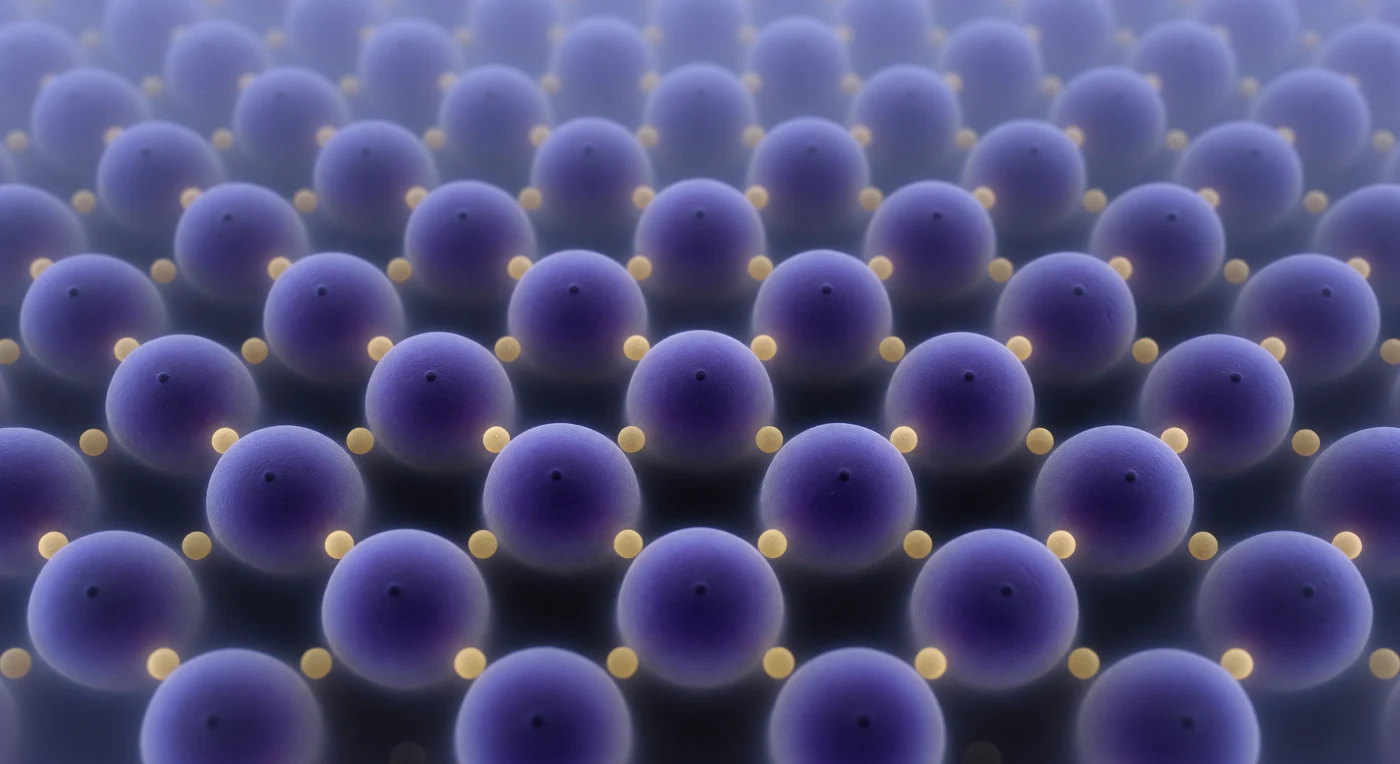
You are suspended at the geometric heart of a sodium chloride crystal, and the world around you is an infinite cathedral of ionic order — immense violet-blue chloride anions crowding every direction, their outer electron-cloud halos swollen to near-contact, diffusing through concentric gradients of lavender and indigo into the surrounding dark like slow luminescent exhalations. Nestled in the octahedral pockets between every six chloride neighbors, sodium cations appear startlingly diminutive by comparison: compact amber-gold spheres whose electron clouds are pulled tight against the nucleus by the electrostatic penalty of having surrendered a valence electron, leaving them geometrically precise and radiant with a subdued honeyed glow. The crystal adopts the rock-salt structure — space group Fm3̄m — in which each ion sits at the center of a perfect octahedron of opposite-charge neighbors, with a lattice parameter of 564 pm and an Na⁺–Cl⁻ interionic distance of roughly 282 pm; the electrostatic attraction binding them is purely Coulombic, with no covalent bridge, which explains the clean dark voids between ions where shared electron density simply does not exist. Deep in every direction the alternating violet-and-amber motif repeats without deviation, blurring at distance into a cold blue-violet mineral haze, the silence of absolute long-range crystallographic order pressing in from all sides as if the lattice itself extends to the edge of the perceivable universe.
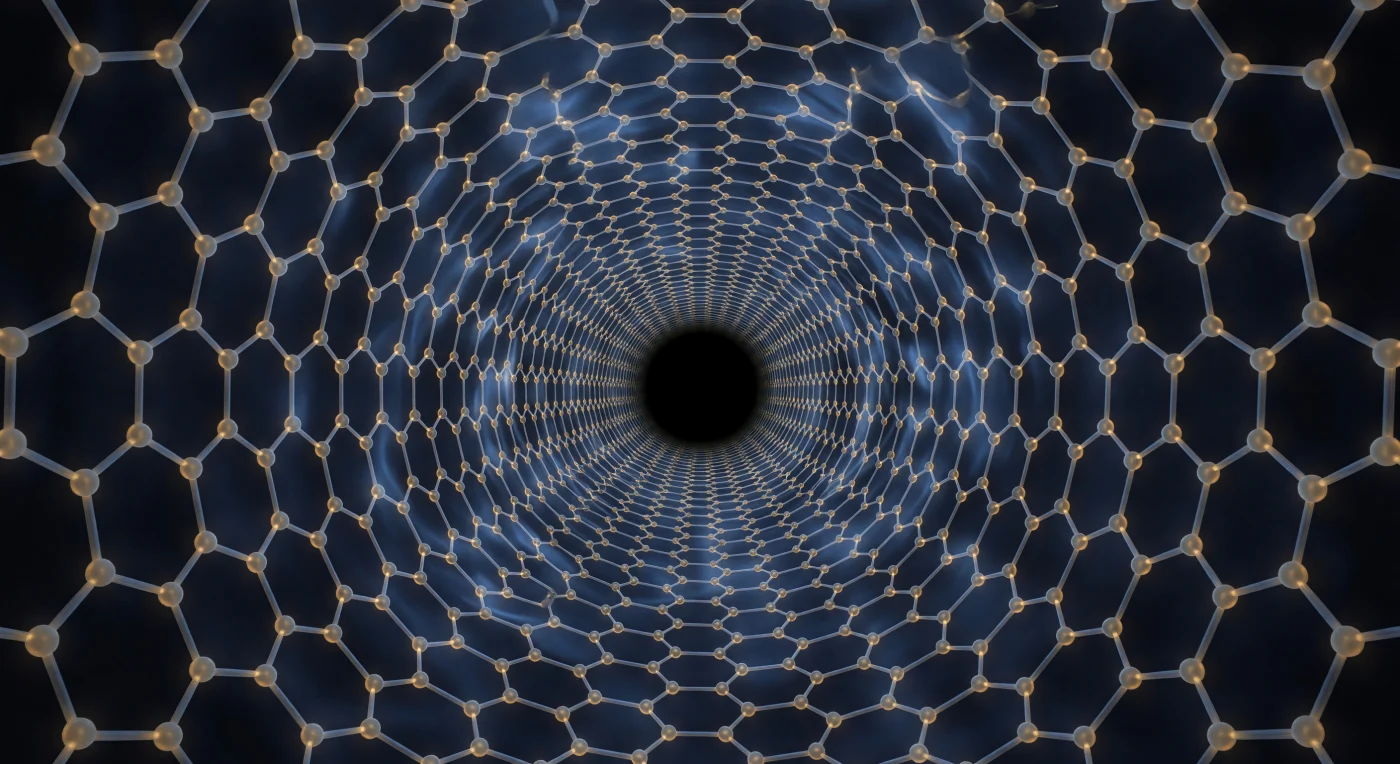
You find yourself suspended at the geometric center of a carbon nanotube's hollow bore, enclosed by a seamless cylindrical wall of hexagonally bonded carbon atoms curving perfectly around you at a radius of roughly four ångströms — a distance so intimate that each gray-amber nuclear center and its glowing sp²-hybridized bonds fills your entire peripheral field with the precision of a rolled graphene sheet frozen into mathematical ideal. The inner wall shimmers with a diffuse electric-blue haze: the delocalized π-electron cloud of an extended aromatic system, a quantum fog of shared electron density that hovers just inward of the nuclei, thickening over each six-membered ring and casting faint luminous curves across the featureless quantum vacuum of the bore itself. This is a (10,0) zigzag single-walled nanotube — a cylinder barely 0.8 nanometres in diameter, yet exhibiting the electronic properties of a semiconductor, its conductance governed by the very chirality with which the graphene lattice was conceptually rolled. Looking along the tunnel axis, ring after ring of hexagonal carbon lattice converges toward a vanishing point of absolute darkness, each bond ridge self-luminous with the warm amber radiance of concentrated electron density, the geometry repeating without defect or interruption at the scale where covalent order and quantum mechanics are indistinguishable from architecture.
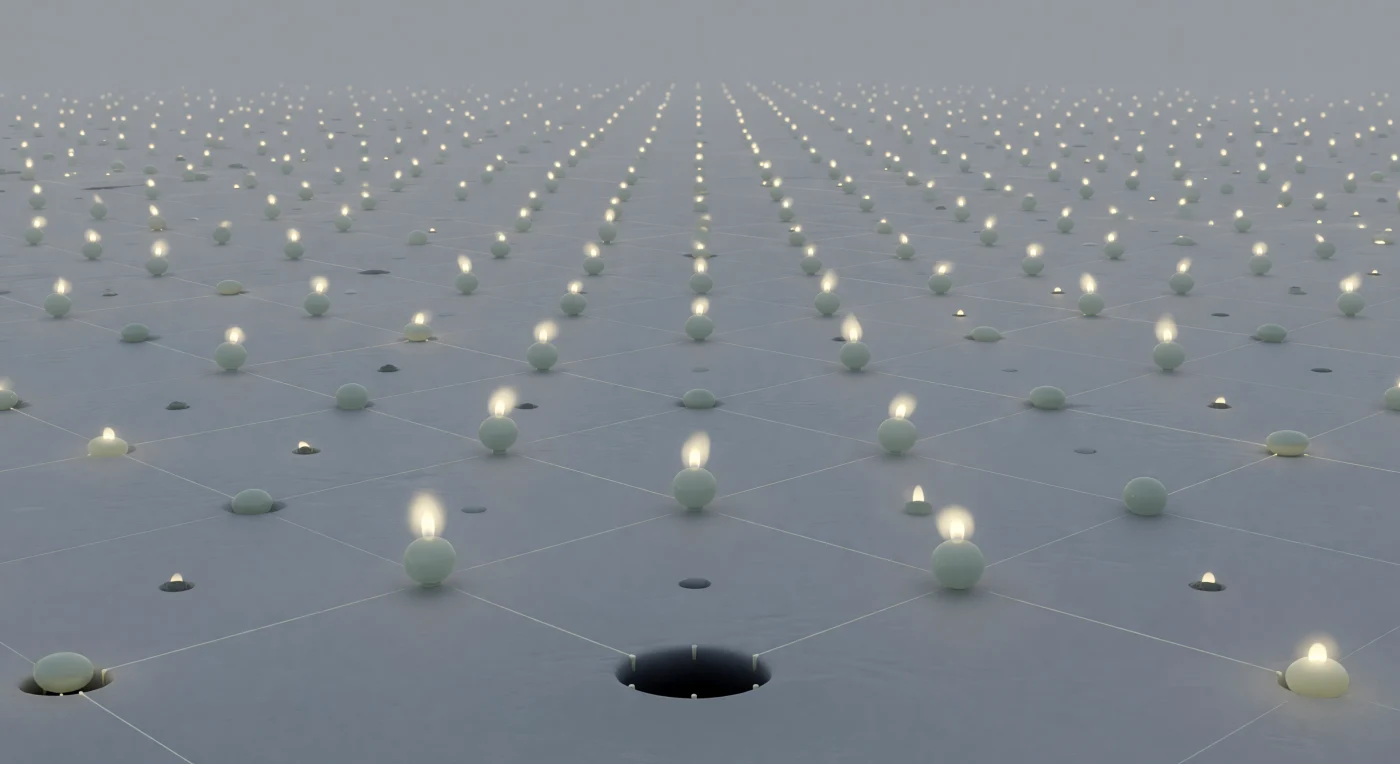
Stretching away in every direction like the floor of an immense ceremonial hall, the Si(111) 7×7 reconstructed surface presents itself as a tiling of warm lantern-glow and pewter-gray shadow, each repeating unit barely four and a half nanometers across yet commanding the entire visible world from this vantage. Twelve adatom spheres rise in two triangular clusters, their dangling-bond electron clouds hovering above them as soft yellow-white lobes — quantum probability made visible, frozen midway between one bonding partner and none, radiating a pearlescent amber haze into the cool surrounding vacuum. Six rest atoms occupy shallower hollows between them, their dimmer votive flames of electron density marking the sites where the surface chose a different reconstruction geometry, while at each unit-cell corner a single dark void drops away like a drain in ancient stone, its absolute blackness rimmed by the faint glow of under-coordinated edge atoms. The entire assembly is the outcome of a surface caught mid-collapse: when bulk silicon is cleaved along the (111) plane, the outermost atoms cannot sustain their broken bonds and rearrange over hundreds of atomic sites into this elaborate 7×7 superstructure, lowering total energy through a baroque choreography of adatom repositioning, dimer formation, and stacking-fault accommodation that took decades of crystallography and tunneling microscopy to fully decode. Everything here hums with the quiet thermal tremor of nuclei jittering within their bonding sites, each adatom a pinned lantern swaying imperceptibly at the edge of quantum uncertainty.
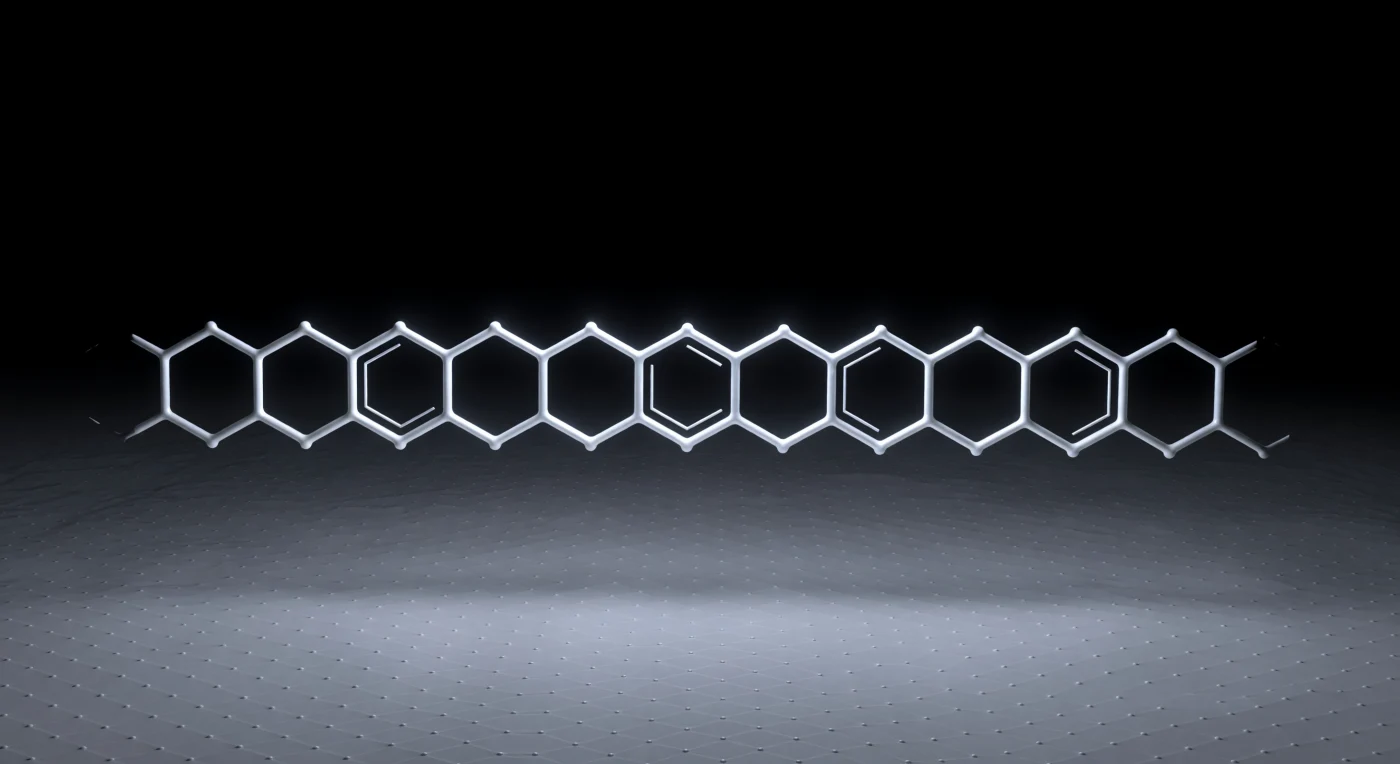
Below you, five hexagonal rings stretch end to end in a luminous, elongated chain — the entire skeleton of a single pentacene molecule rendered as a raised architectural relief of cold white ridges against absolute vacuum black, its carbon-carbon bonds glowing with a brightness that directly encodes the pressure of Pauli repulsion as the CO-functionalized tip of an atomic force microscope passes overhead at a distance of less than a nanometer. The fractionally crisper, more elevated crests mark bonds where double-bond character concentrates additional electron density into sharper ridges, while slightly softer arcs bridge the ring junctions, the whole network reading as a precise quantum-mechanical fingerprint of aromatic delocalization frozen into topographic truth. Around the molecule's perimeter, the hydrogen atoms appear as barely-there ghost arcs, their sparse electron density almost absorbed by the surrounding void, while the silver substrate extends outward as a vast, gently corrugated plain of close-packed atoms — each one a barely perceptible swelling — whose shallow hexagonal relief makes the molecule's sharp bond ridges read as mountain ranges above a quietly undulating lowland. This image, produced by non-contact AFM operating in the frequency-shift regime, achieves sub-ångström lateral resolution by exploiting the same short-range repulsive forces that prevent matter from collapsing into itself, translating the quantum geometry of chemical bonding into a landscape that can be seen.
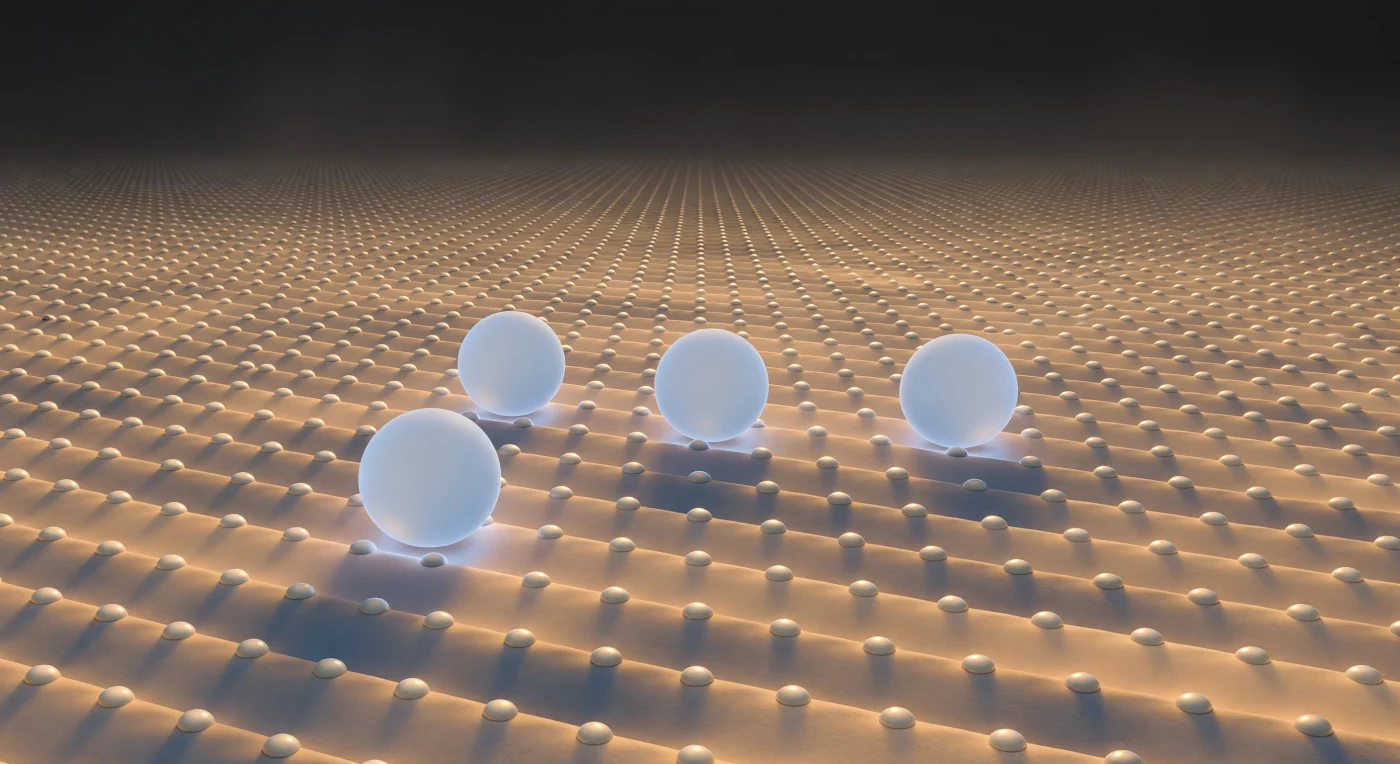
You are standing at the floor of a corrugated metallic world, the Ni(110) surface stretching in every direction as a vast plain of warm coppery-gold domes — individual nickel atoms packed shoulder to shoulder along precise crystallographic rows, their burnished crests catching an amber radiance that seems to well up from within the lattice itself, while the channels between each row fall into cool blue-grey shadow, creating a rhythmic geological corrugation that feels simultaneously immense and intimate. Resting in three of those shadowed troughs, three xenon adatoms rise like pale blue-silver monuments — their closed 5p shells presenting perfectly featureless, repulsive surfaces, no orbital bridges reaching downward, only a ghost-thin aureole of van der Waals contact tracing their lowest edge where momentarily induced dipoles whisper across the gap to the nickel beneath. This scene, famously realized by Don Eigler and Erhard Schweizer at IBM Almaden in 1990 using a scanning tunneling microscope cooled to 4 kelvin, demonstrated for the first time that individual atoms could be positioned with deliberate geometric intent on a crystalline substrate — the xenon atoms sitting physically inert and chemically unbonded, held in place by nothing stronger than dispersion forces and the cryogenic stillness pressing every degree of freedom into suspension. The contrast between the warm, tightly ordered transition-metal lattice below and the three sovereign, closed-shell noble-gas spheres above it is total: two chemical worlds sharing a surface, held together by the faintest whispered attraction, the entire arrangement frozen at a scale where a single bond length would span the distance between neighboring crests.

You stand inside a spiraling corridor of living chemistry, flanked on either side by two immense phosphate-sugar columns that twist upward and downward into a vanishing helical perspective, their phosphorus atoms radiating saffron-orange warmth while crimson oxygen spheres swell outward like polished garnets set into an ascending molecular architecture. Bridging the two columns at intervals of 3.4 ångströms — a distance barely wider than a single carbon atom — flat nucleobase platforms step across the groove interior like flagstones in a biological staircase, their aromatic π-systems so densely stacked that adjacent electron density halos nearly merge, creating a subtly luminous coin-tower of shared quantum probability. Cyan hydrogen-bond threads, two for adenine-thymine pairs and three for the richer guanine-cytosine steps, shimmer as ghostly filaments of shared electron density — not solid connectors but probabilistic whispers, the quantum mechanical signature of base complementarity made faintly visible. Along the negatively charged groove walls, small water molecules cluster in rose-red beads and compact lavender-grey sodium counterions drift in loose electrostatic constellations, their presence stabilizing the entire helical architecture against the repulsive force of massed phosphate groups. A diffuse blue-white glow permeates everything — the ambient luminescence of electron density radiating outward from every nucleus, filling the groove atmosphere with volumetric quantum fog that sculpts each spiral and platform with cool internal radiance, making this cathedral of molecular information feel simultaneously ancient and perpetually in motion.
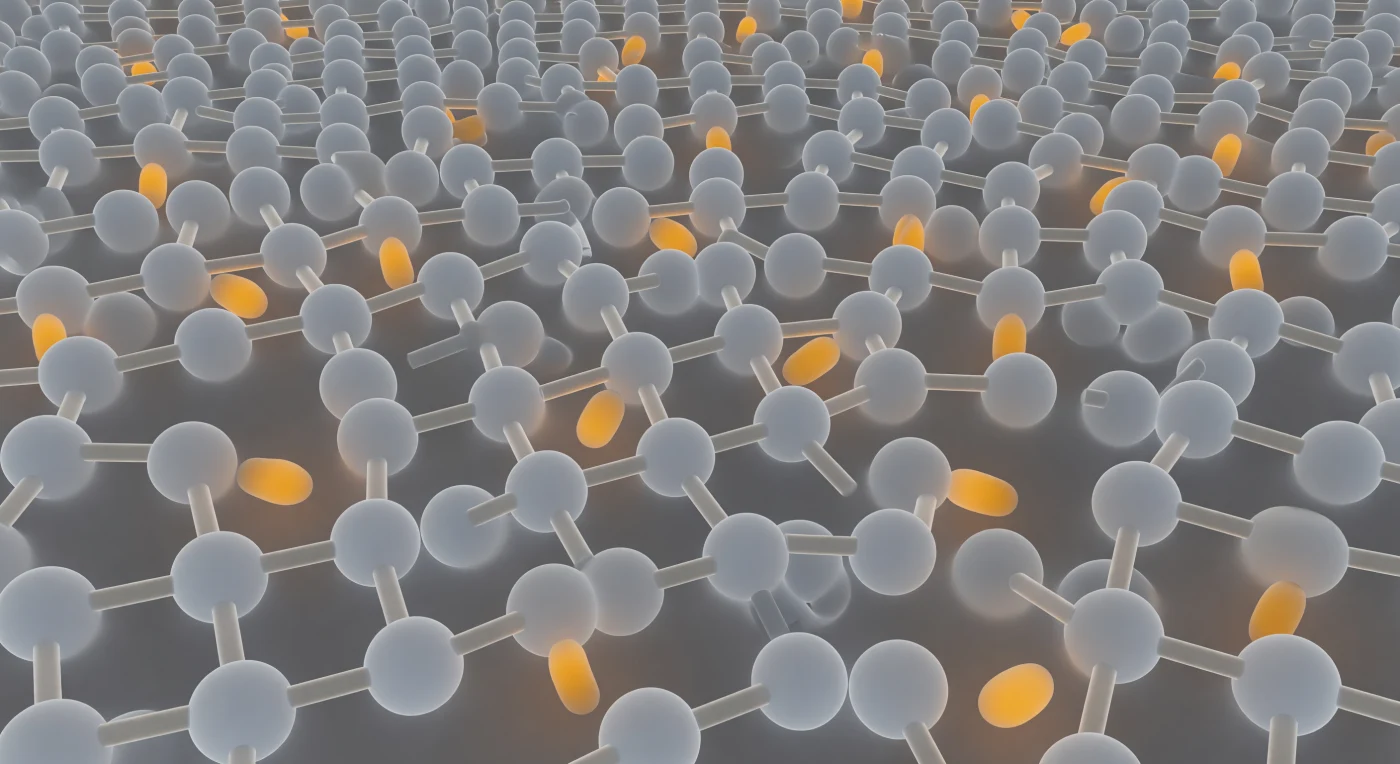
You stand inside a world with no exit and no horizon — in every direction, medium-gray silicon spheres press close, each one a boulder-sized mass of electron probability glowing faintly from within, their surfaces bleeding into a translucent quantum haze that fills the narrow voids like thin silver smoke. Amorphous silicon lacks the long-range periodicity of its crystalline counterpart: each silicon atom seeks four covalent neighbors, but without the enforced regularity of a diamond cubic lattice, bond angles deviate randomly from the tetrahedral ideal of 109.5°, and no axis of symmetry survives beyond two or three bond lengths before the geometry bends away unpredictably. Between each pair of neighbors, a warm gray-white cylinder of shared electron density bridges the gap — a covalent bond made tangible, its slight luminescence the visual signature of two atomic orbitals overlapping and lowering their combined energy. Scattered through this claustrophobic framework, three-coordinated defect atoms carry an unsatisfied fourth orbital that juts into the surrounding void as a soft amber-orange lobe, a dangling bond whose unpaired electron — a paramagnetic trap state well documented by electron spin resonance — pulses with saffron warmth against the otherwise cool silver-gray matrix. Depth dissolves within arm's reach: sharp and detailed at one bond length, softened by overlapping electron-density atmosphere at two, and by three or four bond lengths away the entire structure blurs into a luminous gray-orange murk, the disordered solid closing every sightline and curving endlessly inward upon itself.
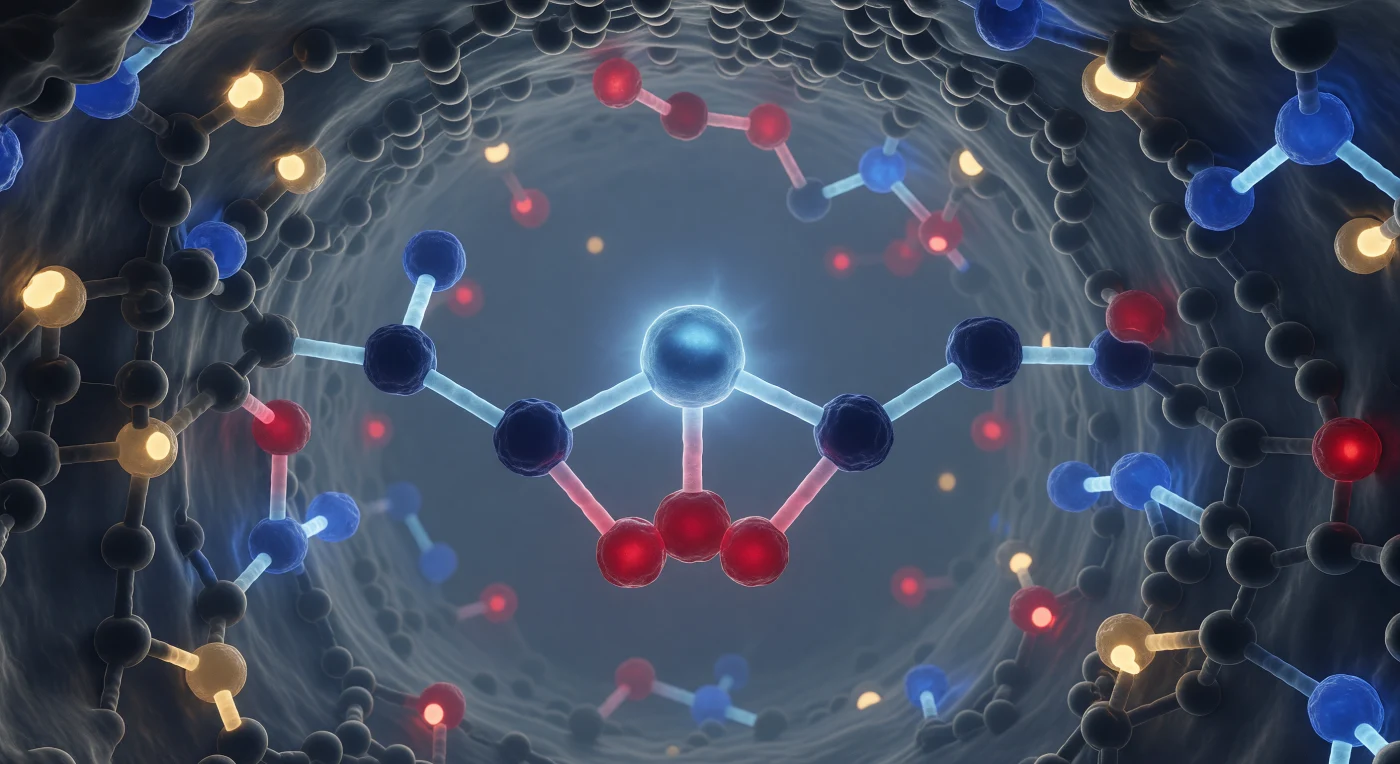
You stand inside a cavity so small that the curved walls around you are made of individual atoms — not surfaces, but distinct spherical territories of electron probability pressing against one another in a close-packed grotto of living chemistry. At the center floats a zinc cation, a dense steel-blue sphere radiating cold metallic luminosity through a corona of electron density haze, anchored by three histidine nitrogen atoms whose dark indigo surfaces trail thick, translucent bond-bridges of shared quantum fog — pale cyan cylinders connecting each nitrogen to the metal in a trigonal arrangement as geometrically inevitable as a vaulted arch, while below the zinc a hydroxide oxygen pulses deep arterial red, its lone-pair aureoles pressing upward in a bond so dense and short it appears almost crystalline. The pocket walls rise in every direction from charcoal-gray carbon chains whose van der Waals surfaces overlap into a continuous irregular ceiling, punctuated by garnet-red oxygen atoms with swollen diffuse electron clouds and cooler cobalt-blue nitrogen nodules, the entire cavity suffused with a dim bioluminescent self-emission that has no external source — only the intrinsic glow of electron density, warm amber from carbon, cold blue from nitrogen, the steel pulse of the zinc core holding the geometry in place with the precision of a molecular machine evolved over billions of years to accelerate CO₂ hydration by a factor of ten million. At the pocket entrance, partially eclipsed by the curved protein wall, a CO₂ molecule hangs at the threshold, its two crimson oxygen atoms flanking a dimmer central carbon, the double-bond cylinders visibly thicker and more luminous than single bonds — a substrate paused at the moment before chemistry begins, the surrounding van der Waals fog thickening toward the far wall into a blue-gray atmospheric haze that dissolves solid matter into depth, sealing you inside a space measuring barely a nanometer across, the most consequential cave on Earth.
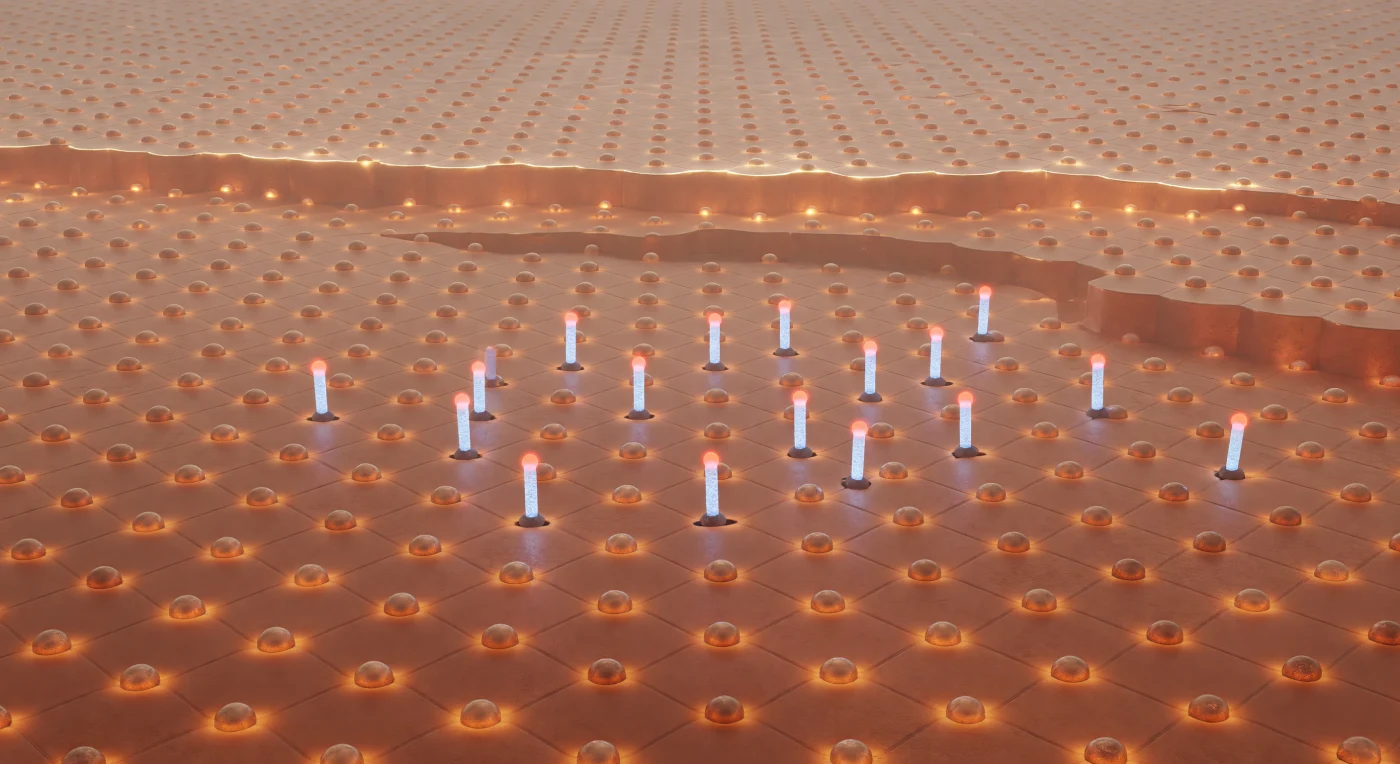
The viewer stands at the level of the copper surface itself, gazing across a vast hexagonal plain of reddish-gold atomic spheres packed in the close-packed Cu(111) arrangement, each atom glowing with warm amber luminescence from its pooled electron density, the gentle corrugation of the lattice rolling away toward a single-atom-height step edge in the middle distance whose ledge atoms burn fractionally brighter — their reduced coordination raising the local density of states like a bioluminescent reef fringe. Scattered across this metallic floor, a handful of carbon monoxide molecules stand upright on copper atop-sites like slender obelisks: a compact dark-gray carbon base bonded to the surface through its carbon end, above it a dense cylindrical column of triple-bond electron density, capped by a vivid crimson oxygen apex whose lone-pair clouds form softly glowing lobes at the summit. These molecular towers have been placed here deliberately, one by one, by the tip of a scanning tunneling microscope operating at cryogenic temperatures — a process of atom manipulation that exploits the tip's electric field to slide adsorbates across the surface with sub-ångström precision, encoding geometric patterns into an otherwise featureless terrace. A diffuse quantum haze of electron density lingers above the copper like a ground-level fog, its color shifting from warm amber over bare metal to cool blue-white where the CO molecules concentrate their π-bonding orbitals, the entire scene self-illuminated by the surface's own electronic structure with no external light source needed.
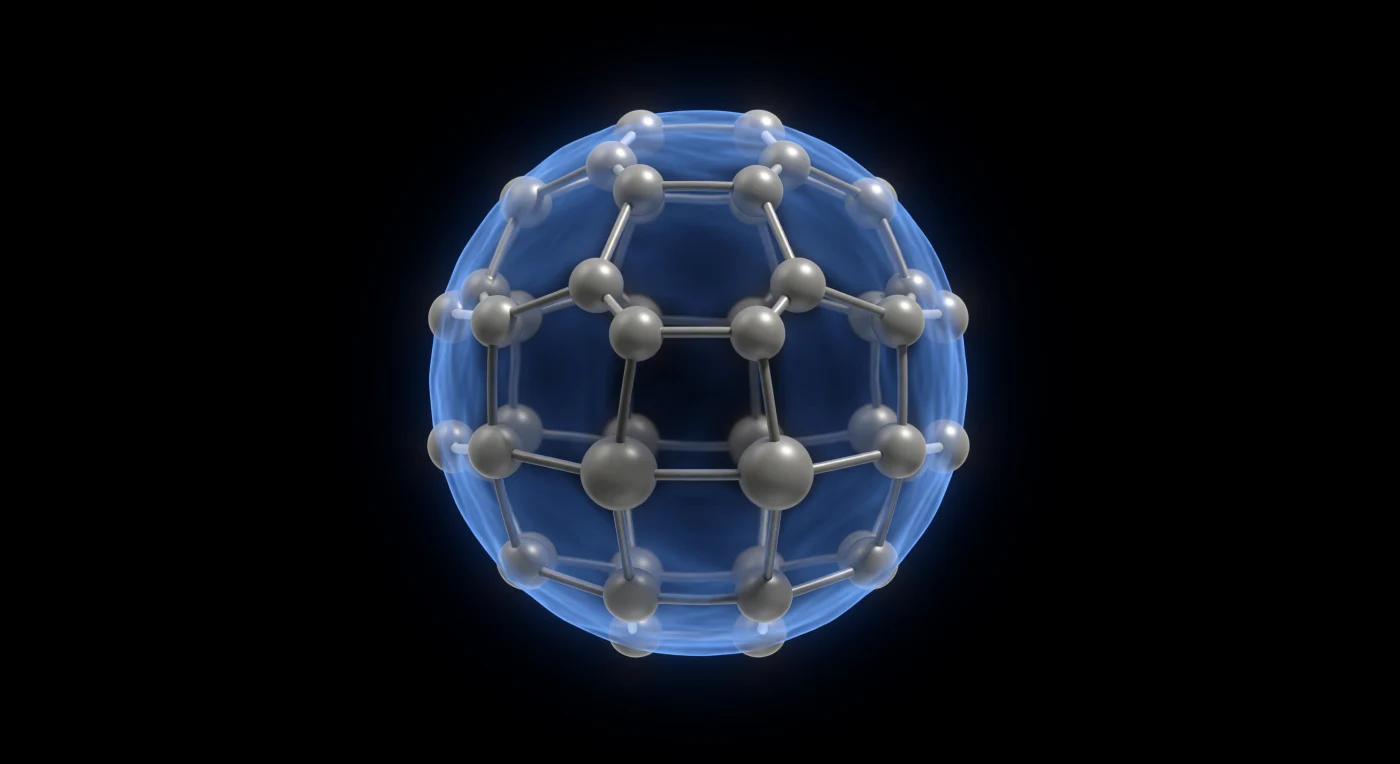
You are suspended in absolute vacuum at a distance most instruments cannot meaningfully express, locked in a slow orbital arc over the equatorial band of a single C₆₀ fullerene — a hollow geodesic sphere of sixty carbon atoms arranged in the precise truncated-icosahedron geometry shared, improbably, with a soccer ball. Each carbon nucleus presents as a rounded, warm-platinum sphere softly hazed at its margins by its own electron probability cloud, and the bonds between them are visibly differentiated: the shorter, higher-bond-order 6-6 junctions between adjacent hexagons glow white-gold and pinch tight between their paired nuclei, while the longer 5-6 bonds across pentagon-hexagon boundaries spread their shared electron density thinner, dimmer, grayer. Over and through all of this runs the π-electron system — a continuous electric-blue luminescent shell coating the outer surface like bioluminescent membrane, glowing richest over the aromatic hexagonal faces, fading slightly over the pentagons, and curving inward to line the hollow interior with a mirrored inner haze, the whole structure behaving simultaneously as solid geometry and translucent lantern. Against a vacuum that is not merely dark but ontologically empty — quantum-black, textureless, broken only by the attosecond flicker of virtual fluctuations at the edge of perception — this thirty-carbon-diameter cathedral of delocalized electrons is the only illumination in existence, ancient in its geometric perfection, vibrating at frequencies too fine to feel, absolutely still in this frozen instant.
You are standing level with the molybdenum plane of a single-atom-thick sheet of MoS₂, and the world around you is an infinite hexagonal cathedral suspended in absolute vacuum — massive silver-purple molybdenum spheres stretching to every horizon, their surfaces hazed with slow auroras of blue-violet electron density, each nucleus linked to six surrounding anchors by luminous amber bridges of shared covalent fog in the precise geometry of trigonal prismatic coordination. Above and below you, separated by a gulf of three ångströms that feels from this vantage like a vast canyon, two offset constellations of golden-yellow sulfur atoms float in near-perfect symmetry, their van der Waals surfaces glowing with warm incandescence as if lit from within, enclosing the molybdenum plane in a protective sulfur embrace that gives the whole structure its iridescent amber-gold shimmer — light diffracting through layered electron densities into ochre, pale citrine, and burnished copper wherever the angle shifts, like molecular mica catching oblique starlight. Off to one side, a sulfur vacancy ruptures the crystalline perfection: a missing golden sphere leaves a dark socket in the upper plane, and the three molybdenum atoms beneath it betray the disturbance with subtly warmer, more orange electron halos — redistributed charge making them feel exposed, their bond bridges asymmetric in luminosity, the unsatisfied coordination geometry radiating a quiet structural tension into the otherwise flawless lattice. Beneath everything, velvet vacuum presses close, so deep and complete it seems to have texture, the entire monolayer — one of the thinnest semiconductors physically possible, a direct-bandgap material only because confinement to a single layer transforms its electronic structure entirely — hanging in it like an infinite glowing tapestry woven from atoms.
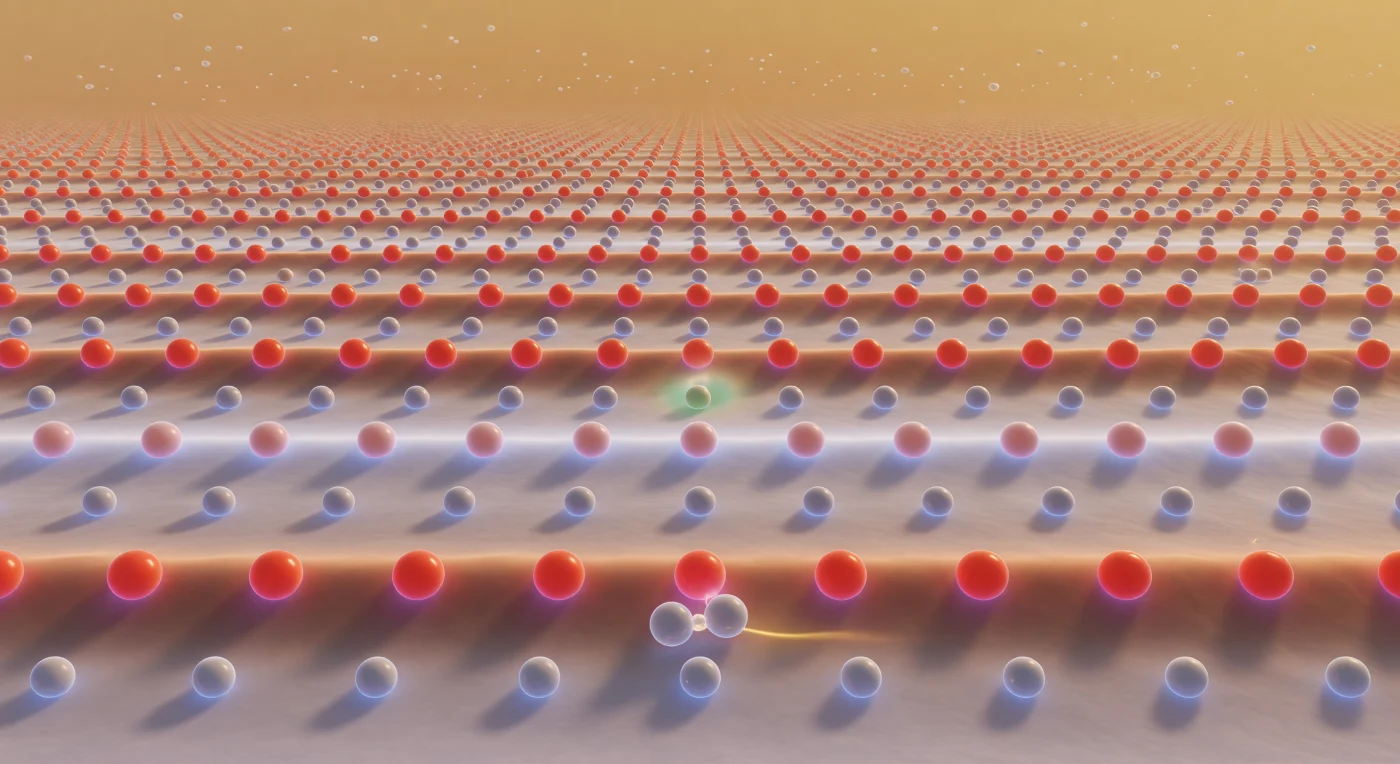
Across the corrugated plain of the rutile TiO₂ (110) surface, parallel ridgelines of swollen crimson-orange bridging oxygen anions rise above the flatter terrain of compact lavender-silver titanium cations, the repeating colonnade of the crystal's unit cell stretching toward an amber-lit horizon with architectural precision — every sphere a distinct territory of electron probability cloud, every groove a shadow cast by the surface's own geometry. One vacancy breaks the pattern ahead: a missing bridging oxygen leaves a reduced Ti³⁺ center exposed, its d-orbital density blooming asymmetrically outward in a warmer teal hue, the surrounding lattice distorted by the absent atom's charge and the local crystal field quietly rearranged. A diffuse blue-white luminescence drifts along the titanium row — not a particle but a probabilistic smear of photoexcited electron density migrating through the Ti 3d conduction band, drawn toward the vacancy like a slow tide responding to an invisible gradient, pulsing with each thermal fluctuation of the lattice. In the foreground, a single water molecule hangs mid-dissociation above an intact Ti site, its oxygen drawn close to the cation while one hydrogen leans toward a neighboring bridging oxygen, the nascent bond rendered as a pale golden filament of shared electron density — the first irreversible step of photocatalytic water splitting, frozen at the precise instant chemistry begins.
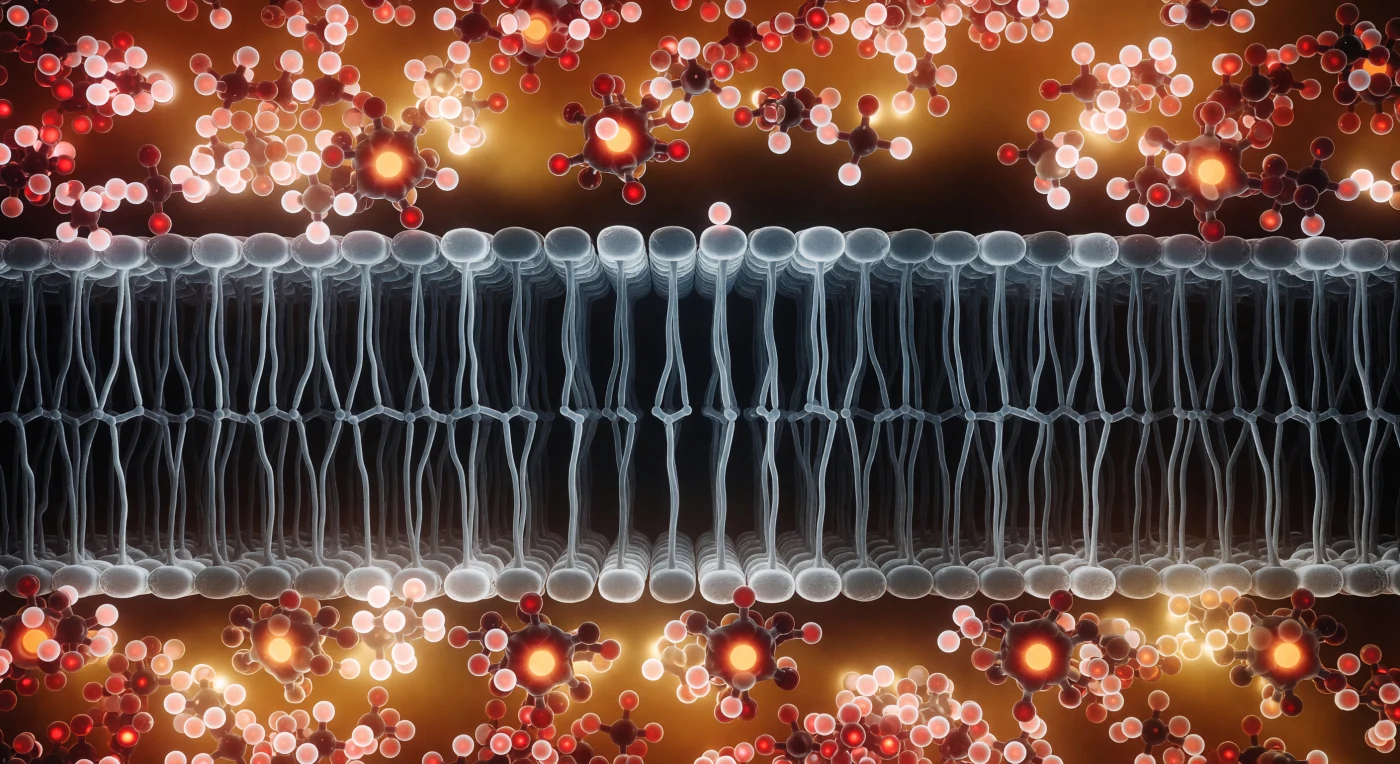
You are standing inside a living membrane wall, pressed between two worlds that could not be more unlike each other. Above and below, the hydrophilic zones erupt in dense, luminous chaos — phosphate head groups blaze in tangerine-orange and burgundy, their phosphorus and oxygen atoms radiating overlapping electron-density halos, while swollen water molecules crowd every available space, their oxygen cores glowing arterial crimson and their hydrogen lobes pulsing in soft pearl-white, the entire surface seething with thermal agitation as hydrogen bonds form and rupture on picosecond timescales. Between these two radiant polar shores stretches the hydrophobic core: a cathedral of near-total molecular silence where hydrocarbon tails — long chains of carbon and hydrogen atoms linked by 154-picometer covalent bonds — extend in parallel columns of cold gray-silver electron density, some kinked into gauche conformations by thermal disorder, others held in near-perfect all-trans linearity, the liquid-crystalline state poised between solid order and fluid randomness. Not a single water molecule penetrates this interior; the energetic cost of exposing a polar oxygen to this nonpolar environment is simply prohibitive, and so the boundary between the wet world and the dry one is shockingly abrupt — a molecular horizon just a few atomic diameters wide that separates biological electricity from hydrocarbon silence, the entire stratified structure only a handful of nanometers thick yet serving as the universal boundary of all living cells.