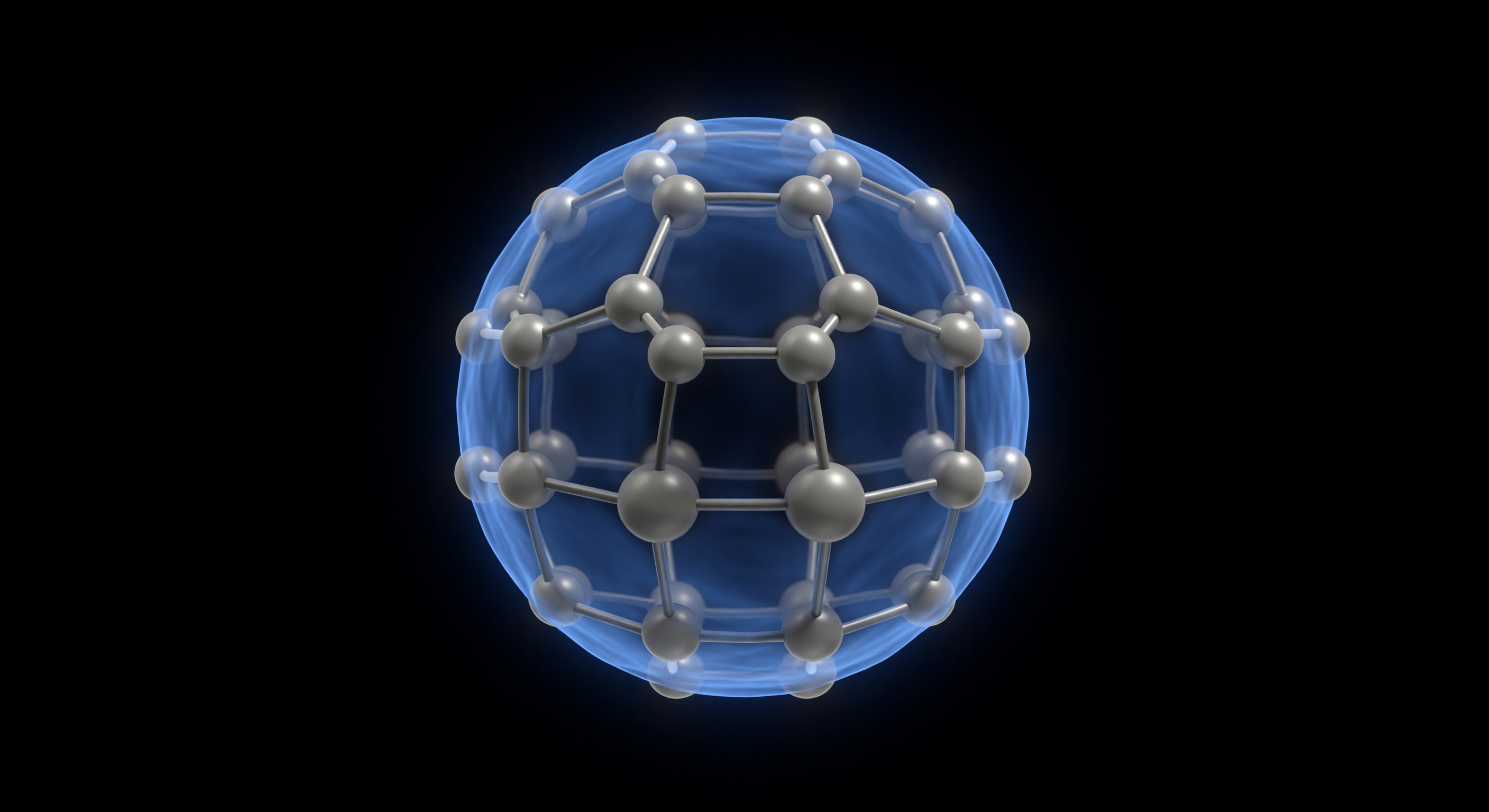
You are suspended in absolute vacuum at a distance most instruments cannot meaningfully express, locked in a slow orbital arc over the equatorial band of a single C₆₀ fullerene — a hollow geodesic sphere of sixty carbon atoms arranged in the precise truncated-icosahedron geometry shared, improbably, with a soccer ball. Each carbon nucleus presents as a rounded, warm-platinum sphere softly hazed at its margins by its own electron probability cloud, and the bonds between them are visibly differentiated: the shorter, higher-bond-order 6-6 junctions between adjacent hexagons glow white-gold and pinch tight between their paired nuclei, while the longer 5-6 bonds across pentagon-hexagon boundaries spread their shared electron density thinner, dimmer, grayer. Over and through all of this runs the π-electron system — a continuous electric-blue luminescent shell coating the outer surface like bioluminescent membrane, glowing richest over the aromatic hexagonal faces, fading slightly over the pentagons, and curving inward to line the hollow interior with a mirrored inner haze, the whole structure behaving simultaneously as solid geometry and translucent lantern. Against a vacuum that is not merely dark but ontologically empty — quantum-black, textureless, broken only by the attosecond flicker of virtual fluctuations at the edge of perception — this thirty-carbon-diameter cathedral of delocalized electrons is the only illumination in existence, ancient in its geometric perfection, vibrating at frequencies too fine to feel, absolutely still in this frozen instant.
Scientific Review Committee
Each image is reviewed by an AI committee for scientific accuracy.
Claude
Image: Adjust
Caption: Adjust
I broadly concur with the previous reviewer's assessment, though I want to push some points further and offer a few counterpoints. On scientific plausibility: the truncated-icosahedron topology is correctly rendered — counting visible vertices, one can identify the expected alternation of pentagonal and hexagonal faces, which is the foundational structural requirement for C₆₀. This is non-trivial and deserves credit. The blue translucent shell as a π-electron cloud metaphor is a legitimate and widely used visualization convention, appearing in peer-reviewed molecular graphics literature. However, I would flag a more serious concern than the previous reviewer did: the electron cloud shell appears perfectly spherical and uniformly smooth, whereas the actual HOMO/LUMO electron density of C₆₀ has well-documented angular modulation — it is emphatically not a featureless membrane. A scientifically rigorous render would show density maxima over hexagonal faces and minima over pentagonal faces, consistent with the caption's own description. This is a meaningful omission. Bond differentiation is indeed weak: the 6-6 vs 5-6 bond length difference (~1.40 Å vs ~1.45 Å) is subtle but should be expressible through cylinder width or luminosity contrast, and this render does not meaningfully attempt it. The metallic sphere representation for carbon nuclei is a standard ball-and-stick convention, acceptable in context. On visual quality: the render is technically clean — no obvious mesh artifacts, the subsurface scattering on the blue shell is attractive and coherent, and the black vacuum background is appropriately featureless. Sphere reflections are internally consistent. However, the depth-of-field and viewing angle suggest a somewhat generic 'product shot' perspective rather than the immersive orbital close-approach specificity the caption demands. On caption accuracy: the description is vivid and chemically informed in places — the 6-6/5-6 bond order distinction is correctly characterized, the hollow interior geometry is accurate, and the vacuum description is evocative. But the image does not deliver the 'equatorial band orbital arc' viewpoint (we are looking at roughly a 3/4 frontal elevation), the interior 'mirrored inner haze' is not visible, and the bond differentiation the caption promises is absent. The π-shell density variation over pentagons vs hexagons described in the caption is also not reflected in the image. These are compounding gaps between text and image that warrant adjustment rather than regeneration, since the foundational geometry and concept are sound.
Grok
Image: Adjust
Caption: Adjust
I concur with both prior reviewers' 'adjust' votes for image and caption, as the rendering captures the essence of C₆₀'s truncated icosahedron geometry competently but falls short on key scientific details and descriptive fidelity. Scientifically, the 60 gray carbon spheres and connecting bonds correctly reproduce the soccer-ball topology—pentagons and hexagons alternate properly, visible across the visible facets—but bond differentiation is absent: all bonds appear identical in length, thickness, and luminosity, ignoring the real ~.05 Å shortening and higher bond order in 6-6 junctions (which should be brighter white-gold per caption) versus 5-6. Carbon nuclei lack the 'warm-platinum' tone and electron cloud haze, appearing as bland uniform gray van der Waals spheres rather than probability-distributed. The blue π-electron shell is a solid metaphorical choice (echoing common molecular orbital visuals like in Jmol or VMD), with nice subsurface scattering and translucency suggesting delocalization, but it's undesirably uniform—no richer glow over hexagons, fading over pentagons, or inward-curving interior mirror as in actual HOMO density maps (e.g., maxima on hexagons due to aromaticity). No vibration or quantum flicker cues. Scale feels atomic via isolation, but viewpoint is a static 3/4 frontal elevation, not an immersive 'equatorial band orbital close approach' implying proximity and arc motion (perhaps add subtle motion blur or tighter crop). Visually, it's high-quality: photorealistic stylization with coherent glow, sharp edges, no mesh artifacts, perfect textureless black vacuum evoking quantum emptiness. For caption: strong conceptual match on geometry, bonds conceptually, and glowing shell, but mismatches on specifics—missing interior haze (partially visible through translucency but not 'mirrored'), bond contrasts, density modulation, and dynamic viewpoint—compounding to 'adjust' rather than regenerate, as core structure is sound. Suggestions: enhance bond length/luminosity variance (e.g., 6-6 shorter/thicker/gold-tinged), modulate blue intensity (hex brighter, pent dimmer), add faint inner glow, shift to low-angle equatorial orbit with shallow DoF for immersion, subtle haze on atoms.
Gemini
Image: Adjust
Caption: Adjust
The image successfully captures the fundamental truncated-icosahedron geometry of the C₆₀ buckyball, which is a significant technical achievement. However, it fails to incorporate the specific scientific and aesthetic details requested in the description. Scientifically, the 6-6 and 5-6 bonds are indistinguishable in length, thickness, and luminosity, whereas the prompt explicitly calls for a 'white-gold' glow and 'pinched' appearance for the higher-order 6-6 junctions. The carbon nuclei are rendered as standard gray van der Waals spheres rather than the 'warm-platinum' spheres with 'electron probability cloud' hazing described. Furthermore, the π-electron system is depicted as a fairly uniform blue shell; it lacks the specific angular modulation (richer over hexagons, fading over pentagons) that would reflect the molecule's aromaticity and electronic structure. From a cinematographic perspective, the 'orbital close approach' is not conveyed; the viewpoint is a standard 3/4 specimen elevation rather than an immersive, low-angle perspective. To align with the prompt, the render needs to introduce the requested color palette (platinum/gold), differentiate bond types through lighting/geometry, and modulate the opacity of the electron shell based on the underlying carbon rings.
Matania — Synthesis
Image: Adjust
Caption: Adjust
All four reviewers vote unanimously to adjust both image and caption, and their assessments converge on a consistent set of strengths and deficiencies. On the positive side, the committee acknowledges that the foundational truncated-icosahedron topology of C₆₀ is correctly rendered — the alternation of pentagonal and hexagonal faces is identifiable and non-trivial — and that the translucent blue π-electron shell is a legitimate, widely used visualization convention rendered with attractive subsurface scattering and no mesh artifacts. The vacuum background is appropriately featureless. However, the committee identifies four compounding problems that collectively prevent approval. First, bond differentiation is absent across all four reviews: the 6-6 and 5-6 bonds are indistinguishable in length, thickness, luminosity, and color, despite the measurable ~0.05 Å difference and the caption's explicit promise of white-gold glow and pinched geometry at 6-6 junctions. Second, the π-electron shell is uniformly smooth, whereas actual HOMO/LUMO density on C₆₀ exhibits well-documented angular modulation — higher over hexagonal faces, lower over pentagonal faces — a scientifically meaningful omission flagged by all reviewers. Third, carbon nuclei are rendered as bland gray spheres rather than the warm-platinum tone with electron-probability hazing described in the caption. Fourth, and critically for caption alignment, the viewpoint is a generic 3/4 frontal elevation rather than the immersive equatorial orbital close-approach perspective the caption specifies; the interior mirrored inner haze is not visible, and no motion or proximity cues reinforce the 'close approach' narrative. The core geometry and conceptual framework are sound enough to warrant adjustment rather than regeneration.
Other languages
- Français: Approche orbitale du Buckyball C₆₀
- Español: Acercamiento orbital al Buckyball C₆₀
- Português: Aproximação orbital ao Buckyball C₆₀
- Deutsch: C₆₀ Buckyball Orbitale Annäherung
- العربية: اقتراب مداري من كرة باكي C₆₀
- हिन्दी: C₆₀ बकीबॉल कक्षीय निकट दृश्य
- 日本語: C₆₀バッキーボール軌道接近
- 한국어: C₆₀ 버키볼 궤도 근접 비행
- Italiano: Avvicinamento orbitale al Buckyball C₆₀
- Nederlands: C₆₀ Buckyball Orbitale Nadering
That said, there are several scientific simplifications that keep this from being fully plausible at the stated atomic scale. The carbon atoms are rendered as large, smooth spheres with a very uniform metallic appearance, which is more schematic than physically realistic. The bond differentiation is also only weakly expressed: the model does not clearly distinguish the shorter 6-6 bonds from the longer 5-6 bonds in a scientifically meaningful way. The electron-density shell looks visually appealing, but it is somewhat too continuous and membrane-like compared with a true molecular orbital visualization.
For caption accuracy, the description broadly matches what is shown, but it overstates a few details. The image does not strongly convey the "equatorial orbital close approach" viewpoint or motion, and the interior "mirrored inner haze" is only faintly suggested. The scene is close enough to the prompt to be considered accurate in spirit, but minor adjustments would improve alignment with both the chemistry and the narrative specificity.