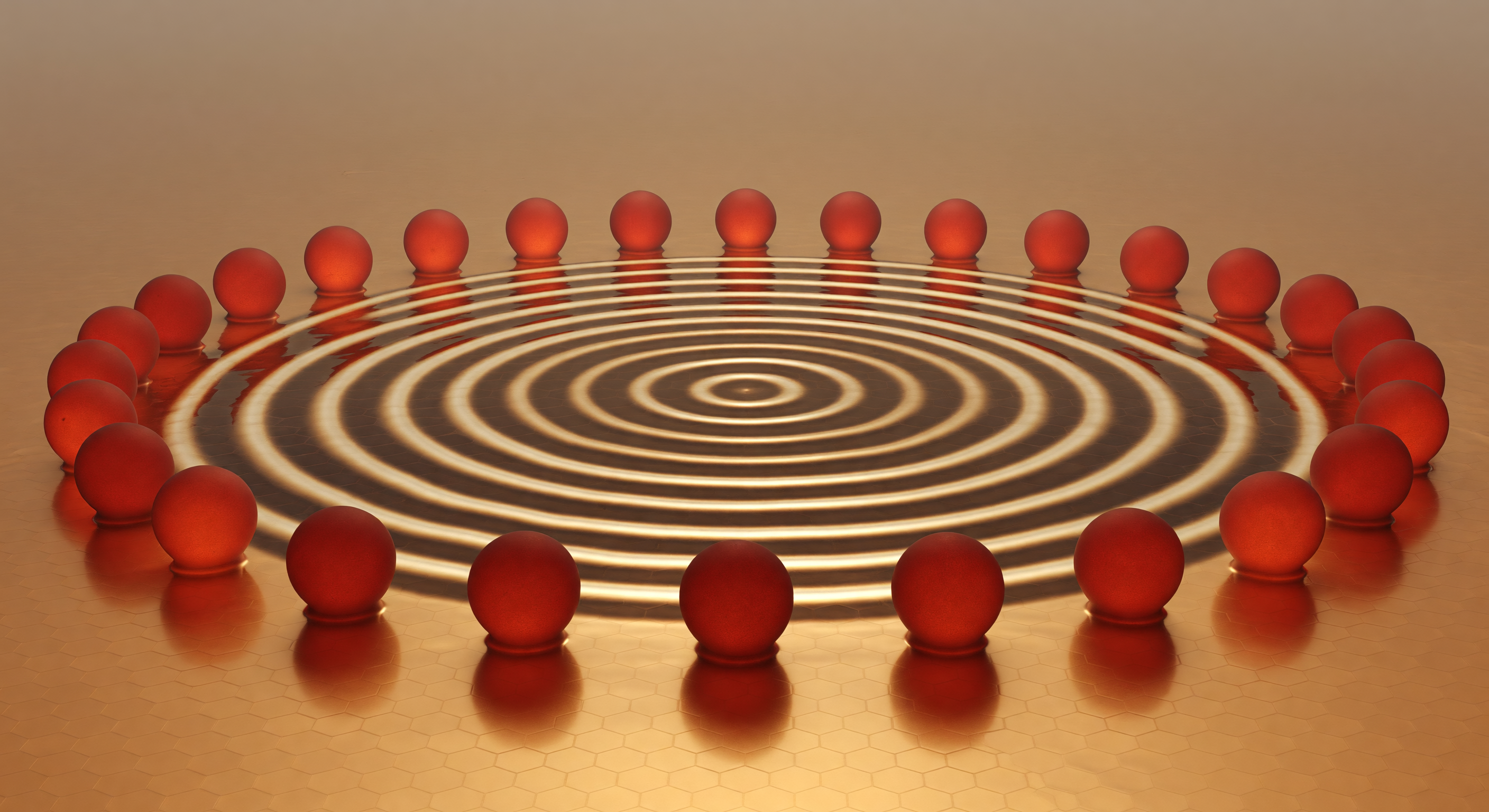
You stand at the rim of a vast circular amphitheater sunk into a burnished amber plain, looking inward across a copper-gold Cu(111) surface where forty-eight iron adatoms rise as rust-red monolithic pillars forming a perfect palisade — their rounded flanks glowing with the dense inner warmth of heated iron, their bases kissed by shallow reflections from the hexagonally corrugated lattice below. Inside the corral, the copper floor is transformed: concentric rings of quantum mechanical standing waves ripple outward from a central bright node, alternating between ivory-gold crests of constructive electron density and deep umber troughs where the surface probability is depleted, each ring separated by roughly eight ångströms — approximately the spacing of a few iron atoms laid side by side. This is the quantum corral, assembled atom by atom using a scanning tunneling microscope tip by Crommie, Lutz, and Eigler at IBM in 1993, the first direct demonstration that individual electrons confined within an atomically precise boundary obey the same standing-wave mathematics as sound trapped inside a drum. The electron density isosurfaces are sharp as polished glass, illuminated not by any external light source but by the self-luminous glow of probability itself — a cathedral whose walls are made of wavefunction, whose architecture is enforced by the Schrödinger equation alone, and whose interior radiates a sacred geometric precision that feels simultaneously microscopic and monumental.
Other languages
- Français: Ondes Stationnaires du Corral Quantique
- Español: Ondas Estacionarias del Corral Cuántico
- Português: Ondas Estacionárias do Curral Quântico
- Deutsch: Stehende Wellen im Quantenkorral
- العربية: أمواج إلكترونية ساكنة في الحظيرة الكمية
- हिन्दी: क्वांटम कोरल इलेक्ट्रॉन स्थायी तरंगें
- 日本語: 量子コラルの電子定在波
- 한국어: 양자 울타리 전자 정상파
- Italiano: Onde Stazionarie del Corral Quantistico
- Nederlands: Staande Golven in Kwantumkraal