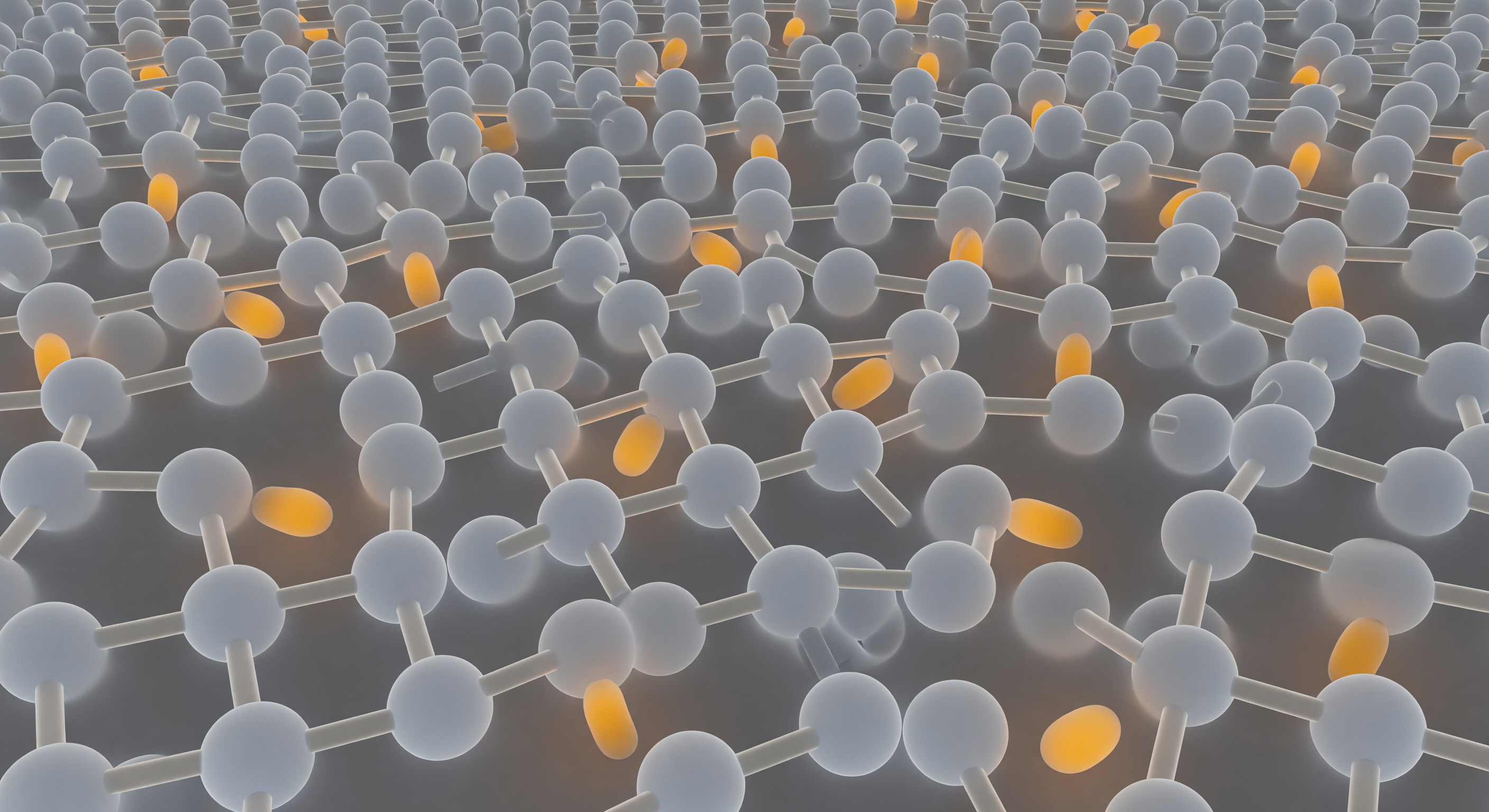
You stand inside a world with no exit and no horizon — in every direction, medium-gray silicon spheres press close, each one a boulder-sized mass of electron probability glowing faintly from within, their surfaces bleeding into a translucent quantum haze that fills the narrow voids like thin silver smoke. Amorphous silicon lacks the long-range periodicity of its crystalline counterpart: each silicon atom seeks four covalent neighbors, but without the enforced regularity of a diamond cubic lattice, bond angles deviate randomly from the tetrahedral ideal of 109.5°, and no axis of symmetry survives beyond two or three bond lengths before the geometry bends away unpredictably. Between each pair of neighbors, a warm gray-white cylinder of shared electron density bridges the gap — a covalent bond made tangible, its slight luminescence the visual signature of two atomic orbitals overlapping and lowering their combined energy. Scattered through this claustrophobic framework, three-coordinated defect atoms carry an unsatisfied fourth orbital that juts into the surrounding void as a soft amber-orange lobe, a dangling bond whose unpaired electron — a paramagnetic trap state well documented by electron spin resonance — pulses with saffron warmth against the otherwise cool silver-gray matrix. Depth dissolves within arm's reach: sharp and detailed at one bond length, softened by overlapping electron-density atmosphere at two, and by three or four bond lengths away the entire structure blurs into a luminous gray-orange murk, the disordered solid closing every sightline and curving endlessly inward upon itself.
Other languages
- Français: Labyrinthe Silicium Amorphe Chaotique
- Español: Laberinto Amorfo de Silicio
- Português: Labirinto Amorfo de Silício
- Deutsch: Amorphes Silizium Wirres Labyrinth
- العربية: متاهة السيليكون غير المتبلور
- हिन्दी: अव्यवस्थित सिलिकॉन भूलभुलैया
- 日本語: アモルファスシリコンの迷宮
- 한국어: 비정질 실리콘 혼돈 미로
- Italiano: Labirinto Silicio Amorfo Caotico
- Nederlands: Amorfe Silicium Chaotisch Labyrint