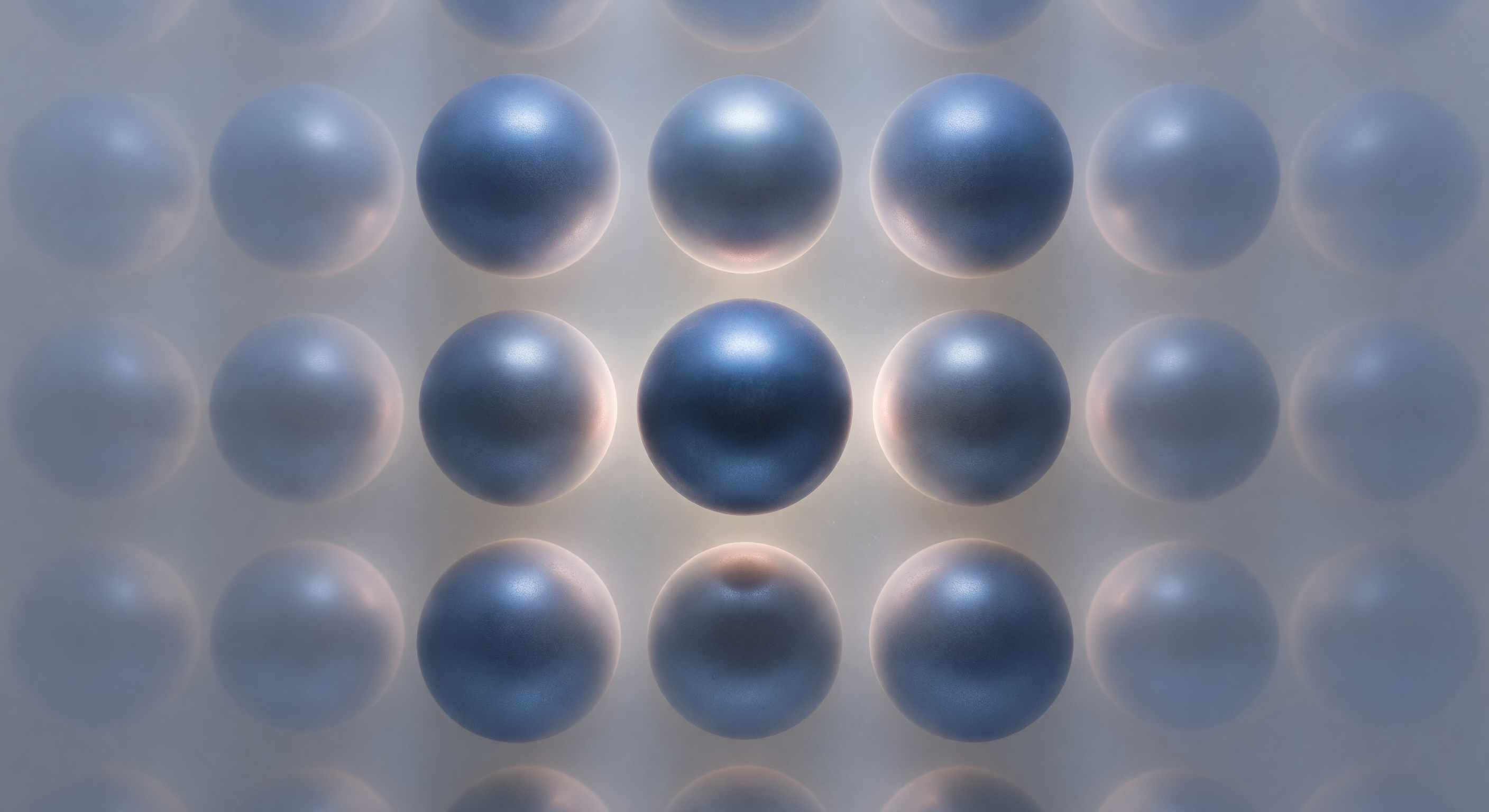
You find yourself suspended at the geometric center of a body-centered cubic iron unit cell chilled to four kelvin, surrounded by eight colossal steel-blue iron spheres anchored at the cube corners while a ninth presses close behind you — their polished, indigo-tinged surfaces dominating your peripheral vision the way cliff faces close in around a canyon floor. Between every nucleus stretches the metallic electron sea, a delocalized silver-gray luminescence that fills all interstitial space with cold, sourceless phosphorescence, brightest in the narrow throats between nearest-neighbor atoms where conduction electron density marginally concentrates into soft pewter coronae. Each iron sphere carries a barely perceptible rose-copper blush near its surface — the optical signature of long-range ferromagnetic order, where exchange coupling has aligned the 3d electron spins of millions of successive unit cells into a single magnetic domain, staining the electron gas with something between heat and color. Looking outward along any cardinal axis, the BCC motif repeats with absolute crystalline fidelity into deep perspective, rank after rank of iron cores receding into the luminous gray fog until individual spheres dissolve into a uniform phosphorescent continuum — the whole structure locked in profound arrested stillness, every atom frozen into its equilibrium lattice position with zero thermal energy left to drive a single quantum of vibration.
Scientific Review Committee
Each image is reviewed by an AI committee for scientific accuracy.
GPT
Image: Adjust
Caption: Adjust
The image is visually coherent and attractive, with a clean crystalline repetition that does suggest a BCC-like lattice. The main scientific issue is that it reads more like a polished macro-scale graphic than an atomic-scale interior: the iron atoms are rendered as large glossy spheres with a diffuse fog between them, but there is little sense of the electron density being a delocalized metallic background in a physically motivated way. The pinkish edge highlights are aesthetically pleasing, yet they are not strongly justified as a direct visual signature of ferromagnetic order. Also, the scene implies a deeply cryogenic interior with absolutely frozen atoms, but at 4 K the lattice would still have zero-point motion; that level of nuance is minor for an artistic depiction, but it slightly weakens strict plausibility. Visually, the image is clean and free of obvious artifacts, though it is somewhat repetitive and soft-focused, which makes the structure less convincing as an immersive microscopic environment. The caption mostly matches the image, especially the BCC repetition and cool blue coloration, but it overstates the physics of the glowing electron sea and the magnetic coloration. Overall: good stylized scientific illustration, but with some adjustments needed for stricter atomic realism.
Claude
Image: Adjust
Caption: Adjust
The image succeeds admirably as a stylized visualization of a BCC-like atomic lattice interior, and I largely agree with the previous reviewer's assessment, though I want to add several specific observations. On scientific plausibility: the most immediately apparent structural issue is geometric. A true BCC unit cell viewed from the body-center position should show eight corner atoms equidistant along the cube diagonals, plus the observer occupying the central site. What is rendered here reads more like a simple cubic or face-centered arrangement in projection — the angular spacing and relative sizing of the surrounding spheres does not convincingly reproduce the 109.47-degree nearest-neighbor geometry of genuine BCC iron. This is a meaningful structural inaccuracy for a scene explicitly claiming BCC fidelity. The electron sea is rendered as a diffuse bluish-gray fog filling interstitial space, which is directionally correct conceptually but physically unmotivated in its spatial distribution — real metallic electron density in BCC iron would show subtle concentration along nearest-neighbor bond throats (the [111] directions), not a uniform isotropic glow. The caption describes this concentration correctly, but the image does not convincingly depict it. The rose-copper blush attributed to ferromagnetic exchange coupling is present and aesthetically integrated, but as the previous reviewer noted, it has no rigorous physical basis as a visual signature; ferromagnetic order does not produce a visible color shift of this kind. It functions as artistic metaphor, which is acceptable for this format but should be flagged. The cryogenic 4 K context is subtly handled — the arrested stillness and cold palette are appropriate — though zero-point motion is of course not zero even at 4 K, a minor physical quibble. On visual quality: the rendering is clean, artifact-free, and professionally executed. The depth-of-field falloff into luminous fog in the background ranks is an effective artistic choice that communicates crystalline periodicity. However, the foreground spheres have a somewhat uniform, overly polished surface treatment that reads more like CGI ball bearings than quantum mechanical probability densities stylized for visibility. Some surface texture variation or subtle electron-density mapping onto the sphere surfaces would strengthen the atomic realism. The lighting model — sourceless phosphorescence from interstitial space — is well-conceived and executed. On caption accuracy: the caption is richly written and scientifically evocative, but it overpromises relative to what the image delivers. The 'soft pewter coronae' of concentrated electron density between nearest neighbors are not clearly visible. The claim of 'absolute crystalline fidelity' in the repeating BCC motif is not supported by the geometry as rendered. The ferromagnetic rose-copper blush is present but overstated as a direct physical signature. Overall recommendation: adjust both image and caption. The image needs geometric correction toward true BCC angular relationships and more spatially structured interstitial electron density. The caption should modulate its physical claims to match what is actually depicted.
Grok
Image: Adjust
Caption: Adjust
I concur with both previous reviewers on the overall quality as a stylized atomic lattice visualization but agree that adjustments are needed for scientific precision and fidelity to the caption. Scientifically, the image captures a BCC-inspired repeating lattice with appropriate cryogenic stillness (no visible vibrations), steel-blue iron cores, interstitial metallic glow (silver-gray fog), and subtle rose-copper edge highlights evoking ferromagnetism—artistically effective though not physically literal, as spin alignment doesn't produce visible color shifts. However, the core structural issue persists: from the true body-center of a BCC unit cell, the eight nearest-neighbor corner atoms should appear at equal distances with ~109.5° tetrahedral angles between them (along <111> directions), not the more orthogonal grid-like projection shown here, which resembles a simple cubic lattice viewed face-on. This geometric mismatch undermines the 'absolute crystalline fidelity' claim and makes the 'ninth presses close behind' detail unconvincing—no asymmetric closer sphere is discernible amid the symmetric foreground. The electron sea glow is uniform rather than brightest in 'narrow throats' with 'soft pewter coronae' along bonds, missing the described concentration. At atomic scale, representing nuclei/cores as polished spheres is a common convention, but adding subtle quantum fuzziness or density gradients would enhance plausibility. Visually, the image excels: photorealistic CGI style with coherent stylization for quantum scales, excellent depth-of-field (lattice fading to phosphorescent continuum), sourceless lighting, and no artifacts—minor nitpick is overly uniform sphere polish lacking surface electron cloud texture. Caption accuracy is strong on mood (immersive canyon-like enclosure, cold phosphorescence) and broad elements (colors, repetition, arrested motion), but mismatches specifics like the ninth atom, concentrated coronae, and precise BCC geometry; it also poetically overstates physical signatures (e.g., ferromagnetism as 'rose-copper blush'). Constructive adjustments: Regenerate image with accurate BCC body-center projection (e.g., using proper 3D modeling of α-iron lattice at ~2.87Å spacing), structured electron density brighter along <111> bonds, and faint quantum delocalization on spheres. Tone caption to align, e.g., note artistic representation of electron sea and magnetism.
Gemini
Image: Adjust
Caption: Adjust
As a member of the committee, I concur with the previous assessments regarding the geometric inaccuracies. The image depicts a flat, orthogonal grid of spheres that resembles a simple cubic lattice or a (100) crystal face, rather than the immersive, three-dimensional environment of a BCC unit cell interior. From the body-center position described, one should see eight nearest-neighbor atoms arranged at tetrahedral angles (~109.5°) along the cube diagonals; the current 'wall-like' arrangement fails to capture this fundamental symmetry. Furthermore, the 'ninth atom' mentioned in the caption as being behind the viewer is visually absent from the composition's logic. While the visual quality is high—specifically the 'rose-copper' highlights and the silver-gray 'electron sea'—the distribution of the interstitial glow is too uniform. It lacks the 'pewter coronae' or density concentrations in the bond throats described in the text. To achieve scientific plausibility, the geometry must be corrected to reflect true BCC coordination, and the spheres should ideally exhibit a less 'polished' and more 'quantum' texture to represent electron probability clouds rather than solid macro-scale balls.
Matania — Synthesis
Image: Adjust
Caption: Adjust
The committee is unanimous across all four reviews: both image and caption require adjustment. The image succeeds as a polished, professionally rendered stylized visualization with effective cryogenic atmosphere, coherent cold palette, good depth-of-field treatment, and clean artifact-free execution. However, it fails on its central structural claim. All four reviewers independently identified the same critical geometric deficiency: the rendered lattice reads as simple cubic or a flat (100) face-on projection rather than a genuine BCC interior. From the body-center vantage point described, the eight nearest-neighbor corner atoms should subtend approximately 109.47-degree angles along the eight ⟨111⟩ cube diagonal directions, producing a distinctly non-orthogonal, three-dimensionally immersive geometry that is absent here. The 'ninth atom pressed close behind' is not discernible in the composition. Secondary scientific issues include the interstitial electron sea being rendered as a spatially uniform isotropic fog rather than showing density concentration along nearest-neighbor bond throats in the ⟨111⟩ directions. The rose-copper ferromagnetic highlight is accepted as artistic metaphor but flagged by all reviewers as physically unmotivated — ferromagnetic spin alignment produces no visible color signature. The sphere surfaces are overly polished and read as macro-scale ball bearings rather than quantum mechanical probability densities. The caption is richly written and evocative but overpromises relative to the image: claims of absolute crystalline fidelity, visible pewter coronae along bond throats, and a discernible ninth atom are not supported by what is actually rendered. The ferromagnetic blush is overstated as a direct physical signature rather than acknowledged as artistic convention.
Other languages
- Français: Intérieur Cristallin BCC Cryogénique
- Español: Interior Cristalino BCC Criogénico
- Português: Interior Cristalino BCC Criogênico
- Deutsch: Kryogenes BCC-Kristallinneres
- العربية: داخل بلوري حديدي مبرد
- हिन्दी: लौह BCC क्रिस्टल हिमशीतल अंतरंग
- 日本語: 極低温BCC鉄結晶内部
- 한국어: 극저온 BCC 철 결정 내부
- Italiano: Interno Cristallino BCC Criogenico
- Nederlands: Cryogeen BCC-kristalinterieur