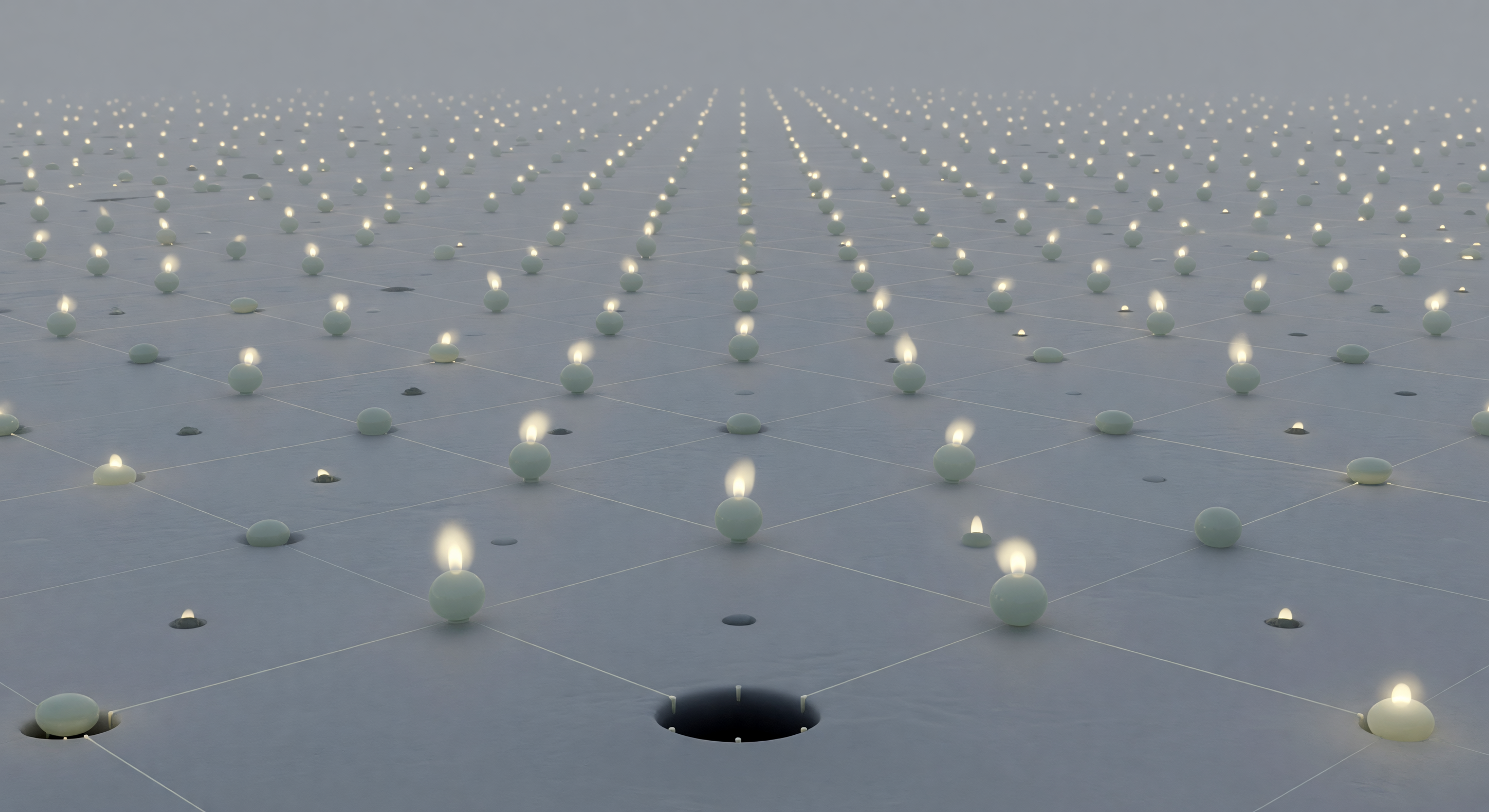
Stretching away in every direction like the floor of an immense ceremonial hall, the Si(111) 7×7 reconstructed surface presents itself as a tiling of warm lantern-glow and pewter-gray shadow, each repeating unit barely four and a half nanometers across yet commanding the entire visible world from this vantage. Twelve adatom spheres rise in two triangular clusters, their dangling-bond electron clouds hovering above them as soft yellow-white lobes — quantum probability made visible, frozen midway between one bonding partner and none, radiating a pearlescent amber haze into the cool surrounding vacuum. Six rest atoms occupy shallower hollows between them, their dimmer votive flames of electron density marking the sites where the surface chose a different reconstruction geometry, while at each unit-cell corner a single dark void drops away like a drain in ancient stone, its absolute blackness rimmed by the faint glow of under-coordinated edge atoms. The entire assembly is the outcome of a surface caught mid-collapse: when bulk silicon is cleaved along the (111) plane, the outermost atoms cannot sustain their broken bonds and rearrange over hundreds of atomic sites into this elaborate 7×7 superstructure, lowering total energy through a baroque choreography of adatom repositioning, dimer formation, and stacking-fault accommodation that took decades of crystallography and tunneling microscopy to fully decode. Everything here hums with the quiet thermal tremor of nuclei jittering within their bonding sites, each adatom a pinned lantern swaying imperceptibly at the edge of quantum uncertainty.
Other languages
- Français: Parquet Baroque Silicium 7×7
- Español: Suelo Barroco Silicio 7×7
- Português: Piso Barroco Silício 7×7
- Deutsch: Silizium 7×7 Barockes Gittermuster
- العربية: أرضية باروكية سيليكون 7×7
- हिन्दी: सिलिकॉन 7×7 बारोक फर्श
- 日本語: シリコン7×7再構成バロック床
- 한국어: 실리콘 7×7 바로크 바닥
- Italiano: Pavimento Barocco Silicio 7×7
- Nederlands: Silicium 7×7 Barok Vloerpatroon