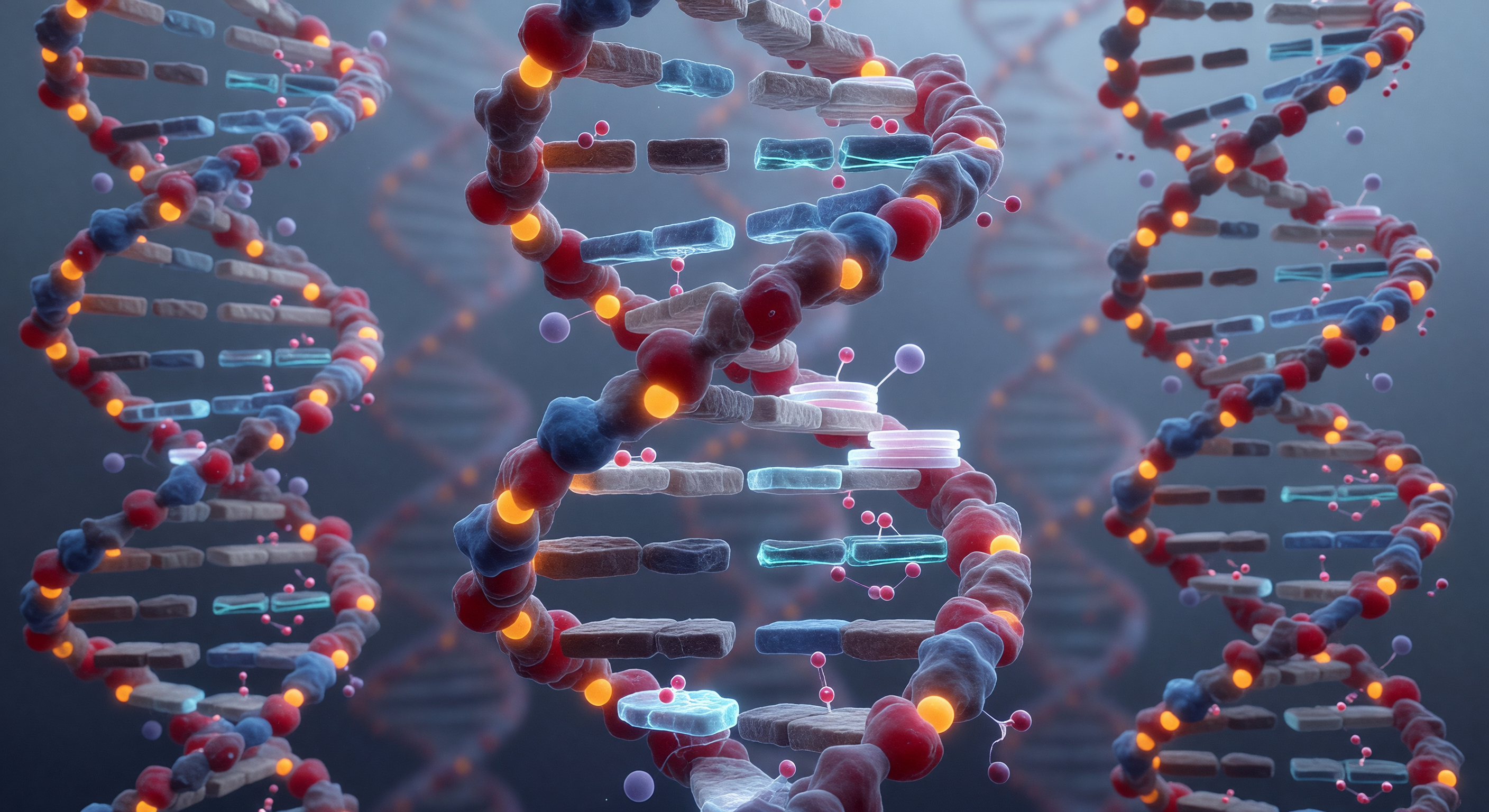
You stand inside a spiraling corridor of living chemistry, flanked on either side by two immense phosphate-sugar columns that twist upward and downward into a vanishing helical perspective, their phosphorus atoms radiating saffron-orange warmth while crimson oxygen spheres swell outward like polished garnets set into an ascending molecular architecture. Bridging the two columns at intervals of 3.4 ångströms — a distance barely wider than a single carbon atom — flat nucleobase platforms step across the groove interior like flagstones in a biological staircase, their aromatic π-systems so densely stacked that adjacent electron density halos nearly merge, creating a subtly luminous coin-tower of shared quantum probability. Cyan hydrogen-bond threads, two for adenine-thymine pairs and three for the richer guanine-cytosine steps, shimmer as ghostly filaments of shared electron density — not solid connectors but probabilistic whispers, the quantum mechanical signature of base complementarity made faintly visible. Along the negatively charged groove walls, small water molecules cluster in rose-red beads and compact lavender-grey sodium counterions drift in loose electrostatic constellations, their presence stabilizing the entire helical architecture against the repulsive force of massed phosphate groups. A diffuse blue-white glow permeates everything — the ambient luminescence of electron density radiating outward from every nucleus, filling the groove atmosphere with volumetric quantum fog that sculpts each spiral and platform with cool internal radiance, making this cathedral of molecular information feel simultaneously ancient and perpetually in motion.
Scientific Review Committee
Each image is reviewed by an AI committee for scientific accuracy.
Claude
Image: Adjust
Caption: Adjust
I largely concur with the previous reviewer's assessment but want to add more granular observations. On scientific plausibility: the overall B-DNA double helix geometry is recognizable — the right-handed twist, the ladder-like base-pair rungs, and the sugar-phosphate backbone beads are all present and correctly oriented. The orange-glowing phosphorus atoms and red oxygen spheres are a reasonable color-coding convention consistent with standard CPK schemes (though phosphorus is conventionally orange and oxygen red, which checks out here). However, the base pairs are rendered as thick, blocky rectangular slabs rather than the flatter, aromatic ring systems they actually are — at true atomic scale, nucleobases are nearly planar and much thinner relative to their width. The stacking distance of ~3.4 Å between bases is visually exaggerated; adjacent platforms appear separated by distances implying far greater spacing, which undermines the 'nearly merging electron density halos' claim in the caption. The three distinct DNA helices shown simultaneously also break the immersive single-groove perspective the description promises — you cannot be standing inside one major groove and simultaneously see two flanking complete helices at equivalent scale. On hydrogen bonds: the caption describes cyan filaments between base pairs, but the image shows no such inter-base connectors. The cross-rungs appear as solid opaque blocks with no visible bonding detail, which is a notable miss. The water molecules and sodium counterions described as rose-red beads and lavender-grey spheres are loosely interpretable in the scattered small spheres visible throughout, but they are indistinguishable from generic decorative particles — no spatial clustering in the groove is evident. The blue-white ambient electron density glow is present and is one of the image's stronger features, creating genuine volumetric atmosphere. For caption accuracy, the macro-level description (helical corridor, phosphate columns, base-pair flagstones, quantum fog) maps adequately onto the visual, but the fine-detail claims — hydrogen bond threads, counterion constellations, 3.4 Å spacing fidelity, major-groove immersion — are either absent or contradicted by the multi-helix composition. I recommend regenerating with a true single-helix interior POV, thinner base-pair geometry, visible inter-base hydrogen bond threads, and groove-clustered solvent molecules to honor both the scientific and narrative ambitions of this description.
Grok
Image: Adjust
Caption: Adjust
I agree with both previous reviewers (GPT and Claude) on the core issues: the image delivers a visually stunning, immersive helical DNA environment with excellent color-coding (saffron-orange phosphorus, crimson-red oxygens aligning with CPK conventions) and a compelling blue-white volumetric glow that effectively evokes quantum electron density fog, enhancing the atomic-scale atmosphere. The sugar-phosphate backbones as twisting columns and stacked base-pair rungs as flagstone platforms are thematically strong, and the overall photorealistic stylization suits a quantum/microscopy-inspired render—no major artifacts, coherent lighting, and high visual quality. However, scientific plausibility requires adjustment: the view shows multiple parallel DNA helices rather than a singular major groove interior POV, disrupting the promised 'spiraling corridor flanked by two immense phosphate-sugar columns' with vanishing helical perspective; this makes the space feel like an external bundle or array, not an intimate groove immersion ~12 Å wide. Base pairs are rendered as thick, opaque, blocky slabs (some cyan/blue, pink/purple) rather than thin, aromatic planar structures with π-stacking halos nearly merging at 3.4 Å—spacing appears exaggerated, lacking precise scale cues. Critically, cyan hydrogen-bond threads (2 for A-T, 3 for G-C) are absent; rungs lack any visible probabilistic filaments or bonding details. Water molecules (rose-red beads) and sodium counterions (lavender-grey) are vaguely interpretable as scattered small spheres (pink/purple/violet dots), but show no groove-wall clustering or electrostatic constellations stabilizing phosphates. Dynamics implied in the caption (perpetually in motion) aren't conveyed in the static render. For caption accuracy, broad elements match (helical architecture, glowing atoms, quantum fog, nucleobase steps), but specifics like H-bond whispers, 3.4 Å bridging, counterion patterns, and single-groove cathedral are loosely or inaccurately represented. Constructive adjustments: refocus to strict single-helix major groove interior (viewer-centered perspective inside the ~12 Å wide space), thin/transparent base pairs with overlaid cyan H-bond threads varying by pair type, clustered solvent/ions along walls, tighter base stacking, and subtle motion blur for dynamism—elevating it to approve-level fidelity.
Gemini
Image: Regenerate
Caption: Regenerate
As a member of the committee, I find that while the image is aesthetically pleasing, it fails fundamentally on both scientific plausibility and caption accuracy. The core issue is perspective: the prompt explicitly describes an immersive, first-person experience ('You stand inside a spiraling corridor') within the major groove of a single DNA molecule. Instead, the image provides an external, macroscopic view of multiple DNA helices. Scientifically, the nucleobases are depicted as thick, chunky blocks rather than the thin, planar aromatic rings they actually are. The 3.4 Å stacking distance—a defining feature of B-DNA—is visually ignored; the bases are spaced so widely that the 'nearly merging electron density halos' described in the caption are nonexistent. Most critically, the 'cyan hydrogen-bond threads' are entirely missing, leaving a physical void between the base pairs where there should be probabilistic filaments. The small spheres intended to represent water and counterions are scattered randomly rather than clustering near the negatively charged phosphate groups as described. To meet the Echelles standards, a regeneration is required that places the camera inside the groove, thins the base-pair geometry, tightens the vertical stacking, and explicitly renders the inter-base hydrogen bonds and localized solvent molecules.
Matania — Synthesis
Image: Adjust
Caption: Adjust
The committee finds broad agreement across all four reviewers: the image is visually accomplished and atmospherically compelling, with competent CPK-aligned color-coding (saffron-orange phosphorus, crimson oxygen), a convincing blue-white volumetric electron-density glow, and recognizable B-DNA helical geometry in its backbone and base-pair ladder structure. However, three reviewers voted adjust and one voted regenerate, converging on a clear set of scientific and compositional failures that prevent approval. The most fundamental problem is one of perspective: the image presents an external or multi-helix array view rather than the promised immersive first-person interior of a single major groove. A viewer standing inside one major groove cannot simultaneously observe two or three flanking complete helices at equivalent scale. Base pairs are rendered as thick, opaque, blocky rectangular slabs rather than the thin, nearly planar aromatic ring systems they physically are, and the inter-base vertical spacing appears grossly exaggerated relative to the canonical 3.4 Å stacking distance. Most critically, the cyan hydrogen-bond threads described in the caption — the 2 for A-T and 3 for G-C pairs — are entirely absent from the image; the rungs carry no inter-base bonding detail whatsoever. Water molecules and sodium counterions are only loosely interpretable as scattered generic particles with no groove-wall clustering or electrostatic spatial logic. The committee does not recommend full regeneration, as the foundational aesthetic language, color scheme, and volumetric atmosphere are strong assets worth preserving through targeted adjustment.
Other languages
- Français: Cathédrale Hélicoïdale du Sillon ADN
- Español: Catedral Helicoidal del Surco del ADN
- Português: Catedral Helicoidal do Sulco do DNA
- Deutsch: Helikale Kathedrale der DNA-Hauptrille
- العربية: كاتدرائية حلزونية في أخدود الحمض النووي
- हिन्दी: डीएनए ग्रूव की हेलिकल गुफा
- 日本語: DNAの大溝らせん大聖堂
- 한국어: DNA 주홈 나선형 대성당
- Italiano: Cattedrale Elicoidale del Solco del DNA
- Nederlands: Helikale Kathedraal van DNA-groef
For caption accuracy, the description matches the image in broad strokes—DNA helix, cross-bridging bases, glowing atoms, and a cathedral-like immersive corridor are all present. That said, specific claims such as visible hydrogen-bond threads, explicit water/sodium counterions, and quantum electron-density fog are only loosely represented or absent. The major groove framing is suggested, but not unambiguously depicted. Overall: aesthetically compelling and thematically aligned, but it needs refinement for tighter scientific fidelity and for the caption to better match the actual visual details.