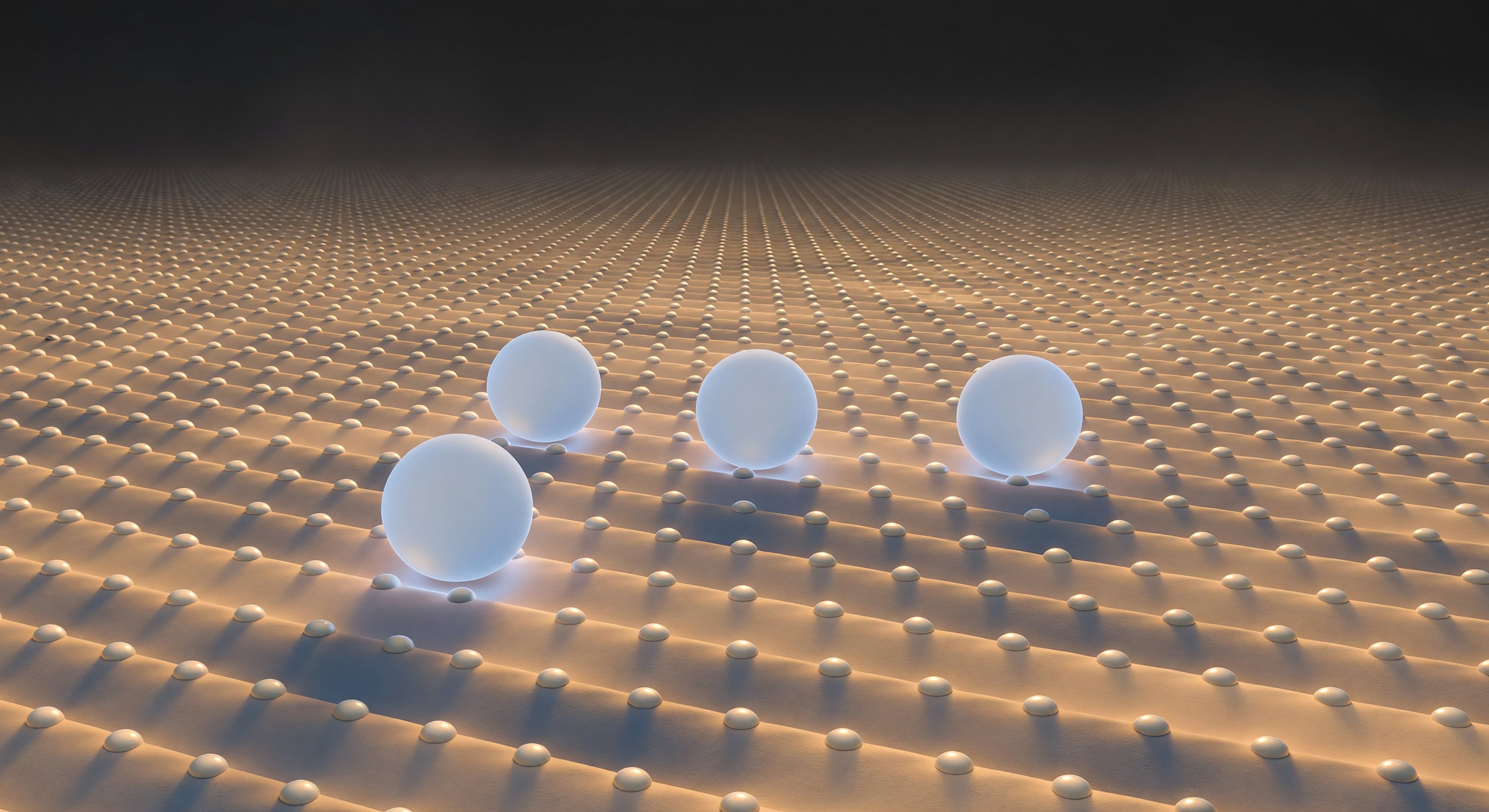
You are standing at the floor of a corrugated metallic world, the Ni(110) surface stretching in every direction as a vast plain of warm coppery-gold domes — individual nickel atoms packed shoulder to shoulder along precise crystallographic rows, their burnished crests catching an amber radiance that seems to well up from within the lattice itself, while the channels between each row fall into cool blue-grey shadow, creating a rhythmic geological corrugation that feels simultaneously immense and intimate. Resting in three of those shadowed troughs, three xenon adatoms rise like pale blue-silver monuments — their closed 5p shells presenting perfectly featureless, repulsive surfaces, no orbital bridges reaching downward, only a ghost-thin aureole of van der Waals contact tracing their lowest edge where momentarily induced dipoles whisper across the gap to the nickel beneath. This scene, famously realized by Don Eigler and Erhard Schweizer at IBM Almaden in 1990 using a scanning tunneling microscope cooled to 4 kelvin, demonstrated for the first time that individual atoms could be positioned with deliberate geometric intent on a crystalline substrate — the xenon atoms sitting physically inert and chemically unbonded, held in place by nothing stronger than dispersion forces and the cryogenic stillness pressing every degree of freedom into suspension. The contrast between the warm, tightly ordered transition-metal lattice below and the three sovereign, closed-shell noble-gas spheres above it is total: two chemical worlds sharing a surface, held together by the faintest whispered attraction, the entire arrangement frozen at a scale where a single bond length would span the distance between neighboring crests.
Other languages
- Français: Xénon sur scène silencieuse
- Español: Átomos de xenón en reposo
- Português: Xenônio em palco sereno
- Deutsch: Xenon-Atome stille Bühne
- العربية: ذرات زينون على مسرح هادئ
- हिन्दी: ज़ेनॉन परमाणु शांत मंच
- 日本語: 静寂のキセノン原子舞台
- 한국어: 고요한 크세논 원자 무대
- Italiano: Atomi di xeno palco quieto
- Nederlands: Xenon atomen stil podium