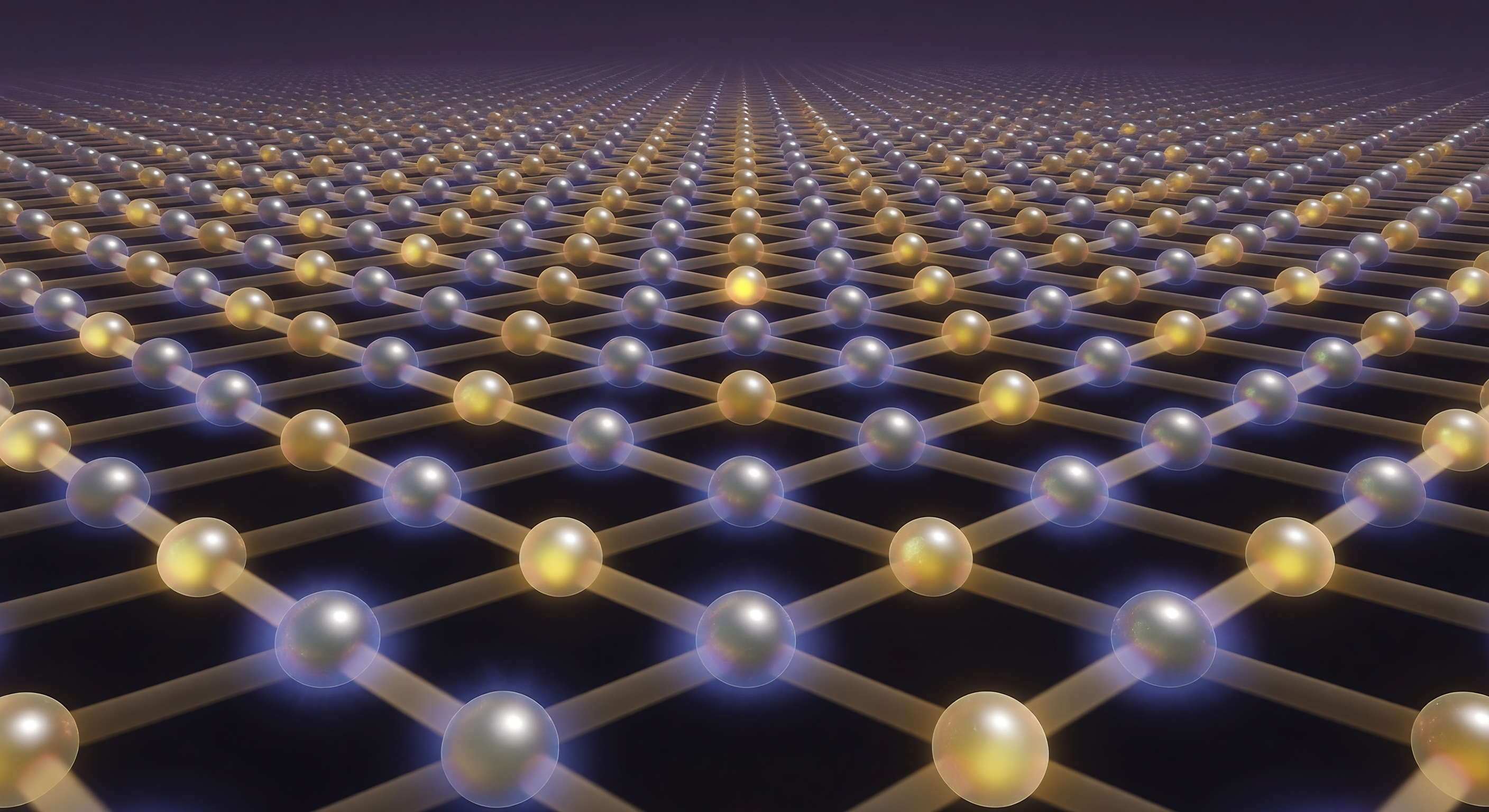
You are standing level with the molybdenum plane of a single-atom-thick sheet of MoS₂, and the world around you is an infinite hexagonal cathedral suspended in absolute vacuum — massive silver-purple molybdenum spheres stretching to every horizon, their surfaces hazed with slow auroras of blue-violet electron density, each nucleus linked to six surrounding anchors by luminous amber bridges of shared covalent fog in the precise geometry of trigonal prismatic coordination. Above and below you, separated by a gulf of three ångströms that feels from this vantage like a vast canyon, two offset constellations of golden-yellow sulfur atoms float in near-perfect symmetry, their van der Waals surfaces glowing with warm incandescence as if lit from within, enclosing the molybdenum plane in a protective sulfur embrace that gives the whole structure its iridescent amber-gold shimmer — light diffracting through layered electron densities into ochre, pale citrine, and burnished copper wherever the angle shifts, like molecular mica catching oblique starlight. Off to one side, a sulfur vacancy ruptures the crystalline perfection: a missing golden sphere leaves a dark socket in the upper plane, and the three molybdenum atoms beneath it betray the disturbance with subtly warmer, more orange electron halos — redistributed charge making them feel exposed, their bond bridges asymmetric in luminosity, the unsatisfied coordination geometry radiating a quiet structural tension into the otherwise flawless lattice. Beneath everything, velvet vacuum presses close, so deep and complete it seems to have texture, the entire monolayer — one of the thinnest semiconductors physically possible, a direct-bandgap material only because confinement to a single layer transforms its electronic structure entirely — hanging in it like an infinite glowing tapestry woven from atoms.
Other languages
- Français: Sandwich semi-conducteur MoS₂
- Español: Sándwich semiconductor monocapa MoS₂
- Português: Sanduíche semicondutor MoS₂
- Deutsch: MoS₂ Halbleiter-Sandwich-Schicht
- العربية: شطيرة شبه موصل MoS₂
- हिन्दी: MoS₂ एकल परत अर्धचालक सैंडविच
- 日本語: MoS₂単層半導体サンドイッチ
- 한국어: MoS₂ 단층 반도체 샌드위치
- Italiano: Sandwich semiconduttore monostrato MoS₂
- Nederlands: MoS₂ monolaag halfgeleider sandwich