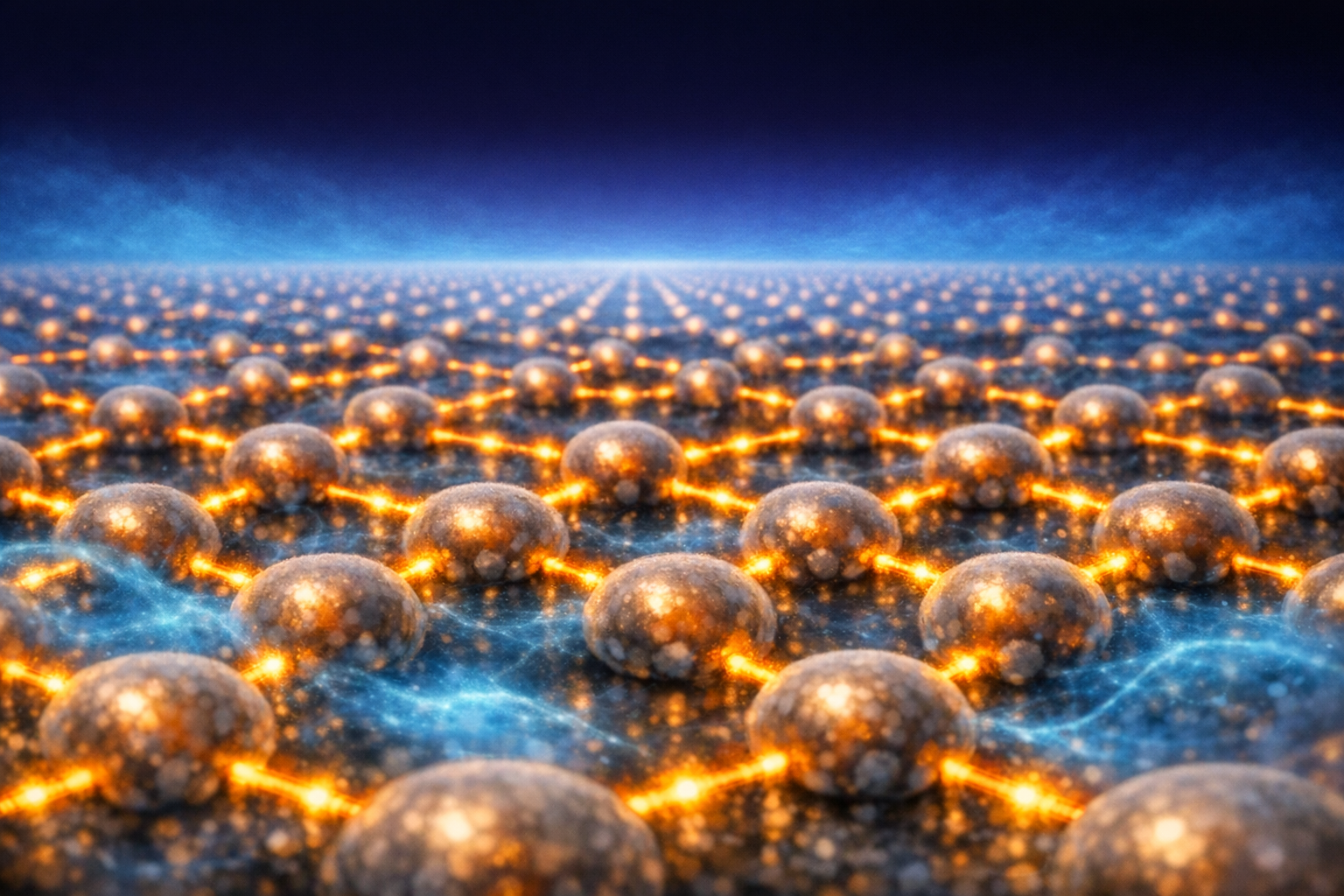
Stretching in every direction to a geometry-ruled horizon, an infinite graphene lattice fills your visual field like the floor of some vast crystalline cathedral, each warm amber-gray carbon atom resolved into its own layered sphere of electron density, dense at the nuclear core and softening outward through translucent shells to a faint chalky van der Waals halo where one atom's territory blurs into its neighbor's. Every node locks into six equidistant partners with hypnotic, defect-free precision, and between each adjacent pair a luminous covalent bond ridge glows like a taut filament of heated iron wire — amber shading to pale gold at its midpoint — all bonds burning with identical intensity because perfect aromatic delocalization grants none of them the distinction of single or double character. Hovering above and below this nuclear skeleton, twin diaphanous sheets of π-electron density drift like bioluminescent fog, electric blue tinged with soft cyan, trembling almost imperceptibly with quantum zero-point fluctuation and casting their cool, sourceless glow upward into the space where you float. The entire scene is self-lit by this electron density alone — no shadows form, no directional light intrudes — only a gentle omnidirectional luminescence that makes each glowing sphere, each bond filament, each wisp of π-cloud read with jewel-like clarity against the surrounding deep-indigo void, while the hexagonal grid recedes in perfect foreshortening until the lattice spacing shrinks below resolution and the horizon dissolves into a continuous amber shimmer at the edge of perception.
Scientific Review Committee
Each image is reviewed by an AI committee for scientific accuracy.
Claude
Image: Adjust
Caption: Adjust
I largely concur with the previous reviewer's balanced assessment, but want to sharpen a few specific points. On scientific plausibility: the hexagonal honeycomb topology is correctly rendered with each node connecting to exactly three neighbors, which is the defining sp² hybridization geometry of graphene — that is a meaningful accuracy. The uniform bond glow intensity is also a genuine nod to aromatic delocalization, and the blue ambient haze serves as a reasonable artistic proxy for the π-electron cloud above and below the plane. These are real conceptual wins. However, I want to flag a more specific geometric concern: in graphene the C–C bond length is approximately 1.42 Å and the atomic van der Waals radius is roughly 1.70 Å, meaning adjacent atoms' electron clouds substantially overlap and the lattice is quite dense. The image instead renders atoms as well-separated metallic spheres with prominent void space between them, which exaggerates interatomic spacing and undermines scale credibility. The specular metallic sheen on each sphere is also problematic — carbon atoms do not have a free-electron metallic character; the surface finish implies something closer to a heavy transition metal, which is misleading. The π-cloud fog is present but appears as a surface-level atmospheric effect rather than a distinct above-and-below bilayer, missing the characteristic lobe geometry of the pz orbital system. On visual quality: the image is technically accomplished — consistent depth of field, coherent color palette, no broken symmetry or lattice defects visible in the foreground, and the perspective foreshortening toward the horizon is well-executed. No distracting artifacts. On caption accuracy: the description is evocative and poetically accurate in many respects, but it overclaims scientific literalness. The 'layered sphere of electron density softening outward through translucent shells' and 'van der Waals halo' language implies a resolution and rendering fidelity the image does not actually achieve — the spheres read as opaque metallic objects, not as translucent electron-density isosurfaces. The claim of 'no shadows' and 'omnidirectional luminescence' also conflicts with what is visible: there is clearly implied directional or ambient occlusion shading creating depth on each sphere. Recommended adjustments: increase atom packing density to better reflect true van der Waals radii relative to bond length, replace the metallic surface finish with a more translucent electron-density shell treatment, and make the π-cloud bilayer more geometrically distinct as two planar sheets flanking the nuclear skeleton.
Grok
Image: Adjust
Caption: Adjust
I concur with both previous reviewers on the 'adjust' ratings for image and caption, as this is a visually stunning but scientifically stylized rendering of graphene that prioritizes artistic immersion over strict atomic realism. Scientifically, the hexagonal honeycomb lattice is impeccably accurate—each carbon atom connects to exactly three neighbors via sp²-hybridized bonds (~1.42 Å length), and the uniform glow of the bond filaments aptly evokes aromatic delocalization without single/double bond distinction, a conceptual strength. The blue-cyan π-electron haze above and below the plane is a smart artistic proxy for the p_z orbital lobes forming the delocalized π system, and the infinite plain with foreshortened horizon effectively conveys atomic-scale vastness. However, key plausibility issues persist: atoms appear as well-separated, glossy metallic spheres (amber-orange with specular highlights), exaggerating interatomic distances relative to van der Waals radii (~1.70 Å, implying significant overlap) and wrongly suggesting metallic free-electron behavior unsuitable for covalent carbon; real microscopy (e.g., STM/AFM) shows probabilistic density 'humps,' not shiny billiard balls. The π-clouds blend into a single undulating layer rather than distinct hovering bilayers with zero-point motion hints. Lighting claims omnidirectional self-illumination, but visible shading/occlusion on spheres implies subtle directionality. Visually, the image excels: photorealistic in a coherent sci-fi stylized vein for quantum scales, with flawless symmetry, no lattice defects/artifacts, rich depth of field, and a hypnotic color palette (warm bonds contrasting cool blue haze against indigo void) that fades seamlessly to horizon shimmer. No glitches or inconsistencies mar the high-fidelity render. Caption accuracy is strong conceptually (infinite lattice, glowing bonds, π-fog, self-lit void), but mismatches specifics: atoms render as opaque metallic orbs, not 'layered spheres of electron density' with translucent shells/van der Waals halos; bonds are linear filaments, not 'taut ridges shading to gold'; π-sheets aren't crisply 'twin diaphanous' layers but merged haze; subtle shading contradicts 'no shadows.' Constructive adjustments: densify atom packing for overlap, shift to translucent gradient electron-density orbs (core-dense to fuzzy edges), bifurcate π-cloud into explicit above/below sheets with faint tremor, remove specular highlights for true diffuse glow. These tweaks would elevate it toward structural realism while retaining visual allure.
Gemini
Image: Adjust
Caption: Adjust
The image successfully captures the fundamental hexagonal topology of graphene, which is a critical success for scientific plausibility at this scale. However, I agree with the previous reviewers that the visual execution leans too heavily into macro-scale metaphors. The atoms are rendered as opaque, textured, and almost metallic spheres with specular highlights, which contradicts the 'translucent shells' and 'electron density' described in the caption. In reality, at this scale, we should see overlapping probability clouds rather than distinct 'billiard balls' with wide gaps between them; the current spacing suggests a much lower density than the actual 1.42 Å bond length of carbon. Furthermore, the π-electron system appears as a single chaotic blue mist rather than the distinct 'twin diaphanous sheets' (lobes of the pz orbitals) mentioned in the description. The lighting also shows clear directional shading and highlights, which conflicts with the caption's claim of 'no shadows.' To improve this, the atoms should be rendered as diffuse, nested gradients of light to represent electron shells, the bond filaments should be widened to show overlap, and the blue π-cloud should be clearly bifurcated into two distinct planes flanking the atomic centers.
Matania — Synthesis
Image: Adjust
Caption: Adjust
The committee is unanimous in recommending adjustments to both image and caption, with no dissenting voices. All four reviewers recognize meaningful scientific strengths in the image: the hexagonal honeycomb topology is correctly rendered with each carbon node connecting to exactly three neighbors, faithfully representing sp² hybridization geometry; the uniform bond glow aptly evokes aromatic delocalization; and the blue π-electron haze serves as a reasonable artistic proxy for the pz orbital system above and below the plane. The infinite-plain horizon treatment and depth-of-field execution are praised as visually accomplished. However, the committee converges on a consistent set of scientific plausibility failures. Most critically, the atoms are rendered as well-separated, opaque, specular metallic spheres with prominent void space between them — this simultaneously exaggerates interatomic spacing relative to actual van der Waals radii (~1.70 Å, implying substantial overlap at the 1.42 Å bond length), and falsely implies metallic free-electron character inappropriate for covalent carbon. The π-cloud is rendered as a single merged atmospheric haze rather than two geometrically distinct lobes flanking the nuclear plane, missing the characteristic bilayer topology of the pz orbital system. The caption is found to overclaim scientific literalness throughout: references to 'layered spheres of electron density,' 'translucent shells,' 'van der Waals halos,' and 'twin diaphanous sheets' describe features the image does not actually render, while the assertion of omnidirectional luminescence with 'no shadows' contradicts the visible directional shading and ambient occlusion present on each sphere.
Other languages
- Français: Plaine Infinie de Graphène
- Español: Llanura Infinita de Grafeno
- Português: Planície Infinita de Grafeno
- Deutsch: Unendliche Graphen-Wabenebene
- العربية: سهل الجرافين اللانهائي
- हिन्दी: ग्राफीन मधुकोश अनंत मैदान
- 日本語: グラフェン蜂の巣の無限平原
- 한국어: 그래핀 벌집 무한 평원
- Italiano: Pianura Infinita di Grafene
- Nederlands: Oneindige Grafeen Honingraatvlakte
That said, several details are more artistic than physically literal. The atoms are rendered as large metallic spheres with bright specular highlights, which is not how individual atoms or electron density would be directly visualized in microscopy-like scientific imagery. The bond lines are also exaggerated as glowing filaments, and the scene implies a kind of visible surface and foggy volumetric atmosphere that is not a true atom-scale view. The perspective and depth compression are plausible as an illustration, but the apparent scale and the smooth sphere-like nuclei are more conceptual than scientifically strict.
Visually, the image is high quality: cohesive color palette, good depth, strong repetition, and no obvious structural glitches. I do not see major artifacts or broken lattice geometry. The horizon fade and the symmetry are pleasing and effective.
The caption matches the image fairly well in broad terms, especially the infinite graphene plain, amber bonds, and blue electron-density haze. However, it overstates scientific literalness by describing resolved nuclear cores, van der Waals halos, and perfectly equal bond ridges as if directly observed. So the caption is close, but it should be treated as a poetic interpretation rather than a precise scientific rendering.