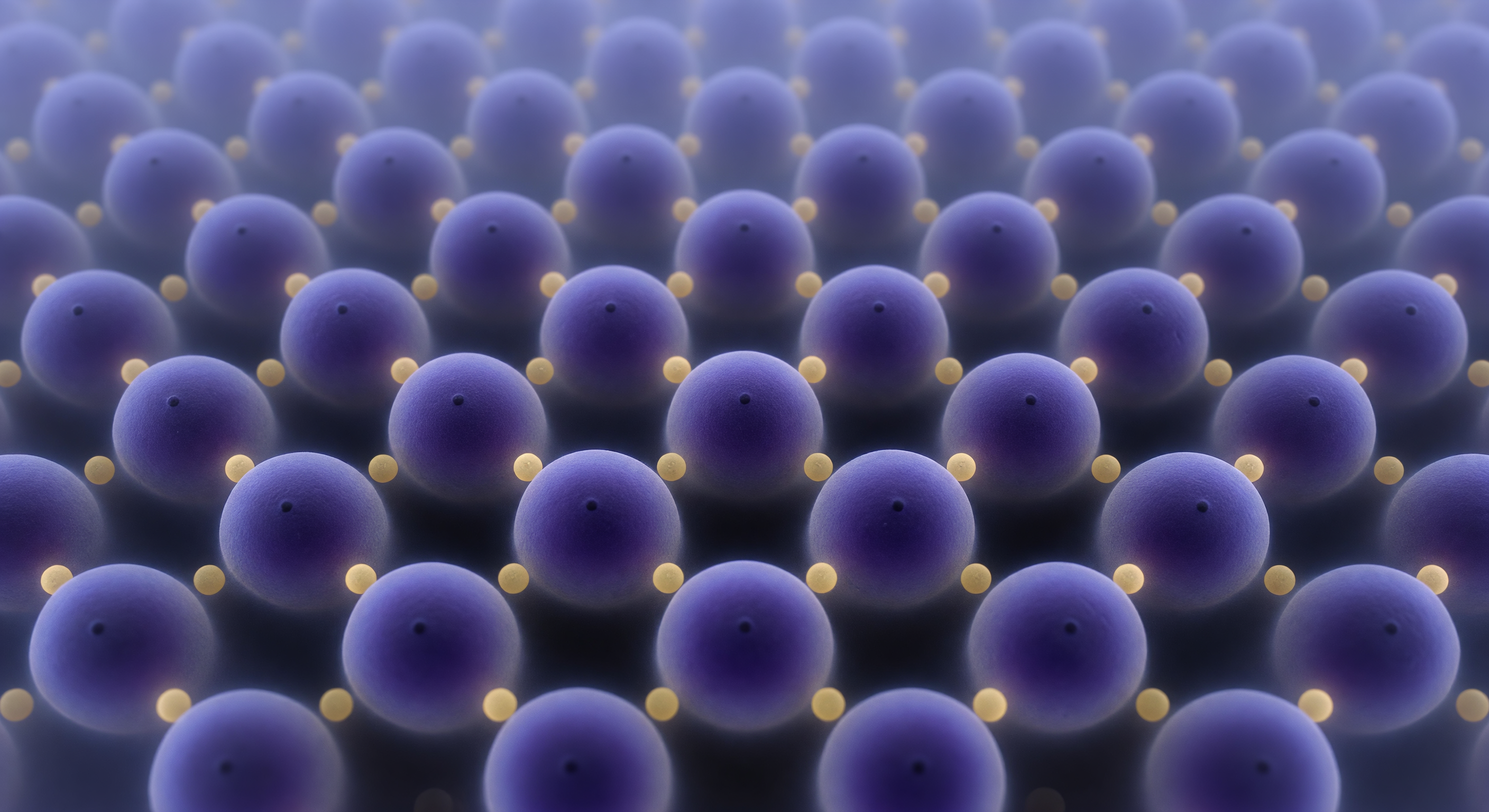
You are suspended at the geometric heart of a sodium chloride crystal, and the world around you is an infinite cathedral of ionic order — immense violet-blue chloride anions crowding every direction, their outer electron-cloud halos swollen to near-contact, diffusing through concentric gradients of lavender and indigo into the surrounding dark like slow luminescent exhalations. Nestled in the octahedral pockets between every six chloride neighbors, sodium cations appear startlingly diminutive by comparison: compact amber-gold spheres whose electron clouds are pulled tight against the nucleus by the electrostatic penalty of having surrendered a valence electron, leaving them geometrically precise and radiant with a subdued honeyed glow. The crystal adopts the rock-salt structure — space group Fm3̄m — in which each ion sits at the center of a perfect octahedron of opposite-charge neighbors, with a lattice parameter of 564 pm and an Na⁺–Cl⁻ interionic distance of roughly 282 pm; the electrostatic attraction binding them is purely Coulombic, with no covalent bridge, which explains the clean dark voids between ions where shared electron density simply does not exist. Deep in every direction the alternating violet-and-amber motif repeats without deviation, blurring at distance into a cold blue-violet mineral haze, the silence of absolute long-range crystallographic order pressing in from all sides as if the lattice itself extends to the edge of the perceivable universe.
Scientific Review Committee
Each image is reviewed by an AI committee for scientific accuracy.
Claude
Image: Adjust
Caption: Adjust
I broadly agree with GPT's assessment but want to add several specific observations. On scientific plausibility: the most immediately defensible choices are the size ratio and color coding. Chloride ions (ionic radius ~181 pm) are indeed substantially larger than sodium ions (~102 pm), and the image captures this contrast reasonably well with the large violet spheres dwarfing the small amber ones. The close-packing and alternating arrangement is consistent with the rock-salt Fm3̄m motif. However, the coordination geometry is the central weakness. In a true rock-salt structure viewed from the interior, each chloride should be surrounded by exactly six sodium neighbors in an octahedral arrangement — three in-plane and one above, one below — giving a very specific angular geometry (90° and 180° separations). The image instead reads as a simple hexagonal close-packed surface projection rather than a true 3D octahedral interior immersion. The sodium ions appear predominantly in the equatorial gaps between chloride spheres, not above and below them, undermining the octahedral claim. The dark dimples on the chloride spheres noted by GPT are physically unjustified and subtly damaging to the atomic realism; electron clouds on closed-shell ions like Cl⁻ should present smooth, spherically symmetric probability densities with no surface features. Regarding the 'clean dark voids' described in the caption as markers of pure ionic (non-covalent) bonding — this is a legitimate and scientifically interesting point, but the image does not render these voids clearly enough; the depth of field compression makes the gaps feel incidental rather than structurally meaningful. The electron-cloud halos on the chloride ions are a nice touch and communicate the diffuse outer electron density well, though they could be slightly more graduated to suggest the exponential decay of the wavefunction. On visual quality: the rendering is technically accomplished — the depth of field, color palette, and surface texture are all coherent and pleasing. The lavender-to-indigo gradient on the chloride spheres is evocative and aesthetically strong. The image is, however, too flat in its three-dimensionality for a purportedly immersive interior view. A true 'geometric heart' perspective should show ions receding in all six octahedral directions, including directly toward and away from the viewer, which would require a more dramatic forced perspective or fisheye-like projection. On caption accuracy: the description is richly detailed and mostly consistent in spirit, but several specific claims are visually unsupported — the octahedral geometry, the 'infinite cathedral' sense of depth, and the 'clean dark voids where shared electron density simply does not exist' are all either absent or underrealized in the image. The amber-gold sodium characterization and the violet-blue chloride characterization are accurate. The mention of lattice parameter (564 pm) and interionic distance (282 pm) are scientifically correct for NaCl at room temperature. Overall verdict: this is a visually strong, conceptually coherent image that warrants an 'adjust' rather than 'regenerate' — the main improvements needed are a more convincing 3D octahedral depth cue, removal of the surface dimple artifacts on the chloride spheres, and a clearer rendering of the interstitial voids to support the ionic bonding narrative.
Grok
Image: Adjust
Caption: Adjust
I concur with both GPT and Claude on the core strengths and weaknesses, adding some targeted insights on atomic-scale fidelity and visual immersion. Scientifically, the image plausibly depicts the rock-salt (Fm3m) lattice through alternating large violet-blue Cl⁻ anions (correctly larger at ~181 pm ionic radius vs. Na⁺ ~102 pm) and smaller amber-gold Na⁺ cations, with diffuse halos evocatively suggesting expanded electron clouds on Cl⁻ (18 electrons) versus contracted ones on Na⁺ (10 electrons post-ionization). The ~282 pm interionic spacing is implicitly scaled well via relative sphere sizes, and the pure ionic Coulombic bonding is hinted at by inter-ion gaps. However, the octahedral coordination—central to the description's 'geometric heart' at an Na⁺ site surrounded by 6 Cl⁻, or vice versa—is poorly conveyed: the view flattens into a quasi-hexagonal equatorial plane of Cl⁻ with Na⁺ in pockets, lacking axial ions receding toward/away from the viewer for true 3D immersion. This makes it resemble a surface slab or [111] projection rather than bulk interior. The prominent dark dimples/pits on Cl⁻ spheres (visible across multiple purple orbs) are a persistent artifact with no physical basis—ionic electron densities are spherically symmetric and smooth, not cratered. Voids are dark but incidental, not sharply defined to emphasize absent covalent density. Dynamics are static, fitting quantum ground-state order, but no subtle vibrational blur for thermal reality at room temp. Visually, the rendering is coherently stylized for quantum scales (not photorealistic microscopy, as atoms aren't 'visible' classically), with excellent color gradients (lavender-indigo halos decaying into dark), soft glows, and depth-of-field haze blurring distant lattice into 'mineral haze'—aesthetically immersive and artifact-free beyond dimples. However, 3D spatial cues are compressed; a fisheye or radial perspective from the octahedral center would enhance the 'infinite cathedral' without regenerate-level overhaul. Caption accuracy is strong on colors, size contrast, lattice parameters, ionic bonding narrative, and repeating motif, but mismatches on immersive octahedral geometry ('six chloride neighbors'), 'clean dark voids' prominence, and enveloping depth ('pressing in from all sides')—the image feels more like a decorative wallpaper than heart-of-crystal suspension. Constructive adjustments: (1) Reposition ions for explicit octahedral view with foreground/background axes; (2) Smooth Cl⁻ surfaces, deepen/sharpen voids; (3) Amplify perspective distortion and haze for infinity sense. No major flaws warrant regenerate; this is a solid 'adjust' candidate.
Gemini
Image: Adjust
Caption: Adjust
The image successfully captures the color palette and the relative size ratio between the large chloride anions (violet) and the small sodium cations (amber), which is scientifically grounded. However, there are significant issues with the geometric representation and visual artifacts. First, the rock-salt (Fm3̄m) structure is cubic, with each ion surrounded by six neighbors in an octahedral arrangement. The image instead presents a quasi-hexagonal packing that looks more like a surface layer or a [111] crystal plane projection rather than an immersive interior 'cathedral.' To satisfy the caption's 'geometric heart' description, the perspective should show ions receding in all three dimensions, including foreground and background axes. Second, the dark dimples or pits on the surface of the chloride ions are non-physical artifacts; electron clouds for closed-shell ions are spherically symmetric and smooth. Third, while the 'mineral haze' is aesthetically pleasing, the depth of field is too shallow to convey the 'infinite' nature of the lattice described. Adjustments should focus on correcting the 3D octahedral geometry, removing the surface dimples, and using a wider perspective to suggest a boundless interior environment.
Matania — Synthesis
Image: Adjust
Caption: Adjust
The committee reached unanimous consensus on 'adjust' for both image and caption, with no dissenting votes across all four reviewers. The image earns credit for its correct color coding (violet-blue for Cl⁻, amber-gold for Na⁺), its accurate relative ion size ratio (~181 pm vs ~102 pm ionic radii), the evocative diffuse halos suggesting electron cloud density on the larger anion, and a generally coherent color palette with pleasing depth-of-field rendering. The rock-salt alternating motif is recognizable and the overall aesthetic is scientifically literate. However, all four reviewers independently identified the same cluster of weaknesses. The most consequential is the failure to convey true three-dimensional octahedral coordination geometry: the image reads as a quasi-hexagonal equatorial plane, resembling a surface slab or [111]-projection rather than an immersive bulk interior where ions recede along all six octahedral axes including the viewer-axis. This directly undermines the caption's central 'geometric heart' and 'infinite cathedral' claims. A second unanimous concern is the dark dimple artifacts on the chloride ion surfaces, which are physically unjustified — closed-shell ionic electron densities are spherically symmetric with no surface features. Third, the interstitial voids, while present, are rendered too incidentally to carry the intended narrative weight of pure ionic (non-covalent) bonding. On the caption side, the scientific data cited (lattice parameter 564 pm, interionic distance 282 pm) is correct, color and size characterizations are accurate, and the ionic bonding framing is legitimate — but the specific geometric and atmospheric claims (octahedral immersion, infinite depth, clean dark voids, ions pressing in from all sides) are visually unsupported by the current render. The committee agrees this is a solid foundation warranting targeted adjustment rather than regeneration.
Other languages
- Français: Intérieur Royal Cristal NaCl
- Español: Interior Regio Cristal NaCl
- Português: Interior Régio Cristal NaCl
- Deutsch: NaCl Kristall Königliches Innere
- العربية: داخل بلوري ملكي NaCl
- हिन्दी: NaCl क्रिस्टल राजसी अंदर
- 日本語: NaCl結晶の荘厳な内部
- 한국어: NaCl 결정 장엄한 내부
- Italiano: Interno Regale Cristallo NaCl
- Nederlands: NaCl Kristal Koninklijk Interieur
That said, there are a few scientific and visual limitations. Scientifically, the ions are rendered as nearly touching smooth spheres with very uniform spacing, which is a bit too literal and regular for an atomic-scale visualization; the description emphasizes octahedral coordination and clean voids, but the image does not strongly convey the octahedral environment or the deep three-dimensional Fm3̄m alternation. The scale cues are also ambiguous: the scene feels more like a stylized molecular model than an immersive atomic interior with any sense of interionic distance or electrostatic field structure. The small dark dimples on the ions are not well justified physically and read as an artifact.
Visually, the rendering is attractive and coherent, with good color harmony and depth of field, but it is slightly repetitive and synthetic. The halos and lighting are pleasant, yet the image lacks the more crystalline sharpness or mineral translucency that would make the lattice feel more like a true solid and less like a decorative 3D pattern.
Caption-wise, the description matches the main elements fairly well: alternating chloride and sodium ions, violet and amber palette, long-range periodic order, and the rock-salt structure. However, some of the more specific claims are not visibly supported, especially the "infinite cathedral" atmosphere, the exact octahedral geometry, and the impression of sharply defined clean voids. Overall: good conceptual match, but it would benefit from a slight scientific and visual refinement rather than full approval.