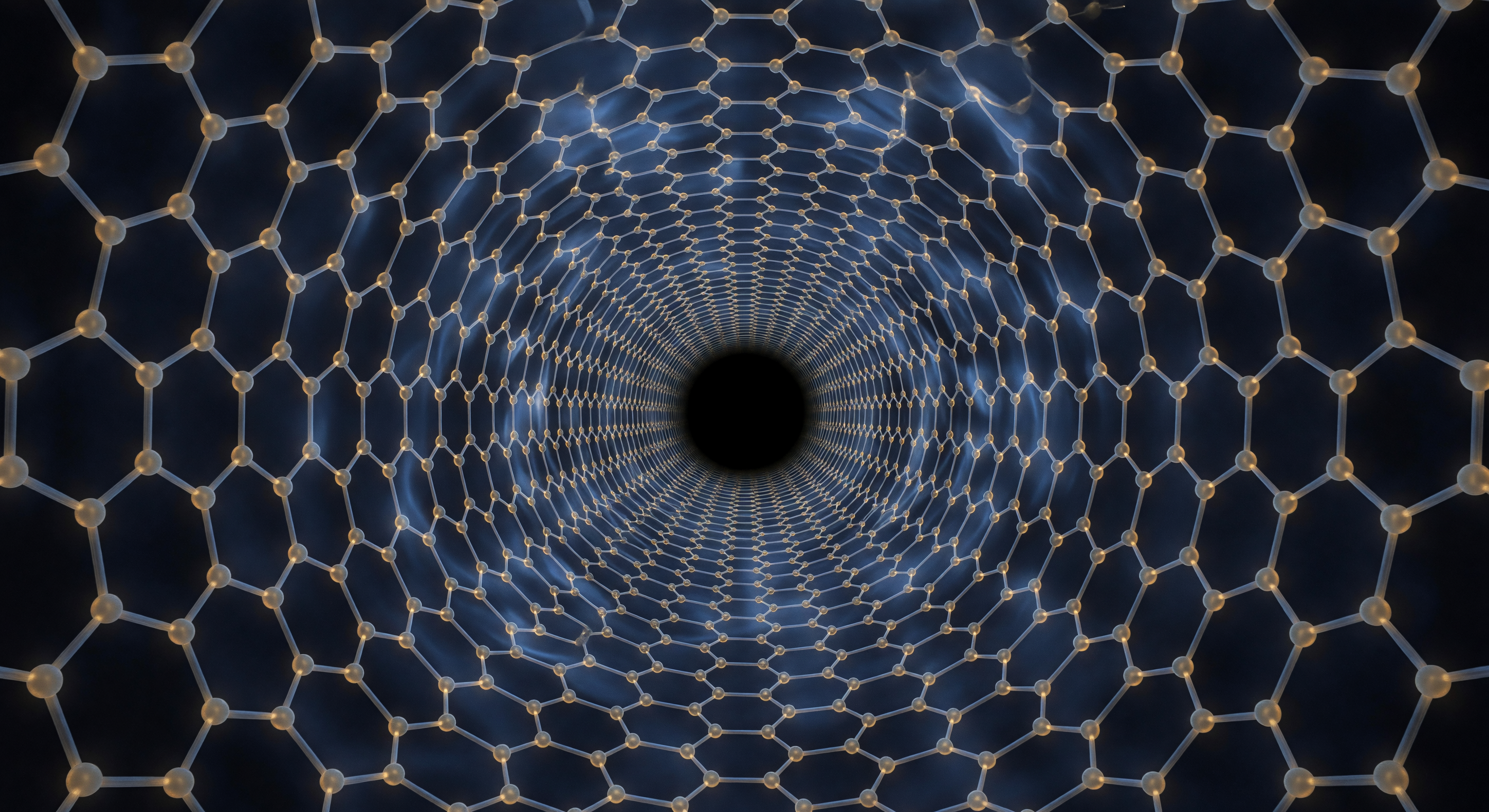
You find yourself suspended at the geometric center of a carbon nanotube's hollow bore, enclosed by a seamless cylindrical wall of hexagonally bonded carbon atoms curving perfectly around you at a radius of roughly four ångströms — a distance so intimate that each gray-amber nuclear center and its glowing sp²-hybridized bonds fills your entire peripheral field with the precision of a rolled graphene sheet frozen into mathematical ideal. The inner wall shimmers with a diffuse electric-blue haze: the delocalized π-electron cloud of an extended aromatic system, a quantum fog of shared electron density that hovers just inward of the nuclei, thickening over each six-membered ring and casting faint luminous curves across the featureless quantum vacuum of the bore itself. This is a (10,0) zigzag single-walled nanotube — a cylinder barely 0.8 nanometres in diameter, yet exhibiting the electronic properties of a semiconductor, its conductance governed by the very chirality with which the graphene lattice was conceptually rolled. Looking along the tunnel axis, ring after ring of hexagonal carbon lattice converges toward a vanishing point of absolute darkness, each bond ridge self-luminous with the warm amber radiance of concentrated electron density, the geometry repeating without defect or interruption at the scale where covalent order and quantum mechanics are indistinguishable from architecture.
Other languages
- Français: Tunnel Intérieur Nanotube Carbone
- Español: Interior del Túnel Nanotubo
- Português: Interior do Túnel Nanotubo
- Deutsch: Kohlenstoff-Nanoröhren-Tunnel
- العربية: داخل نفق النانو الكربوني
- हिन्दी: कार्बन नैनोट्यूब सुरंग भीतर
- 日本語: カーボンナノチューブ内部トンネル
- 한국어: 탄소 나노튜브 터널 내부
- Italiano: Tunnel Interno Nanotubi Carbonio
- Nederlands: Koolstof Nanotube Tunnel Interieur