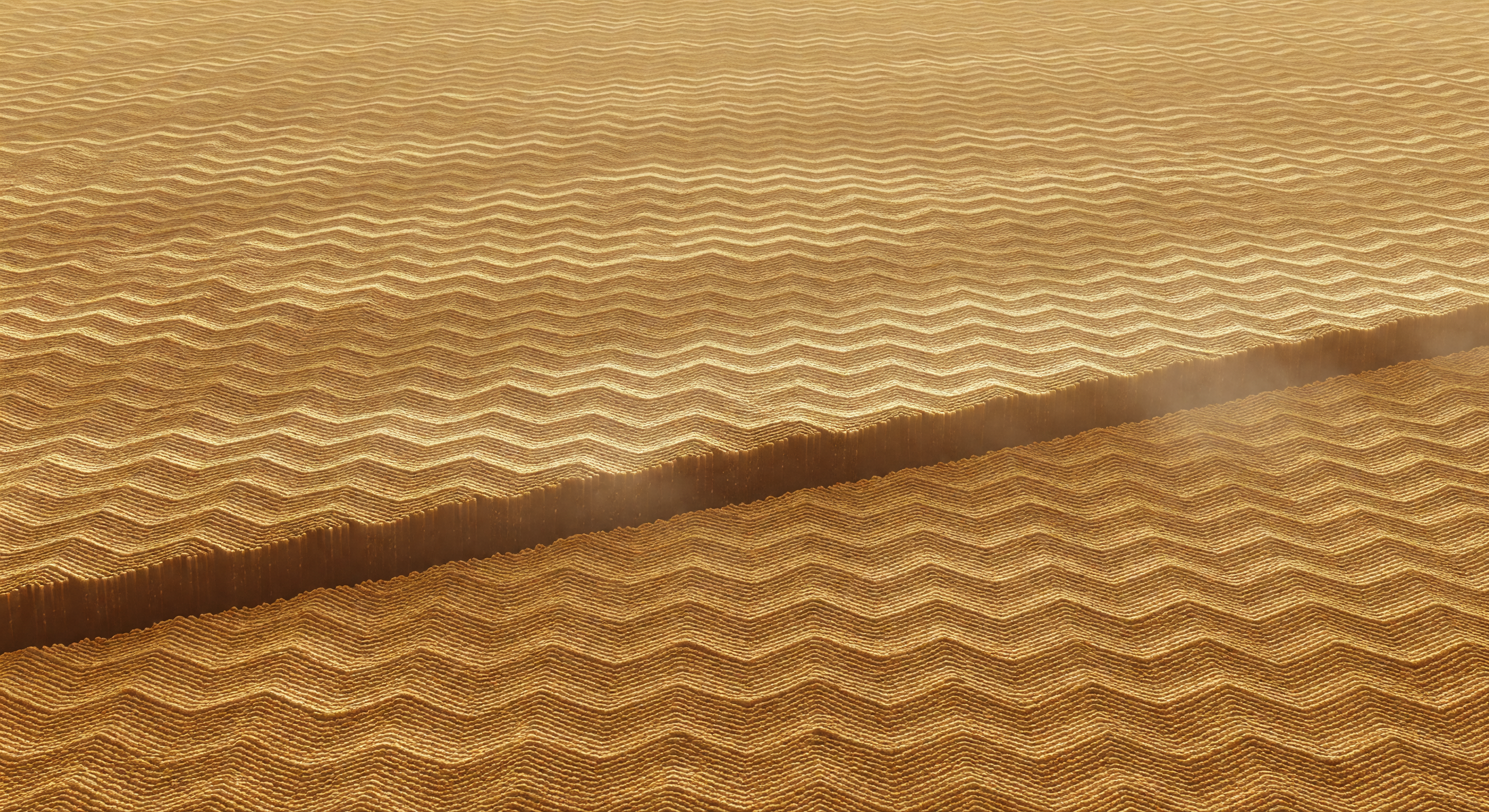
The viewer floats above a vast, precisely ordered plain of gold atoms, each one a softly glowing amber dome nestled with geometric inevitability against its six neighbors, their overlapping electron density halos merging into a continuous, self-luminous topaz sea that stretches without interruption in every direction. Across this close-packed hexagonal field, long sinuous ridges trace the famous herringbone reconstruction of the Au(111) surface — a spontaneous structural rearrangement in which the topmost gold atoms compress slightly along one direction, forcing the crystal to relieve that lateral stress by partitioning itself into alternating face-centered cubic and hexagonal close-packed stacking domains separated by soliton walls that undulate across the surface like slow dunes frozen mid-drift. These domain boundaries rise by a fraction of an atomic diameter yet catch the cold overhead tunneling illumination with enough contrast to glow pale champagne at their crests while the troughs deepen into burnt-sienna shadow, the entire corrugation pattern repeating with crystalline regularity until distance compresses the zigzag lines into a shimmering moiré-like fabric at the horizon. Cutting diagonally through the scene, a single-atom-high step edge drops away as an abrupt dark cliff — a vertical wall of packed gold nuclei whose shadowed face falls into deep ochre obscurity — yet its height, just 235 picometers in reality, feels here as dramatic and final as a continental escarpment, a reminder that at this scale the smallest discontinuity in crystal geometry becomes an absolute boundary reshaping the local electronic landscape.
Other languages
- Français: Surface Dorée Chevron STM
- Español: Vista STM Superficie Espiga Dorada
- Português: Superfície Ouro Espinha STM
- Deutsch: Gold Fischgrat Oberfläche STM
- العربية: سطح ذهبي هيرينغبون STM
- हिन्दी: सोना हेरिंगबोन सतह STM दृश्य
- 日本語: 金ヘリンボーン表面STM像
- 한국어: 금 헤링본 표면 STM 뷰
- Italiano: Superficie Oro Spigato STM
- Nederlands: Goud Visgraat Oppervlak STM