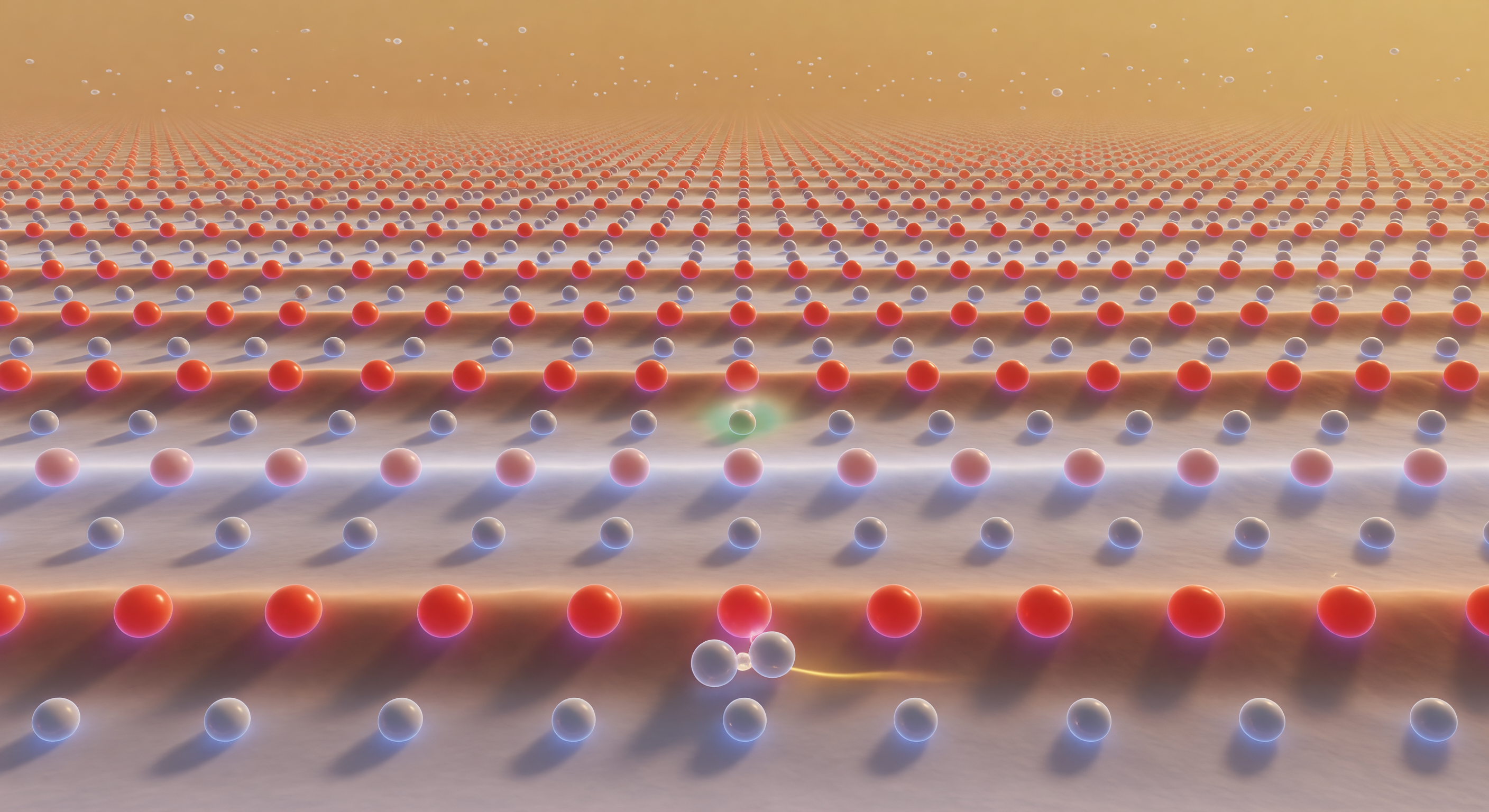
Across the corrugated plain of the rutile TiO₂ (110) surface, parallel ridgelines of swollen crimson-orange bridging oxygen anions rise above the flatter terrain of compact lavender-silver titanium cations, the repeating colonnade of the crystal's unit cell stretching toward an amber-lit horizon with architectural precision — every sphere a distinct territory of electron probability cloud, every groove a shadow cast by the surface's own geometry. One vacancy breaks the pattern ahead: a missing bridging oxygen leaves a reduced Ti³⁺ center exposed, its d-orbital density blooming asymmetrically outward in a warmer teal hue, the surrounding lattice distorted by the absent atom's charge and the local crystal field quietly rearranged. A diffuse blue-white luminescence drifts along the titanium row — not a particle but a probabilistic smear of photoexcited electron density migrating through the Ti 3d conduction band, drawn toward the vacancy like a slow tide responding to an invisible gradient, pulsing with each thermal fluctuation of the lattice. In the foreground, a single water molecule hangs mid-dissociation above an intact Ti site, its oxygen drawn close to the cation while one hydrogen leans toward a neighboring bridging oxygen, the nascent bond rendered as a pale golden filament of shared electron density — the first irreversible step of photocatalytic water splitting, frozen at the precise instant chemistry begins.
Other languages
- Français: Éclair Photocatalytique Rutile
- Español: Destello Fotocatalítico Rutilo
- Português: Faísca Fotocatalítica Rutilo
- Deutsch: Rutil Photokatalytischer Blitz
- العربية: وميض التحفيز الضوئي الروتيل
- हिन्दी: रूटाइल प्रकाश उत्प्रेरक चमक
- 日本語: ルチル光触媒の閃光
- 한국어: 루타일 광촉매 섬광
- Italiano: Lampo Fotocatalitico Rutile
- Nederlands: Rutiel Fotokatalytische Flits