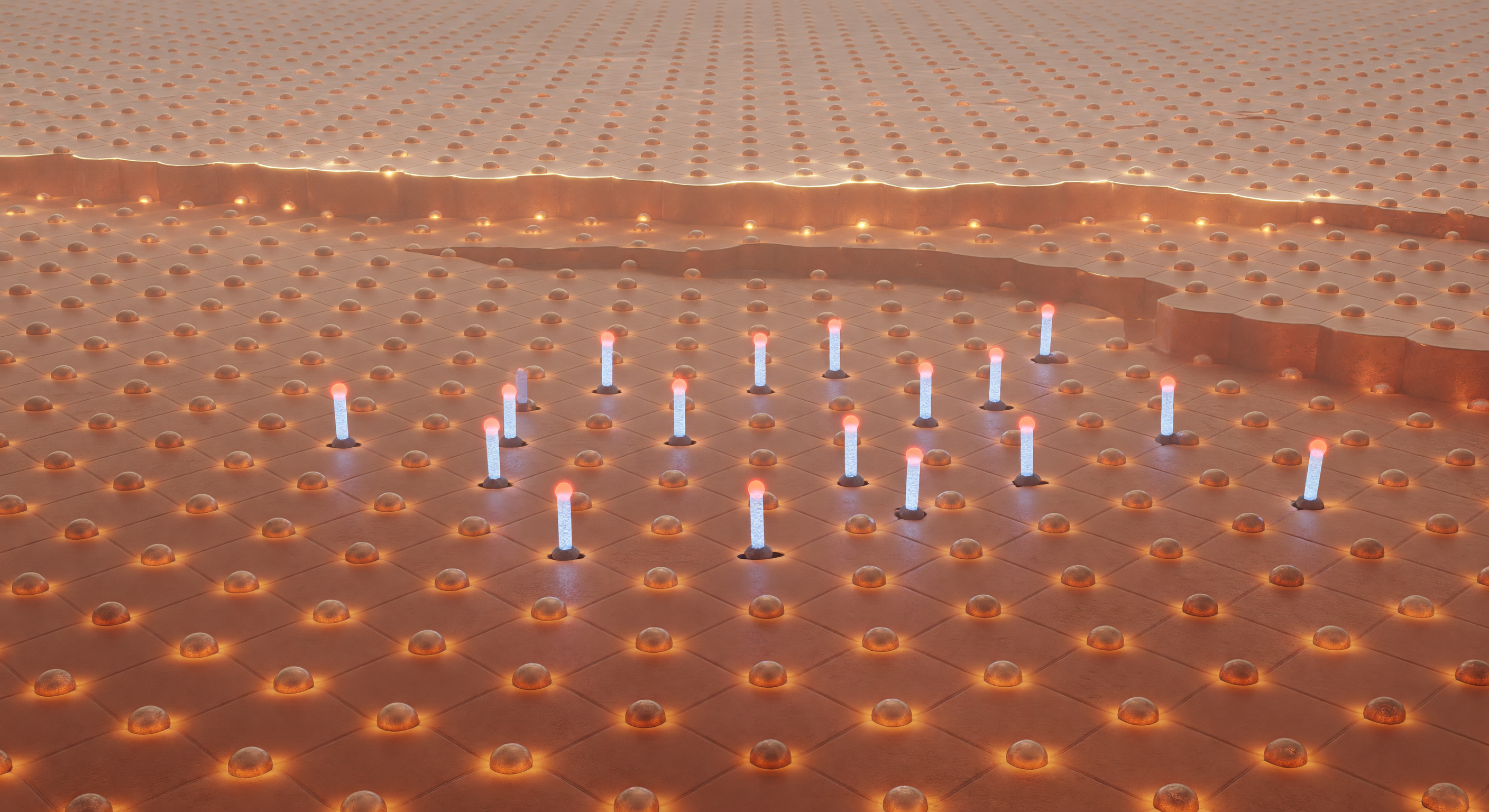
The viewer stands at the level of the copper surface itself, gazing across a vast hexagonal plain of reddish-gold atomic spheres packed in the close-packed Cu(111) arrangement, each atom glowing with warm amber luminescence from its pooled electron density, the gentle corrugation of the lattice rolling away toward a single-atom-height step edge in the middle distance whose ledge atoms burn fractionally brighter — their reduced coordination raising the local density of states like a bioluminescent reef fringe. Scattered across this metallic floor, a handful of carbon monoxide molecules stand upright on copper atop-sites like slender obelisks: a compact dark-gray carbon base bonded to the surface through its carbon end, above it a dense cylindrical column of triple-bond electron density, capped by a vivid crimson oxygen apex whose lone-pair clouds form softly glowing lobes at the summit. These molecular towers have been placed here deliberately, one by one, by the tip of a scanning tunneling microscope operating at cryogenic temperatures — a process of atom manipulation that exploits the tip's electric field to slide adsorbates across the surface with sub-ångström precision, encoding geometric patterns into an otherwise featureless terrace. A diffuse quantum haze of electron density lingers above the copper like a ground-level fog, its color shifting from warm amber over bare metal to cool blue-white where the CO molecules concentrate their π-bonding orbitals, the entire scene self-illuminated by the surface's own electronic structure with no external light source needed.
Other languages
- Français: Assemblage Moléculaire sur Cuivre
- Español: Ensamblaje Molecular en Cobre
- Português: Montagem Molecular em Cobre
- Deutsch: CO-Molekülanordnung auf Kupfer
- العربية: تجميع جزيئات فوق النحاس
- हिन्दी: तांबे पर CO अणु संयोजन
- 日本語: 銅面上のCO分子配列
- 한국어: 구리 표면 CO 분자 배열
- Italiano: Assemblaggio Molecolare su Rame
- Nederlands: CO-molecuulpatroon op Koper