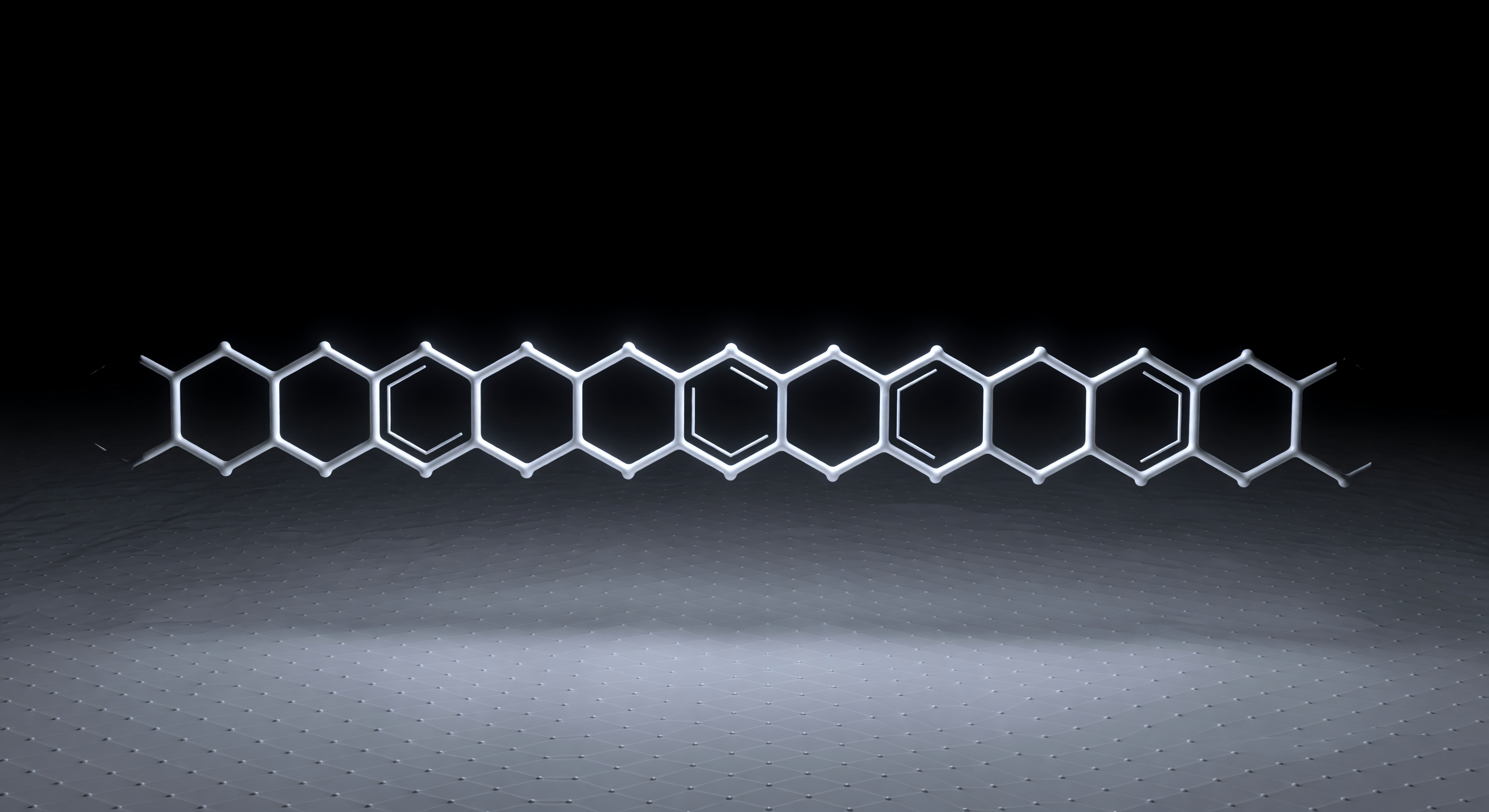
Below you, five hexagonal rings stretch end to end in a luminous, elongated chain — the entire skeleton of a single pentacene molecule rendered as a raised architectural relief of cold white ridges against absolute vacuum black, its carbon-carbon bonds glowing with a brightness that directly encodes the pressure of Pauli repulsion as the CO-functionalized tip of an atomic force microscope passes overhead at a distance of less than a nanometer. The fractionally crisper, more elevated crests mark bonds where double-bond character concentrates additional electron density into sharper ridges, while slightly softer arcs bridge the ring junctions, the whole network reading as a precise quantum-mechanical fingerprint of aromatic delocalization frozen into topographic truth. Around the molecule's perimeter, the hydrogen atoms appear as barely-there ghost arcs, their sparse electron density almost absorbed by the surrounding void, while the silver substrate extends outward as a vast, gently corrugated plain of close-packed atoms — each one a barely perceptible swelling — whose shallow hexagonal relief makes the molecule's sharp bond ridges read as mountain ranges above a quietly undulating lowland. This image, produced by non-contact AFM operating in the frequency-shift regime, achieves sub-ångström lateral resolution by exploiting the same short-range repulsive forces that prevent matter from collapsing into itself, translating the quantum geometry of chemical bonding into a landscape that can be seen.
Other languages
- Français: Carte de liaisons pentacène AFM
- Español: Mapa de enlaces pentaceno AFM
- Português: Mapa de ligações pentaceno AFM
- Deutsch: Pentacen Bindungskarte CO-AFM
- العربية: خريطة روابط جزيء بنتاسين
- हिन्दी: पेंटासीन अणु बंध मानचित्र
- 日本語: ペンタセン分子結合マップ
- 한국어: 펜타센 분자 결합 지도
- Italiano: Mappa legami pentacene CO-AFM
- Nederlands: Pentaceen molecuul bindingskaart