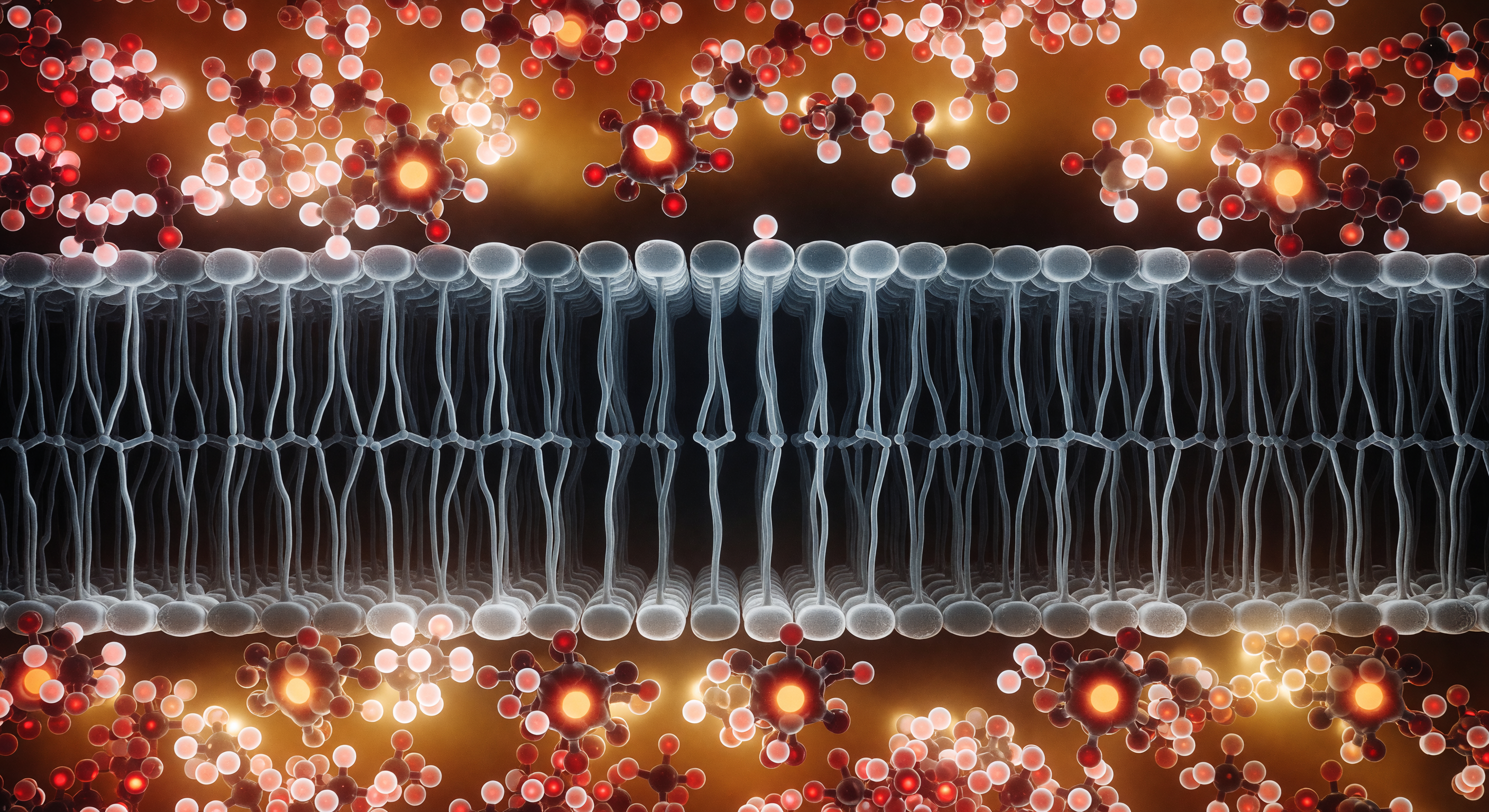
You are standing inside a living membrane wall, pressed between two worlds that could not be more unlike each other. Above and below, the hydrophilic zones erupt in dense, luminous chaos — phosphate head groups blaze in tangerine-orange and burgundy, their phosphorus and oxygen atoms radiating overlapping electron-density halos, while swollen water molecules crowd every available space, their oxygen cores glowing arterial crimson and their hydrogen lobes pulsing in soft pearl-white, the entire surface seething with thermal agitation as hydrogen bonds form and rupture on picosecond timescales. Between these two radiant polar shores stretches the hydrophobic core: a cathedral of near-total molecular silence where hydrocarbon tails — long chains of carbon and hydrogen atoms linked by 154-picometer covalent bonds — extend in parallel columns of cold gray-silver electron density, some kinked into gauche conformations by thermal disorder, others held in near-perfect all-trans linearity, the liquid-crystalline state poised between solid order and fluid randomness. Not a single water molecule penetrates this interior; the energetic cost of exposing a polar oxygen to this nonpolar environment is simply prohibitive, and so the boundary between the wet world and the dry one is shockingly abrupt — a molecular horizon just a few atomic diameters wide that separates biological electricity from hydrocarbon silence, the entire stratified structure only a handful of nanometers thick yet serving as the universal boundary of all living cells.
Other languages
- Français: Canyon Biologique Bicouche Lipidique
- Español: Cañón Biológico Bicapa Lipídica
- Português: Cânion Biológico Bicamada Lipídica
- Deutsch: Biologische Schlucht Lipiddoppelschicht
- العربية: وادي الطبقة الدهنية المزدوجة
- हिन्दी: लिपिड द्विस्तर जैविक घाटी
- 日本語: 脂質二重層の生物学的峡谷
- 한국어: 지질 이중층 생물학적 협곡
- Italiano: Canyon Biologico Doppio Strato Lipidico
- Nederlands: Biologische Canyon Lipide Dubbellaag