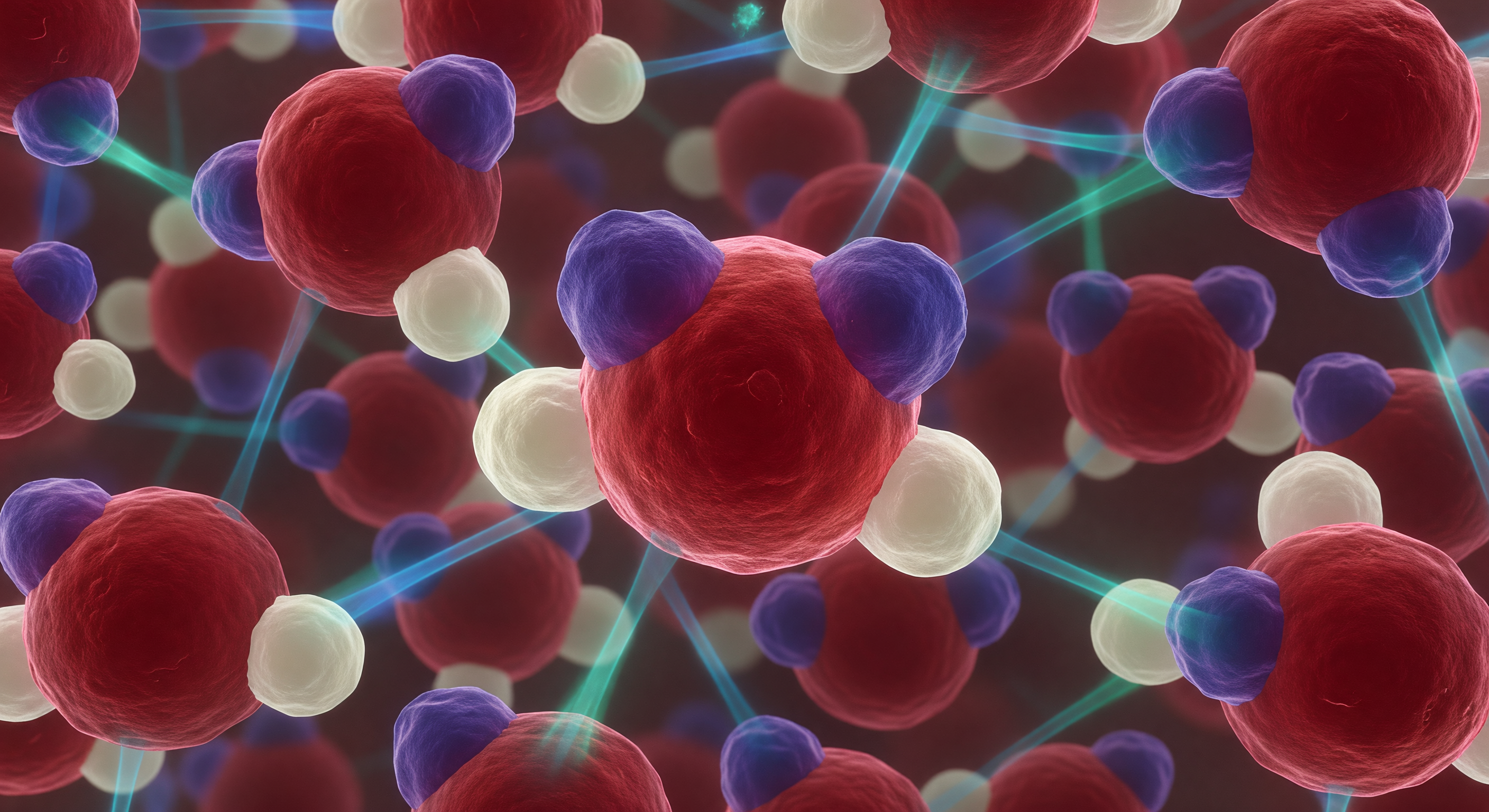
You are suspended inside a living labyrinth with no walls and no exit, pressed on every side by enormous crimson spheres — the oxygen cores of water molecules — each one easily filling your entire field of view before another shoulder its way into frame. Each oxygen carries twin violet-indigo lobes of lone-pair electron density jutting outward like shadowed hoods, pulsing with a deep aubergine glow that shifts as neighboring molecules drift and rotate, while on the opposite face two cream-white hydrogen nodules flare outward at their fixed 104.5° angle, catching the ambient chemical radiance like pale lanterns held at arm's length. Between molecules, gossamer filaments of cyan-turquoise light snap into existence and dissolve again within a picosecond — hydrogen bonds, each one a transient corridor of shared electron density bridging one molecule's hydrogen nodule to a neighboring oxygen's lone-pair lobe, their edges dissolving into diffuse fog where quantum probability fades back into nothing. This is liquid water at 300 K in its truest interior reality: the hydrogen-bond network is not a stable lattice but a continuously reweaving turbulence, each molecule simultaneously donor and acceptor, rotating and translating in all directions at once, the entire crowd heaving and reshuffling so that no two consecutive moments are alike — garnet shadows pooling in the voids, cool cyan streaks flaring where bonds momentarily hold, and a faint lavender haze of electron-density halos merging in the middle distance into a glowing, breathing, structureless press of matter that has no floor, no ceiling, and no stillness anywhere.
Other languages
- Français: Turbulence des liaisons hydrogène
- Español: Turbulencia de enlaces de hidrógeno
- Português: Turbulência da rede de hidrogênio
- Deutsch: Wasserstoffbrücken-Netzwerk-Turbulenz
- العربية: اضطراب شبكة الروابط الهيدروجينية
- हिन्दी: जल हाइड्रोजन बंध उथल-पुथल
- 日本語: 水素結合網の乱流
- 한국어: 수소결합 네트워크 난류
- Italiano: Turbolenza dei legami idrogeno
- Nederlands: Waterstofbrug-netwerk turbulentie