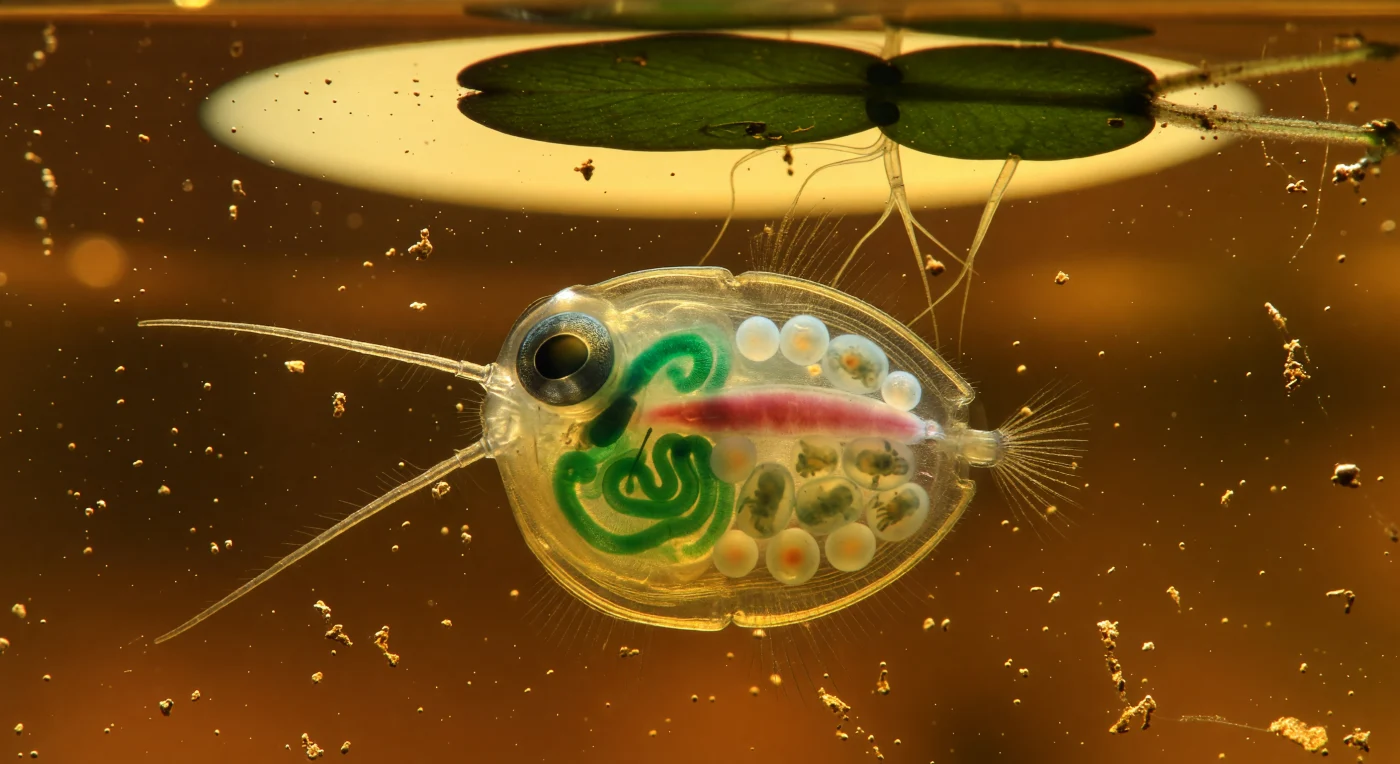
Suspended at eye level with a *Daphnia magna*, the viewer peers through a column of tannin-saturated freshwater that functions less like a medium than like a substance — warm amber light diffusing through dissolved humic acids to turn the entire water column into slow-moving honey, threaded with drifting flecks of bronze detritus and crowned above by Snell's window, where a duckweed frond cuts a dark continental silhouette across the compressed oval of the sky. At the center of this golden world floats the *Daphnia* herself, her bivalved carapace — two hinged panels of thin chitin no more than two millimeters across — so translucent in the amber light that the interior reads like a lit museum specimen: a single large compound eye rotating with neurological intent in its socket, a dorsal heart visibly mid-systole as a deep-rose muscle stripe, and a gut coiling in luminous emerald-green loops fed by chlorophyll-dense algae. Behind the gut, a brood chamber cradles a dozen embryos at staggered developmental stages, from smooth opalescent spheres to older forms already pressing shadowed limb buds against the inner wall like hands against frosted glass — an entire generation carried within the body of an animal smaller than a pencil mark. *Daphnia* are keystone grazers in freshwater ecosystems, filtering phytoplankton through comb-like setae and cycling nutrients at rates that can clear a shallow pond's algal bloom within days, their heartbeats — between 60 and 200 beats per minute, visible through that glassy carapace — keeping pace with a metabolic intensity entirely invisible to the unaided eye.
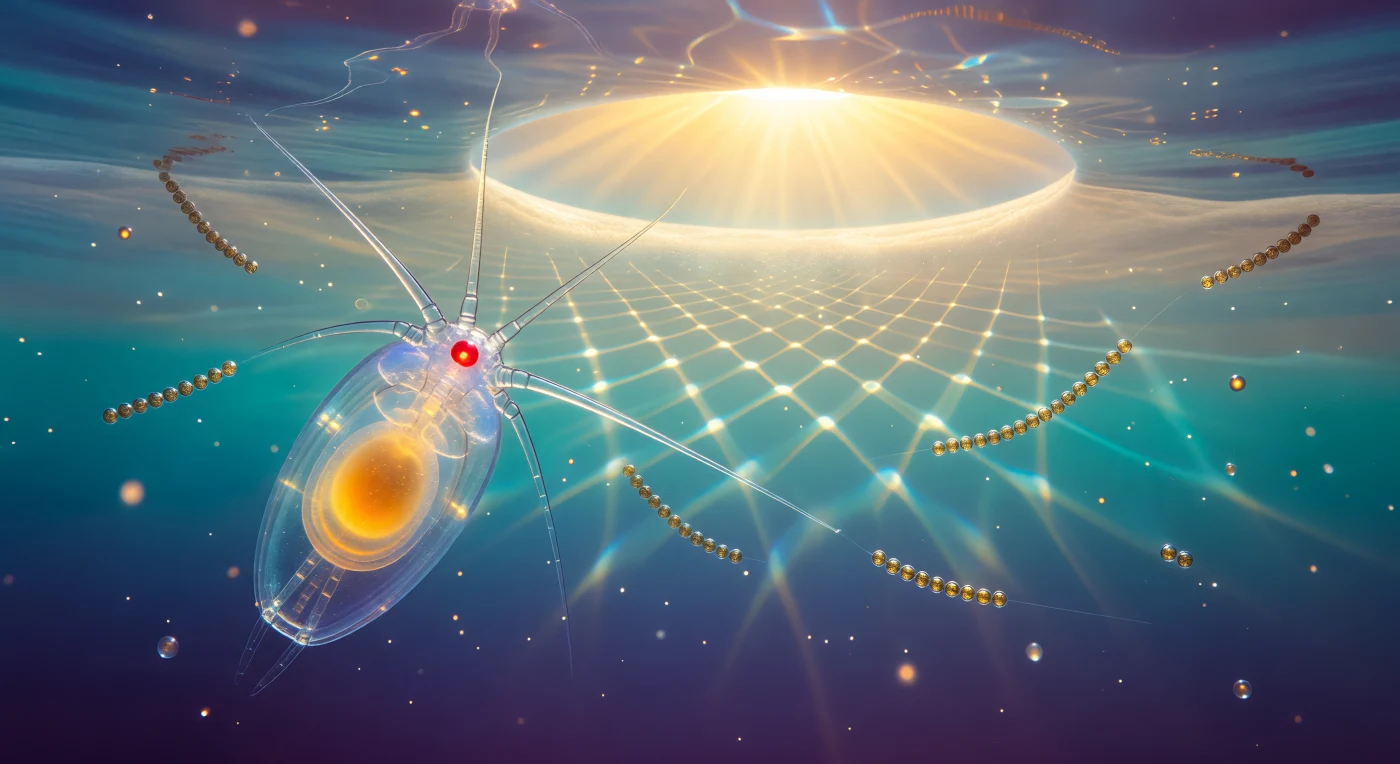
You are suspended centimeters from the anterior face of a *Calanus finmarchicus*, your viewpoint level with its single ruby-red nauplius eye, and the animal fills your left field of vision as an architecture of living glass — a teardrop of optically clear chitin whose margins bend the ambient turquoise light into faint prismatic halos, its interior amber lipid sac glowing like a lantern of warm saffron suspended in crystal, dense with stratified wax esters that grade from deep gold at the core to pale champagne at the edges. The antennules radiate outward in every direction like the arms of a crystal chandelier, each hyaline rod so thin it is visible only where a caustic ray catches it and ignites a brief line of refracted light. Above the animal, Snell's window compresses the entire sky and its direct sun into a blazing white-gold oval framed instantaneously by a perfect mirror ceiling of total internal reflection — and from that window, shifting caustic lattices pour downward in overlapping nets of gold and ice-blue, weaving continuously across the copepod's transparent body, dragging bright lines over the amber sac and momentarily bleaching it toward white before the wave passes and the orange warmth returns. This is the sunlit epipelagic zone at ten meters depth, where the ocean's most abundant multicellular animals hover in a low-Reynolds-number world that makes still water feel faintly viscous, filtering the rain of diatom chains — their silica walls catching individual caustic flashes like strung glass beads — that drift downward through a water column deepening from saturated cyan at mid-frame into a profound indigo-violet below, the light attenuating exponentially until the edges of the visible world dissolve into a cold, luminous, pressing dark.
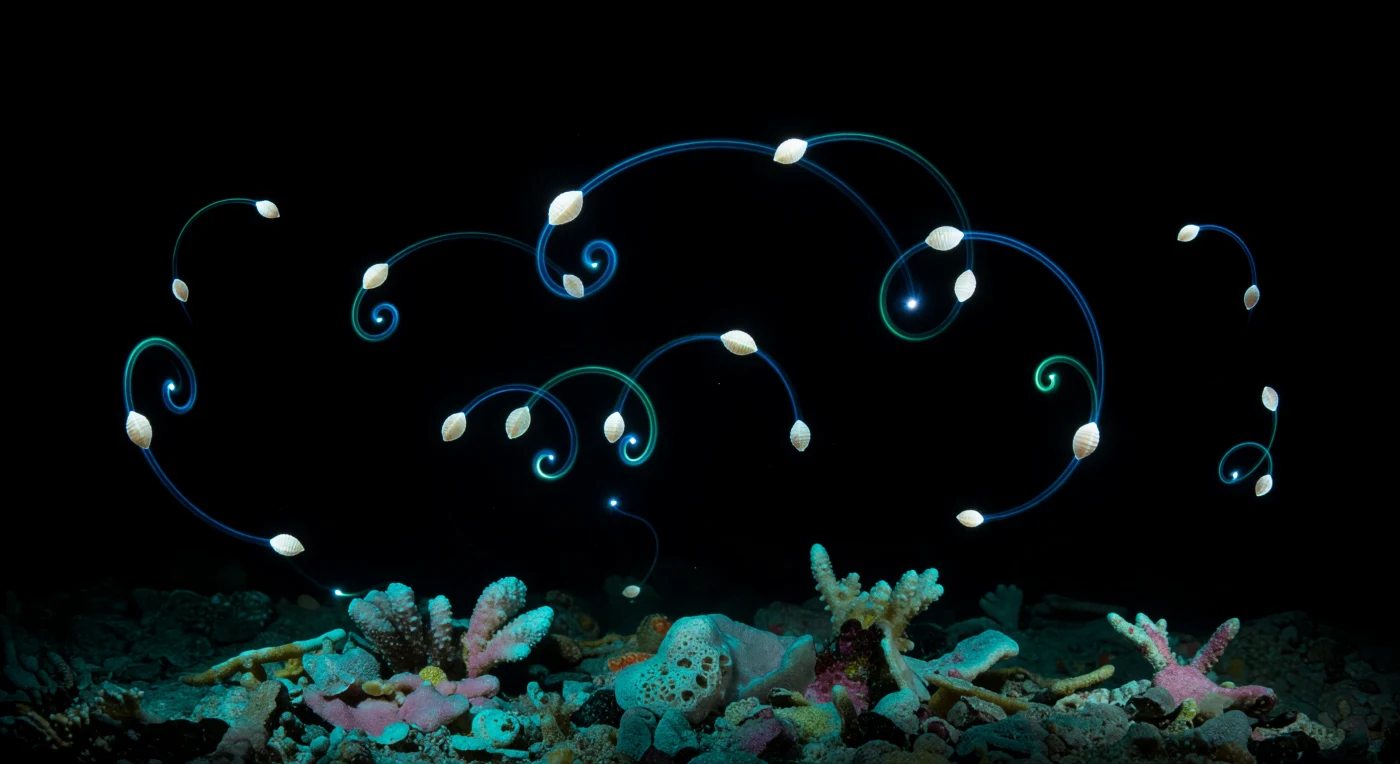
You are suspended in absolute tropical darkness, and what illuminates the world is not light from above but chemistry from within — dozens of *Vargula hilgendorfii* males, each barely a millimeter long, expelling paired jets of luciferin-luciferase fluid from their rostral glands in discrete bioluminescent pulses, tracing spiraling helical arcs of electric blue-green cold fire through the water column around you, aqua-white at the point of emission and cooling through teal, cerulean, and indigo before dissolving back into the void. Each ostracode's calcified bivalved carapace — ribbed with parallel ridges, scattered with microscopic pore-pits — glows with its own faint internal luminescence, a drifting seed of mother-of-pearl light, as the luciferin oxidation reaction occurs inside secretory cells and the resulting photons scatter outward through calcium carbonate and chitin. The display is species-specific in its geometry, a mating advertisement encoded in the precise curvature and pulse-timing of each trail — a chemical sentence broadcast into darkness, readable only to conspecific females filtering the same water column. Below, coral rubble fragments exist only as cold aquamarine silhouettes, their porous carbonate surfaces rendered barely visible by the upwelling glow of the nearest trails, everything else swallowed entirely by an oceanic blackness so complete it has texture, pressing cool and saline against every surface while the living constellation writes its ritual geometry in light and seawater above.
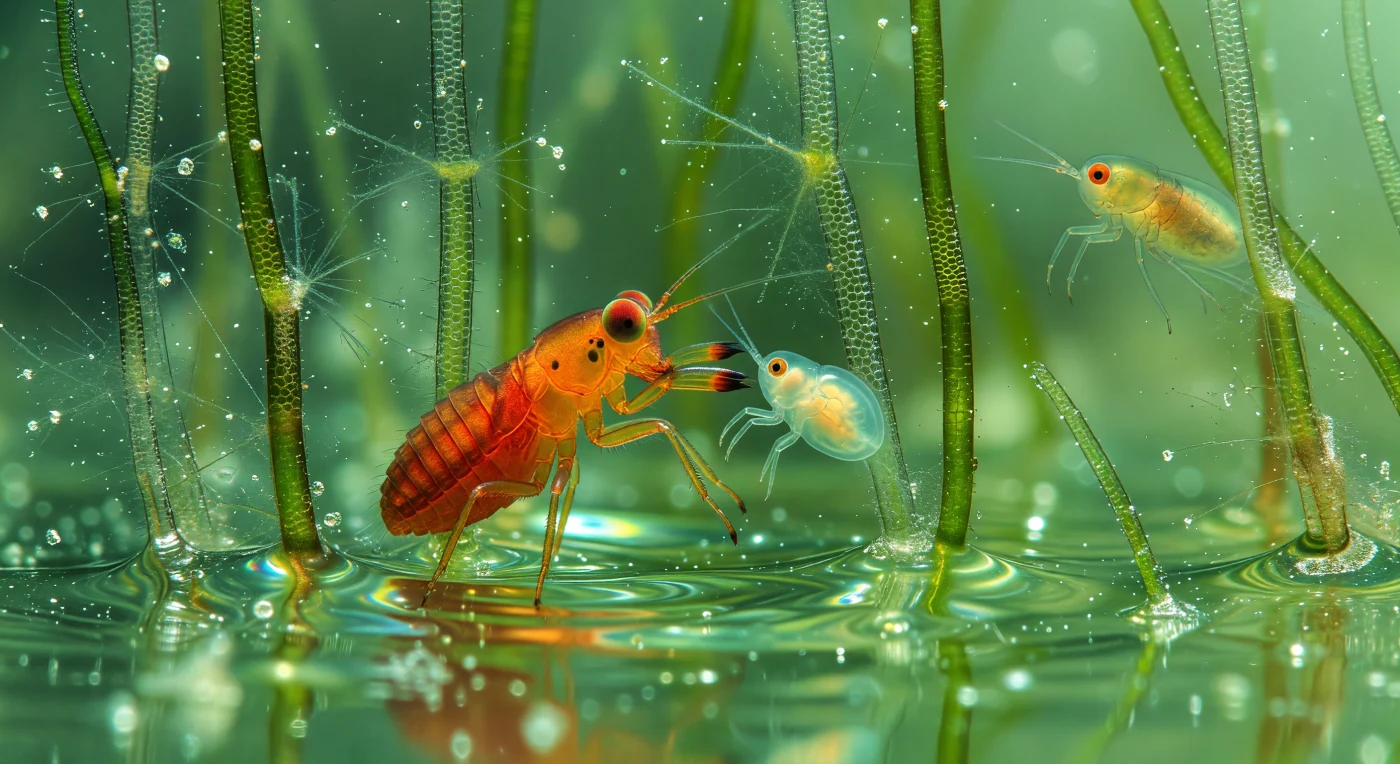
Suspended in water so clear it reads as pure green-tinted glass, we hover at the exact scale of the drama unfolding before us — a world where a single millimeter contains predator, prey, and the full architecture of ambush. *Mesocyclops leuckarti*, compact and amber-orange as polished amber, fills the frame mid-lunge, its single garnet eye blazing with arrested intensity, its raptorial maxillipeds already in contact with a nauplius larva whose transparent body shows the first dimple of compression, the tissue membrane yielding visibly to chitin-driven force. Cyclopoid copepods are among the most efficient ambush predators at this scale, operating in a low-Reynolds-number regime where water resists sudden movement like a viscous medium, yet their strikes accelerate in milliseconds to velocities that rank among the fastest mass-specific accelerations in the animal kingdom — the fluid mechanics propagating outward here not as sharp turbulence but as thick concentric pressure rings that warp the refractive index of the water itself, bending the background into subtle iridescent lenses. Behind the combatants, macrophyte stems rise as living columns of chlorophyll-green glass, their stacked parenchyma cells filtering diffuse surface light into an omnidirectional jade radiance that illuminates every seta and egg sac without casting hard shadow, while in the upper-right distance a second nauplius has already fired its escape response — antennal appendages swept back in a power stroke, single eye blazing orange against the green depth — a reminder that in this inhabited interior, survival is measured in fractions of a millisecond.
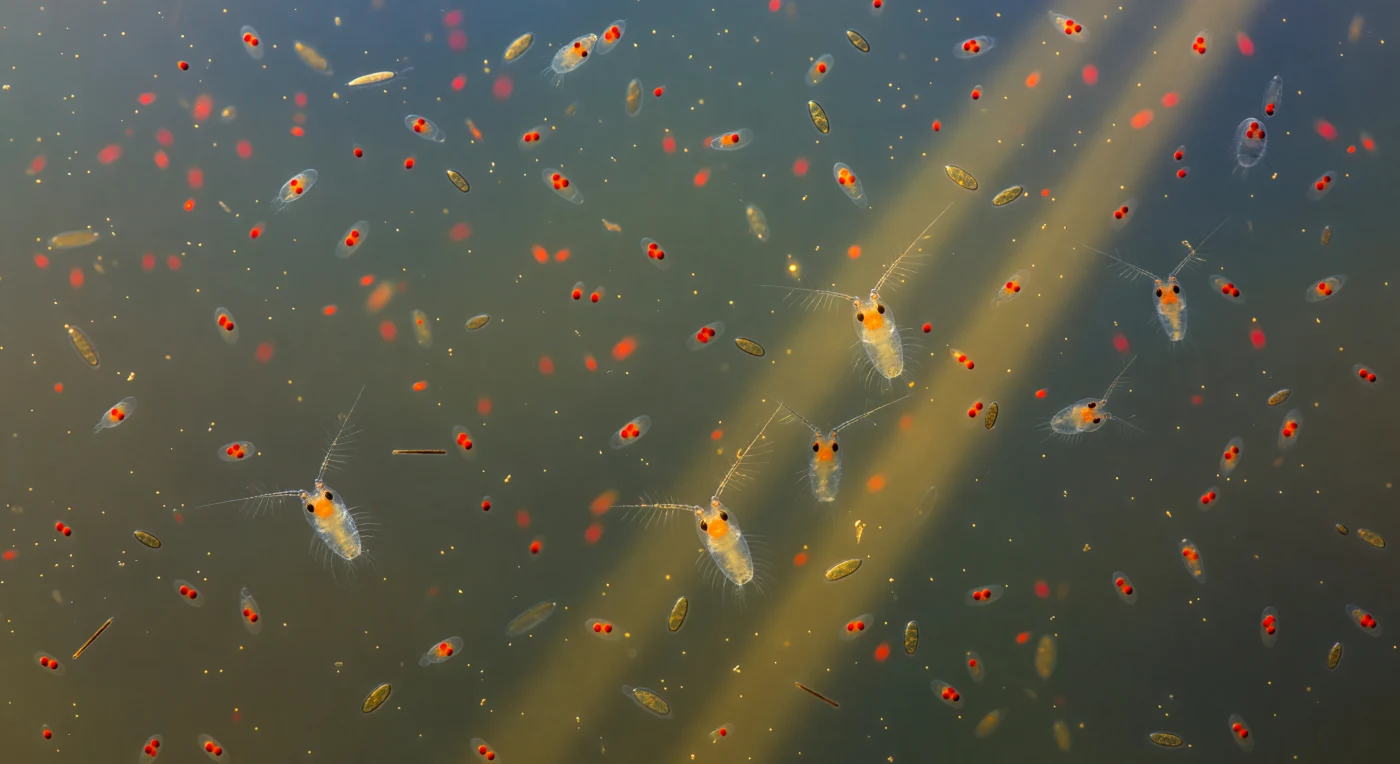
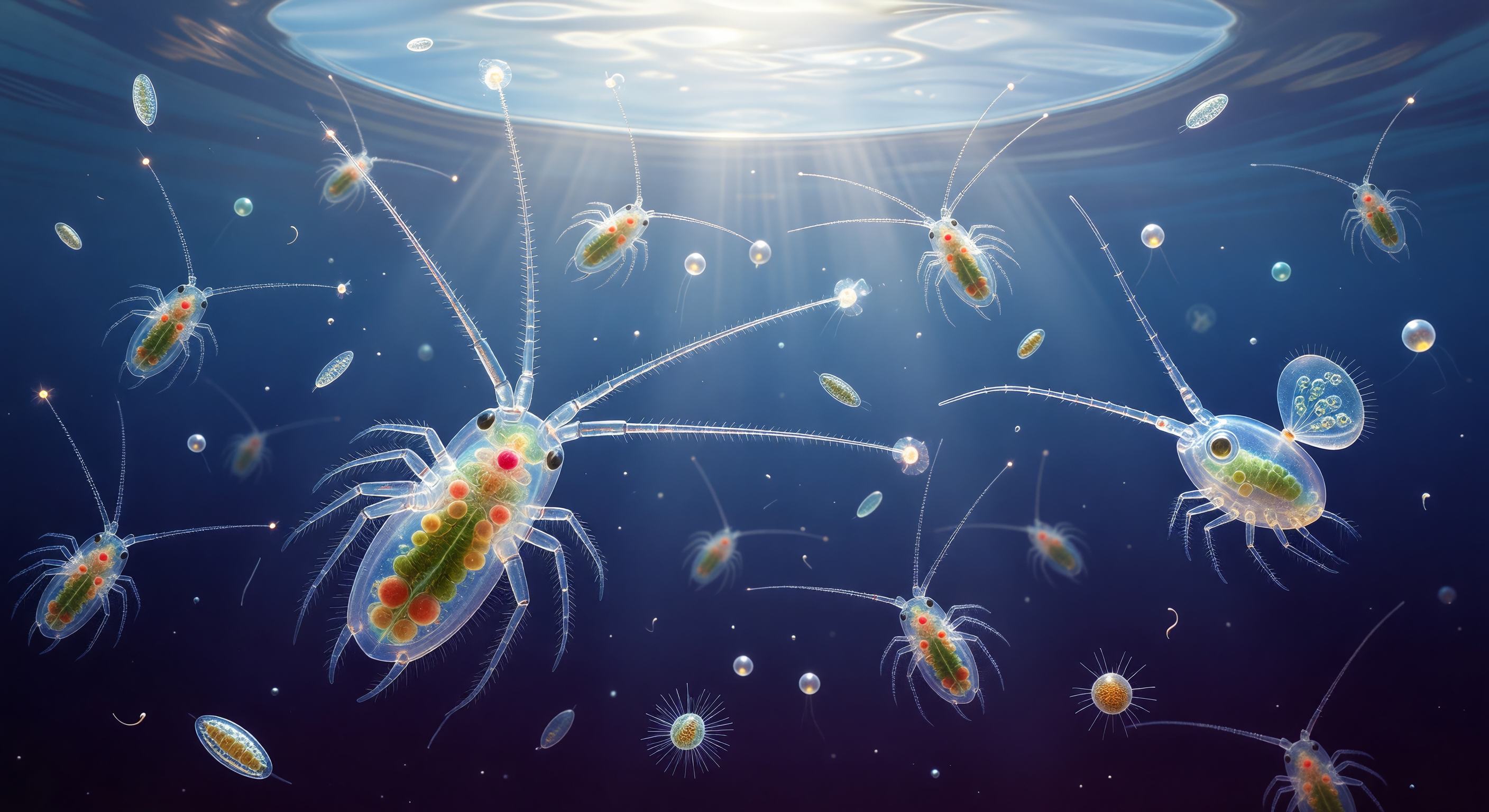
You are suspended in the water column at the scale of the smallest animals in the sea, surrounded by a breathing cloud of nauplius larvae — each one a ghost of living jelly, 120 micrometres of near-perfect transparency betrayed only by a single tripartite eyespot burning orange-red at its centre, silver antennal setae splaying outward like fractured crystal in mid-tumble. These are the hatching larvae of barnacles and copepods, the first free-living stage of crustaceans that will go on to dominate the ocean's food web; at this moment they exist in their tens of thousands per cubic metre, filter-feeding on the diatoms drifting among them — elongate *Nitzschia* frustules, their silica walls gold-brown and prismatic, catching the low dawn light like scattered amber needles. Narrow Tyndall beams of amber morning light pierce the turbid estuarine water from above, made visible by suspended clay minerals and detritus, illuminating thin golden corridors through the swarm in which transparent larval bodies briefly ignite into pale fire, their eyespots flaring a deeper crimson. Into the middle distance the larvae lose all form and become only ruby sparks receding into blue-green turbid obscurity — dozens of them, then hundreds, constellation after constellation of burning points dissolving into the murk, the entire rear field a soft luminous fog of suspended embers that communicates, unmistakably, that every cubic centimetre of this grey-green water is shared by dozens of transparent lives.
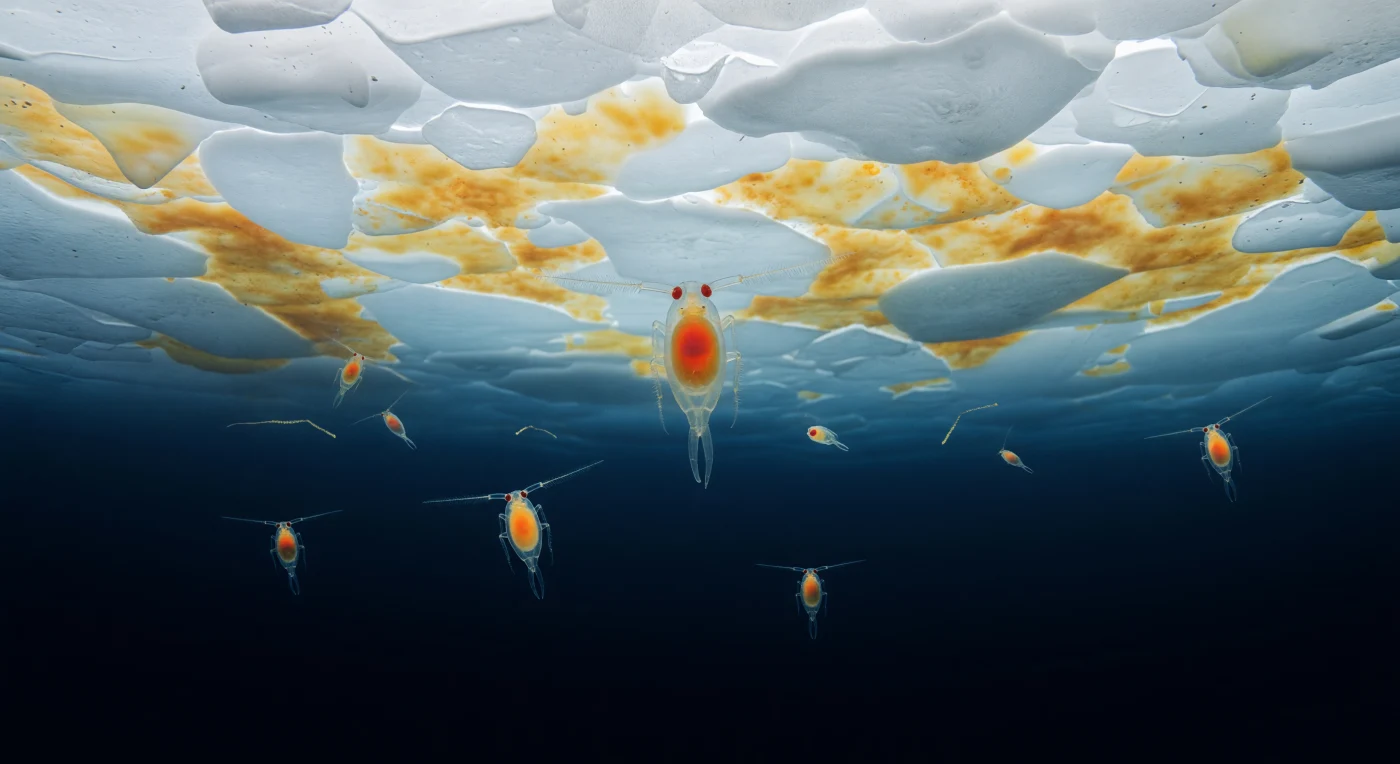
Looking upward from the Arctic water column, the underside of the sea ice fills the sky — a vast sculpted ceiling of translucent white and pale aquamarine panels glowing with diffuse cold light, its lower face colonized by irregular amber and ochre patches of diatom biofilm that stain the ice like honey pressed against frosted glass, the whole surface simultaneously a light source and a living biological landscape. Ascending directly through this cold blue space is a single *Calanus hyperboreus*, its transparent body a glass envelope dominated entirely by the lipid sac — a massive ovoid reservoir of wax esters backlit by the ice-glow into a saturated orange-red ember, the color of heated iron, vivid and warm against the surrounding cobalt water — while its feathered antennules extend forward, each fine aesthetasc seta catching the diffuse light as the animal climbs toward the algae-rich ice to feed and replenish the very energy store that glows within it. This lipid sac is not ornamental but existential: *Calanus hyperboreus* spends the Arctic winter in diapause at depth, surviving months of polar darkness on nothing but these accumulated wax esters, descending as the light fails and ascending each spring to graze the ice algae bloom before open water phytoplankton becomes available, the orange glow inside each animal a direct measure of its survival margin. Below, the water column drops into absolute black, and through the mid-water several more copepods ascend as progressively smaller orange coals, each one separated by enormous volumes of empty blue, the whole assembly conveying the scale of a vertical migration that is both intimate — measured in millimeters of body — and oceanic in its consequences for Arctic carbon cycling.
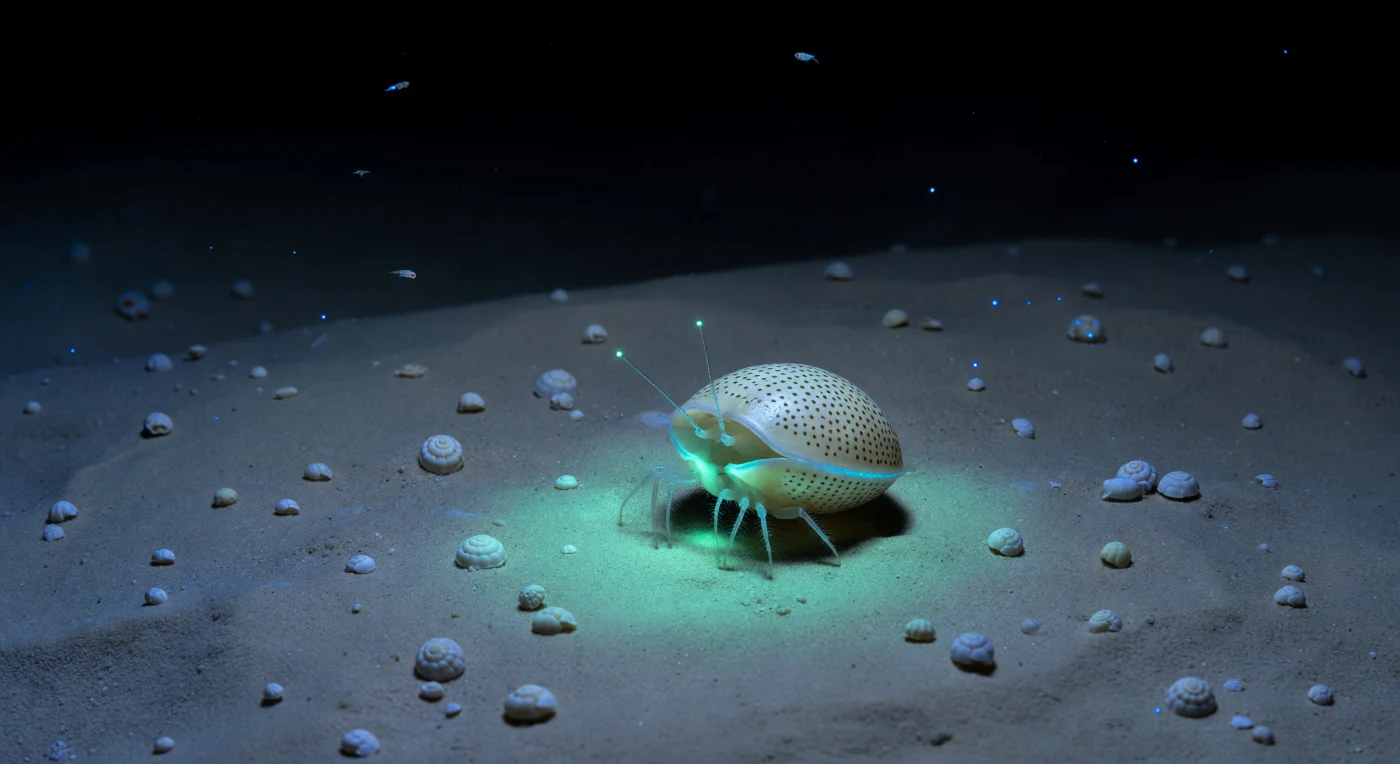
At sediment level, crouched against the floor of a continental shelf plunged into perpetual darkness, the eye takes in a vast pale plain of compacted grey-beige silt stretching away like suede under a microscope, its micro-topography of ridges and shallow depressions scattered with foraminifera tests — perfect spiraled calcite shells the size of pin-heads that catch and redirect the only light in this universe. That light belongs to a single living animal just ahead: an ostracode no larger than a sesame seed, its cream-ivory bivalved carapace perforated by a species-specific grid of dark pore canals, from whose gaping valve seam a continuous bioluminescent secretion bleeds outward — cold, saturated blue-green, the product of a luciferin-luciferase reaction brightest at the valve margin and fading within a centimeter to a spectral aquamarine ghost before dissolving into absolute black. Setose walking legs extend below the valves and grip the soft substrate, each dactyl tip pressing hairline impressions into the clay, while paired sensory antennae reach forward as luminous filaments probing the pressurized void; at fifteen atmospheres, this animal's chemical light paints the world teal for the length of its body and no further, and beyond that intimate radius the sediment plain retreats through indigo into pitch darkness punctuated only by scattered cold-blue pinpoints — bacteria on drifting organic particles, unnamed organisms in the mid-water column — like the faintest stars of a universe that has never once seen the sun.
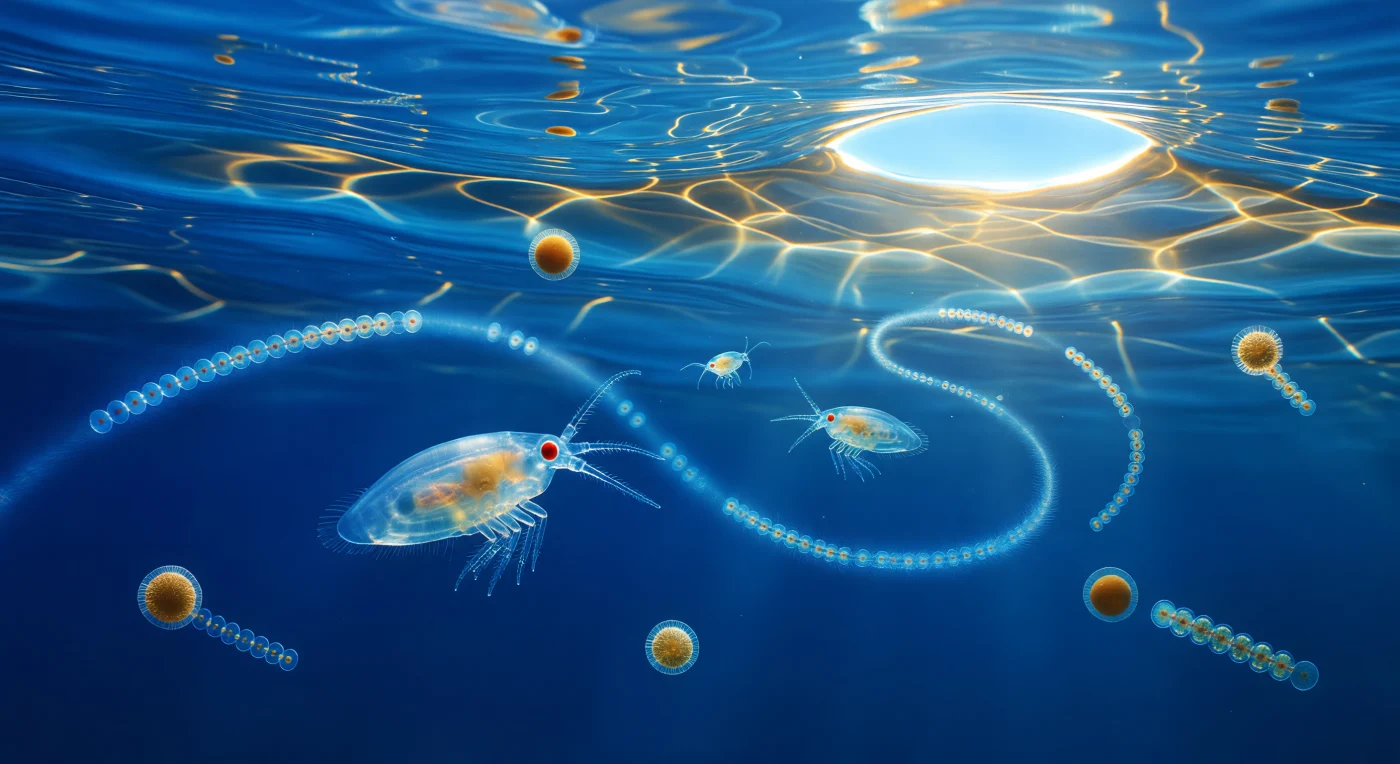
You are looking along a pursuit corridor that exists entirely within a world measured in millimetres, suspended in tropical blue at ten metres depth where full sunlight still arrives with authority. In the sharpest foreground, a male calanoid copepod — his body a teardrop of near-perfect glass, one to two millimetres of living transparency — dominates the scene: his single median nauplius eye burns ruby-red at the anterior pole, his amber lipid sac glows like a bead of autumn resin, and his modified antennules arc forward with their iridescent aesthetascs vibrating in the molecular gradient she has left behind, while thirty body-lengths ahead the female appears smaller, cooler, equally transparent, her own antennules angled back as if already reading the pressure wave closing on her through water that, at this scale, resists movement the way syrup resists a spoon. Between them coils a helical ribbon of faint cerulean luminescence — an interpretive trace of the pheromone trail she has inscribed in molecular chemistry against the indifferent ocean, its soft edges feathering into the surrounding blue like exhaled breath, the winding record of her exact recent trajectory through a viscous medium governed by low Reynolds-number physics. The surrounding column blazes with cascading caustic lattices refracted through the swell above, Snell's window burning as a white-gold oval in the upper right, and scattered throughout the radiant void, armoured dinoflagellate spheres and silica-setaed diatom chains catch the golden light at random intervals, each one a reminder that this entire scene — pursuit, chemistry, transparency, light — unfolds within a biological universe whose largest citizens would balance on the edge of a coin.
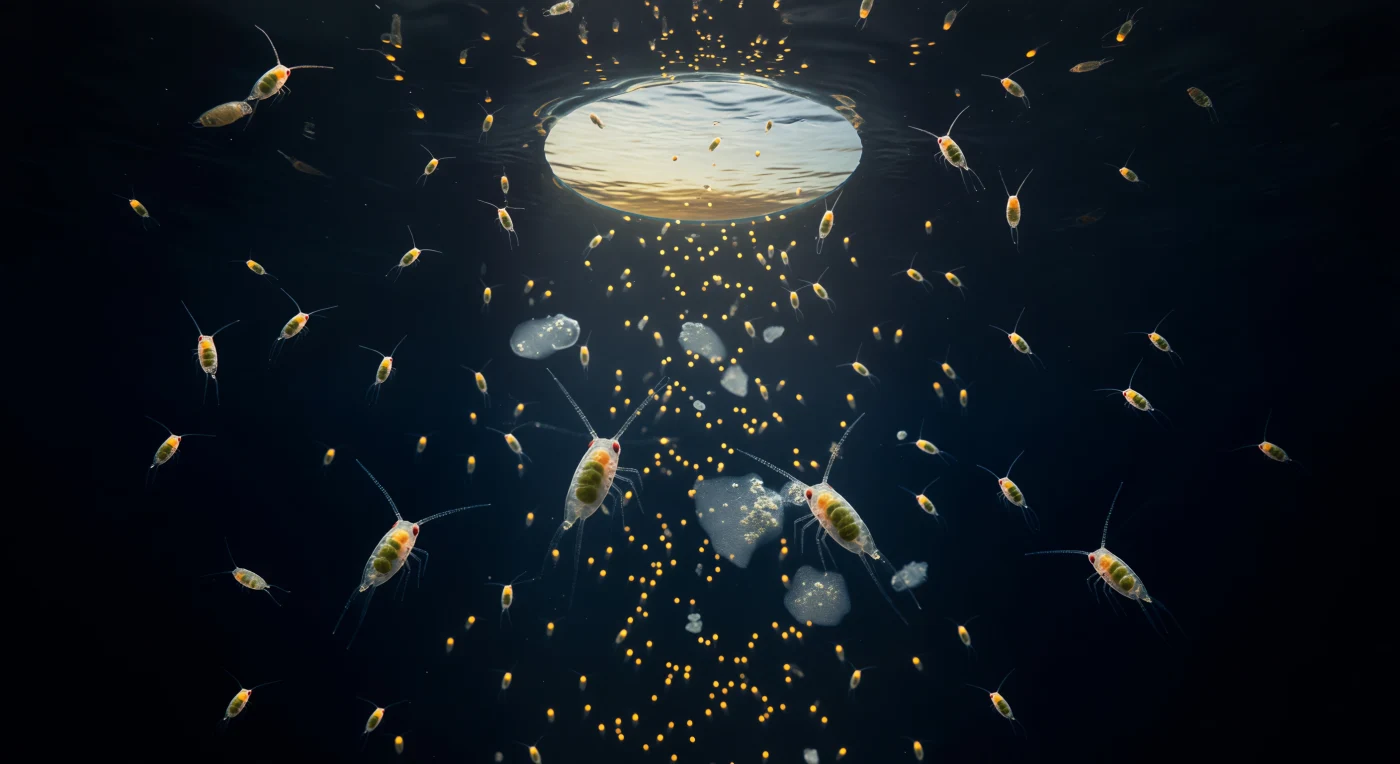
You are looking straight up through eighty meters of pre-dawn Atlantic, and the ocean above you is on fire with tiny ascending lights. Hundreds of *Calanus* copepods — each body a glassy two-to-three-millimeter torpedo, nearly invisible but for the amber-orange lipid droplet burning inside its prosome like a caged ember — rise in loose pulsing streams through the water column, executing the nightly return leg of their diel vertical migration: a twelve-hour, hundred-meter journey driven by the need to feed in surface waters under cover of darkness and retreat to depth before daylight exposes them to visual predators. The nearest individuals resolve into extraordinary anatomical clarity, their paired antennules fanned into feathery arcs of hair-thin setae, their single ruby nauplius eyes catching the last cold blue of the deep, their segmented urosomes trailing beneath like pale jointed threads, while through their glass-clear carapaces the olive-green gut boluses of digested diatoms show as dark inclusions alongside the glowing oil sac — wax esters and lipids stored across weeks of surface feeding, the metabolic currency that will sustain them through winter diapause at depth. Above this close foreground, the swarm expands into the middle column, individual amber points multiplying and blurring together into a soft vertical galaxy of converging ember-light that narrows toward a single destination: the Snell's window overhead, a perfect circular disc still silver-pale but warming gold at its rim with the approaching sunrise, its sharp edge the compressed boundary between ocean and atmosphere, the entire sky collapsed into one bright portal through which a hundred million copepods are simultaneously navigating. Threading downward in the opposite direction, pale curtains of marine snow — mucus aggregates, diatom frustules, fecal pellets — drift between the rising animals like ash falling through fireflies, and two of the nearest copepods have pivoted from their ascent to intercept a passing flake, their feeding appendages spinning micro-vortices in the cold pressured dark, amber sacs still lit, the whole scene suspended in a single crystalline instant of organized biological purpose.
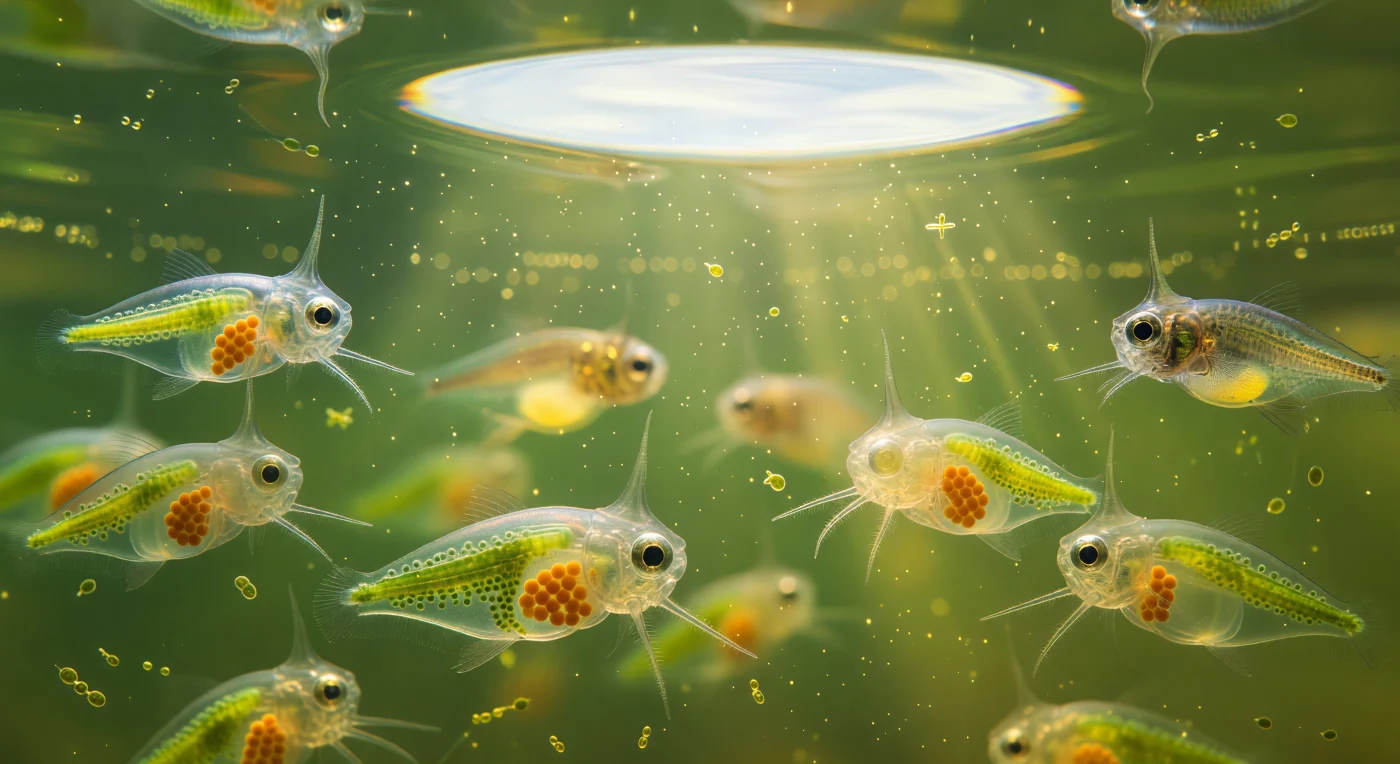
You are suspended in the luminous green interior of a northern European lake, drifting eye-to-eye with a loose congregation of *Daphnia cucullata*, each one an improbable sculpture in living glass — their bivalved carapaces perfectly transparent, their towering helmet projections rising like bishop's mitres of compressed chitin, thin-walled enough that light traces only their luminous edges against the jade-tinted water column. These helmets are not ornament but armor shaped by chemical terror: *Daphnia* detect predator-released kairomones dissolved in the water and grow these elaborate cranial spikes within a single generation, making themselves geometrically harder to swallow, a phenotypic gamble played out in real time at the population level. Inside each animal, the biology is on full display through the transparent shell — guts glowing chartreuse with digested algae, brood pouches packed with saturated tangerine eggs whose carotenoid yolk reserves burn like tiny lanterns, a single dark compound eye rotating perpetually in its socket. In the foreground, one *Daphnia* has already read the signal that the rest have not yet processed, her body arched into a tight escape flex, antennae locked at the apex of a power stroke, the near-field water around her bending light in a ghost-wave of displaced volume — and beyond her, warm and silver-gold in soft focus, the two-centimeter fish larva that triggered all of this hangs in the phytoplankton haze, its enormous dark eye sharp enough to register intent, perfectly patient.
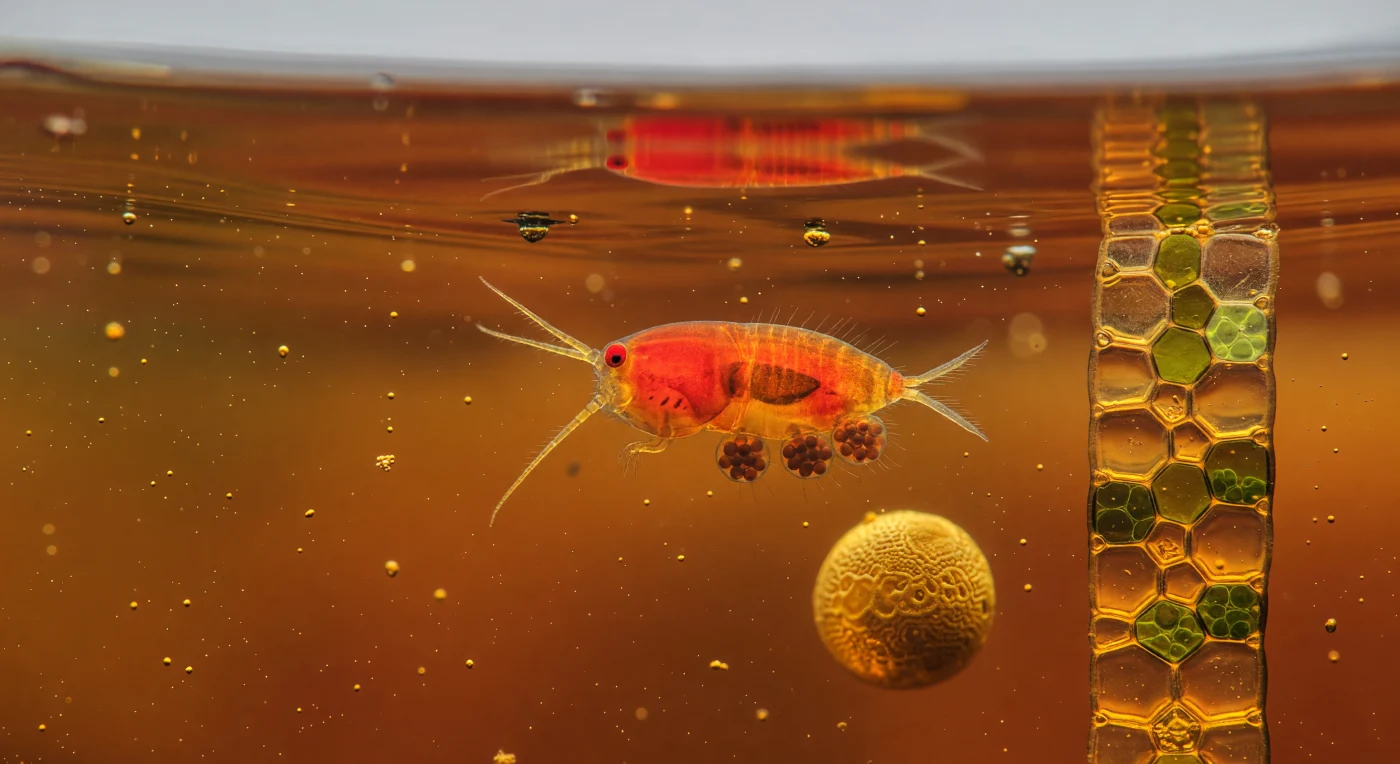
The viewer floats at eye level with a world measured in fractions of a millimeter, suspended inside a peat bog where the water itself has become a liquid amber — every photon arriving from the overcast sky above has been chemically transformed by dissolved humic and fulvic acids into warm honey-gold, deepening to mahogany-brown at a distance of mere centimeters that reads here as a foggy horizon. At the center of the scene, an *Acanthocyclops robustus* cyclopoid burns with improbable color, its carotenoid-saturated orange-red body the single vivid element in an otherwise monochromatic amber universe; the teardrop prosome is armored in semi-transparent chitin through which the darker gut stripe is faintly legible, the antennules spread laterally like a pair of sensor arrays, each individual seta resolved as a hair-thin gold filament in the diffuse light. To the right, a Sphagnum stem presents its cellular architecture like a stained-glass wall — enormous dead hyaline cells glowing as translucent amber chambers, rhythmically interrupted by the cooler chlorophyll-green of living photosynthetic cells in a pattern that reveals how this plant engineers its own water-retention, while in the foreground a pine pollen grain the size of a small planet relative to the copepod tumbles slowly, its sculpted reticulate exine catching warm light across ridges and air-bladder lobes formed long before any insect or crustacean registered its presence. Above, the water surface is an amber mirror of total internal reflection broken only by Snell's window — a compressed circle of cold grey sky, the sole reminder that a larger, cooler world exists beyond this ancient, resinous interior.
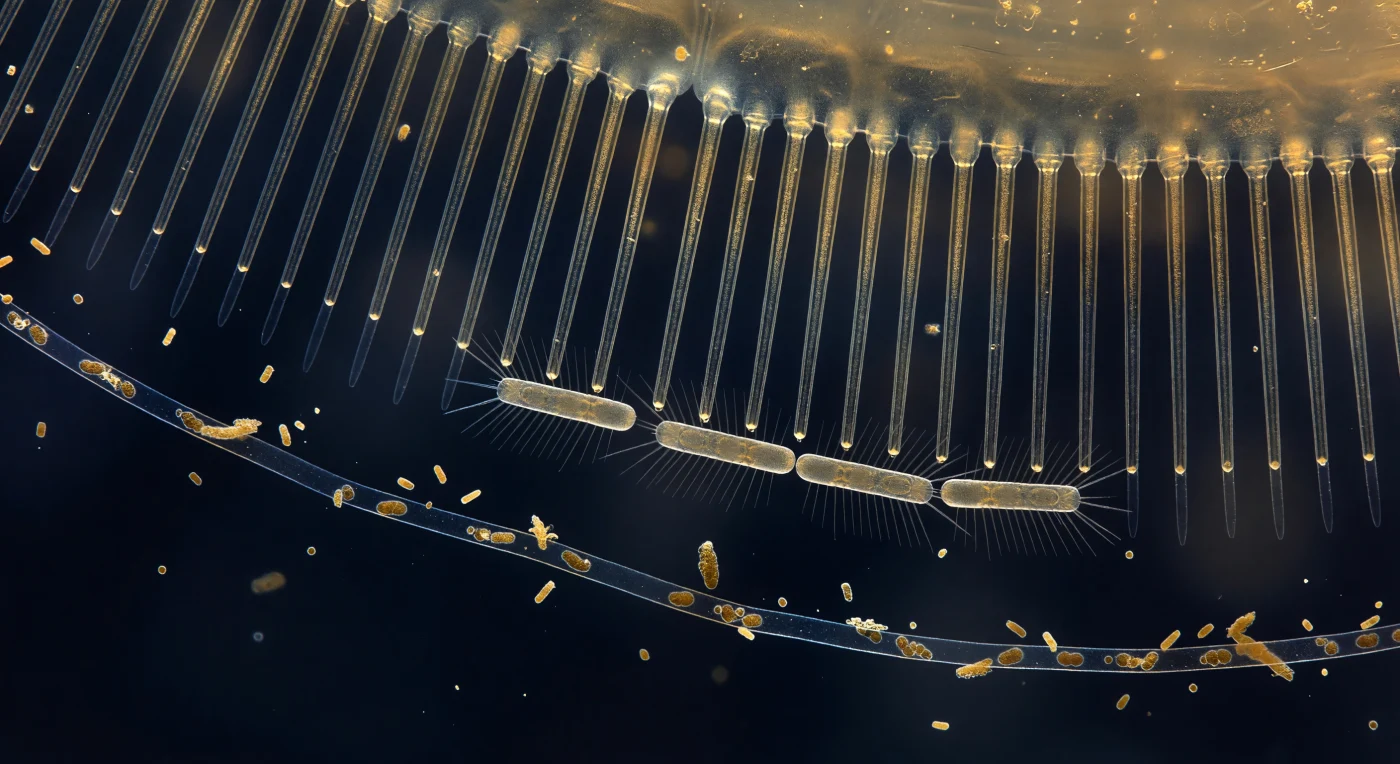
You are suspended at the outermost margin of a feeding vortex generated by the rhythmic beating of a copepod's maxillary appendages, a current so precisely engineered that the surrounding water bends into laminar arcs converging on a mouth you cannot yet see. Before you, filling every plane of your visual field, rises the setal comb of *Temora longicornis* — ranks of chitinous filaments two to five microns in diameter, each one geometrically spaced from its neighbor to form apertures calibrated at the micron scale, wide enough to pass dissolved molecules freely while retaining phytoplankton cells, the whole lattice transmitting diffuse blue-black ambient light through its semi-transparent walls until each filament glows like amber fiber-optic glass, self-luminous and warm against the absolute cobalt darkness behind it. Caught mid-passage between two adjacent setae, a *Chaetoceros* chain — three silica-walled diatom cells in series, their lateral glass spines still projecting outside the comb, the structure bowed slightly under hydrodynamic pressure — records the precise instant when biological predation operates at the threshold between fluid dynamics and solid contact, the copepod's appendage musculature pulsing with slow contractile waves visible as traveling shadows behind the amber glow. Around you, diatom frustule fragments and collapsed dinoflagellate husks drift on identical arcing trajectories, fellow particles in a flow field that at this Reynolds number feels less like water than like a medium with memory, directing everything it carries toward a single predetermined destination.
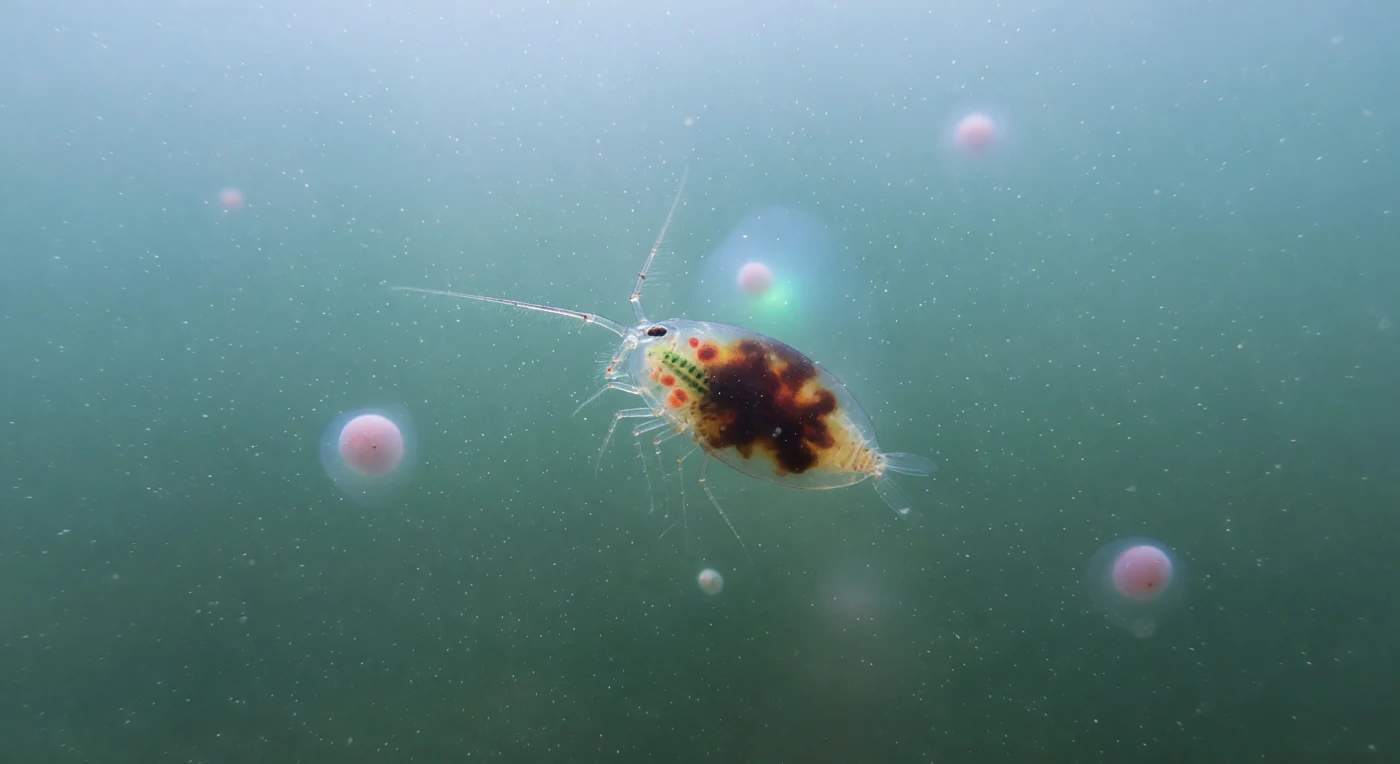
We hover eye-level with a *Calanus helgolandicus* female suspended in coastal North Sea water, her elongated teardrop body centered in a blue-green murk threaded with suspended particulate matter — each drifting grain catching diffuse downwelling light as a cold spark before dissolving into layered haze. She should be a marvel of living glass, her carapace wall thin enough to reveal the interior geometry of a working organism: the orange-red ovarian masses, the clean green gut column, the rhythmic pulse of a beating heart — but instead a dense amber-brown mass occupies her body cavity, a gregarine parasite colony pressing against the integument from within, its mottled mahogany texture visible as a shadowy, granular opacity through translucent chitin that was never meant to hide anything. Gregarines are apicomplexan parasites that colonize the guts of invertebrate hosts, often reaching densities that displace normal tissue and disrupt digestion entirely, yet rarely killing the host outright — instead sustaining themselves within a living architecture that continues to function around them. Her antennules still extend wide, their setae softening into optical haze at their tips, and her swimming legs still beat in their paired rhythmic strokes, performing the complete external vocabulary of a healthy copepod, while behind the carapace wall the interior has become a closed amber room belonging to something else entirely; behind her, pale gelatinous dinoflagellate spheres drift in the turbid water column, one exhaling a brief blue-green bioluminescent pulse that illuminates the surrounding water in a cold corona before fading back into the ambient light.
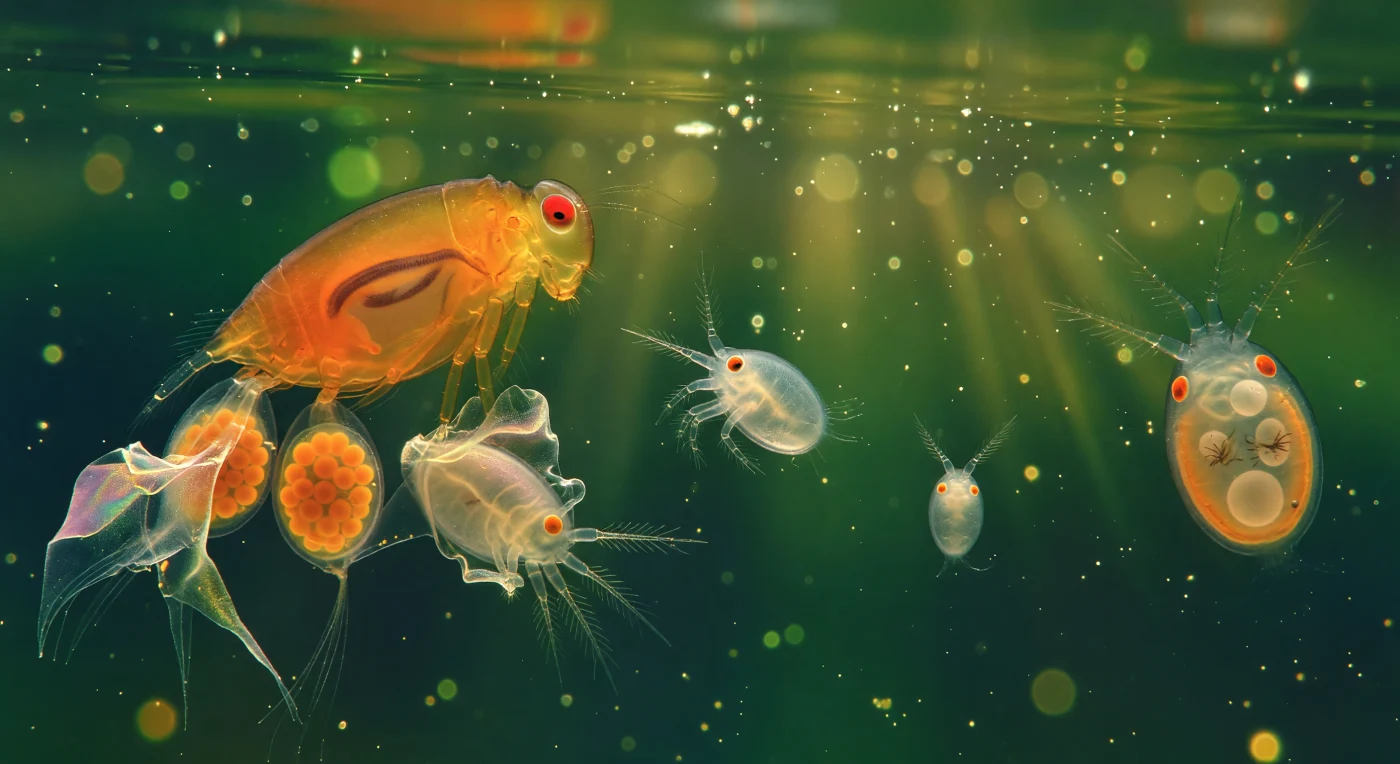
We hover at eye level with a female *Cyclops* copepod in the green-amber water column of a temperate lake, her amber-orange prosome filling the left of the frame with the quiet monumentality of a warm-lit architectural form, her single ruby median eye refracting light like a polished gemstone, her twin egg sacs swelling from the base of her tapered urosome with their cargo of carotenoid-saturated yolk visible as tessellated spheres through the thinning membrane wall. The left sac is rupturing — its chitin-reinforced membrane, iridescent with interference colors, tears at the pole and billows outward in translucent filaments that catch the diffuse phytoplankton-green light like silver-gilt cobwebs, releasing three nauplius larvae at different instants: one still shrouded in gossamer embryonic membrane, one tumbling mid-water with its three setose appendage pairs — antennules, antennae, mandibles — already beginning to sculpt the viscous, low-Reynolds-number medium into their first feeding vortex, and one hanging free as a luminous teardrop, its orange-red tripartite eyespot already burning with recognition. Each nauplius, barely 100 micrometres at hatching, enters a world in which still water feels nearly gelatinous and individual phytoplankton cells drift past like luminous dust particles, while within the intact right-hand sac, embryos at earlier stages press pale shadows of limb buds against the orange membrane, waiting their turn. The surrounding water fades into saturated emerald-blue darkness behind the scene, suspended detritus catching stray photons as soft bokeh spheres of gold and green, the whole environment carrying the quality of a candlelit interior receding into soft, living shadow.
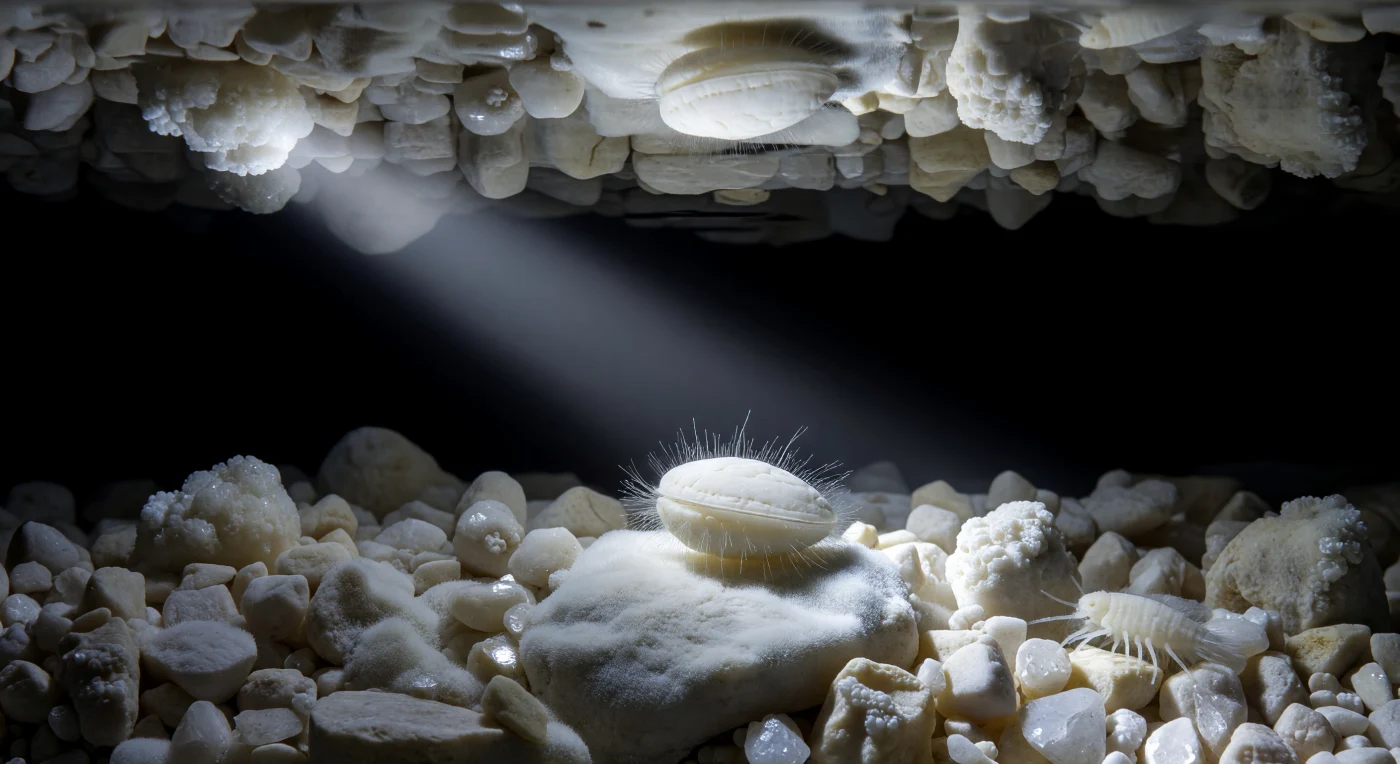
A single cone of cold white light drives back absolute darkness to reveal, at its burning center, a creature no larger than a grain of sand that has spent its entire evolutionary history preparing for exactly this lightless world. The ostracode — a *Pseudocandona* stygobite, its smooth ivory carapace barely parted along its ventral gape — rests on pale angular limestone gravel surrounded by a velvet carpet of white bacterial mat, the whole scene suspended in water of perfect crystalline clarity that renders every cobble texture with hyper-real sharpness; above, the stream surface throws the headlamp's reflection back as a trembling silver disc oscillating across the limestone ceiling, the only motion in an otherwise geological stillness. What the eye catches first is extraordinary: from the carapace gape extend aesthetasc hairs of almost impossible fineness, sensory filaments that replace the eyes this lineage abandoned across millions of years of karst darkness, each hair casting a hairline shadow across the gravel below that speaks to both the beam's harshness and the animal's exquisite fragility. At frame's edge, a depigmented amphipod presses ghostly and segmented against a cobble, equally eyeless, equally cream-white — two architectures of permanent night caught briefly in the only light this cave has ever known — and beyond the beam's sharp margin, darkness is not dim but absolute, a physical boundary enclosing the entire observable universe within one cone of borrowed illumination.
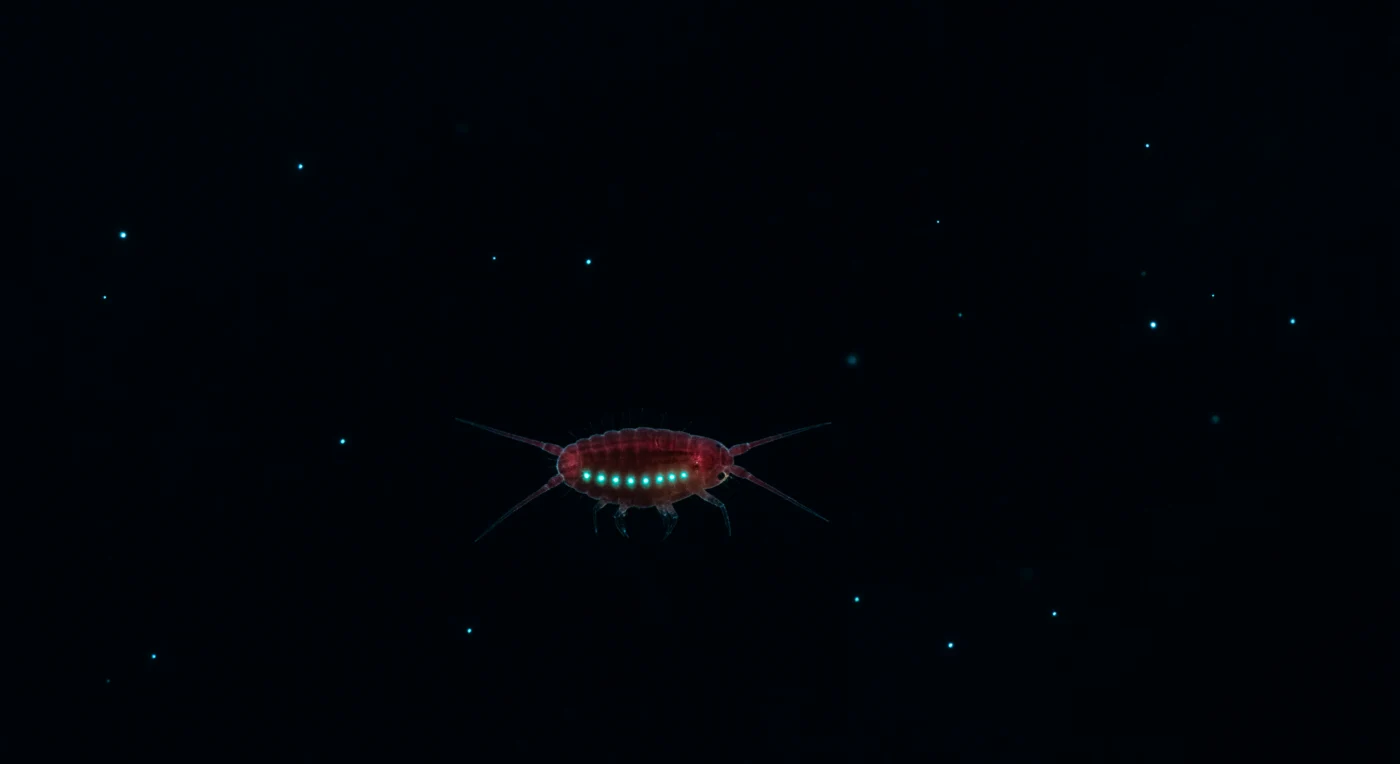
You are suspended in absolute darkness — not the comfortable dark of closed eyes but a pressurized, mineral absence six hundred meters below any memory of sunlight, where the surrounding medium registers against the body as something between water and cold glycerin. Directly before you, a *Gaussia princeps* copepod occupies the entire meaningful universe: roughly four millimeters of maroon-crimson architecture hanging motionless in the void, its deep pigmentation an evolutionary solution to the mesopelagic condition, absorbing stray bioluminescent photons that might otherwise silhouette the animal against a predator's upward gaze. Then your implied approach propagates through the viscous near-field and the ventral urosome responds — a sequential row of bioluminescent photophores fires anterior to posterior, each one blooming as a cold aquamarine point of pure chemiluminescence that spills sideways without warming the water even fractionally, the traveling wave of cold fire revealing in half-light the segmented urosome, the bands of darker burgundy musculature beneath the cuticle, and the setal combs on the swimming legs catching the glow as momentary silver filaments before vanishing back into black. In the far distance — established as distance only by the diminishing scale of scattered sparks — a dozen cold-blue points pulse and extinguish at irregular intervals, the defensive flashes of organisms disturbed by invisible rains of sinking marine snow drifting down from the productive surface world above, each flash a brief protest that confirms the void has extension but offers no further information about what lies beyond.
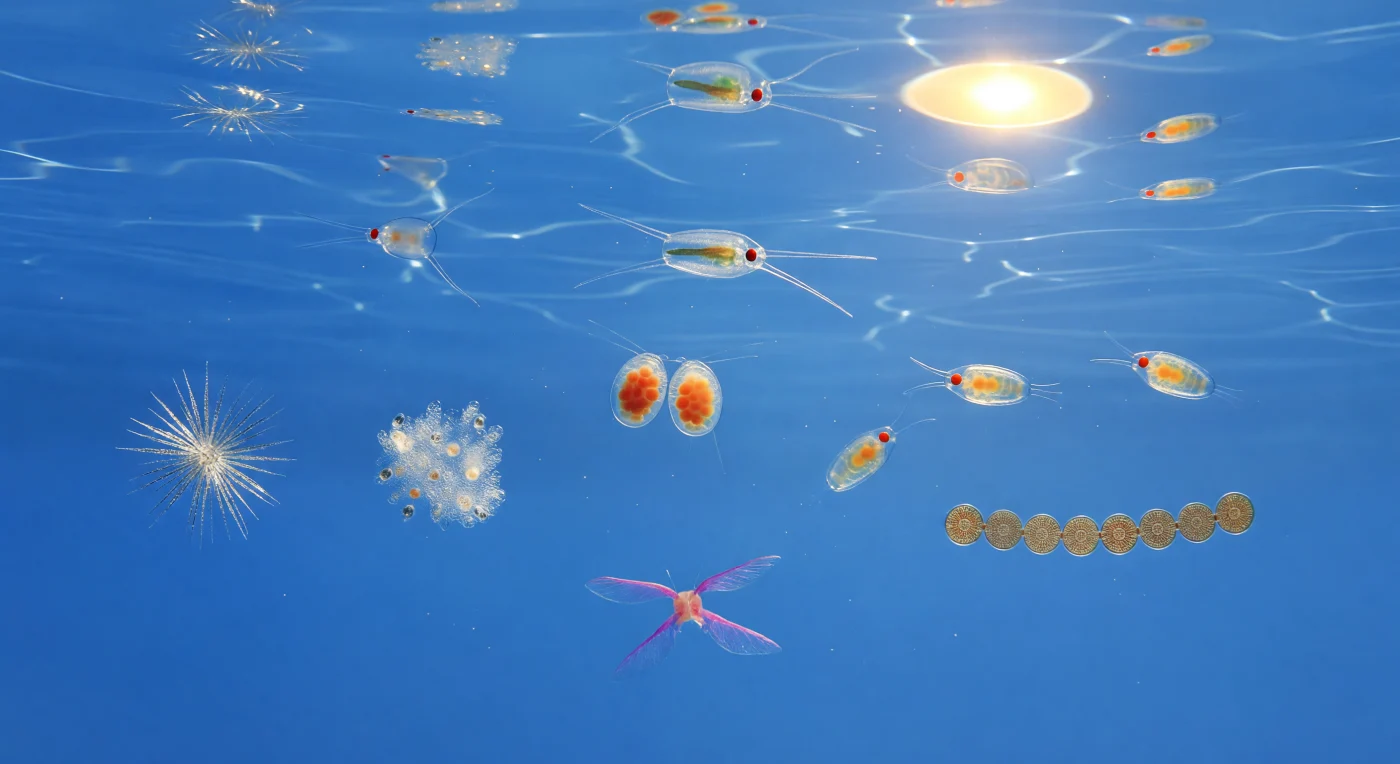
Suspended weightless in the crystalline heart of the central Pacific subtropical gyre, you float inside the clearest ocean water on Earth, surrounded by an unbounded blue so luminous and pure it registers less as color than as the physical sensation of distance — cobalt brightening toward the compressed silver-gold disc of Snell's window upper-right, deepening to indigo below without seam or boundary. Within arm's reach and yet twenty body-lengths distant, a *Clausocalanus* copepod exists more as a refractive event than an animal, its 0.8-millimeter body a near-invisible lens distortion in the water column, antennae extending as spun-glass filaments while its single nauplius eye returns one fleck of crimson light; nearby, an *Oithona* cyclopoid carries its paired egg sacs like amber lanterns, three tumbling nauplius larvae each orbit their own fierce orange-red eyespot through the blue, and a *Thalassiosira* diatom chain drifts laterally as linked golden-brown silica discs etched with radial pore geometry. These organisms inhabit the oligotrophic gyre — a vast, nutrient-depleted oceanic desert where extreme transparency is itself a consequence of biological scarcity, yet the planktonic community that persists here is exquisitely adapted to this low-Reynolds-number world, each body a variation on glass, amber, or fire suspended in what amounts to the clearest natural liquid volume on Earth, the entire assembly flickering with photon caustics that ripple across every transparent surface like slow silver nets dissolving in the barely-moving water column.
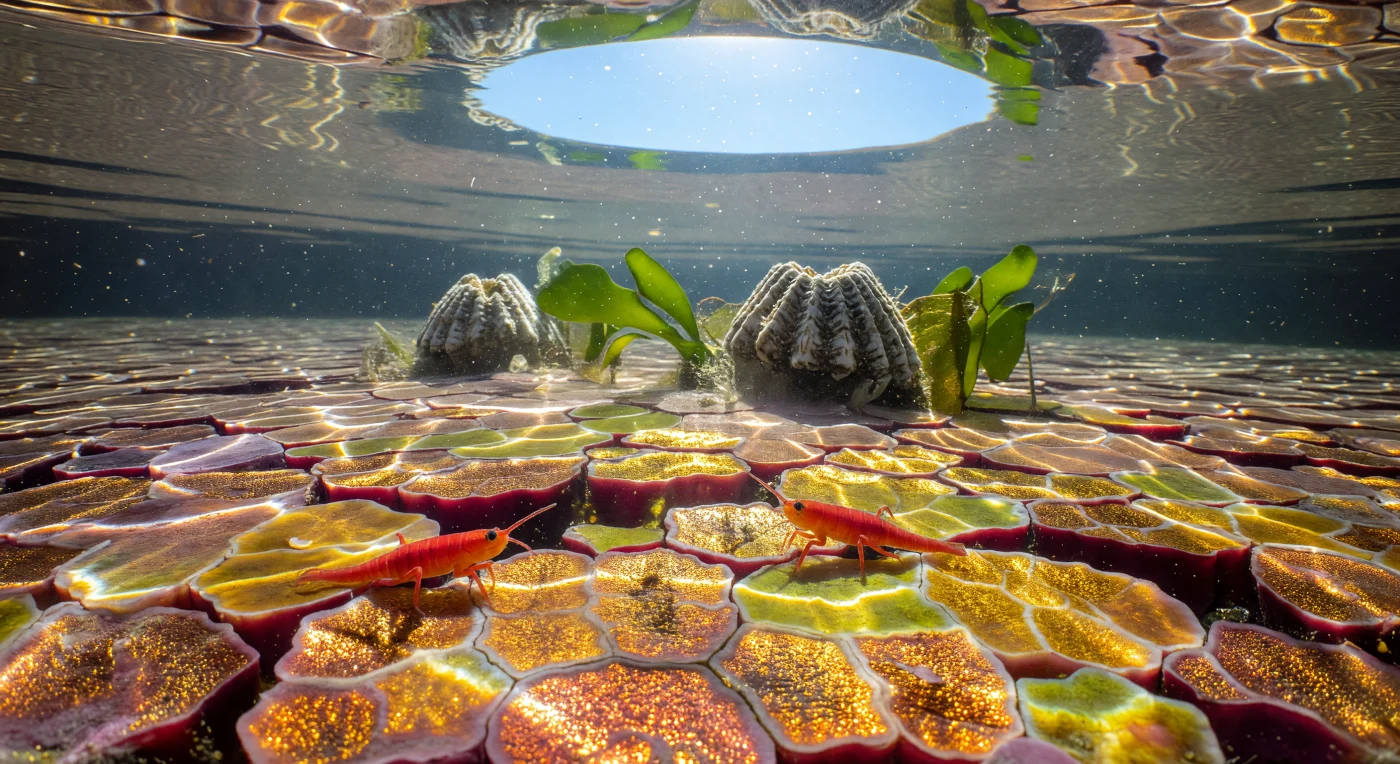
You are looking across a sunlit floor that seems to extend to a geological horizon, though you are barely beneath the surface of the world — the pink-purple coralline algae beneath you is calcified and architectural, its interlocking platelets each a courtyard's width relative to the two orange-red animals moving across it, their flattened bodies pressed close to every contour as they probe the iridescent diatom biofilm with stubby antennules. These are *Tigriopus californicus*, harpacticoid copepods built for exactly this intimate, crawling existence on encrusting substrates, their vivid carotenoid pigmentation — arterial orange against burgundy algal shadow — accumulated through a diet of the very biofilm they now traverse, a tessellated mosaic of amber, ochre, and copper diatom cells coating every pitted surface of the living calcium carbonate crust. Afternoon Pacific sunlight passes through two centimeters of clear seawater and refracts into racing caustic networks across the algal floor, overlapping ovals of white-gold light that shift and reform each fraction of a second, turning the diatom tiles into something Byzantine and incandescent. Above, the water surface resolves into Snell's window — a compressed oval of saturated Pacific sky, cleanly ringed by the granite pool rim's dark silhouette — while barnacle cones rise in the middle distance like grey limestone towers, and translucent *Ulva* sheets drape between them, the entire enclosed world suspended between blazing light above and calcified stone below.