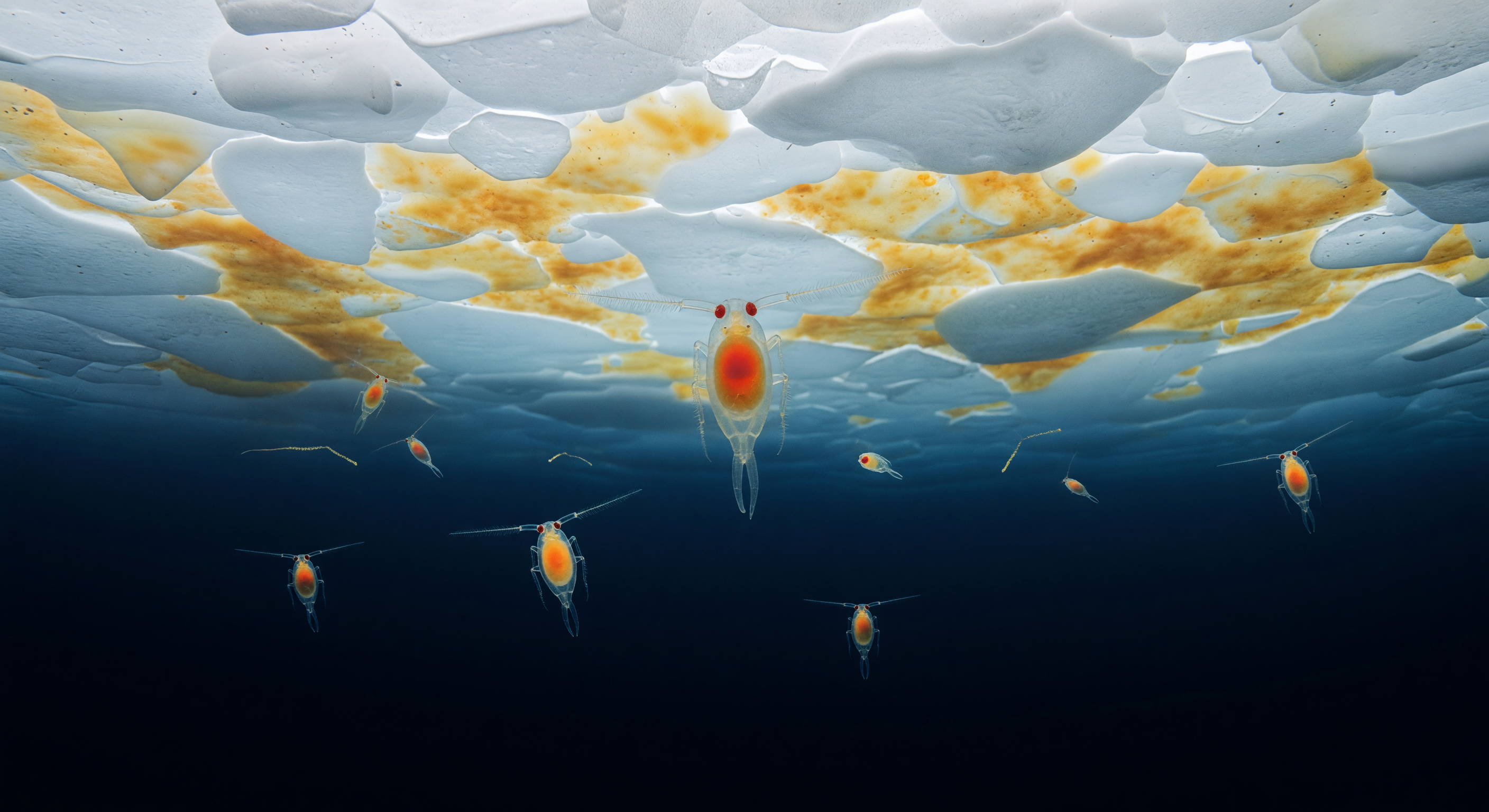
Looking upward from the Arctic water column, the underside of the sea ice fills the sky — a vast sculpted ceiling of translucent white and pale aquamarine panels glowing with diffuse cold light, its lower face colonized by irregular amber and ochre patches of diatom biofilm that stain the ice like honey pressed against frosted glass, the whole surface simultaneously a light source and a living biological landscape. Ascending directly through this cold blue space is a single *Calanus hyperboreus*, its transparent body a glass envelope dominated entirely by the lipid sac — a massive ovoid reservoir of wax esters backlit by the ice-glow into a saturated orange-red ember, the color of heated iron, vivid and warm against the surrounding cobalt water — while its feathered antennules extend forward, each fine aesthetasc seta catching the diffuse light as the animal climbs toward the algae-rich ice to feed and replenish the very energy store that glows within it. This lipid sac is not ornamental but existential: *Calanus hyperboreus* spends the Arctic winter in diapause at depth, surviving months of polar darkness on nothing but these accumulated wax esters, descending as the light fails and ascending each spring to graze the ice algae bloom before open water phytoplankton becomes available, the orange glow inside each animal a direct measure of its survival margin. Below, the water column drops into absolute black, and through the mid-water several more copepods ascend as progressively smaller orange coals, each one separated by enormous volumes of empty blue, the whole assembly conveying the scale of a vertical migration that is both intimate — measured in millimeters of body — and oceanic in its consequences for Arctic carbon cycling.
Other languages
- Français: Sac Lipidique sous la Glace Arctique
- Español: Saco Lipídico bajo el Hielo Ártico
- Português: Saco Lipídico sob o Gelo Ártico
- Deutsch: Lipidsack unter Arktischem Meereis
- العربية: كيس الدهون تحت جليد القطب
- हिन्दी: आर्कटिक हिम के नीचे लिपिड थैली
- 日本語: 氷の下の北極脂質嚢
- 한국어: 북극 해빙 아래 지질 낭
- Italiano: Sacco Lipidico sotto il Ghiaccio Artico
- Nederlands: Lipidzak onder Arctisch Zeeijs