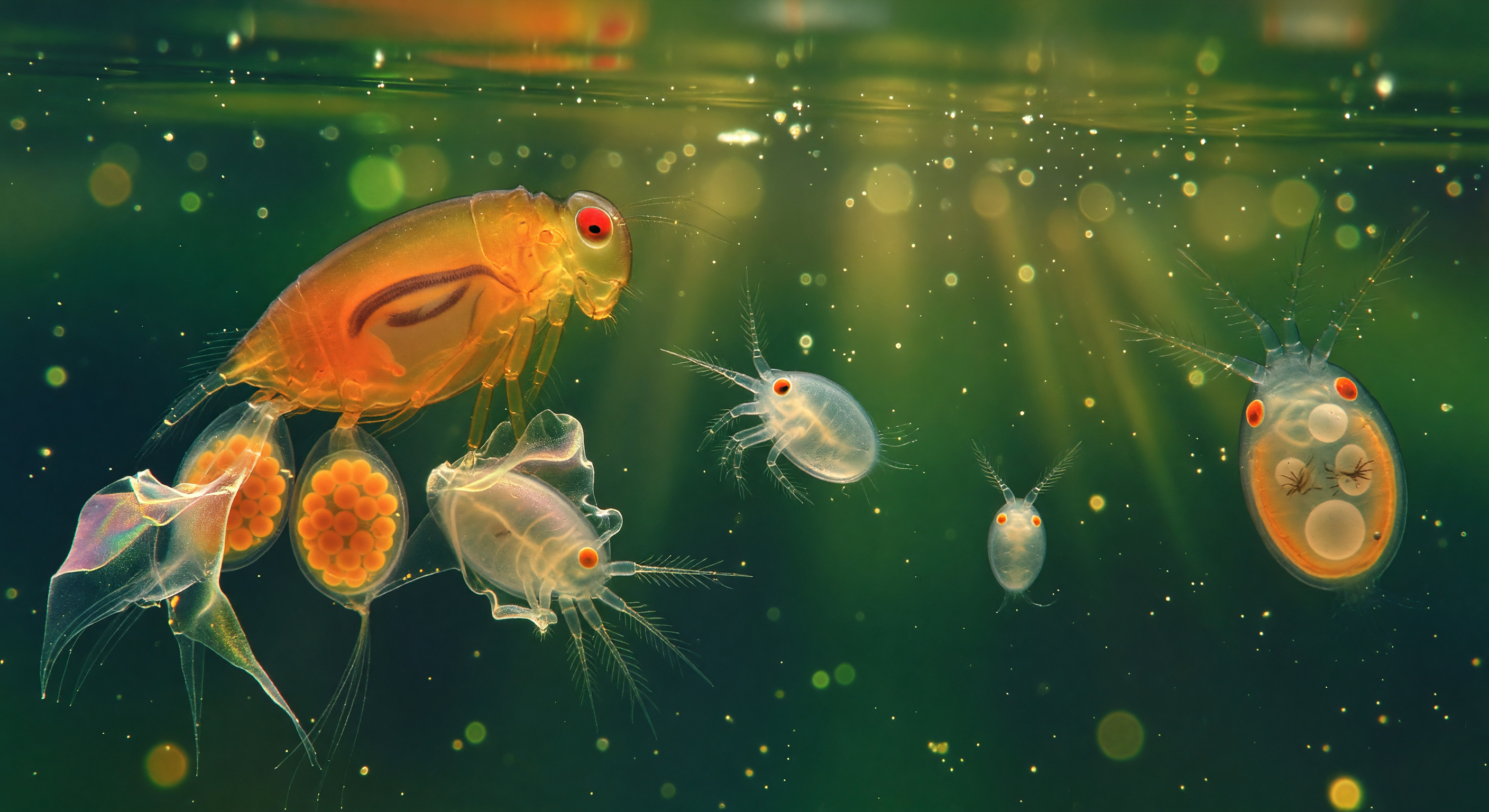
We hover at eye level with a female *Cyclops* copepod in the green-amber water column of a temperate lake, her amber-orange prosome filling the left of the frame with the quiet monumentality of a warm-lit architectural form, her single ruby median eye refracting light like a polished gemstone, her twin egg sacs swelling from the base of her tapered urosome with their cargo of carotenoid-saturated yolk visible as tessellated spheres through the thinning membrane wall. The left sac is rupturing — its chitin-reinforced membrane, iridescent with interference colors, tears at the pole and billows outward in translucent filaments that catch the diffuse phytoplankton-green light like silver-gilt cobwebs, releasing three nauplius larvae at different instants: one still shrouded in gossamer embryonic membrane, one tumbling mid-water with its three setose appendage pairs — antennules, antennae, mandibles — already beginning to sculpt the viscous, low-Reynolds-number medium into their first feeding vortex, and one hanging free as a luminous teardrop, its orange-red tripartite eyespot already burning with recognition. Each nauplius, barely 100 micrometres at hatching, enters a world in which still water feels nearly gelatinous and individual phytoplankton cells drift past like luminous dust particles, while within the intact right-hand sac, embryos at earlier stages press pale shadows of limb buds against the orange membrane, waiting their turn. The surrounding water fades into saturated emerald-blue darkness behind the scene, suspended detritus catching stray photons as soft bokeh spheres of gold and green, the whole environment carrying the quality of a candlelit interior receding into soft, living shadow.
Other languages
- Français: Nauplius éclos du sac orange
- Español: Nauplio emergiendo del saco naranja
- Português: Náuplio eclodindo do saco laranja
- Deutsch: Nauplius schlüpft aus Eiersack
- العربية: يرقة تفقس من كيس البيض
- हिन्दी: नॉपलियस का नारंगी थैले से जन्म
- 日本語: 橙色の卵嚢から孵るノープリウス
- 한국어: 주황 난낭에서 부화하는 노플리우스
- Italiano: Nauplio che schiude dal sacco arancione
- Nederlands: Nauplius ontluikt uit oranje eiersac