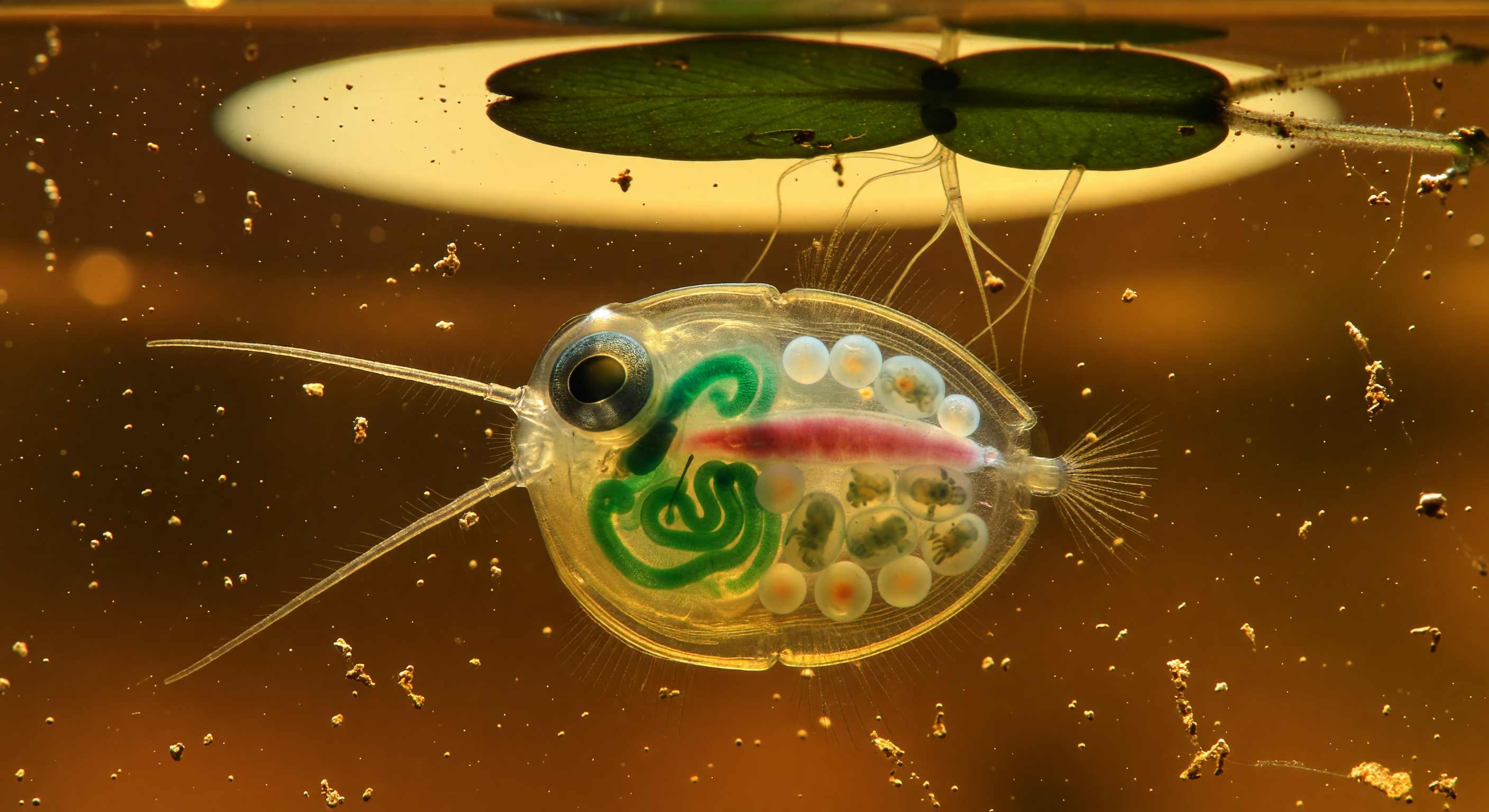
Suspended at eye level with a *Daphnia magna*, the viewer peers through a column of tannin-saturated freshwater that functions less like a medium than like a substance — warm amber light diffusing through dissolved humic acids to turn the entire water column into slow-moving honey, threaded with drifting flecks of bronze detritus and crowned above by Snell's window, where a duckweed frond cuts a dark continental silhouette across the compressed oval of the sky. At the center of this golden world floats the *Daphnia* herself, her bivalved carapace — two hinged panels of thin chitin no more than two millimeters across — so translucent in the amber light that the interior reads like a lit museum specimen: a single large compound eye rotating with neurological intent in its socket, a dorsal heart visibly mid-systole as a deep-rose muscle stripe, and a gut coiling in luminous emerald-green loops fed by chlorophyll-dense algae. Behind the gut, a brood chamber cradles a dozen embryos at staggered developmental stages, from smooth opalescent spheres to older forms already pressing shadowed limb buds against the inner wall like hands against frosted glass — an entire generation carried within the body of an animal smaller than a pencil mark. *Daphnia* are keystone grazers in freshwater ecosystems, filtering phytoplankton through comb-like setae and cycling nutrients at rates that can clear a shallow pond's algal bloom within days, their heartbeats — between 60 and 200 beats per minute, visible through that glassy carapace — keeping pace with a metabolic intensity entirely invisible to the unaided eye.
Other languages
- Français: Battement de Daphnie Ambrée
- Español: Latido de Dafnia Ámbar
- Português: Coração de Dáfnia Âmbar
- Deutsch: Bernstein Daphnia Herzschlag
- العربية: نبض دافنيا الكهرماني
- हिन्दी: एम्बर तालाब डाफनिया हृदयस्पंद
- 日本語: 琥珀池のミジンコ心拍
- 한국어: 호박빛 연못 물벼룩 심장
- Italiano: Dafnia Ambrata Pulsante
- Nederlands: Amber Vijver Daphnia Hartslag