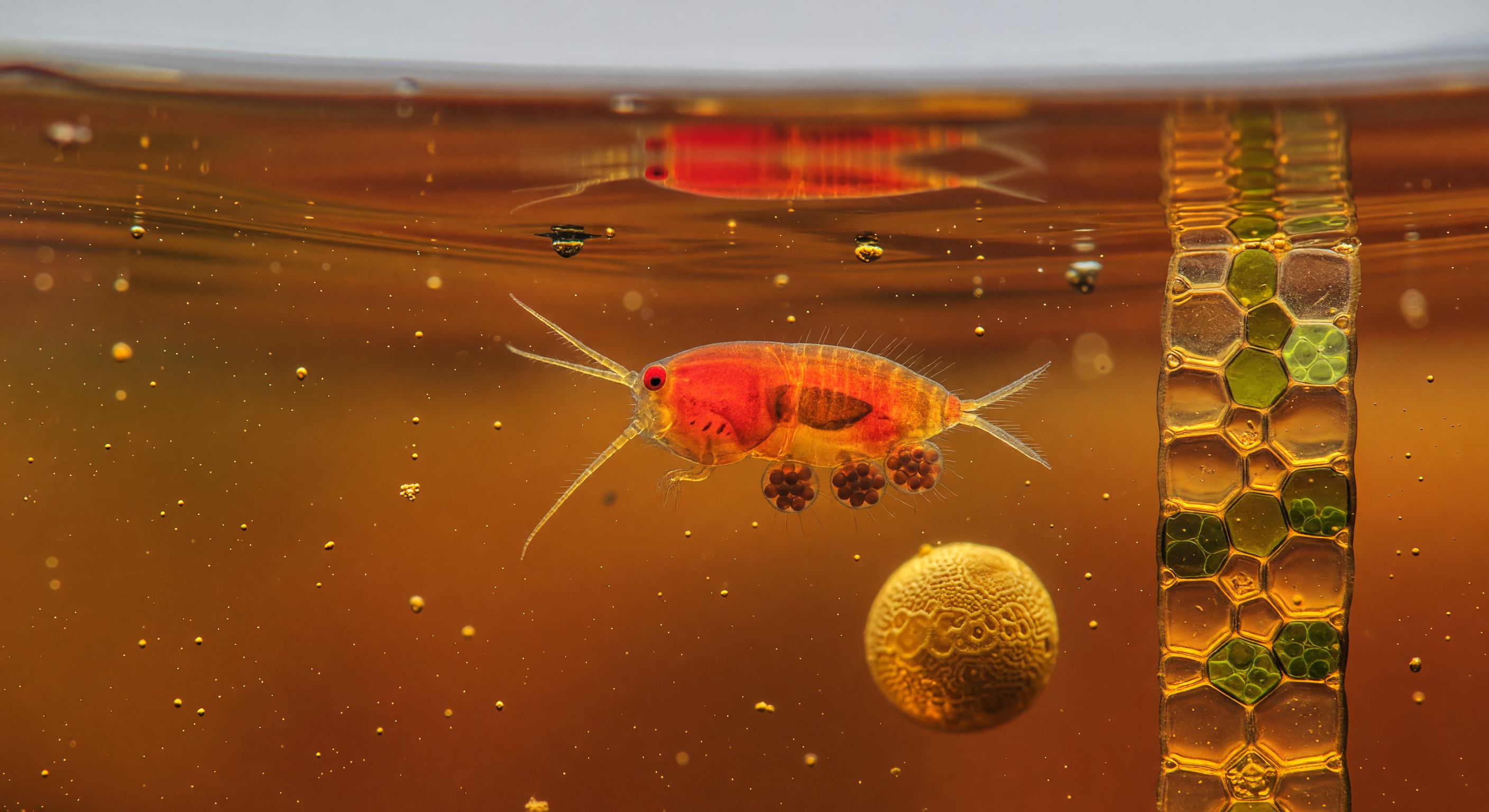
The viewer floats at eye level with a world measured in fractions of a millimeter, suspended inside a peat bog where the water itself has become a liquid amber — every photon arriving from the overcast sky above has been chemically transformed by dissolved humic and fulvic acids into warm honey-gold, deepening to mahogany-brown at a distance of mere centimeters that reads here as a foggy horizon. At the center of the scene, an *Acanthocyclops robustus* cyclopoid burns with improbable color, its carotenoid-saturated orange-red body the single vivid element in an otherwise monochromatic amber universe; the teardrop prosome is armored in semi-transparent chitin through which the darker gut stripe is faintly legible, the antennules spread laterally like a pair of sensor arrays, each individual seta resolved as a hair-thin gold filament in the diffuse light. To the right, a Sphagnum stem presents its cellular architecture like a stained-glass wall — enormous dead hyaline cells glowing as translucent amber chambers, rhythmically interrupted by the cooler chlorophyll-green of living photosynthetic cells in a pattern that reveals how this plant engineers its own water-retention, while in the foreground a pine pollen grain the size of a small planet relative to the copepod tumbles slowly, its sculpted reticulate exine catching warm light across ridges and air-bladder lobes formed long before any insect or crustacean registered its presence. Above, the water surface is an amber mirror of total internal reflection broken only by Snell's window — a compressed circle of cold grey sky, the sole reminder that a larger, cooler world exists beyond this ancient, resinous interior.
Other languages
- Français: Copépode des tourbières dorées
- Español: Copépodo en mundo ámbar
- Português: Copépodo em mundo âmbar
- Deutsch: Hüpferling in Bernsteinwelt
- العربية: قشريات العنبر الخثي
- हिन्दी: एम्बर जगत का कोपेपॉड
- 日本語: 琥珀色の泥炭湿原
- 한국어: 호박빛 이탄 습지
- Italiano: Copepode nel mondo ambrato
- Nederlands: Veenkreeftje in barnsteenwereld