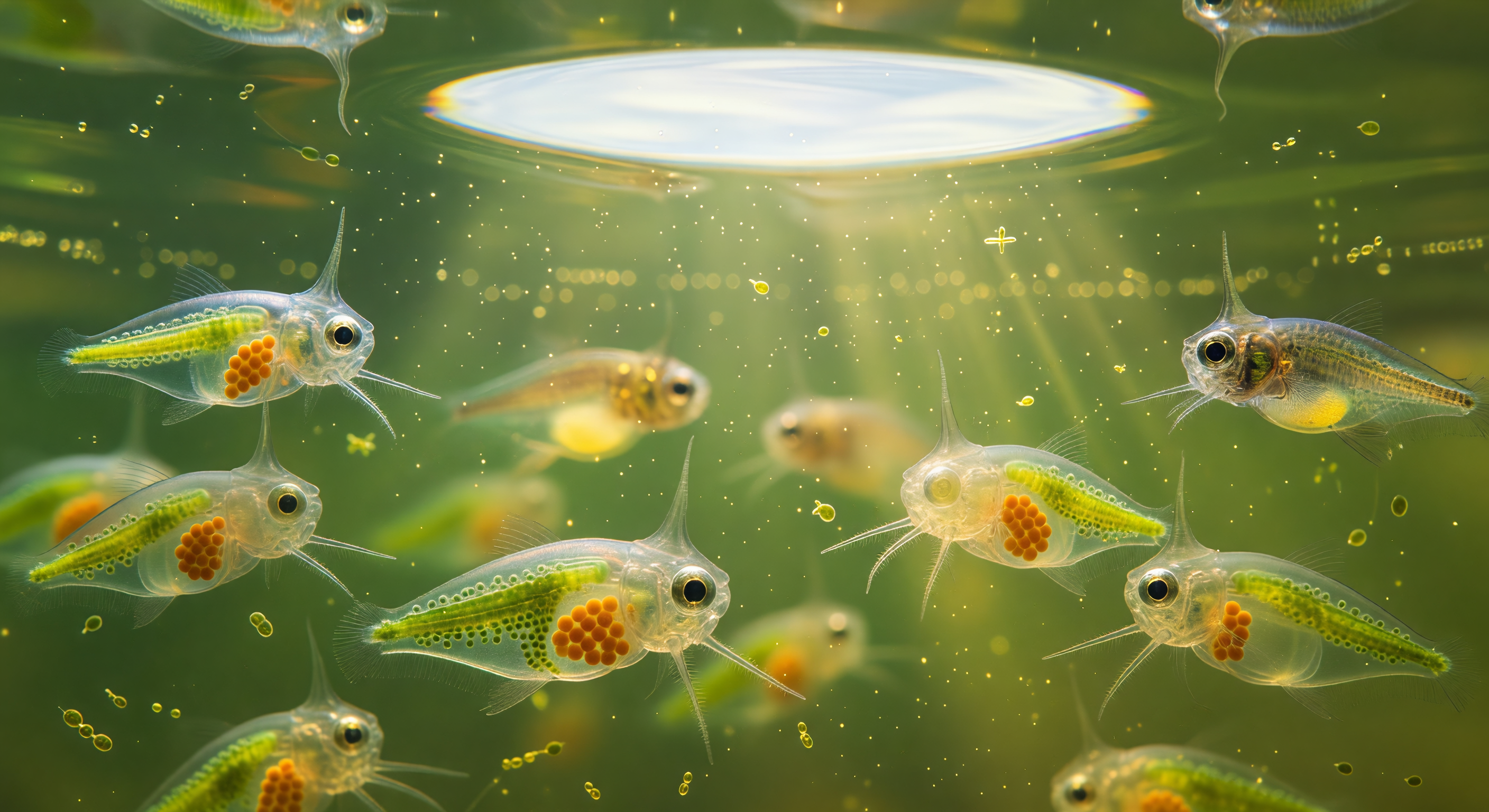
You are suspended in the luminous green interior of a northern European lake, drifting eye-to-eye with a loose congregation of *Daphnia cucullata*, each one an improbable sculpture in living glass — their bivalved carapaces perfectly transparent, their towering helmet projections rising like bishop's mitres of compressed chitin, thin-walled enough that light traces only their luminous edges against the jade-tinted water column. These helmets are not ornament but armor shaped by chemical terror: *Daphnia* detect predator-released kairomones dissolved in the water and grow these elaborate cranial spikes within a single generation, making themselves geometrically harder to swallow, a phenotypic gamble played out in real time at the population level. Inside each animal, the biology is on full display through the transparent shell — guts glowing chartreuse with digested algae, brood pouches packed with saturated tangerine eggs whose carotenoid yolk reserves burn like tiny lanterns, a single dark compound eye rotating perpetually in its socket. In the foreground, one *Daphnia* has already read the signal that the rest have not yet processed, her body arched into a tight escape flex, antennae locked at the apex of a power stroke, the near-field water around her bending light in a ghost-wave of displaced volume — and beyond her, warm and silver-gold in soft focus, the two-centimeter fish larva that triggered all of this hangs in the phytoplankton haze, its enormous dark eye sharp enough to register intent, perfectly patient.
Other languages
- Français: Daphnia casquée sous menace cachée
- Español: Dafnia con casco y depredador acechante
- Português: Dafnia Capacetada com Predador à Espreita
- Deutsch: Gehelmte Daphnia mit lauerndem Räuber
- العربية: دافنيا مخوذة مع مفترس كامن
- हिन्दी: हेलमेटी डैफनिया और छिपा शिकारी
- 日本語: 兜型ミジンコと潜む捕食者
- 한국어: 투구 물벼룩과 도사린 포식자
- Italiano: Dafnia elmetata con predatore in agguato
- Nederlands: Gehelmd Daphnia met loerende rover