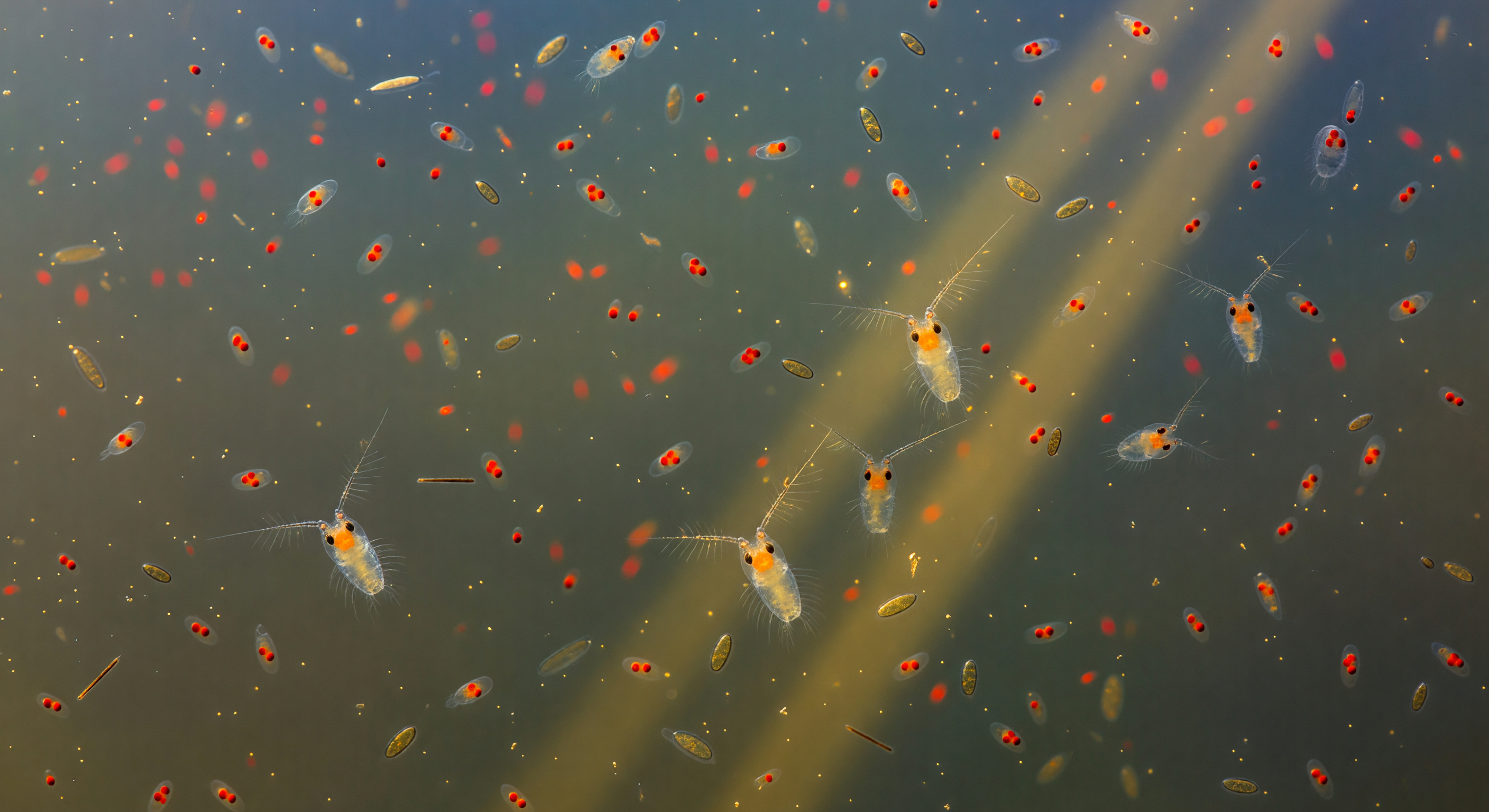
You are suspended in the water column at the scale of the smallest animals in the sea, surrounded by a breathing cloud of nauplius larvae — each one a ghost of living jelly, 120 micrometres of near-perfect transparency betrayed only by a single tripartite eyespot burning orange-red at its centre, silver antennal setae splaying outward like fractured crystal in mid-tumble. These are the hatching larvae of barnacles and copepods, the first free-living stage of crustaceans that will go on to dominate the ocean's food web; at this moment they exist in their tens of thousands per cubic metre, filter-feeding on the diatoms drifting among them — elongate *Nitzschia* frustules, their silica walls gold-brown and prismatic, catching the low dawn light like scattered amber needles. Narrow Tyndall beams of amber morning light pierce the turbid estuarine water from above, made visible by suspended clay minerals and detritus, illuminating thin golden corridors through the swarm in which transparent larval bodies briefly ignite into pale fire, their eyespots flaring a deeper crimson. Into the middle distance the larvae lose all form and become only ruby sparks receding into blue-green turbid obscurity — dozens of them, then hundreds, constellation after constellation of burning points dissolving into the murk, the entire rear field a soft luminous fog of suspended embers that communicates, unmistakably, that every cubic centimetre of this grey-green water is shared by dozens of transparent lives.
Other languages
- Français: Nuée de Nauplies à l'Aube Estuarienne
- Español: Enjambre de Nauplios en el Alba Estuarina
- Português: Enxame de Náuplios na Aurora do Estuário
- Deutsch: Nauplius-Schwarm im Ästuar-Morgengrauen
- العربية: سرب النوبليوس عند فجر المصب
- हिन्दी: मुहाने की भोर में नॉपलियस झुंड
- 日本語: 河口の夜明けノープリウス群
- 한국어: 하구의 새벽 노플리우스 떼
- Italiano: Sciame di Naupli all'Alba Estuarina
- Nederlands: Nauplius-zwerm bij Estuariene Dageraad