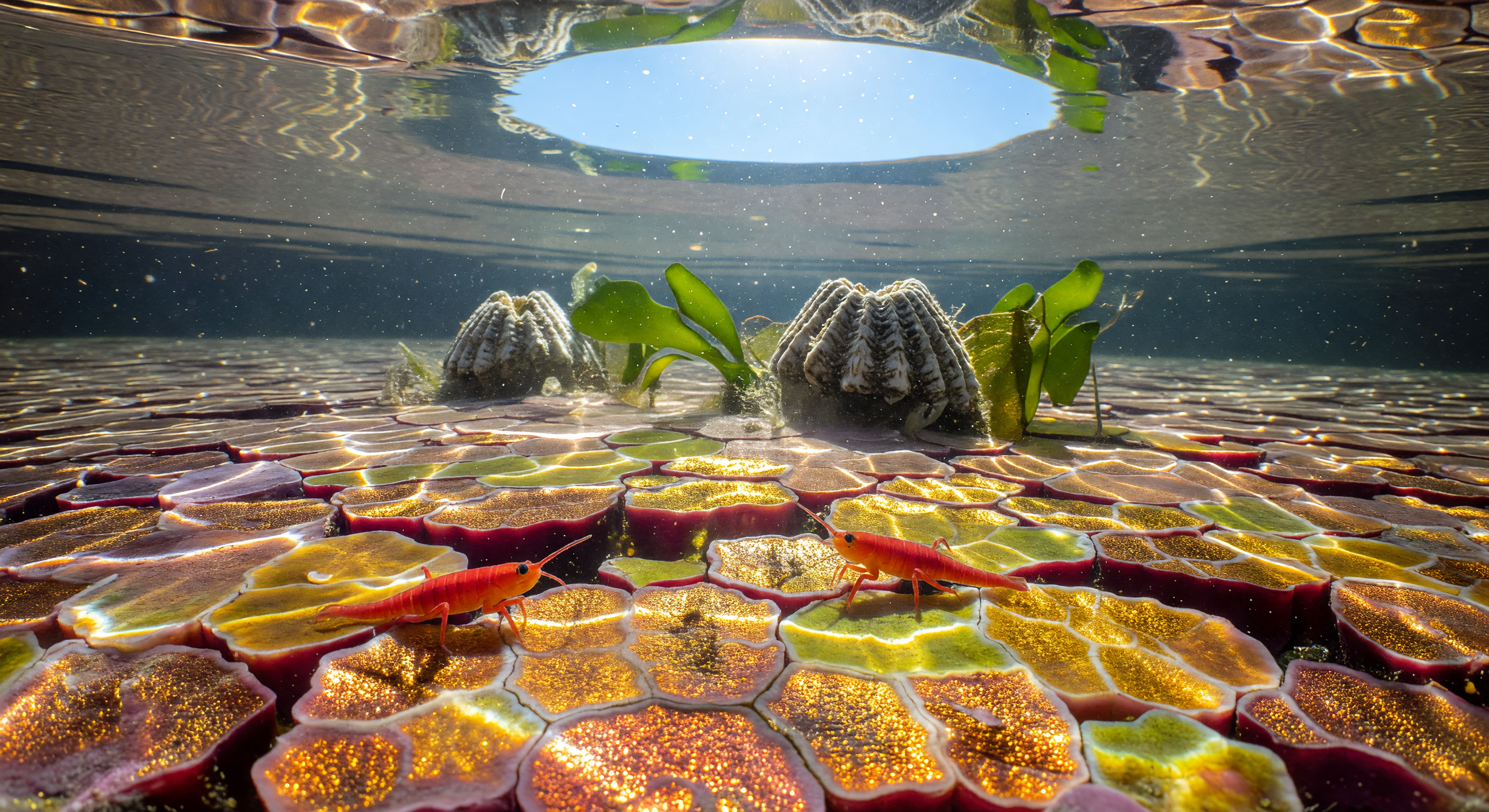
You are looking across a sunlit floor that seems to extend to a geological horizon, though you are barely beneath the surface of the world — the pink-purple coralline algae beneath you is calcified and architectural, its interlocking platelets each a courtyard's width relative to the two orange-red animals moving across it, their flattened bodies pressed close to every contour as they probe the iridescent diatom biofilm with stubby antennules. These are *Tigriopus californicus*, harpacticoid copepods built for exactly this intimate, crawling existence on encrusting substrates, their vivid carotenoid pigmentation — arterial orange against burgundy algal shadow — accumulated through a diet of the very biofilm they now traverse, a tessellated mosaic of amber, ochre, and copper diatom cells coating every pitted surface of the living calcium carbonate crust. Afternoon Pacific sunlight passes through two centimeters of clear seawater and refracts into racing caustic networks across the algal floor, overlapping ovals of white-gold light that shift and reform each fraction of a second, turning the diatom tiles into something Byzantine and incandescent. Above, the water surface resolves into Snell's window — a compressed oval of saturated Pacific sky, cleanly ringed by the granite pool rim's dark silhouette — while barnacle cones rise in the middle distance like grey limestone towers, and translucent *Ulva* sheets drape between them, the entire enclosed world suspended between blazing light above and calcified stone below.
Other languages
- Français: Copépode sur Algue Coralline
- Español: Harpacticoide en Alga Coralina
- Português: Copépode em Alga Coralina
- Deutsch: Harpacticoid auf Korallinalge
- العربية: قشريات على طحالب مرجانية
- हिन्दी: प्रवाल शैवाल पर सूक्ष्म क्रस्टेशियन
- 日本語: 珊瑚藻上のカイアシ類
- 한국어: 산호말 위의 요각류
- Italiano: Copepode su Alga Corallina
- Nederlands: Harpacticoide op Corallijne Alg