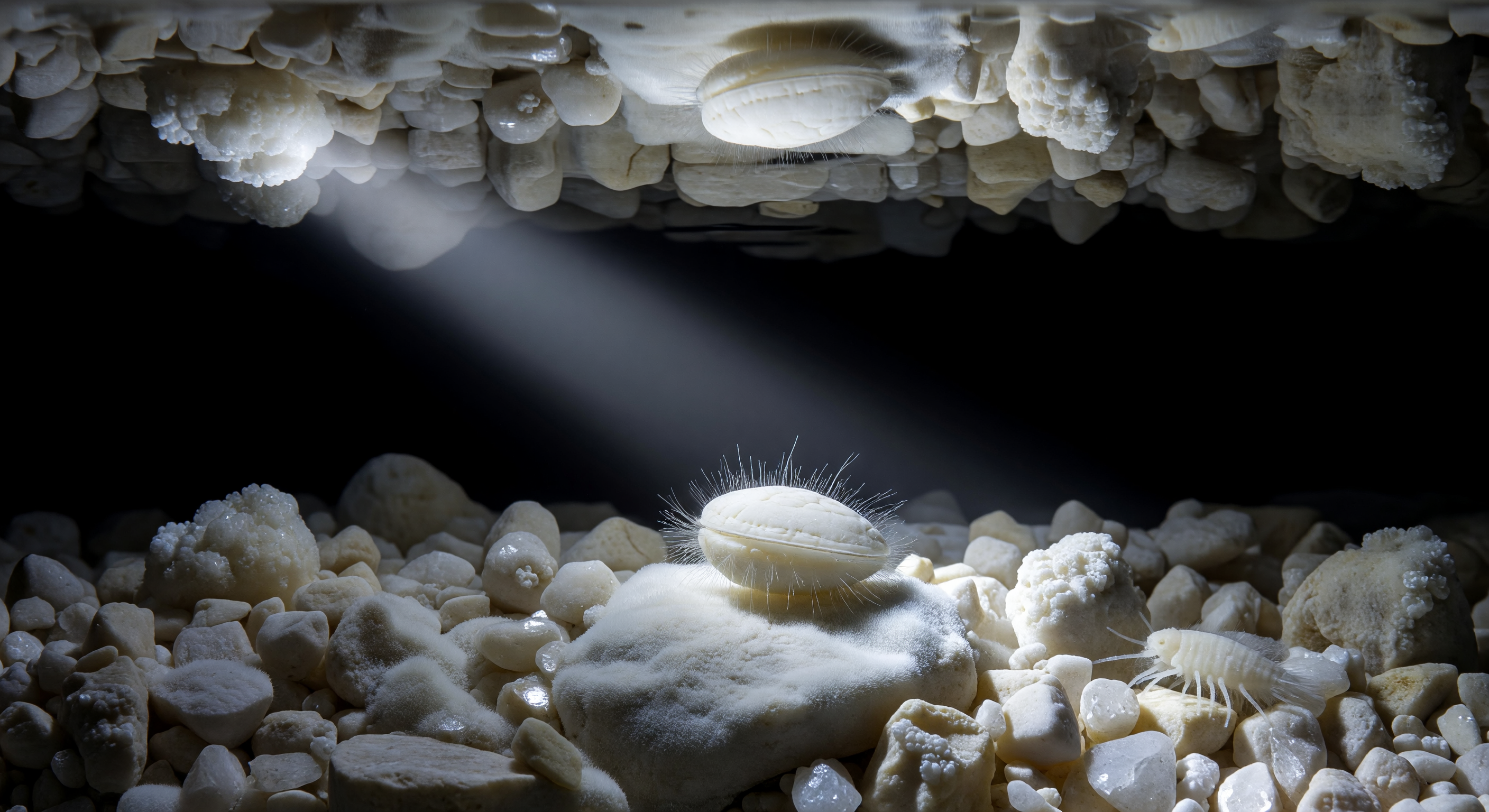
A single cone of cold white light drives back absolute darkness to reveal, at its burning center, a creature no larger than a grain of sand that has spent its entire evolutionary history preparing for exactly this lightless world. The ostracode — a *Pseudocandona* stygobite, its smooth ivory carapace barely parted along its ventral gape — rests on pale angular limestone gravel surrounded by a velvet carpet of white bacterial mat, the whole scene suspended in water of perfect crystalline clarity that renders every cobble texture with hyper-real sharpness; above, the stream surface throws the headlamp's reflection back as a trembling silver disc oscillating across the limestone ceiling, the only motion in an otherwise geological stillness. What the eye catches first is extraordinary: from the carapace gape extend aesthetasc hairs of almost impossible fineness, sensory filaments that replace the eyes this lineage abandoned across millions of years of karst darkness, each hair casting a hairline shadow across the gravel below that speaks to both the beam's harshness and the animal's exquisite fragility. At frame's edge, a depigmented amphipod presses ghostly and segmented against a cobble, equally eyeless, equally cream-white — two architectures of permanent night caught briefly in the only light this cave has ever known — and beyond the beam's sharp margin, darkness is not dim but absolute, a physical boundary enclosing the entire observable universe within one cone of borrowed illumination.
Other languages
- Français: Ostracoda des Grottes sous Faisceau
- Español: Ostrácodo Cavernícola bajo el Faro
- Português: Ostrácodo Cavernal sob Feixe de Luz
- Deutsch: Höhlen-Ostrakode im Stirnlampenstrahl
- العربية: قشريات الكهف تحت شعاع المصباح
- हिन्दी: गुफा ओस्ट्राकोड हेडलैंप की रोशनी में
- 日本語: 洞窟カイムシをヘッドランプで照らす
- 한국어: 헤드램프 빛 아래 동굴 패충류
- Italiano: Ostracoda Cavernicolo sotto il Fascio Frontale
- Nederlands: Grotostracode onder Hoofdlampstraal