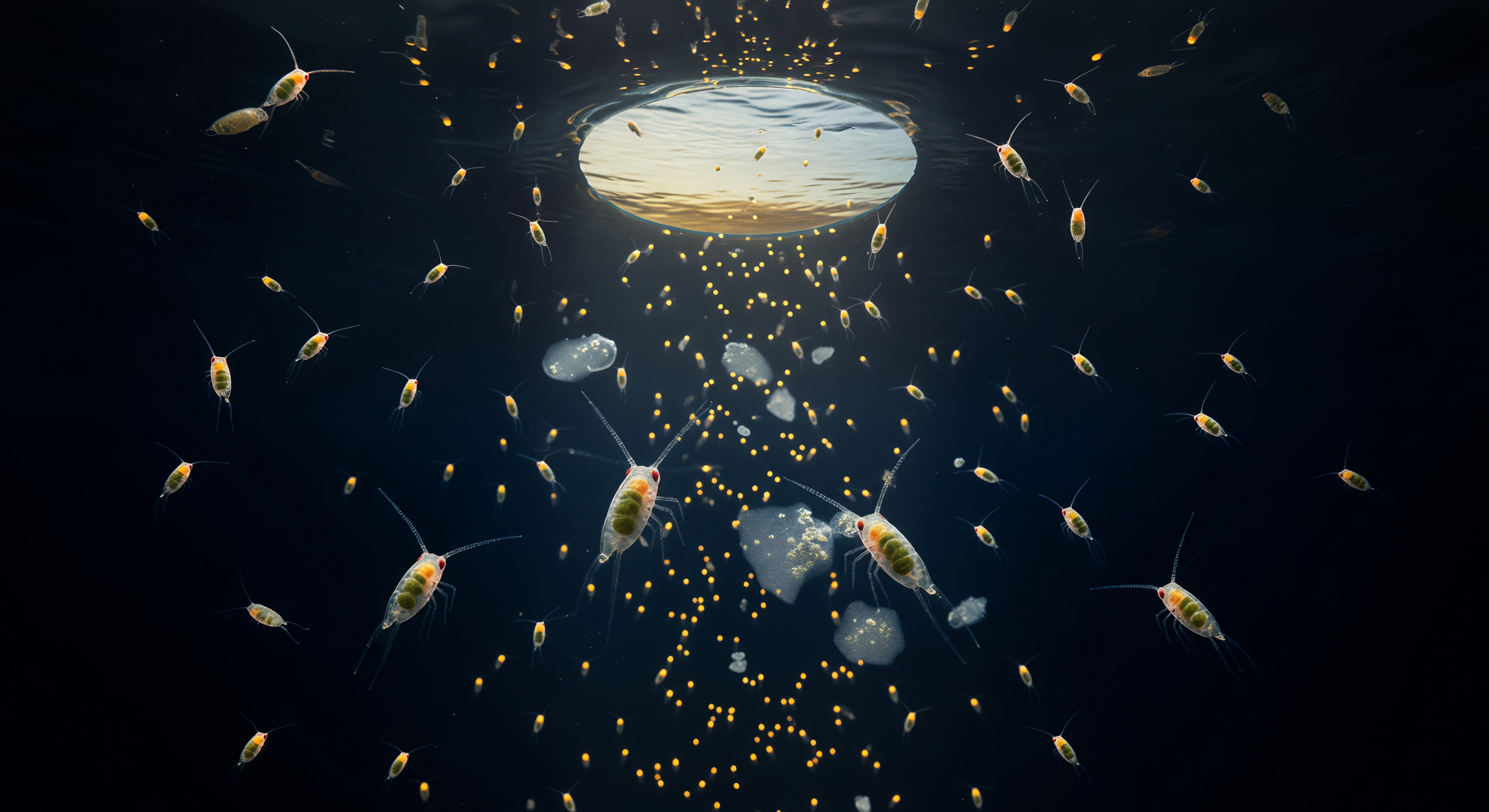
You are looking straight up through eighty meters of pre-dawn Atlantic, and the ocean above you is on fire with tiny ascending lights. Hundreds of *Calanus* copepods — each body a glassy two-to-three-millimeter torpedo, nearly invisible but for the amber-orange lipid droplet burning inside its prosome like a caged ember — rise in loose pulsing streams through the water column, executing the nightly return leg of their diel vertical migration: a twelve-hour, hundred-meter journey driven by the need to feed in surface waters under cover of darkness and retreat to depth before daylight exposes them to visual predators. The nearest individuals resolve into extraordinary anatomical clarity, their paired antennules fanned into feathery arcs of hair-thin setae, their single ruby nauplius eyes catching the last cold blue of the deep, their segmented urosomes trailing beneath like pale jointed threads, while through their glass-clear carapaces the olive-green gut boluses of digested diatoms show as dark inclusions alongside the glowing oil sac — wax esters and lipids stored across weeks of surface feeding, the metabolic currency that will sustain them through winter diapause at depth. Above this close foreground, the swarm expands into the middle column, individual amber points multiplying and blurring together into a soft vertical galaxy of converging ember-light that narrows toward a single destination: the Snell's window overhead, a perfect circular disc still silver-pale but warming gold at its rim with the approaching sunrise, its sharp edge the compressed boundary between ocean and atmosphere, the entire sky collapsed into one bright portal through which a hundred million copepods are simultaneously navigating. Threading downward in the opposite direction, pale curtains of marine snow — mucus aggregates, diatom frustules, fecal pellets — drift between the rising animals like ash falling through fireflies, and two of the nearest copepods have pivoted from their ascent to intercept a passing flake, their feeding appendages spinning micro-vortices in the cold pressured dark, amber sacs still lit, the whole scene suspended in a single crystalline instant of organized biological purpose.
Other languages
- Français: Migration Ascendante à l'Aube
- Español: Migración Masiva al Amanecer
- Português: Ascensão em Massa ao Amanhecer
- Deutsch: Massenwanderung im Morgengrauen
- العربية: هجرة الصعود عند الفجر
- हिन्दी: भोर की सामूहिक ऊर्ध्व यात्रा
- 日本語: 夜明けの大集団上昇
- 한국어: 새벽 대규모 상승 이동
- Italiano: Migrazione Ascendente all'Alba
- Nederlands: Massa Opkomst bij Dageraad