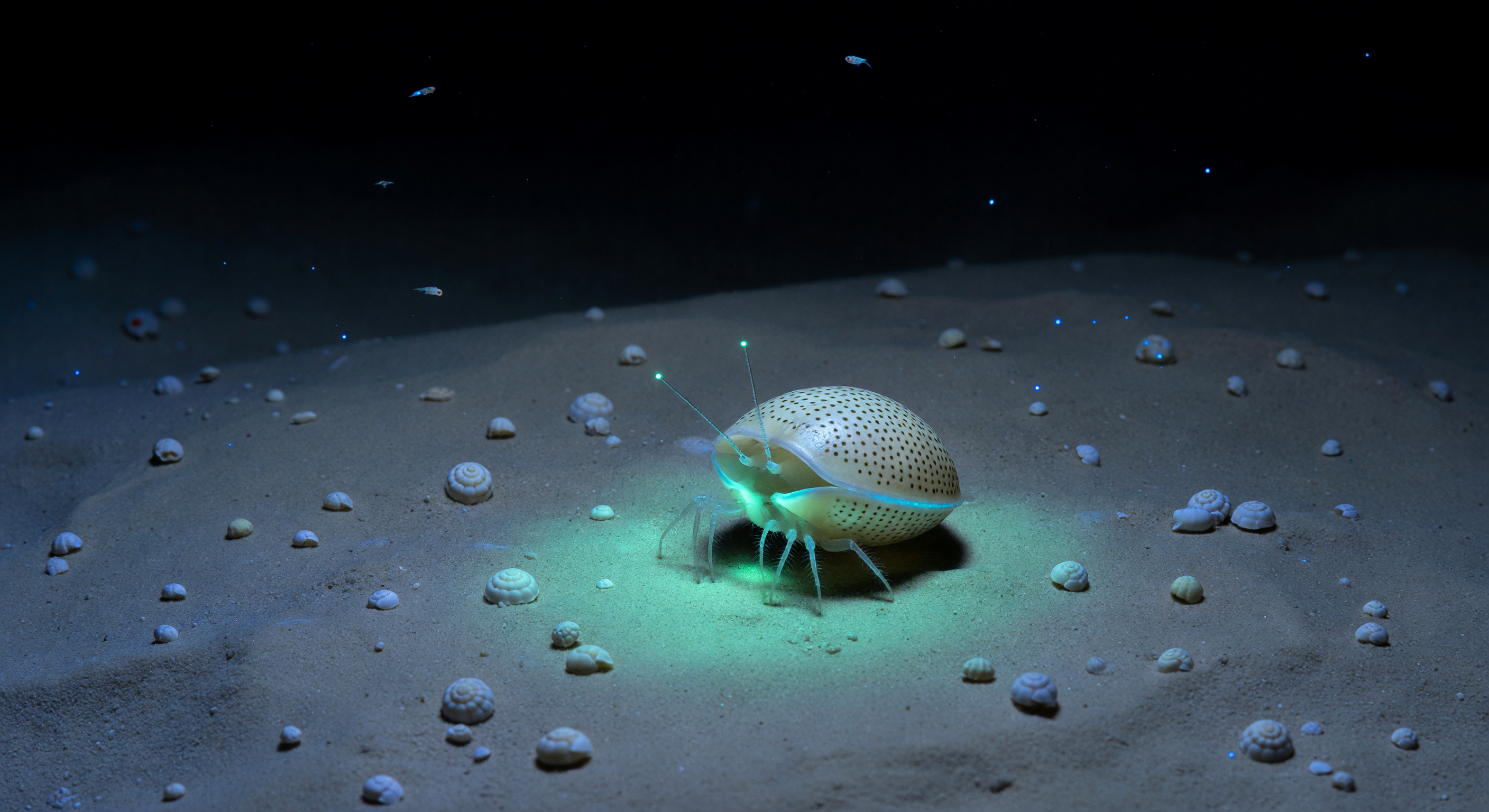
At sediment level, crouched against the floor of a continental shelf plunged into perpetual darkness, the eye takes in a vast pale plain of compacted grey-beige silt stretching away like suede under a microscope, its micro-topography of ridges and shallow depressions scattered with foraminifera tests — perfect spiraled calcite shells the size of pin-heads that catch and redirect the only light in this universe. That light belongs to a single living animal just ahead: an ostracode no larger than a sesame seed, its cream-ivory bivalved carapace perforated by a species-specific grid of dark pore canals, from whose gaping valve seam a continuous bioluminescent secretion bleeds outward — cold, saturated blue-green, the product of a luciferin-luciferase reaction brightest at the valve margin and fading within a centimeter to a spectral aquamarine ghost before dissolving into absolute black. Setose walking legs extend below the valves and grip the soft substrate, each dactyl tip pressing hairline impressions into the clay, while paired sensory antennae reach forward as luminous filaments probing the pressurized void; at fifteen atmospheres, this animal's chemical light paints the world teal for the length of its body and no further, and beyond that intimate radius the sediment plain retreats through indigo into pitch darkness punctuated only by scattered cold-blue pinpoints — bacteria on drifting organic particles, unnamed organisms in the mid-water column — like the faintest stars of a universe that has never once seen the sun.
Other languages
- Français: Ostracode Rampant sur Sédiment Mésoéplagique
- Español: Ostrácodo Reptando sobre Sedimento Mesopelágico
- Português: Ostrácodo Rastejando em Sedimento Mesopelágico
- Deutsch: Ostrakode Kriecht über Mesopelagisches Sediment
- العربية: قشريات بحرية تزحف على رواسب المنطقة المتوسطة
- हिन्दी: मेसोपेलैजिक तलछट पर रेंगता ओस्ट्राकोड
- 日本語: 中層堆積物を這うオストラコーダ
- 한국어: 중층 퇴적물 위를 기어가는 패충류
- Italiano: Ostracode che Striscia su Sedimento Mesopelagico
- Nederlands: Ostracood Kruipend over Mesopelagisch Sediment