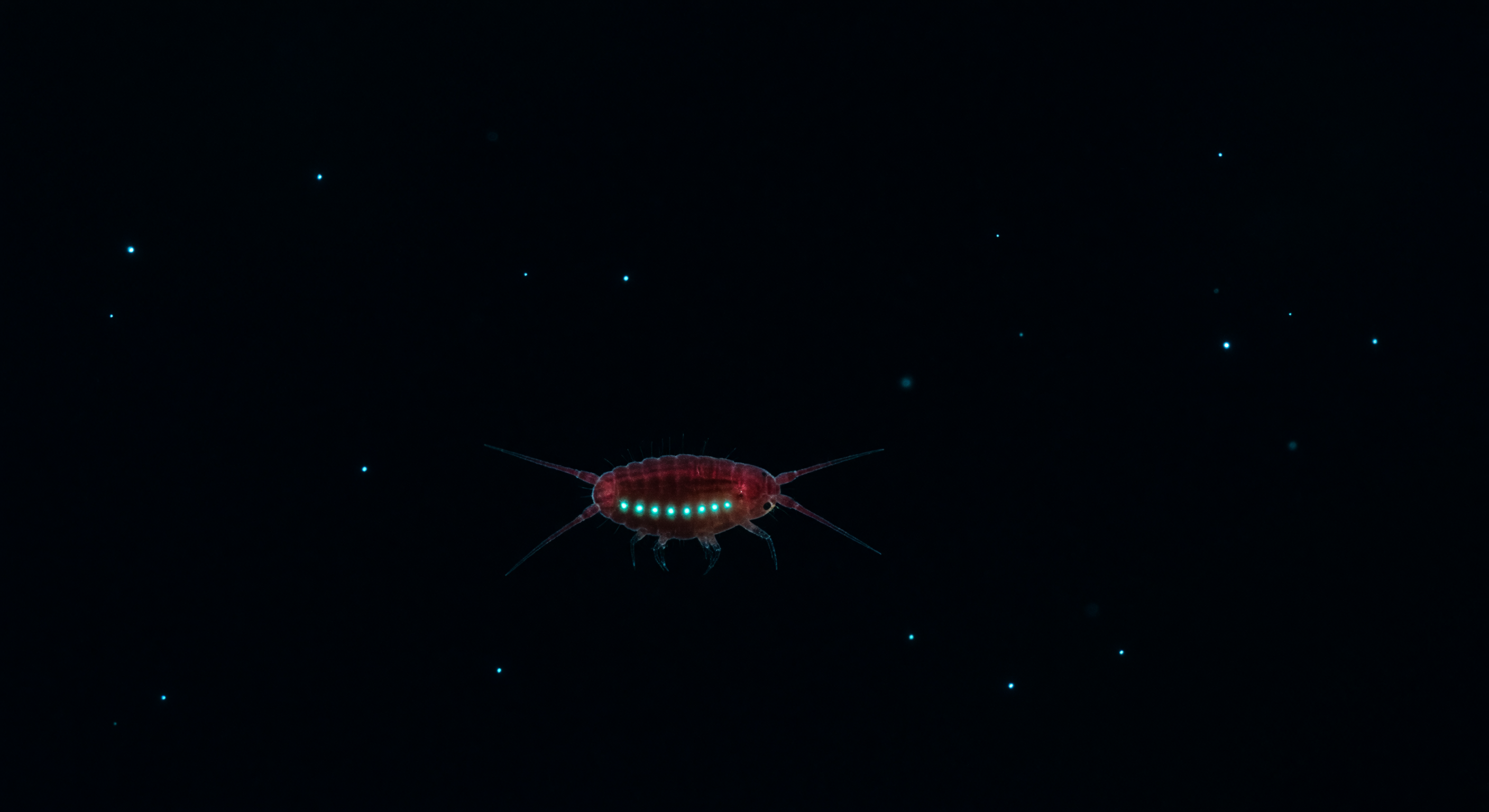
You are suspended in absolute darkness — not the comfortable dark of closed eyes but a pressurized, mineral absence six hundred meters below any memory of sunlight, where the surrounding medium registers against the body as something between water and cold glycerin. Directly before you, a *Gaussia princeps* copepod occupies the entire meaningful universe: roughly four millimeters of maroon-crimson architecture hanging motionless in the void, its deep pigmentation an evolutionary solution to the mesopelagic condition, absorbing stray bioluminescent photons that might otherwise silhouette the animal against a predator's upward gaze. Then your implied approach propagates through the viscous near-field and the ventral urosome responds — a sequential row of bioluminescent photophores fires anterior to posterior, each one blooming as a cold aquamarine point of pure chemiluminescence that spills sideways without warming the water even fractionally, the traveling wave of cold fire revealing in half-light the segmented urosome, the bands of darker burgundy musculature beneath the cuticle, and the setal combs on the swimming legs catching the glow as momentary silver filaments before vanishing back into black. In the far distance — established as distance only by the diminishing scale of scattered sparks — a dozen cold-blue points pulse and extinguish at irregular intervals, the defensive flashes of organisms disturbed by invisible rains of sinking marine snow drifting down from the productive surface world above, each flash a brief protest that confirms the void has extension but offers no further information about what lies beyond.
Other languages
- Français: Copépode Cramoisi dans l'Abîsse
- Español: Copépodo Carmesí en el Vacío Profundo
- Português: Copépode Carmim no Vazio Mesopelágico
- Deutsch: Dunkelroter Copepode im Tiefseeabgrund
- العربية: قشريات قرمزية في الظلام العميق
- हिन्दी: गहरे लाल कोपेपॉड अंधेरे गहराई में
- 日本語: 深海の紅いカイアシ類の輝き
- 한국어: 심해 암흑 속 붉은 요각류
- Italiano: Copepode Cremisi nel Vuoto Mesopelagico
- Nederlands: Donkerrode Copepode in Mesopelagische Leegte