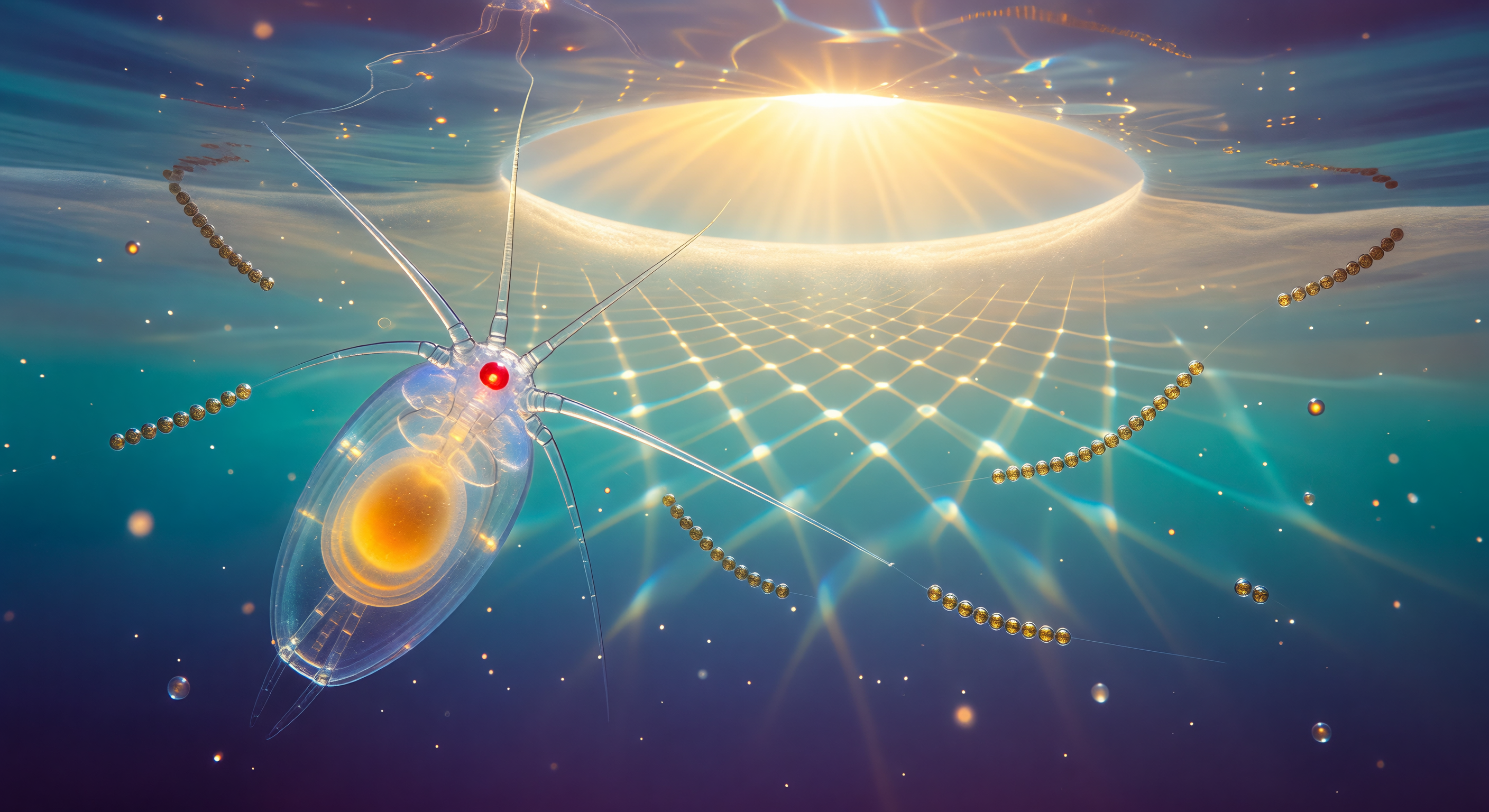
You are suspended centimeters from the anterior face of a *Calanus finmarchicus*, your viewpoint level with its single ruby-red nauplius eye, and the animal fills your left field of vision as an architecture of living glass — a teardrop of optically clear chitin whose margins bend the ambient turquoise light into faint prismatic halos, its interior amber lipid sac glowing like a lantern of warm saffron suspended in crystal, dense with stratified wax esters that grade from deep gold at the core to pale champagne at the edges. The antennules radiate outward in every direction like the arms of a crystal chandelier, each hyaline rod so thin it is visible only where a caustic ray catches it and ignites a brief line of refracted light. Above the animal, Snell's window compresses the entire sky and its direct sun into a blazing white-gold oval framed instantaneously by a perfect mirror ceiling of total internal reflection — and from that window, shifting caustic lattices pour downward in overlapping nets of gold and ice-blue, weaving continuously across the copepod's transparent body, dragging bright lines over the amber sac and momentarily bleaching it toward white before the wave passes and the orange warmth returns. This is the sunlit epipelagic zone at ten meters depth, where the ocean's most abundant multicellular animals hover in a low-Reynolds-number world that makes still water feel faintly viscous, filtering the rain of diatom chains — their silica walls catching individual caustic flashes like strung glass beads — that drift downward through a water column deepening from saturated cyan at mid-frame into a profound indigo-violet below, the light attenuating exponentially until the edges of the visible world dissolve into a cold, luminous, pressing dark.
Other languages
- Français: Copépode de verre dans les caustiques
- Español: Copépodo de cristal entre cáusticas
- Português: Copépode vítreo entre cáusticas
- Deutsch: Gläserner Ruderfußkrebs in Kaustiken
- العربية: قشريات زجاجية في أضواء الماء
- हिन्दी: काचीय कोपेपॉड प्रकाश-जाल में
- 日本語: 光の網に漂うガラスのカイアシ
- 한국어: 빛의 격자 속 유리 요각류
- Italiano: Copepode di vetro tra le caustiche
- Nederlands: Glazen Roeipootkreeft in Lichtpatronen