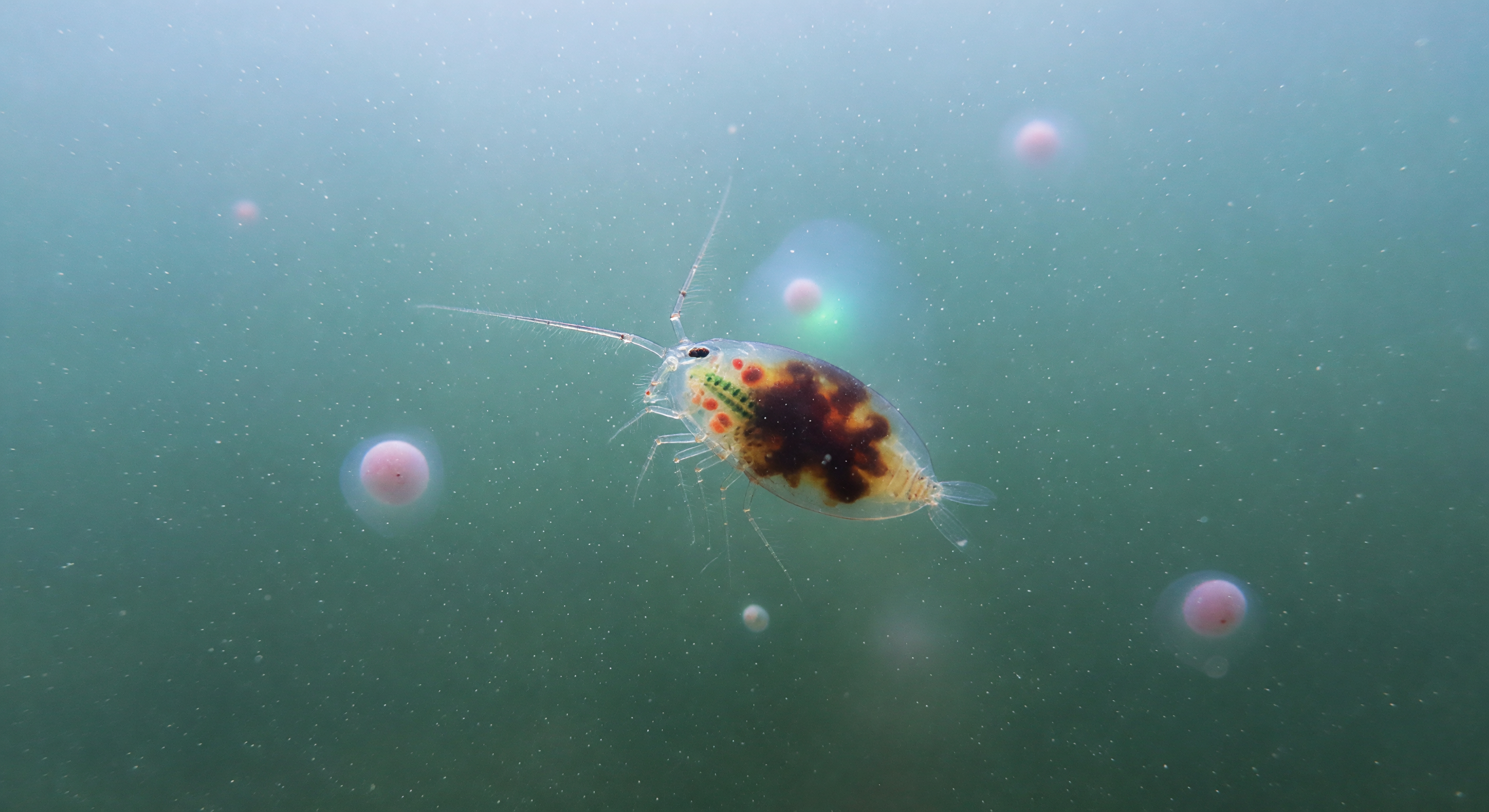
We hover eye-level with a *Calanus helgolandicus* female suspended in coastal North Sea water, her elongated teardrop body centered in a blue-green murk threaded with suspended particulate matter — each drifting grain catching diffuse downwelling light as a cold spark before dissolving into layered haze. She should be a marvel of living glass, her carapace wall thin enough to reveal the interior geometry of a working organism: the orange-red ovarian masses, the clean green gut column, the rhythmic pulse of a beating heart — but instead a dense amber-brown mass occupies her body cavity, a gregarine parasite colony pressing against the integument from within, its mottled mahogany texture visible as a shadowy, granular opacity through translucent chitin that was never meant to hide anything. Gregarines are apicomplexan parasites that colonize the guts of invertebrate hosts, often reaching densities that displace normal tissue and disrupt digestion entirely, yet rarely killing the host outright — instead sustaining themselves within a living architecture that continues to function around them. Her antennules still extend wide, their setae softening into optical haze at their tips, and her swimming legs still beat in their paired rhythmic strokes, performing the complete external vocabulary of a healthy copepod, while behind the carapace wall the interior has become a closed amber room belonging to something else entirely; behind her, pale gelatinous dinoflagellate spheres drift in the turbid water column, one exhaling a brief blue-green bioluminescent pulse that illuminates the surrounding water in a cold corona before fading back into the ambient light.
Other languages
- Français: Copépode Parasité aux Grégarines
- Español: Copépodo Parasitado con Gregarinas
- Português: Copépode Parasitado por Gregarinas
- Deutsch: Parasitierter Copepode mit Gregarinen
- العربية: قشيريات مضيفة لطفيليات الغريغارين
- हिन्दी: ग्रेगेरीन भार सहित परजीवी कोपेपॉड
- 日本語: グレガリン寄生のカイアシ類
- 한국어: 그레가린에 기생된 요각류
- Italiano: Copepode Parassitato con Gregarini
- Nederlands: Geparasiteerde Copepode met Gregarinen