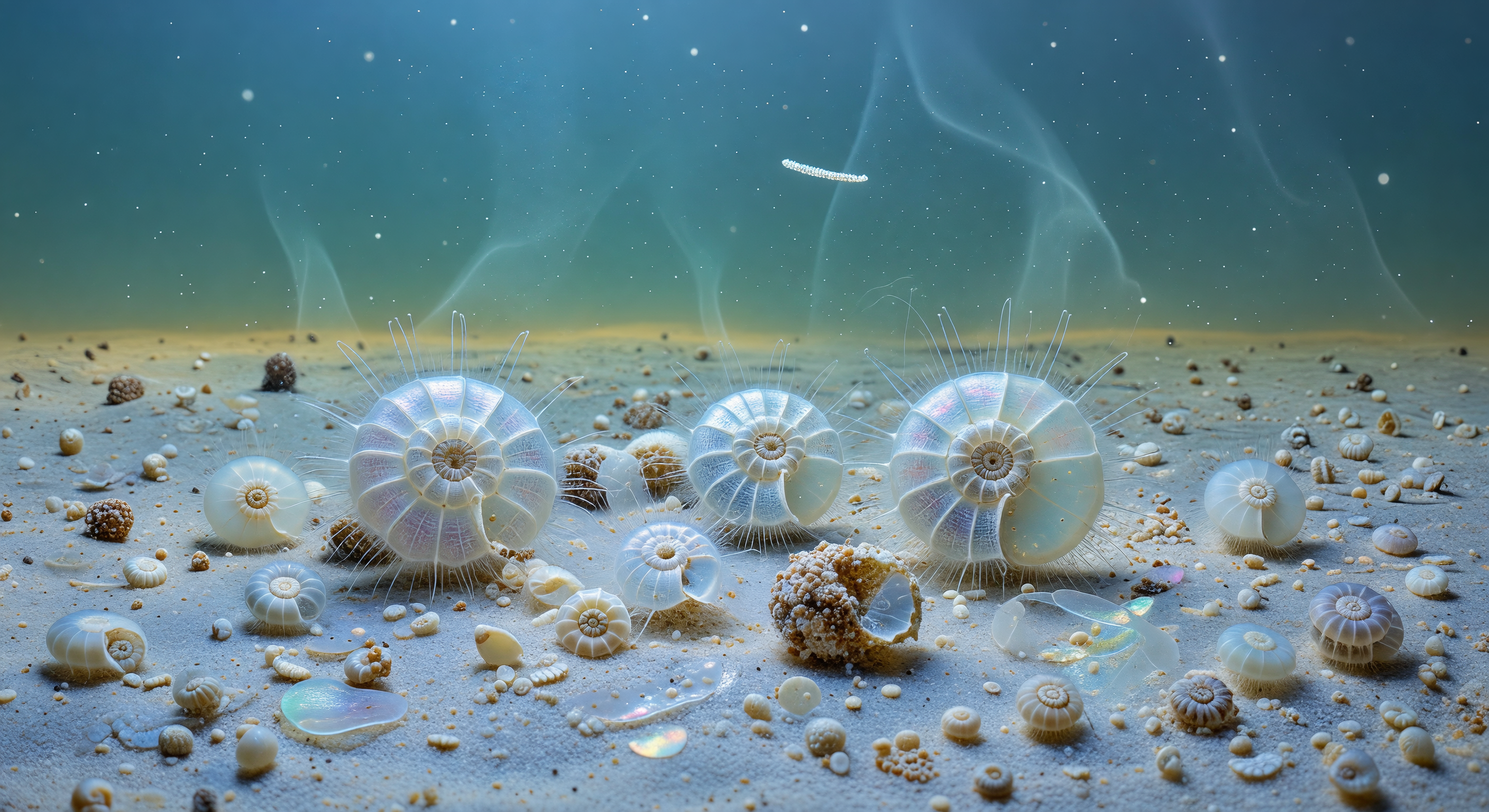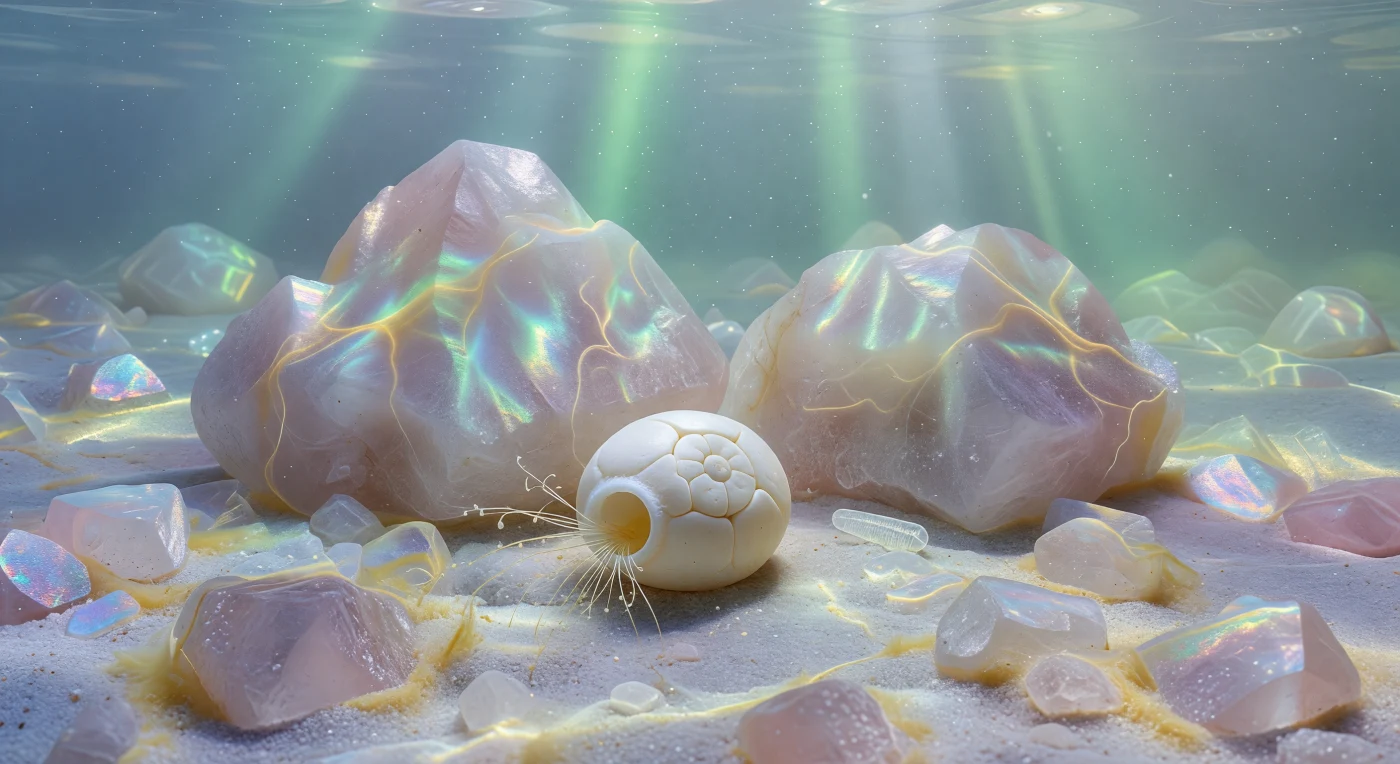
Standing at the level of the seafloor itself, you look out across a landscape of towering quartz boulders — each grain now a translucent mountain of pale rose and milky white, its broad conchoidal facets wrapped in a gossamer bacterial biofilm that shimmers with amber-gold and faint violet interference color wherever the slow-shifting shafts of green-blue sunlight rake across it from above. Between two of these mineral giants sits a Quinqueloculina test: ivory-white, matte, and unmistakably ceramic in character, its overlapping porcelaneous chambers built not from glassy calcite crystals but from a dense felt of randomly oriented calcite needles that renders the wall entirely opaque — a biological choice that distinguishes this lineage from its hyaline relatives and has persisted in the fossil record for hundreds of millions of years. From the rounded aperture at its oral end, a sparse fan of amber reticulopodia reaches outward across the detrital substrate — each thread a living cytoplasmic stream capable of flowing at several micrometers per second, merging and diverging as the cell probes the organic flocculent material for bacteria and diatom frustules, including the glass-clear pennate form lying nearby, its silica valve cross-hatched with the fine regular striae of its ornament. The seawater itself is a presence here, faintly hazy with dissolved organics, filling every interstice between grains with a cool aquamarine translucency that blurs the far distance into luminous, pale obscurity — a reminder that in this viscous medium, diffusion and drag govern the world far more than gravity ever could.
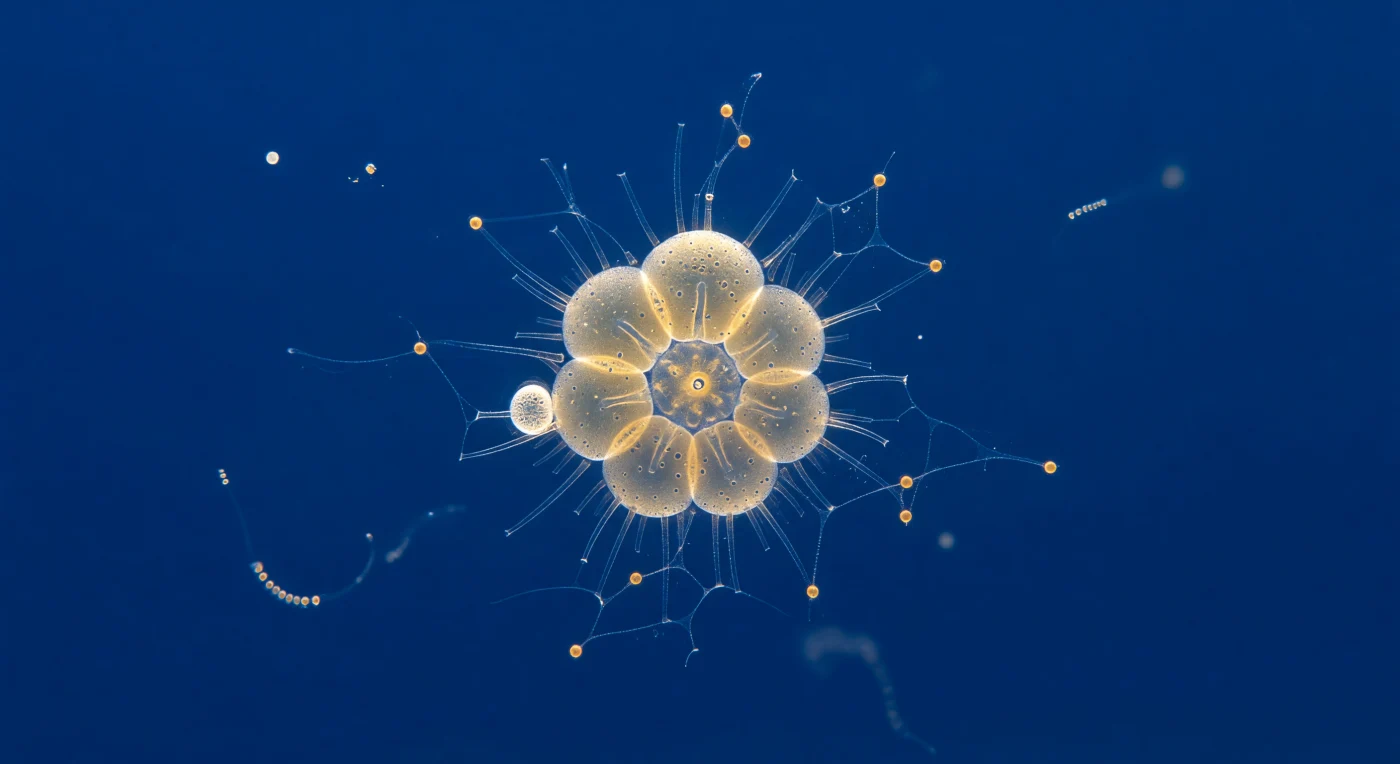
Suspended at eye-level with a single living *Globigerinoides ruber*, you face a luminous amber lantern floating against an infinite cobalt void — four globular calcite chambers arranged in a low trochospiral whorl, each wall translucent enough that diffuse tropical sunlight seems to radiate from within the mineral itself, and the finely perforated surface gives the test the texture of polished stone riddled with microscopic wells. From its aperture and spine bases, monocrystalline calcite needles radiate outward in every direction — water-clear and nearly invisible except where they refract the down-welling light into drifting arc-shaped caustics, three hundred micrometers of glass-thin mineral vibrating at the threshold of perception. Between these spines, a gossamer reticulopodial network spreads into the surrounding seawater as barely-visible silver-blue threads that branch, anastomose, and dissolve into the ambient blue, their invisible cytoplasmic highways traced only by a slow procession of golden-brown zooxanthellae beads drifting toward the test surface like lanterns carried along a dark river. This single cell — a marine protist whose calcite test will eventually sink through thousands of meters of ocean and persist in sediment for millions of years — occupies the absolute center of a three-dimensional liquid space that extends in all directions to infinity, its mineral architecture simultaneously immaculate and fragile, geometrically absolute against the cold cobalt silence of the photic zone.
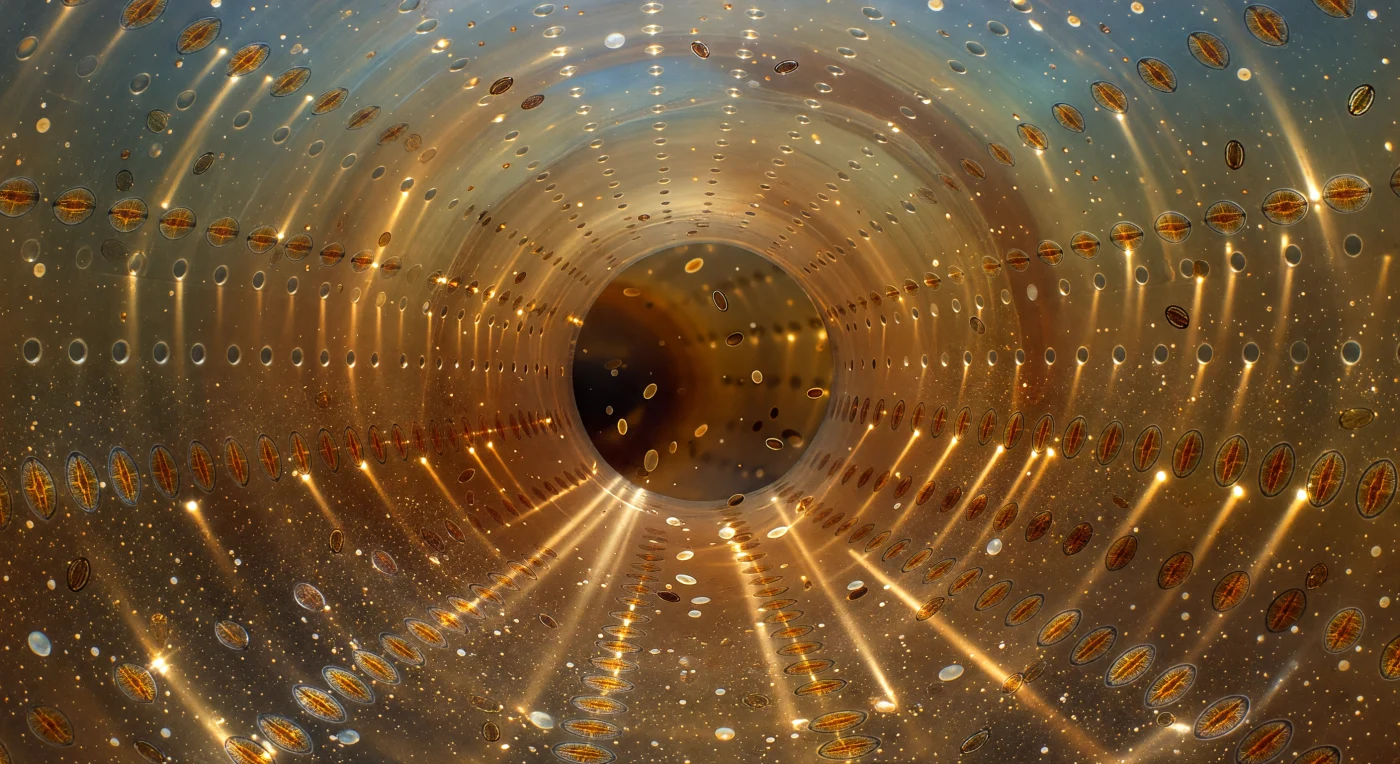
You stand inside the mineral body of a living cell — enclosed within a single chamber of an *Amphistegina lobifera* test, a vaulted cavity of semi-crystalline calcite whose amber-gold walls arch overhead like the interior of a lantern carved from warm honey glass. The walls are perforated by rows of perfectly circular pores, each admitting a needle-thin column of oceanic light that angles across the chamber floor in golden shafts, catching suspended particles in the cytoplasm and making them briefly sparkle as they drift through each beam. Arranged across the chamber floor and mid-space are the diatom symbionts — flattened ellipsoidal cells a few microns long, their deep chocolate-gold chloroplasts ordered in bilateral rows that follow the vault's curvature, their silica frustules returning the pore-light as faint iridescent shimmer along beveled edges, while between them the granular ectoplasm drifts in slow amber suspension, dense with tumbling mitochondria and opalescent lipid droplets. The entire enclosure functions as a photosynthetic nursery: the symbiotic diatoms are sequestered here by the foraminifer, harvested for the sugars their chloroplasts produce under this carefully filtered light, a metabolic partnership sustained within walls of mineral only a few microns thick. Directly ahead, the septal foramen opens as a smooth circular portal cut through the calcite partition — a gravitational focal point drawing the eye into the deeper amber-brown obscurity of the next chamber, the architecture continuing inward through rooms within rooms, each one alive.
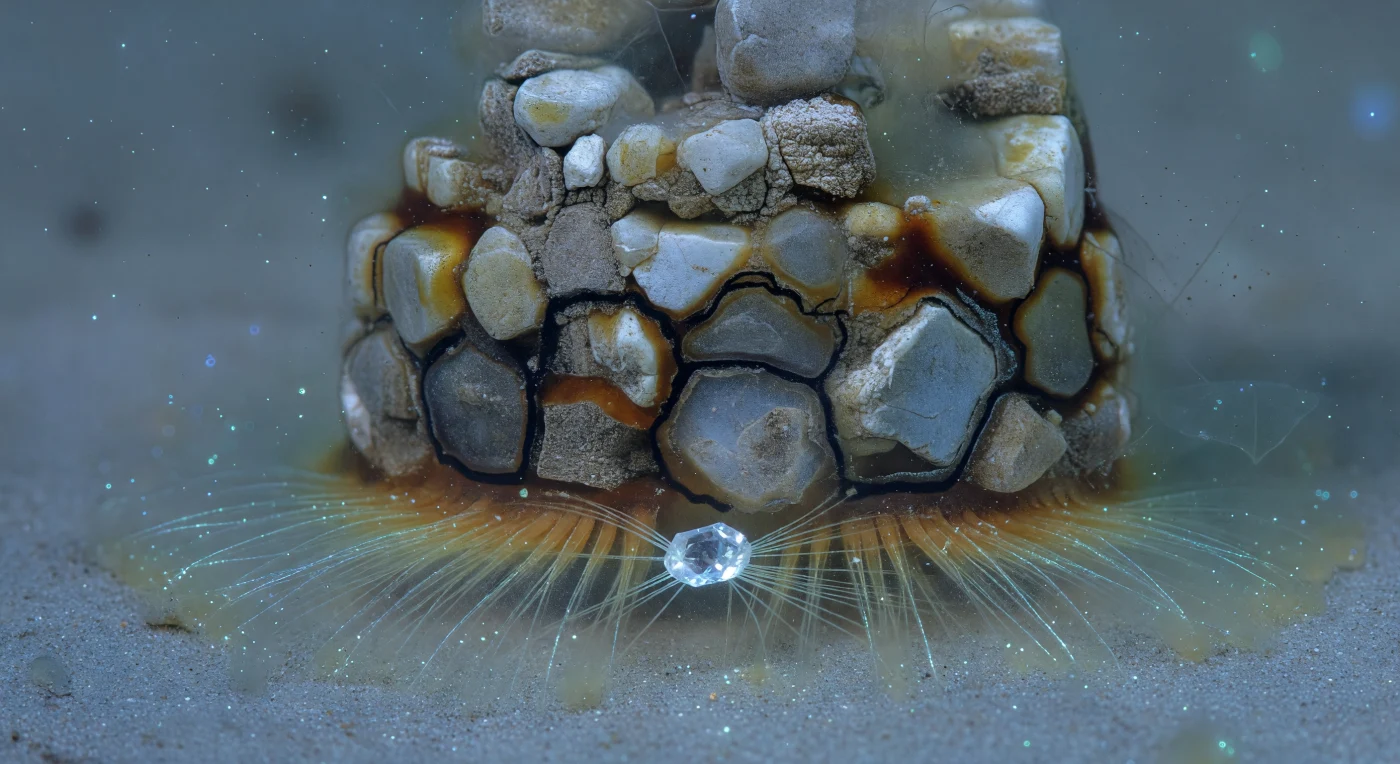
You are hovering in cold, faintly turbid seawater at the scale of a grain of fine sand, suspended in a blue-green aquatic twilight where visibility dissolves into organic haze barely two millimeters ahead, and before you a biserial tower of agglutinated mineral masonry rises to fill your field of view — each chamber a rough mosaic of angular quartz grains mortared with dark amber organic cement, the sutures between them reading like the seams of ancient stonework laid down across geological time. At the open growing end, a broad reticulopodial fan spreads outward across the silty seafloor, dozens of glistening cytoplasmic strands flowing with barely visible granular streaming as they collectively grasp, rotate, and position individual mineral grains against a ghost-thin organic template film that outlines the future chamber wall — a biological construction process operating with architectural precision at the level of a single cell. One object arrests the eye entirely: a fifteen-micrometer rhombohedral quartz crystal held in amber strands, its faces catching the diffuse blue-green light and refracting it into cold prismatic flashes, a cut gemstone being fitted with deliberate exactness into a living wall. The contrast between that geometrically perfect, glinting crystal and the rough granular mass of completed chambers above it makes visceral what foraminifera have done for hundreds of millions of years — selecting, sorting, and cementing the mineral world grain by grain into structures that will outlast the organism by epochs, eventually settling into the sediment record as some of Earth's most eloquent paleoceanographic archives.
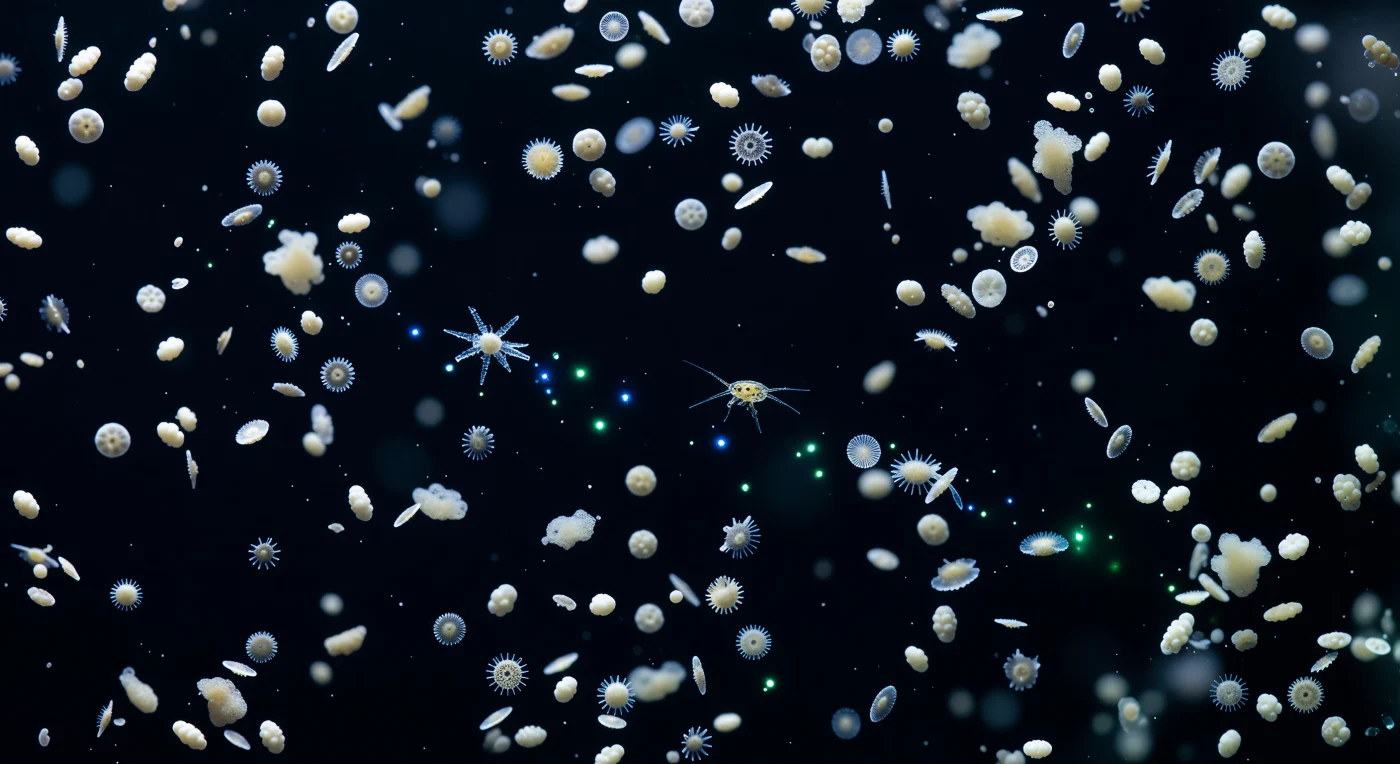
You are suspended two kilometers below the last trace of sunlight, drifting weightless in seawater so cold and still it feels like dark glass, surrounded by a snowfall that has been falling, unwitnessed, for geological ages. All around you, the dead descend: chalky-white Globigerina bulloides tumble past in lazy arcs, their clusters of globular calcite chambers returning a ghostly cream-white luminosity against the indigo-black, each test no larger than a grain of sugar, each a single cell's architectural achievement now emptied and falling toward the sediment kilometers below. Compressed lenticular Globorotalia discs flash cold silver at the edge of perception, their sharp peripheral keels catching scattered ambient light before vanishing back into shadow, while a rare spinose form drifts close trailing fractured crystalline needles — broken spine fragments refracting the darkness into hairline glints of pale blue. Between the tests drift loose flocs of marine snow, mucoid and fibrous, the organic and the mineral descending together in absolute contrast: calcite geometry against dissolving matter, the rigid suture lines of a foram wall against a shapeless smear of bacterial film. Then a single copepod cuts horizontally through the vertical cascade, and for less than a second its bioluminescent wake blooms blue-green across a dozen falling tests, illuminating their pore fields and chamber walls in sharp relief before the darkness closes again, and the slow white rain continues downward without end.
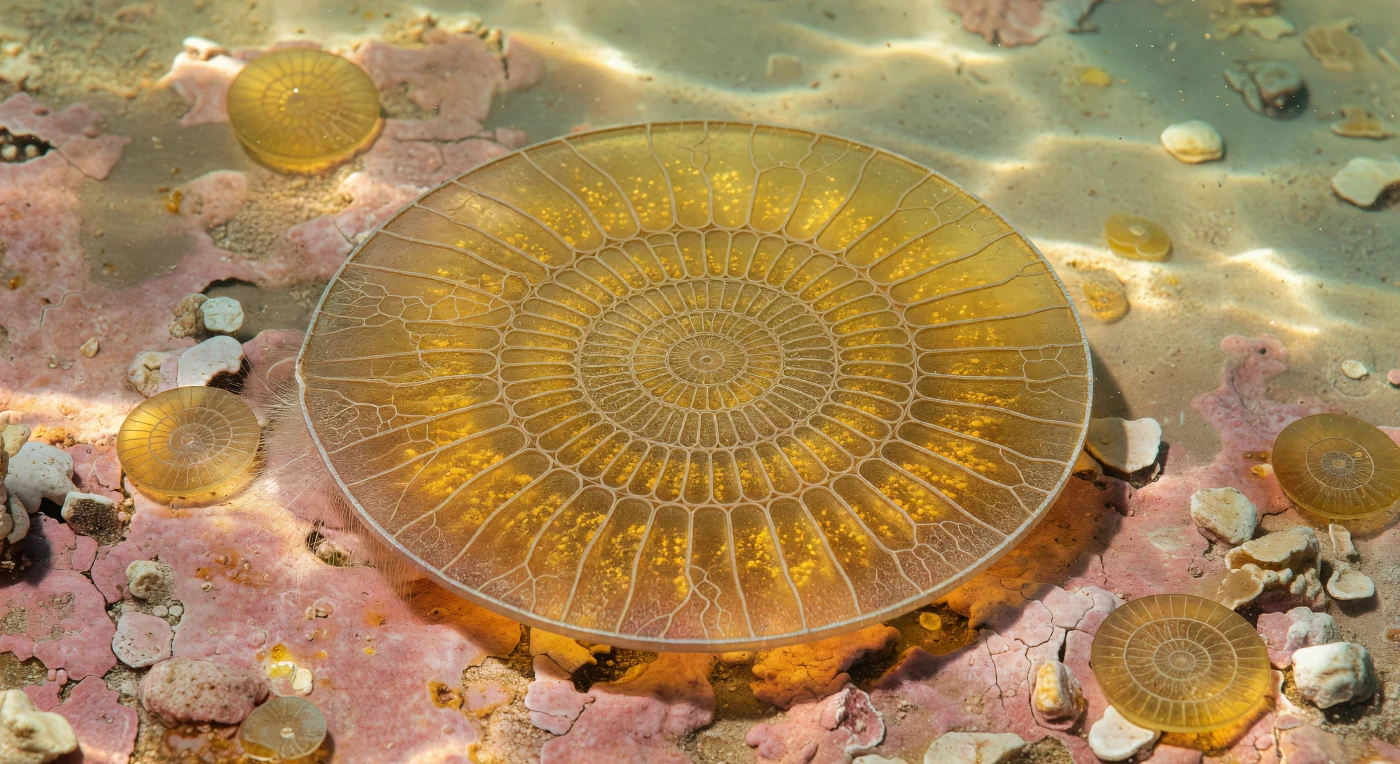
Suspended in the sun-warmed shallows of an Eocene tropical sea, you hover above a seafloor of encrusting pink coralline algae and scattered coral rubble, gazing down at a living *Nummulites gizehensis* whose lenticular disc fills your entire field of view like a burnished golden medallion — a single cell that has secreted a calcite architecture of extraordinary precision, its planispiral chambers accumulating in a logarithmic spiral that traces outward from the central boss as a breathtaking web of pale, slightly raised suture ridges, the whole surface glowing with the warm amber-gold luminescence of densely packed symbiotic dinoflagellates packed into every chamber. The hyaline calcite walls, built from calcite crystals oriented perpendicular to their surface, transmit the shifting caustic light of the water column from above in stained-glass patterns, while the marginal cord traces a crisp equatorial seam around the full circumference of the lens — a structural ridge that marks the outermost extent of a test that, in life, functions simultaneously as skeleton, greenhouse, and fortress. From one edge of the disc, nearly invisible against the bright pink substrate, hair-thin reticulopodial strands extend outward across the algal crust, the living cytoplasmic net through which this single giant cell senses, feeds, and remains anchored to the seafloor of a sea that will not exist for another thirty-four million years. Around the dominant specimen, other amber discs lie tilted and scattered across the mosaic substrate, each one a smaller iteration of the same extraordinary geometric solution to the problem of building a life at the boundary between the mineral and the living.
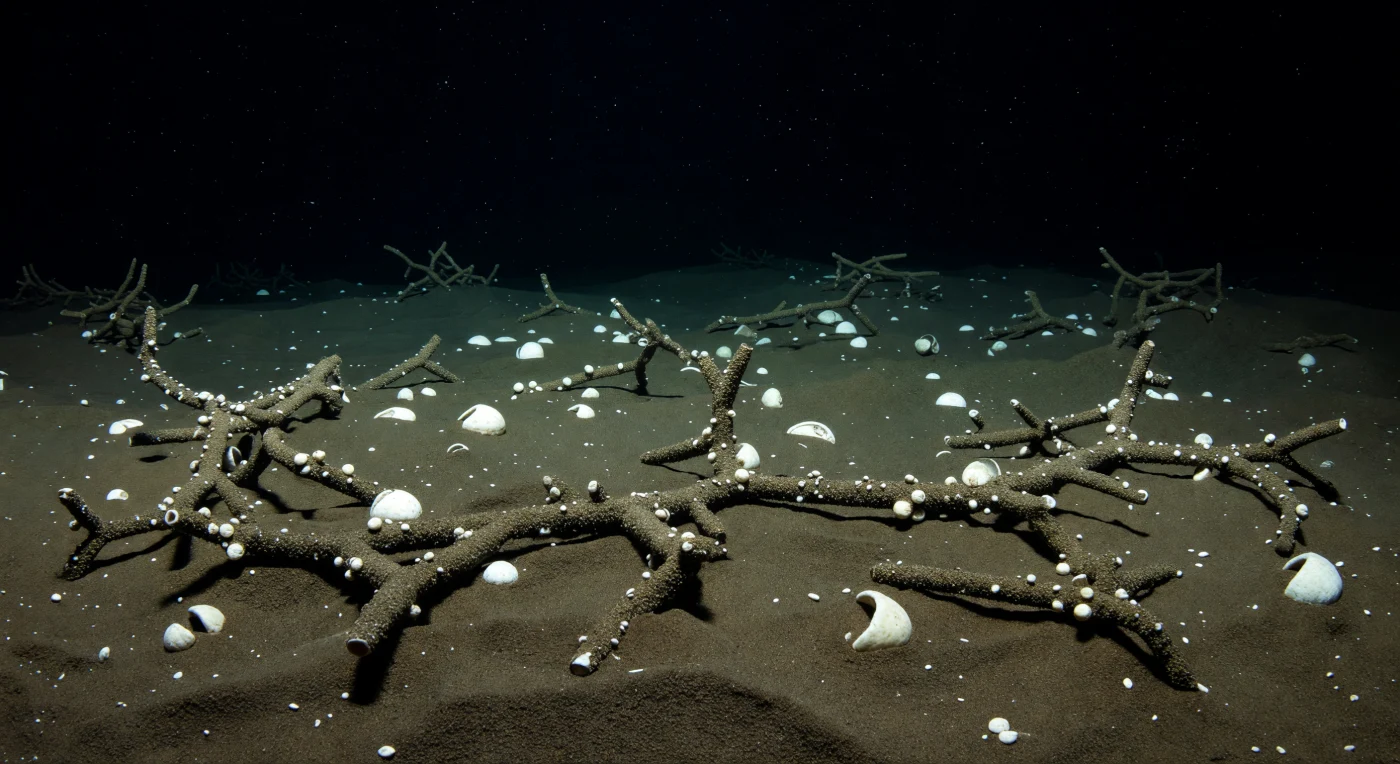
You hang suspended above a terrain that swallows light entirely, your cold beam the only thing separating structure from void: below you, the abyssal plain stretches as a velvety dark ooze of compacted silt and carbonate dust, punctuated by the tilted, milky-white tests of dead foraminifera half-claimed by sediment like the ruins of a drowned cemetery. Across this surface, a single Rhabdammina abyssorum has built its body outward in branching cylindrical tubes — each roughly 200 micrometers wide, rough-textured with coarse grains cemented in dark organic mortar of ochre and grey — the whole network lying in a sprawling, collapsed lattice that reads at this scale like a dead coral skeleton pressed flat into the ooze, its junctions swollen, its free ends sealed against the dark. Clusters of juvenile foraminifera cling to the tube walls in pale, cream-white colonies, their tiny trochospiral coils catching the cold light like fragments of chalk mortared to gravel, the entire agglutinated architecture simultaneously geological and biological — a single cell engineering its shelter grain by grain from the sediment it inhabits. Above everything, the water column presses down as absolute darkness, fine ooze particles drifting as faint suspended motes at the edge of your light before vanishing back into 4,500 meters of cold, crushing black.
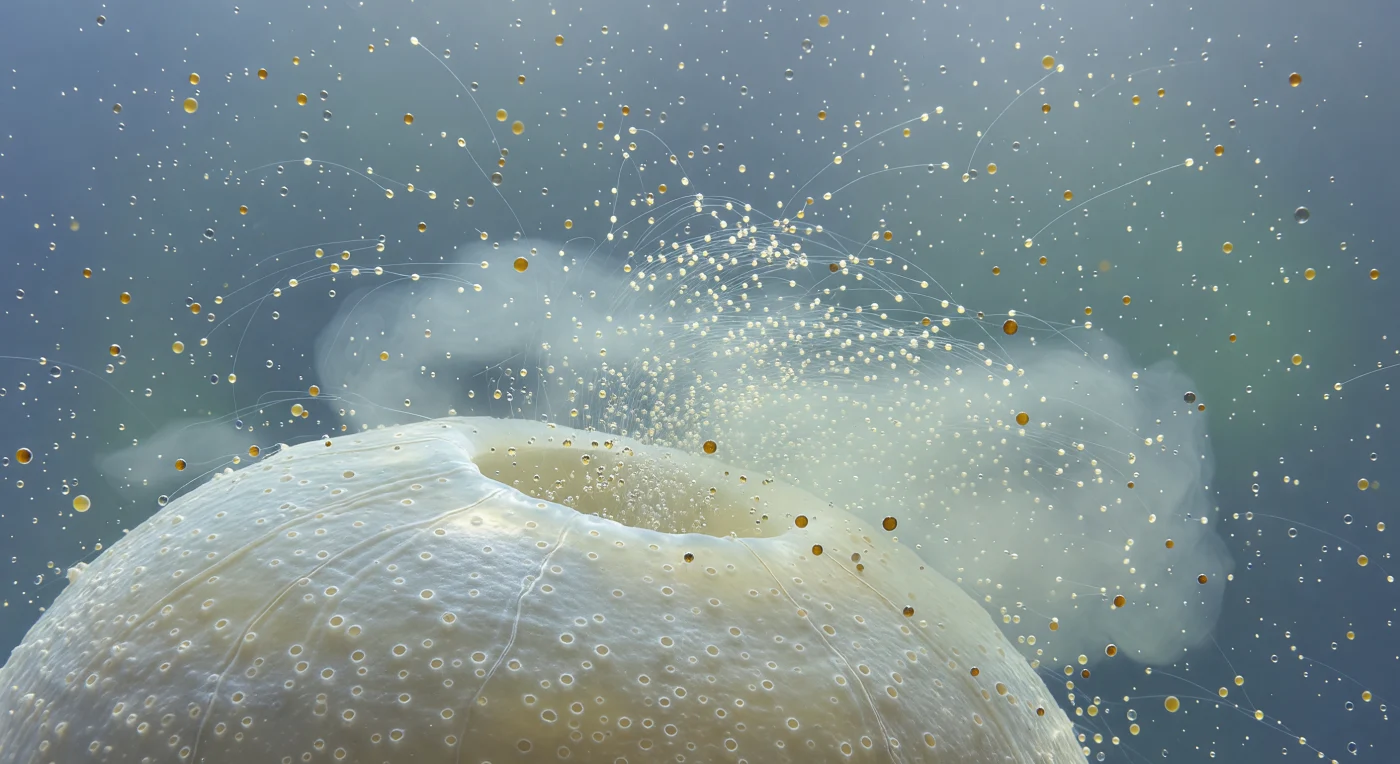
You are suspended in open water at the scale of a bacterium, and the world before you is dominated by the enormous pale facade of a single-celled organism larger than most human intuitions allow — the calcite test of *Globigerinoides sacculifer*, its creamy hyaline walls rising like a crater-pocked lunar cliff, every circular spine-scar a rimmed pit where a silica spine once anchored, the sutures between chambers curving away into blue haze like mountain ridges disappearing over a horizon. From the dark oval of the aperture — an opening that reads at this scale as a volcanic vent or cave mouth — erupts a continuous torrent of biflagellate gametes, each pale 4 µm sphere trailing two frantically beating flagella, pouring outward in their thousands and collectively forming an expanding milky-white cloud that turbidifies the surrounding water column into something pearlescent and opaque, a fog bank of biological material emanating from a single reproductive event. Interspersed through this pale cascade drift the released zooxanthellae, each a golden-brown sphere roughly twice the gametes' size, their photosynthetic pigments concentrating the diffuse blue-green ambient light into warm amber tones that contrast sharply with the cold milky fog around them. Between these drifting spheres, translucent lipid droplets catch stray light as brief iridescent glints, pale oil beads tumbling slowly past in the diffuse radiance. What you witness is gametogenesis — the terminal reproductive act of a planktonic protist dismantling itself entirely, shedding its symbionts, dissolving its cytoplasm into thousands of independent swimmers, and releasing them into an ocean three orders of magnitude larger than the organism that made them.
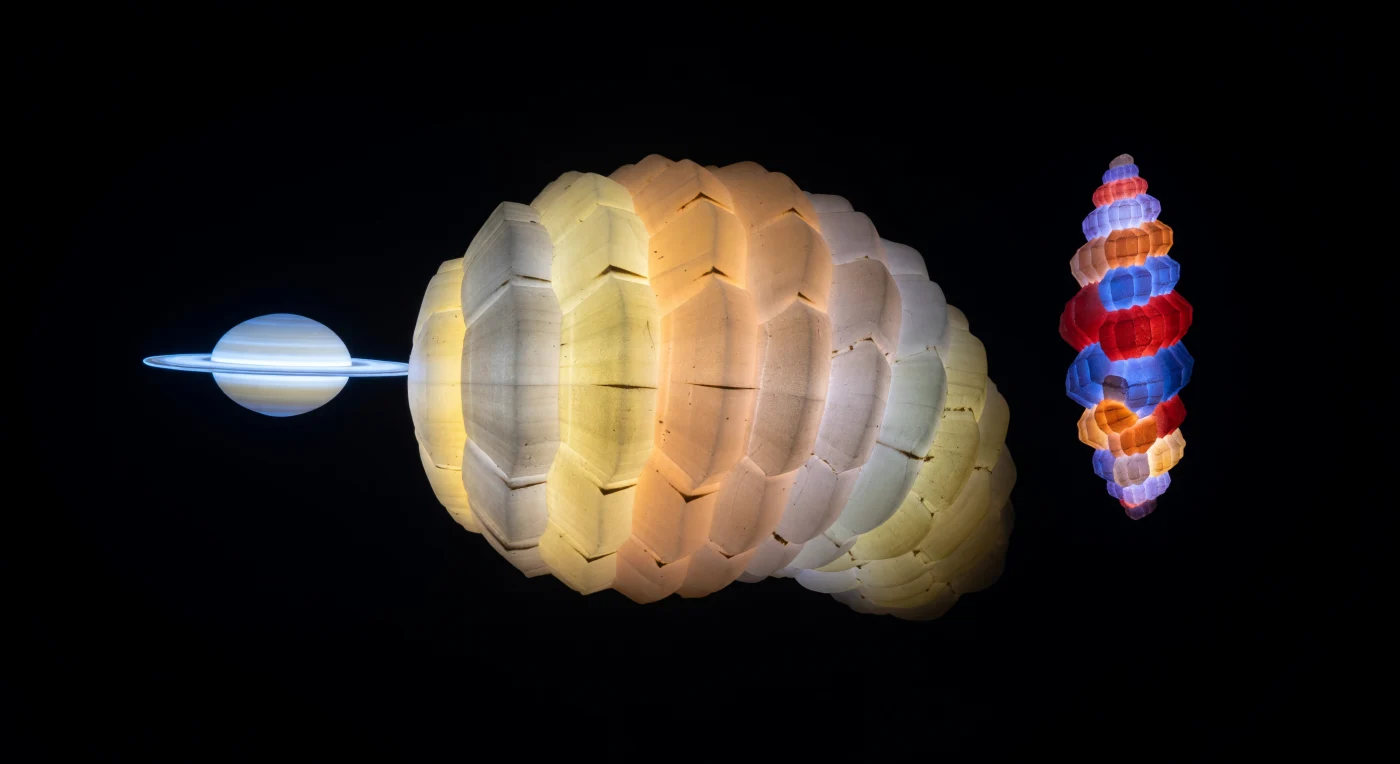
You are floating inside a perfect optical void, a darkness that has no equivalent in the natural world — not the dark of ocean depths or unlit caves, but the absolute extinction of polarized light itself, and from within it, the foraminifera around you burn like self-illuminating architecture. The curved chambers of a *Globigerina* test rise at cathedral scale before you, each calcite domain glowing in warm first-order yellows and pale tangerine where the crystal lattice thickens, cooling to cream-white at the sutures, the entire coiled geometry reading as a stained-glass basilica lit not by any external source but purely by the physics of crystallographic orientation speaking through crossed polarizing fields. Nearby, the compressed keel of a *Globorotalia* disc blazes with electric blue-white — a geometrically sharp mineral blade only micrometers thick, its interference color maximized along its entire length like the arc of a welding torch — while at the assemblage's edge, a *Textularia* column rises as a mosaic of deep crimson, sapphire, and burnt orange, each cemented quartz grain glowing in its own crystallographic direction, a record of individual mineral histories rather than biological intent. Against all of this chromatic fire, the *Quinqueloculina* test beside them registers as the most absolute darkness in the field: its porcelaneous calcite, randomly oriented, extinguishes every photon of polarized light that passes through it, rendering the most geometrically complex shell in the assemblage as a perfect, matte black silhouette — the most beautiful absence in a world defined entirely by the presence or extinction of light.
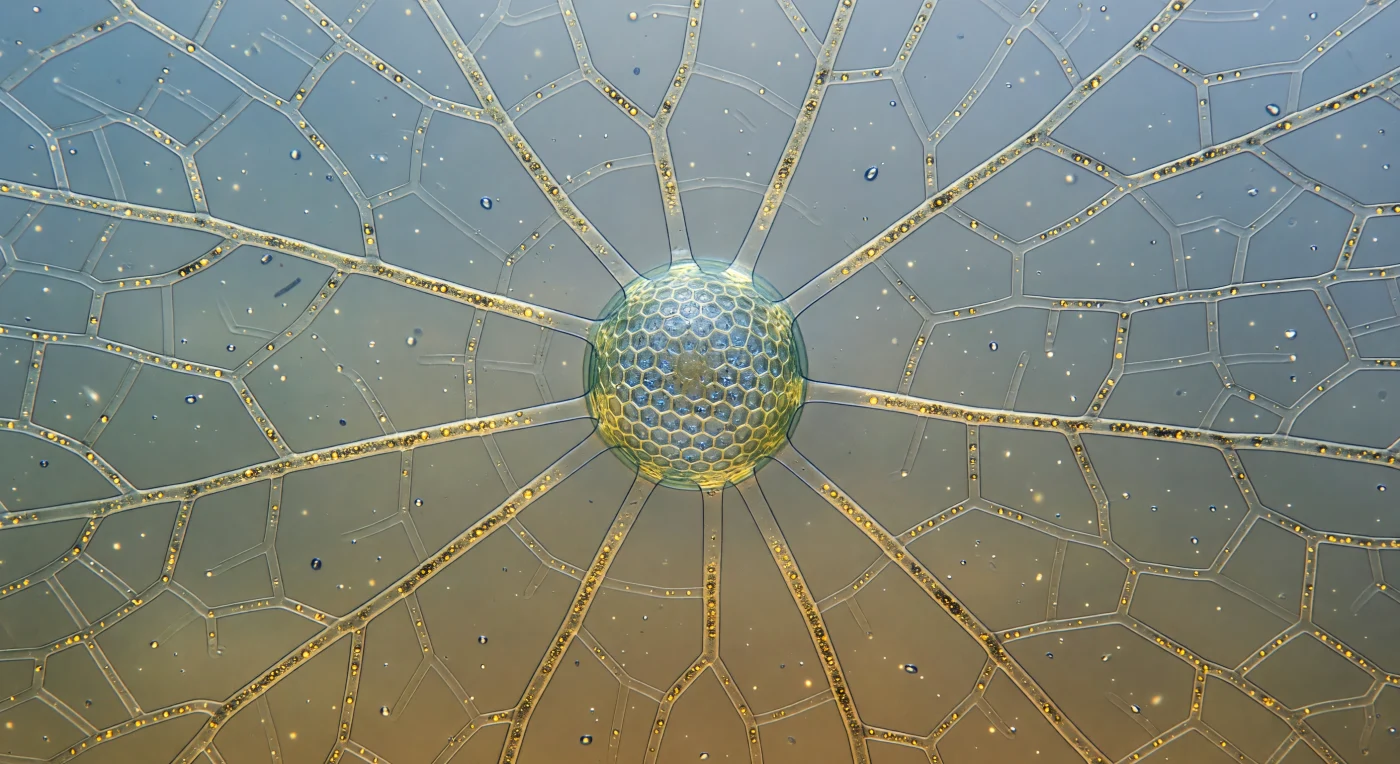
You are suspended inside a living net that has no edge — a three-dimensional lacework of amber-translucent strands extending in every direction through blue-green seawater so thick with diffusion it reads as a faintly luminous gel, each hair-fine filament less than a micron wide yet visibly alive with twin rivers of dark golden granules rolling simultaneously inward and outward along its interior, the bidirectional streaming of cytoplasm that is both the circulatory system and the muscular apparatus of a single cell doing everything at once. These are reticulopodia, the pseudopodial extensions of a benthic foraminifera, and they are not merely passive threads but active structures capable of fusing at nodes — anastomosing junctions that flare briefly brighter where strands merge and catch the dim downwelling light like beads of resin, building and rebuilding a net that functions simultaneously as road, hand, stomach, and chemical sensor across hundreds of microns of sediment surface. At the center of your field, commanding attention with the optical authority of fine glass, a Thalassiosira diatom hangs motionless — a twenty-micron silica cylinder whose disc faces are etched with hexagonal pore arrays so geometrically precise they read as engineered architecture, each pore scattering the ambient blue-white light inward as a cold constellation against the biological warmth of the surrounding cytoplasm. Six reticulopodial strands have already contacted its girdle and are spreading laterally, their amber cytoplasm flattening into a thin translucent film that creeps across the silica wall while, on the far side, the earliest membrane of a food vacuole has begun to close around it — a difference in refractive index barely distinguishable from its surroundings, like a soap bubble forming in absolute silence around a gemstone, the whole process unfolding in a medium where viscosity and surface chemistry govern every motion and gravity has ceased to matter.
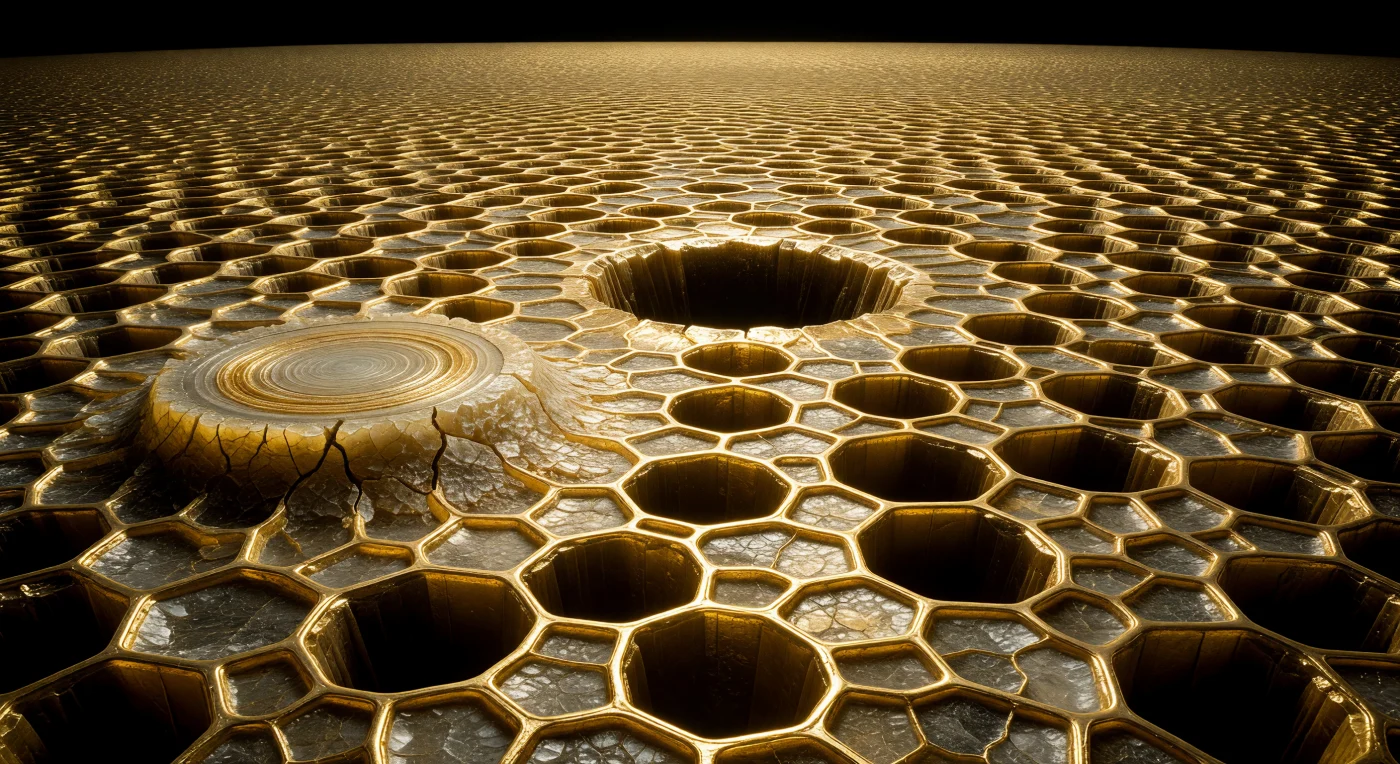
You stand on what appears to be a vast planetary surface of burnished gold, stretching to every horizon with perfect sharpness — for here, in the vacuum world of the scanning electron microscope, there is no atmosphere to soften distance, no scattering of light, only the hard geometry of gold-sputter-coated calcite rendered in infinite depth of field. The surface belongs to the test wall of a foraminifera, and what reads as a landscape of cracked earth — anastomosing ridges forming irregular polygonal cells, each edge a blade of bright gold above a shadow-filled valley — is in fact the cancellate ultrastructure of a single-celled organism's mineralized skeleton, built from calcite crystals whose c-axes align perpendicular to the wall with a precision that rivals engineered materials. Dominating the middle ground, and repeating in a near-hexagonal lattice across the entire plain, circular pore craters punch through the surface at mathematically regular intervals — each roughly three micrometers across, rimmed with a smoothly raised collar that catches the electron beam as a bright gold arc before the inner wall curves away into absolute black, these pores being the transcellular conduits through which reticulopodia once streamed outward into the sea as a living, shifting net of pseudopods. To one side, a fractured spine base rises as a circular mound exposing its interior in cross-section, concentric growth rings preserved in the calcite like mineral tree rings, each annular layer a slightly different tone of gold against the cooler, granular texture of the uncoated interior — a frozen record of the cell's own biomineralization sequence, now silent and perfect in the sourceless amber glow of a world reduced to geometry and shadow.
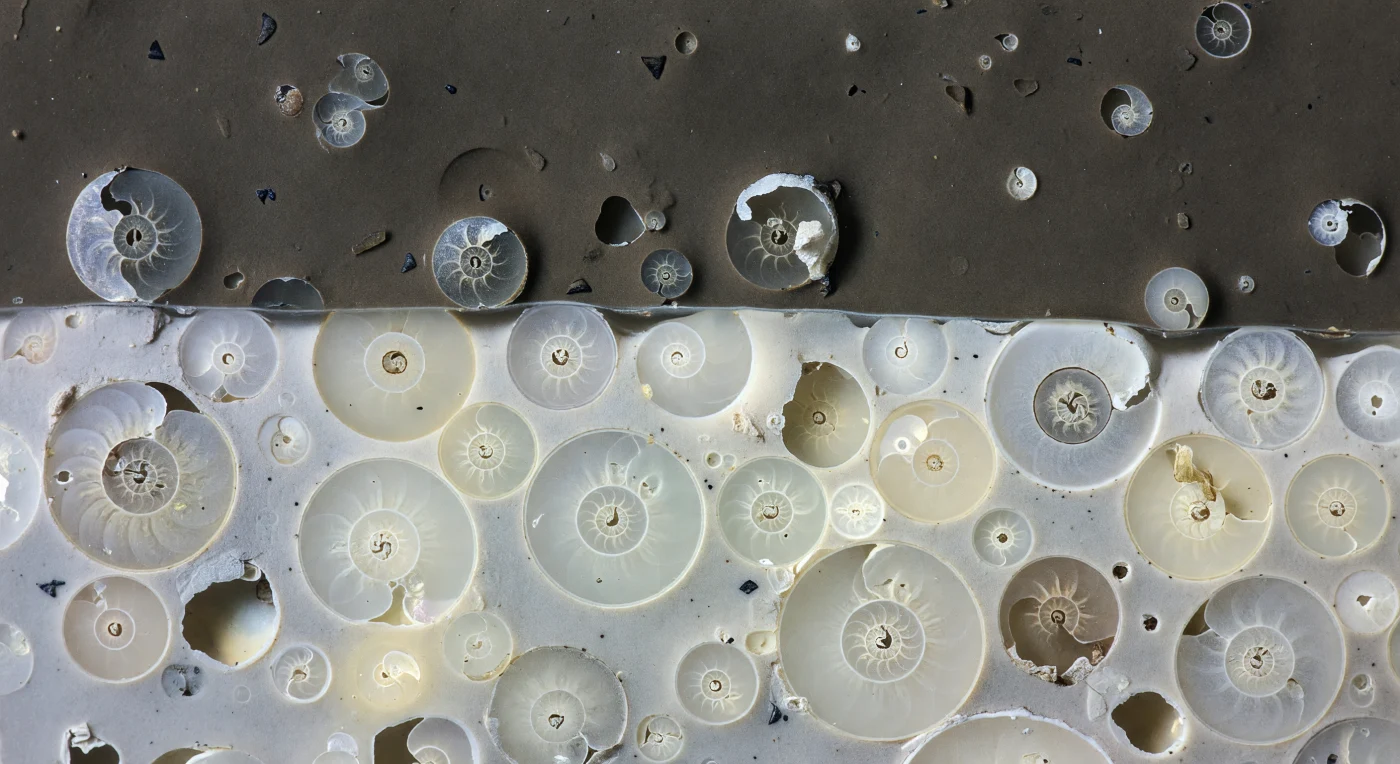
You are pressed flat against a freshly cleaved face of deep-sea sediment like an observer pinned to a cliff of compressed geological time, the cut surface stretching before you in two worlds divided by a single, nearly horizontal line less than a millimeter thick. Below that boundary, the sediment glows pale cream and ivory — a densely packed mosaic of foraminifera tests sliced open at every angle, their internal calcite chamber walls curving in perfect spirals, each foraminal opening a small dark hollow in a crystalline partition, the surrounding matrix a fine white powder of coccolithophore debris that catches the cool light with a faint birefringent shimmer of pale gold and silver where fresh crystal faces were exposed by the cut. Above the boundary, everything shifts abruptly to deep brownish-grey clay, matte and light-absorbing, where fewer foram tests survive and those that remain are ghost versions of their former selves — walls thinned and translucent, sutures widened into open grooves, pore walls ragged where carbonate dissolution retreated the calcite crystal by crystal over thousands of years. Scattered through this darker zone, tiny black triangular shards of phosphatic fish teeth lie pristine and geometrically sharp, chemically inert and utterly indifferent to the dissolution that consumed the carbonates around them, their resistance a quiet record of the ocean chemistry that defined this moment. This boundary is not merely a color change but a preserved threshold in Earth's climate history — the transition from a warm interglacial ocean saturated with calcium carbonate and alive with calcifying plankton, to a colder glacial interval where deepwater corrosivity rose and the seafloor began dissolving what life had built.
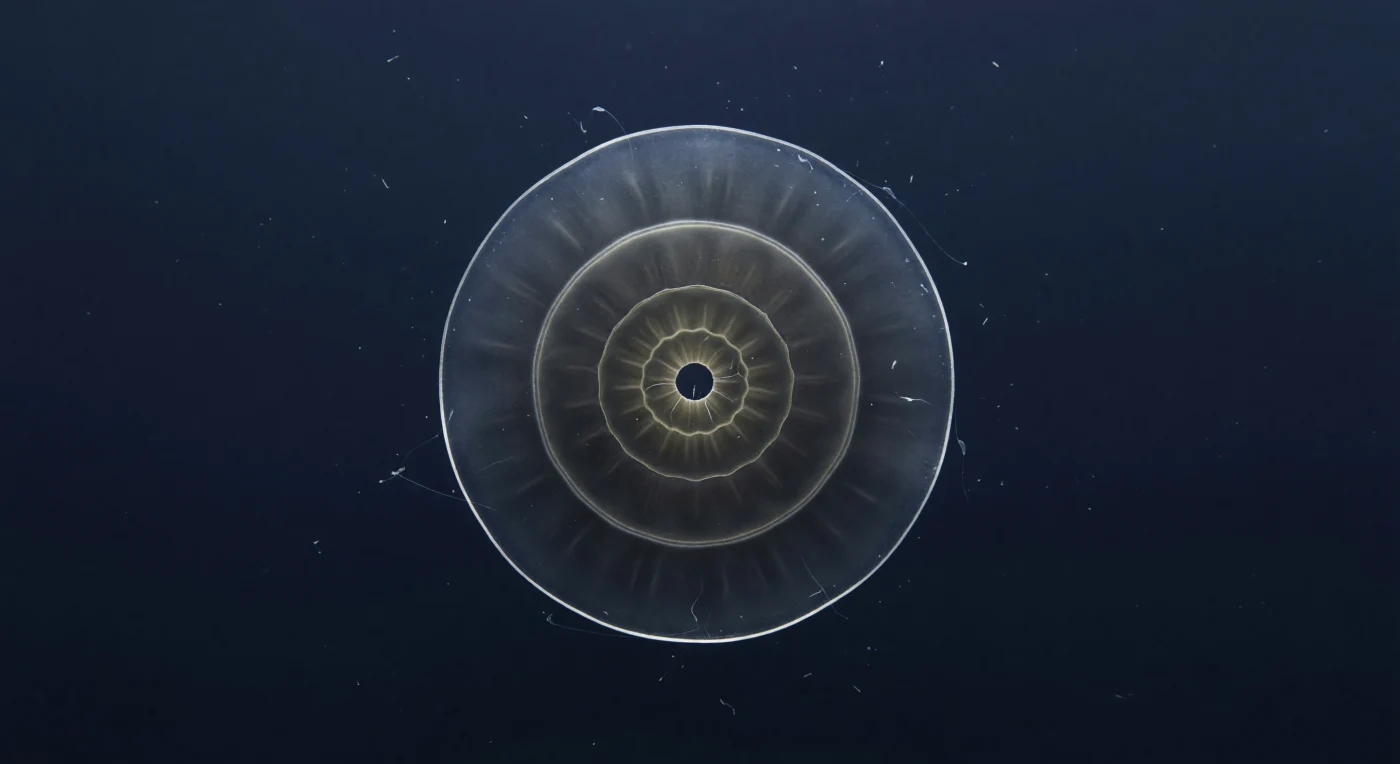
You float in near-absolute darkness at two hundred metres depth, suspended in water so cold it registers as physical pressure against every surface, the light above you reduced to a faint blue-grey luminescence that barely separates the vertical from the horizontal. Before you, resolving slowly from the indigo gloom, is a disc of frosted calcite roughly the apparent size of a dinner plate held at arm's length — Globorotalia menardii, oriented ventral face toward you, its tightly wound trochospiral architecture of overlapping chambers reading as gently lobed arcs pressed into smooth hyaline walls the colour of old bone, the boundaries between chambers marked by backward-curving depressed sutures that darken toward the central umbilical pit, itself a small circle of absolute black from which two or three hair-fine reticulopodial strands extend into the surrounding cold, barely visible except where the ambient blue catches their refractive edges. Around the entire equatorial rim of the compressed biconvex test runs the organism's defining structure: a continuous keel of calcite so thin and crystallographically pure it approaches transparency, projecting perpendicular to the disc like the blade of a tool, and where the sparse downwelling light strikes it at grazing incidence it ignites into a single unbroken ring of cold blue-silver radiance — the sharpest edge in an otherwise edgeless world. This keel is not ornament but engineering, a peripheral reinforcement that stiffens the test against hydrostatic pressure at depth and likely functions as a hydrodynamic stabiliser during the slow passive sinking and rising that carries these organisms through the water column across their entire life cycle, their calcite chemistry encoding, layer by layer, a record of the temperatures and carbon isotope ratios of waters that no instrument existed to measure when these animals were alive.
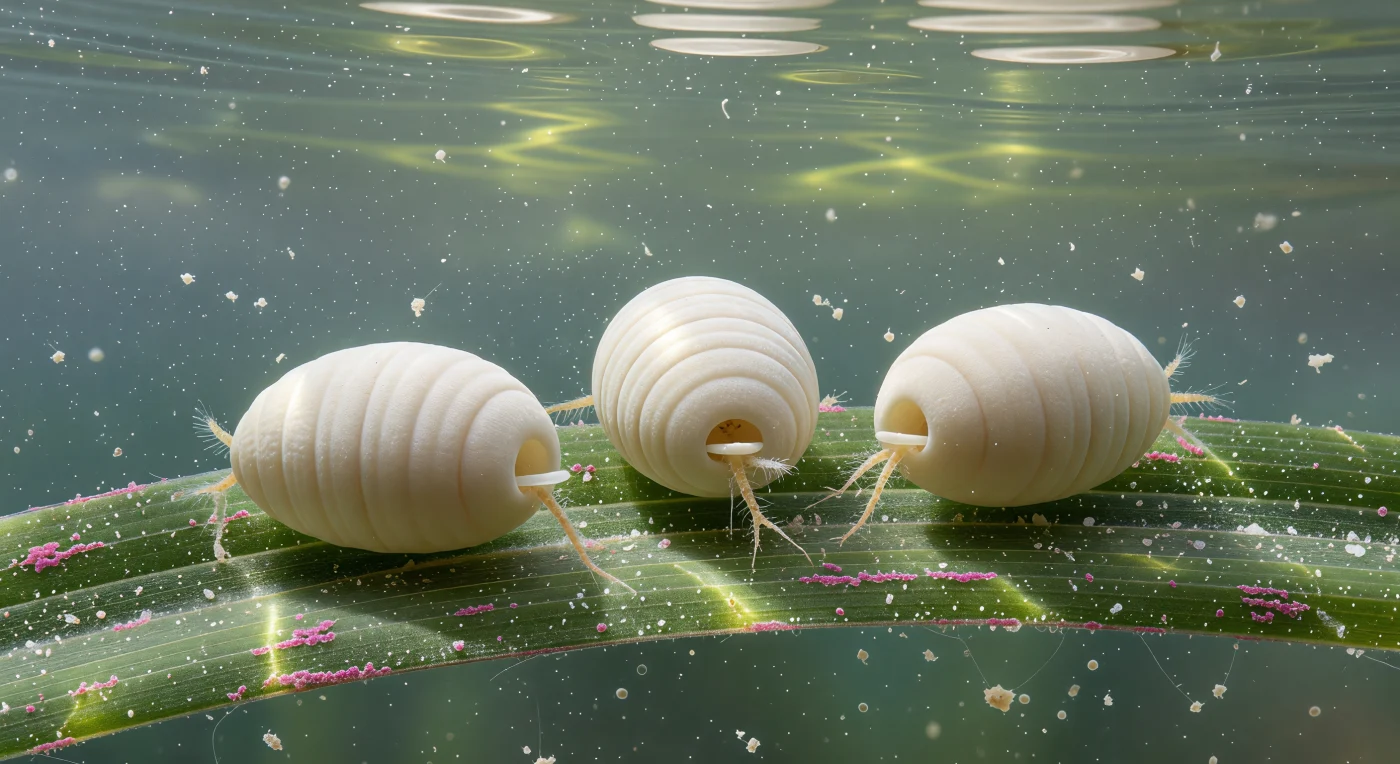
You drift at the level of a single *Posidonia* leaf, and the world before you is defined by three enormous ivory monuments rising from a green and pink plain — *Quinqueloculina seminulum* tests, each an elongated ovoid of dense, imperforate porcelaneous calcite whose cream-white walls scatter light rather than transmit it, giving them the opaque, matte solidity of unglazed ceramic rather than anything glassy or translucent. Their surfaces are wrapped in the characteristic quinqueloculine suture ridges — smooth seams spiraling around each test in offset planes, the calcite needles packed randomly into a tight fabric that catches the slow caustic sweeps of refracted surface light as a faint silky sheen, each ridge casting a shallow shadow and holding a thin highlight along its crest, so the whole body reads as precise mineral topography. From each aperture, framed by a small projecting tooth of pale calcite, stubby amber reticulopodia extend outward — granular with streaming endoplasm, branching into fine tendrils that make contact with the biofilm coating the seagrass blade below, probing for the bacteria and organic particles that constitute their food in this shallow, sun-warmed coastal sea. Beneath the tests, encrusting coralline algae paint the older portions of the leaf in knobbled magenta and pink, their calcified surfaces offering a vivid textural and chromatic contrast to the smooth ivory walls resting upon them, while the seagrass veins run beneath everything like low topographic rails, trapping angular quartz grains that glint in the green-lit water. Above, the sea surface shimmers as an undulating silver-green ceiling, its light threading down through five meters of warm water to illuminate this dense, mineral, utterly precise world at the boundary between the living leaf and the open sea.
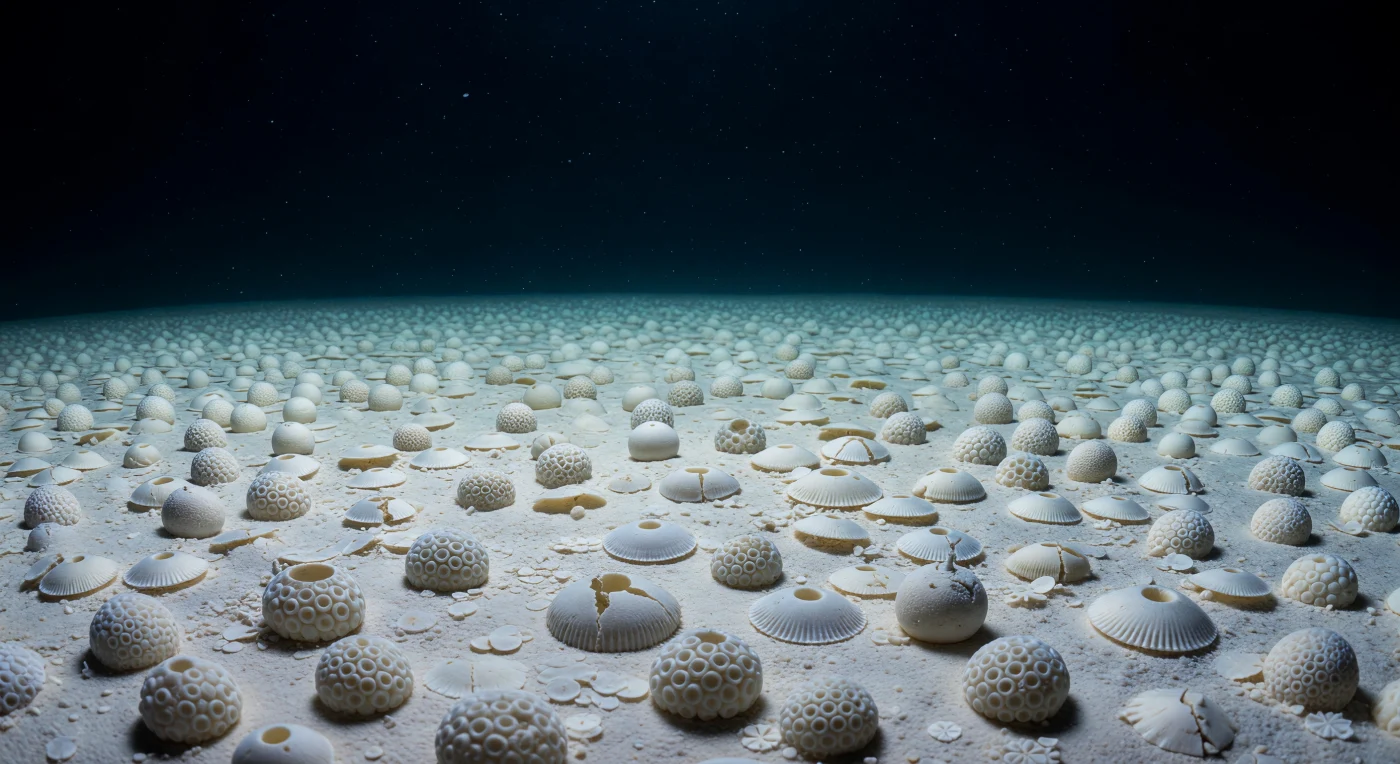
Beneath you, the abyssal seafloor resolves not as mud but as an unbroken mosaic of calcite architecture — thousands of foraminiferan tests pressed together across every visible surface, each one a distinct sculptural object built by a single cell now long vanished, their collective pale ivory luminosity glowing softly against the absolute black of the water column pressing down from above. Globigerina bulloides rise in globose clusters of interconnected spherical chambers, their pore-riddled surfaces giving them a matte, chalky texture; beside them, Globorotalia menardii lies blade-flat, its sharp peripheral keel catching the dim light as a hairline of brighter white, while perfect spheres of Orbulina universa rest like frosted marbles, their broken spine stumps projecting into the water as a faint bristled halo. Every interstice between the tests is packed with coccolithophore debris — the disaggregated calcite platelets of Emiliania and Coccolithus, ground to a near-powder that fills the gaps like white mortar between cobblestones, smoothing the surface into something lunar and self-luminous. This is globigerina ooze: a sediment composed almost entirely of biological calcium carbonate, a million-year archive of dissolved surface-ocean history laid down at a rate of centimeters per millennium, silent and pressurized and cold, every shell a chemical message from a sea surface that no longer exists.
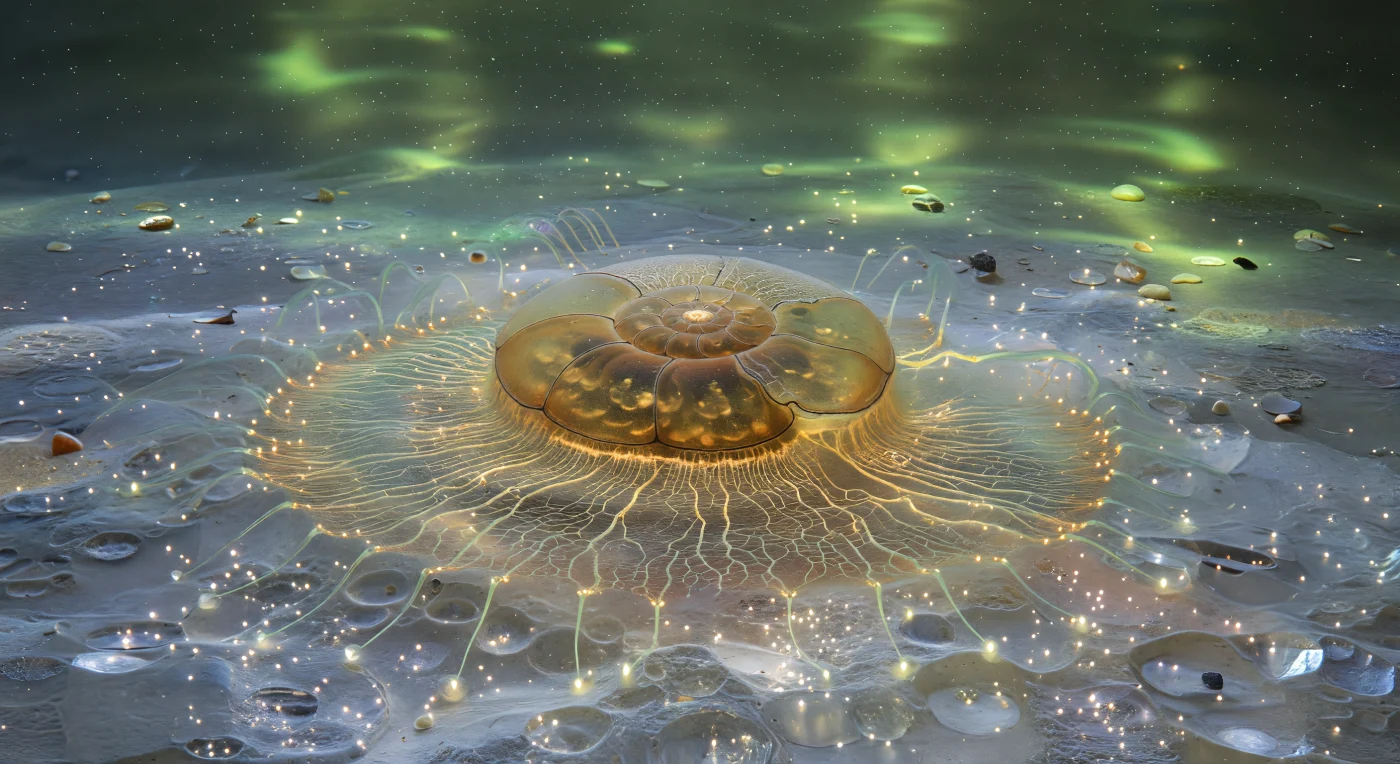
You hang suspended just above a vast frosted plain that stretches to every horizon — the surface of a single quartz grain, its interior alive with refracted shallow-water sunlight that throws cold starbursts and amber glints across a topography of glassy craters, conchoidal scarps, and polished plateaus as dramatic at this vantage as a mountain range seen from low altitude. At the center of this mineral landscape, a living Rosalina globularis commands the scene: its flat trochospiral test — six gently inflated chambers of translucent hyaline calcite arranged in a low coil, glowing amber-green as diffuse green-teal light passes through walls only microns thick — slides forward across the grain on a broad reticulopodial sheet that spreads beneath it like a shifting stained-glass carpet, each cytoplasmic strand a fraction of a micrometer wide yet fusing with its neighbors in a continuously rewiring anastomosing mesh that grips the mineral surface at dozens of adhesion points simultaneously. This is foraminiferal locomotion in its full physical reality: the leading fans of the net dissolve into near-invisibility as they probe forward over the quartz facets, while the trailing strands lift away and retract, leaving faint iridescent mucus traces — hairline threads of interference color shifting from violet to pale gold — that record the organism's passage across the grain. A single cell, housed in a calcite architecture it secreted chamber by chamber over weeks, is actively navigating a sediment landscape it experiences as a complex three-dimensional terrain, its reticulopodia simultaneously serving as locomotor apparatus, prey-capture net, and sensory interface with the mineral and chemical world of the seafloor.