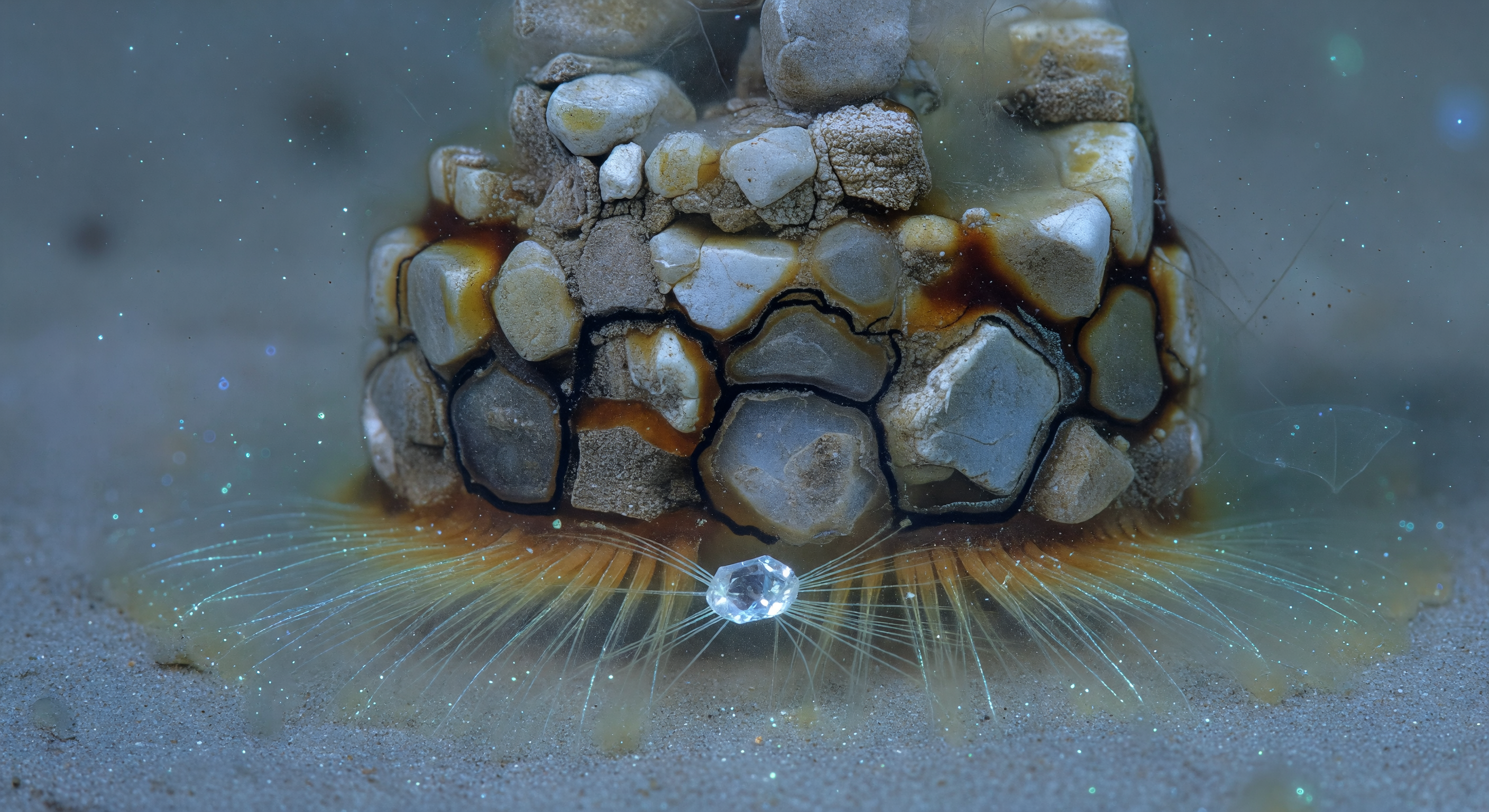
You are hovering in cold, faintly turbid seawater at the scale of a grain of fine sand, suspended in a blue-green aquatic twilight where visibility dissolves into organic haze barely two millimeters ahead, and before you a biserial tower of agglutinated mineral masonry rises to fill your field of view — each chamber a rough mosaic of angular quartz grains mortared with dark amber organic cement, the sutures between them reading like the seams of ancient stonework laid down across geological time. At the open growing end, a broad reticulopodial fan spreads outward across the silty seafloor, dozens of glistening cytoplasmic strands flowing with barely visible granular streaming as they collectively grasp, rotate, and position individual mineral grains against a ghost-thin organic template film that outlines the future chamber wall — a biological construction process operating with architectural precision at the level of a single cell. One object arrests the eye entirely: a fifteen-micrometer rhombohedral quartz crystal held in amber strands, its faces catching the diffuse blue-green light and refracting it into cold prismatic flashes, a cut gemstone being fitted with deliberate exactness into a living wall. The contrast between that geometrically perfect, glinting crystal and the rough granular mass of completed chambers above it makes visceral what foraminifera have done for hundreds of millions of years — selecting, sorting, and cementing the mineral world grain by grain into structures that will outlast the organism by epochs, eventually settling into the sediment record as some of Earth's most eloquent paleoceanographic archives.
Other languages
- Français: Mur Agglutiné en Chantier
- Español: Muro Aglutinado en Construcción
- Português: Parede Aglutinada em Construção
- Deutsch: Agglutinierte Mauer im Bau
- العربية: جدار ملتصق قيد البناء
- हिन्दी: निर्माणाधीन संयुक्त दीवार
- 日本語: 膠着壁の建設中
- 한국어: 건설 중인 교결 벽
- Italiano: Muro Agglutinato in Costruzione
- Nederlands: Geaggluteende Muur in Aanbouw