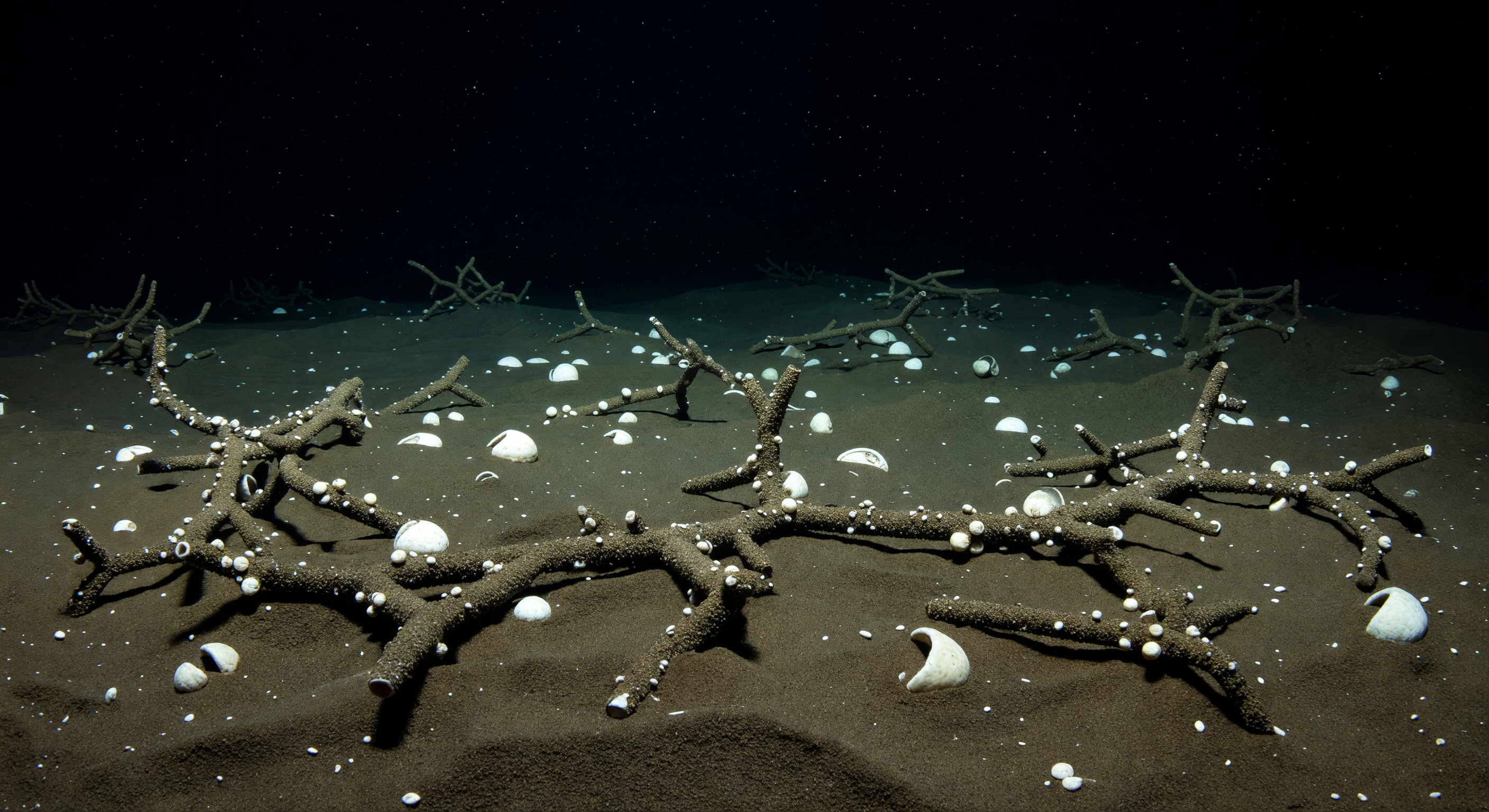
You hang suspended above a terrain that swallows light entirely, your cold beam the only thing separating structure from void: below you, the abyssal plain stretches as a velvety dark ooze of compacted silt and carbonate dust, punctuated by the tilted, milky-white tests of dead foraminifera half-claimed by sediment like the ruins of a drowned cemetery. Across this surface, a single Rhabdammina abyssorum has built its body outward in branching cylindrical tubes — each roughly 200 micrometers wide, rough-textured with coarse grains cemented in dark organic mortar of ochre and grey — the whole network lying in a sprawling, collapsed lattice that reads at this scale like a dead coral skeleton pressed flat into the ooze, its junctions swollen, its free ends sealed against the dark. Clusters of juvenile foraminifera cling to the tube walls in pale, cream-white colonies, their tiny trochospiral coils catching the cold light like fragments of chalk mortared to gravel, the entire agglutinated architecture simultaneously geological and biological — a single cell engineering its shelter grain by grain from the sediment it inhabits. Above everything, the water column presses down as absolute darkness, fine ooze particles drifting as faint suspended motes at the edge of your light before vanishing back into 4,500 meters of cold, crushing black.
Other languages
- Français: Vase Abyssale, Tubes Rhabdammina
- Español: Limo Abisal, Tubos Rhabdammina
- Português: Lodo Abissal, Tubos Rhabdammina
- Deutsch: TiefseeSchlamm, Rhabdammina Röhren
- العربية: وحل هاوية، أنابيب رابدامينا
- हिन्दी: अगाध कीचड़, रैब्डामिना नलिकाएं
- 日本語: 深海泥、ラブダミナ管
- 한국어: 심해 연니, 랍다미나 관
- Italiano: Melma Abissale, Tubi Rhabdammina
- Nederlands: Abyssale Slib, Rhabdammina Buizen