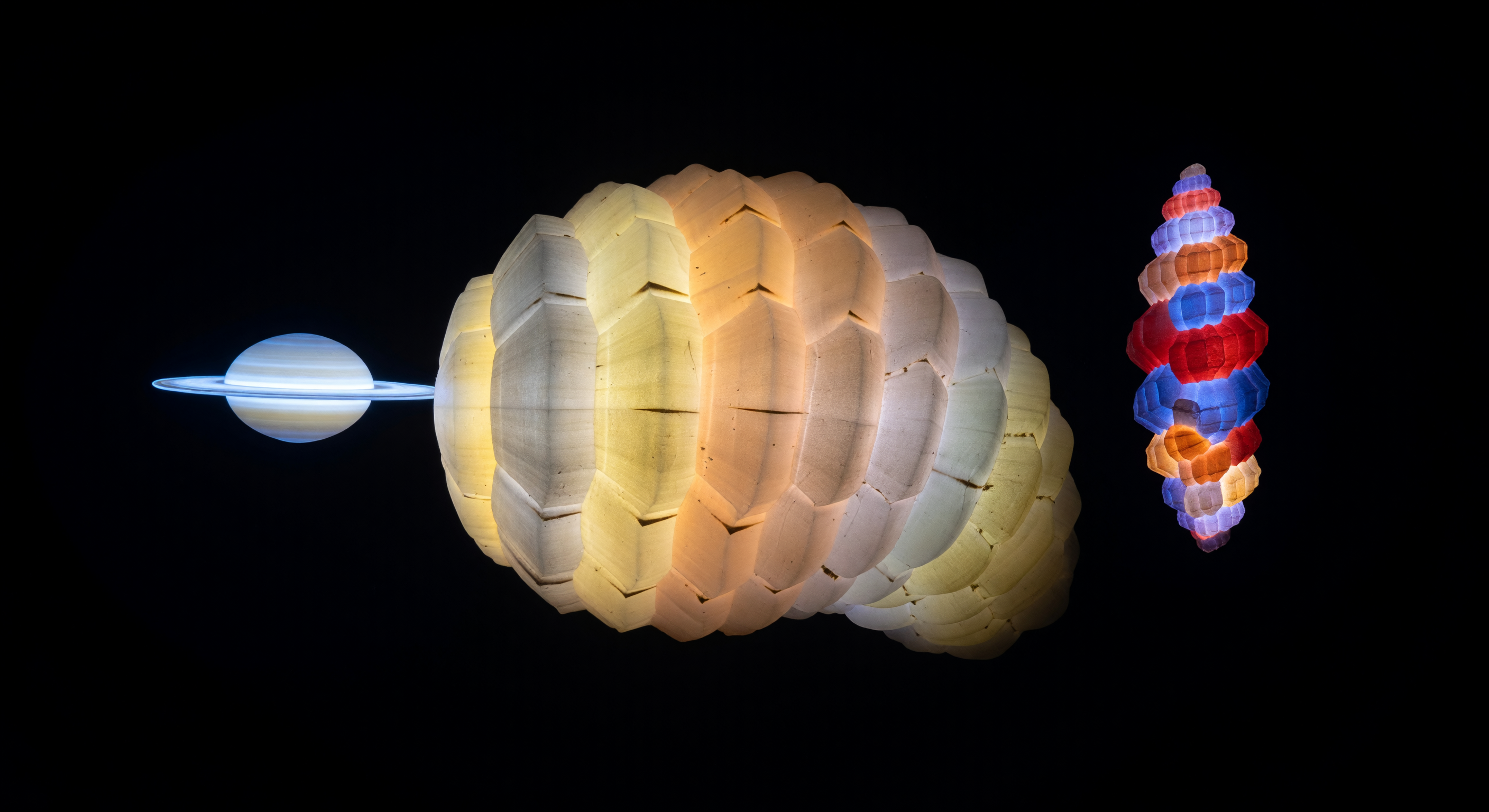
You are floating inside a perfect optical void, a darkness that has no equivalent in the natural world — not the dark of ocean depths or unlit caves, but the absolute extinction of polarized light itself, and from within it, the foraminifera around you burn like self-illuminating architecture. The curved chambers of a *Globigerina* test rise at cathedral scale before you, each calcite domain glowing in warm first-order yellows and pale tangerine where the crystal lattice thickens, cooling to cream-white at the sutures, the entire coiled geometry reading as a stained-glass basilica lit not by any external source but purely by the physics of crystallographic orientation speaking through crossed polarizing fields. Nearby, the compressed keel of a *Globorotalia* disc blazes with electric blue-white — a geometrically sharp mineral blade only micrometers thick, its interference color maximized along its entire length like the arc of a welding torch — while at the assemblage's edge, a *Textularia* column rises as a mosaic of deep crimson, sapphire, and burnt orange, each cemented quartz grain glowing in its own crystallographic direction, a record of individual mineral histories rather than biological intent. Against all of this chromatic fire, the *Quinqueloculina* test beside them registers as the most absolute darkness in the field: its porcelaneous calcite, randomly oriented, extinguishes every photon of polarized light that passes through it, rendering the most geometrically complex shell in the assemblage as a perfect, matte black silhouette — the most beautiful absence in a world defined entirely by the presence or extinction of light.
Other languages
- Français: Constellation Lumière Polarisée
- Español: Constelación de Luz Polarizada
- Português: Constelação de Luz Polarizada
- Deutsch: Polarisiertes Licht Konstellation
- العربية: كوكبة الضوء المستقطب
- हिन्दी: ध्रुवीकृत प्रकाश नक्षत्र
- 日本語: 偏光の星座
- 한국어: 편광 별자리
- Italiano: Costellazione di Luce Polarizzata
- Nederlands: Gepoleerd Licht Constellatie