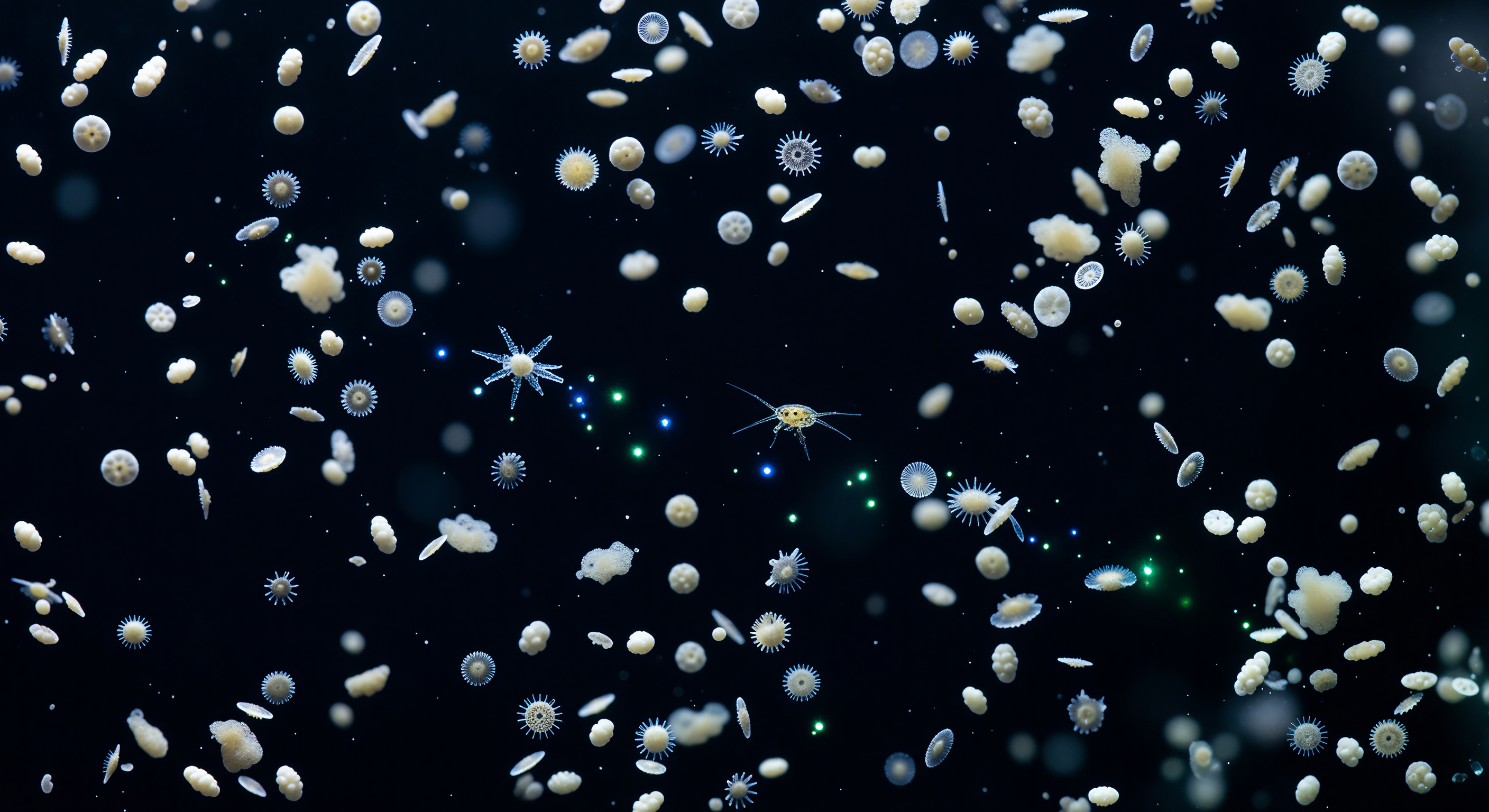
You are suspended two kilometers below the last trace of sunlight, drifting weightless in seawater so cold and still it feels like dark glass, surrounded by a snowfall that has been falling, unwitnessed, for geological ages. All around you, the dead descend: chalky-white Globigerina bulloides tumble past in lazy arcs, their clusters of globular calcite chambers returning a ghostly cream-white luminosity against the indigo-black, each test no larger than a grain of sugar, each a single cell's architectural achievement now emptied and falling toward the sediment kilometers below. Compressed lenticular Globorotalia discs flash cold silver at the edge of perception, their sharp peripheral keels catching scattered ambient light before vanishing back into shadow, while a rare spinose form drifts close trailing fractured crystalline needles — broken spine fragments refracting the darkness into hairline glints of pale blue. Between the tests drift loose flocs of marine snow, mucoid and fibrous, the organic and the mineral descending together in absolute contrast: calcite geometry against dissolving matter, the rigid suture lines of a foram wall against a shapeless smear of bacterial film. Then a single copepod cuts horizontally through the vertical cascade, and for less than a second its bioluminescent wake blooms blue-green across a dozen falling tests, illuminating their pore fields and chamber walls in sharp relief before the darkness closes again, and the slow white rain continues downward without end.
Other languages
- Français: Pluie de Tests, Zone Abyssale
- Español: Lluvia de Conchas en Aguas Profundas
- Português: Chuva de Carapaças nas Profundezas
- Deutsch: Tiefsee-Schnee im Mitternachtszone
- العربية: مطر القواقب في الأعماق المظلمة
- हिन्दी: गहरे जल में खोल वर्षा
- 日本語: 深海の殻の雪、真夜中の層
- 한국어: 심해 껍질 눈, 자정 수역
- Italiano: Pioggia di Gusci nelle Profondità
- Nederlands: Diepzee Schelpsneeuw, Middernachtzone