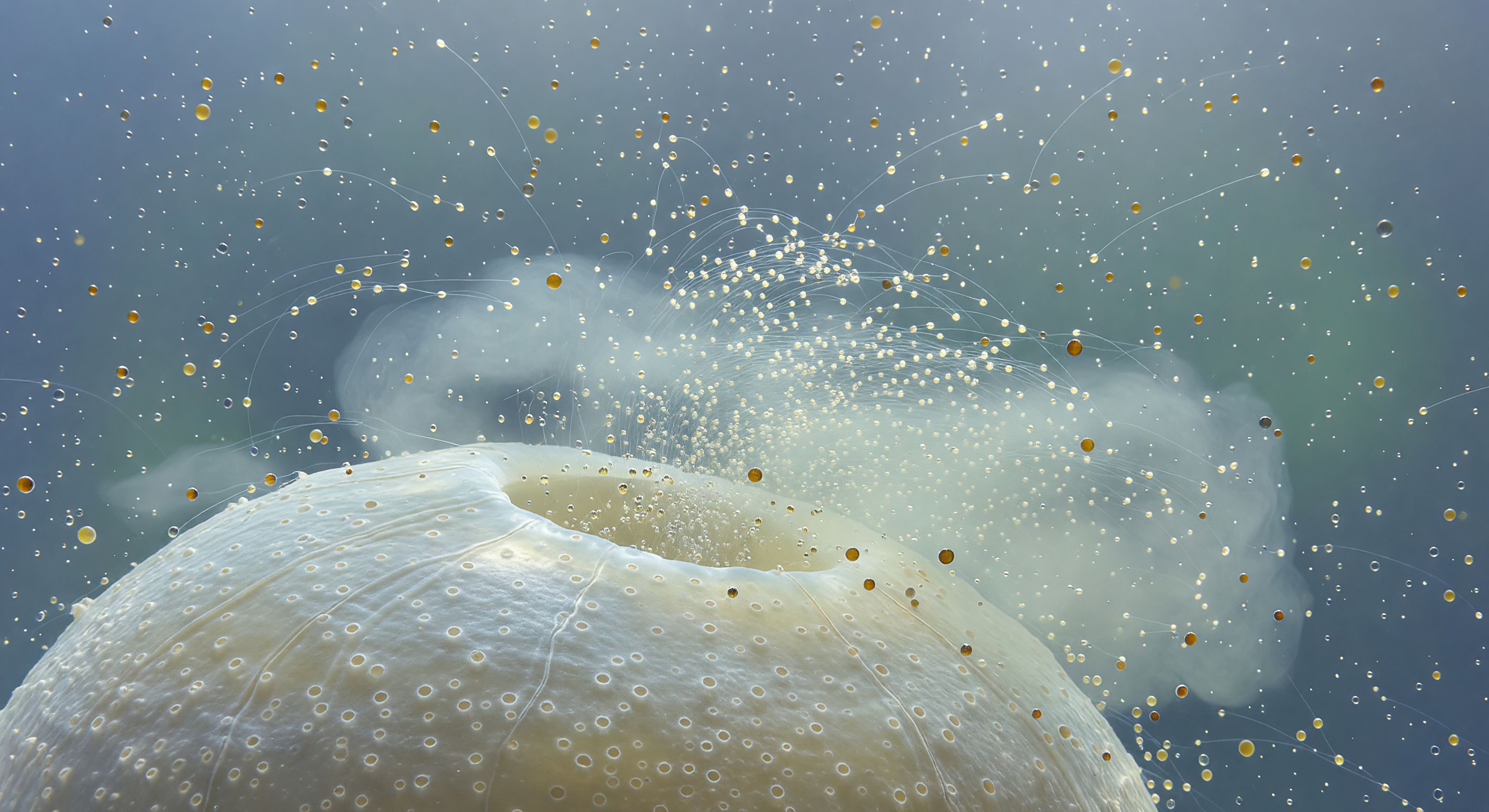
You are suspended in open water at the scale of a bacterium, and the world before you is dominated by the enormous pale facade of a single-celled organism larger than most human intuitions allow — the calcite test of *Globigerinoides sacculifer*, its creamy hyaline walls rising like a crater-pocked lunar cliff, every circular spine-scar a rimmed pit where a silica spine once anchored, the sutures between chambers curving away into blue haze like mountain ridges disappearing over a horizon. From the dark oval of the aperture — an opening that reads at this scale as a volcanic vent or cave mouth — erupts a continuous torrent of biflagellate gametes, each pale 4 µm sphere trailing two frantically beating flagella, pouring outward in their thousands and collectively forming an expanding milky-white cloud that turbidifies the surrounding water column into something pearlescent and opaque, a fog bank of biological material emanating from a single reproductive event. Interspersed through this pale cascade drift the released zooxanthellae, each a golden-brown sphere roughly twice the gametes' size, their photosynthetic pigments concentrating the diffuse blue-green ambient light into warm amber tones that contrast sharply with the cold milky fog around them. Between these drifting spheres, translucent lipid droplets catch stray light as brief iridescent glints, pale oil beads tumbling slowly past in the diffuse radiance. What you witness is gametogenesis — the terminal reproductive act of a planktonic protist dismantling itself entirely, shedding its symbionts, dissolving its cytoplasm into thousands of independent swimmers, and releasing them into an ocean three orders of magnitude larger than the organism that made them.
Other languages
- Français: Éruption de Gamètes en Mer
- Español: Erupción de Gametos en Alta Mar
- Português: Erupção de Gametas em Mar Aberto
- Deutsch: Gameten-Eruption im Offenen Meer
- العربية: انفجار الأمشاج في البحر المفتوح
- हिन्दी: खुले जल में युग्मक विस्फोट
- 日本語: 外洋での配偶子噴出
- 한국어: 열린 바다 배우자 분출
- Italiano: Eruzione di Gameti in Mare Aperto
- Nederlands: Gameet-uitbarsting op Open Zee