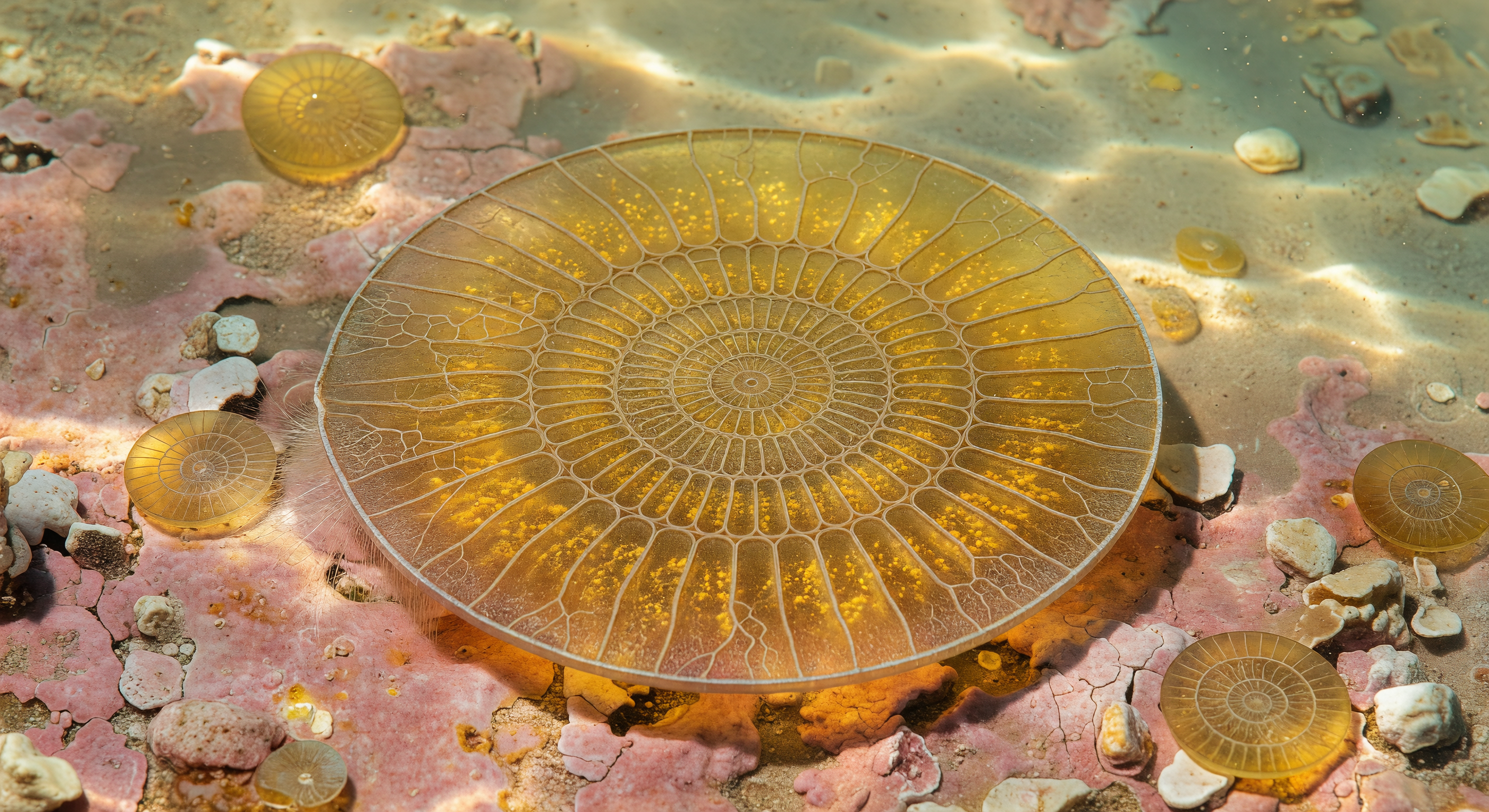
Suspended in the sun-warmed shallows of an Eocene tropical sea, you hover above a seafloor of encrusting pink coralline algae and scattered coral rubble, gazing down at a living *Nummulites gizehensis* whose lenticular disc fills your entire field of view like a burnished golden medallion — a single cell that has secreted a calcite architecture of extraordinary precision, its planispiral chambers accumulating in a logarithmic spiral that traces outward from the central boss as a breathtaking web of pale, slightly raised suture ridges, the whole surface glowing with the warm amber-gold luminescence of densely packed symbiotic dinoflagellates packed into every chamber. The hyaline calcite walls, built from calcite crystals oriented perpendicular to their surface, transmit the shifting caustic light of the water column from above in stained-glass patterns, while the marginal cord traces a crisp equatorial seam around the full circumference of the lens — a structural ridge that marks the outermost extent of a test that, in life, functions simultaneously as skeleton, greenhouse, and fortress. From one edge of the disc, nearly invisible against the bright pink substrate, hair-thin reticulopodial strands extend outward across the algal crust, the living cytoplasmic net through which this single giant cell senses, feeds, and remains anchored to the seafloor of a sea that will not exist for another thirty-four million years. Around the dominant specimen, other amber discs lie tilted and scattered across the mosaic substrate, each one a smaller iteration of the same extraordinary geometric solution to the problem of building a life at the boundary between the mineral and the living.
Other languages
- Français: Disque Nummulite, Mer Éocène
- Español: Disco Numulita, Mar Eoceno
- Português: Disco Numulite, Raso Eoceno
- Deutsch: Nummuliten-Scheibe, Eozäne Untiefen
- العربية: قرص النوميوليت، أعماق الإيوسين
- हिन्दी: नम्युलाइट चक्र, इओसीन उथले
- 日本語: ヌンムライト円盤、始新世の浅海
- 한국어: 화폐석 원반, 에오세 얕은 바다
- Italiano: Disco Nummulite, Acque Eocene
- Nederlands: Nummuliet Schijf, Eoceen Ondiep