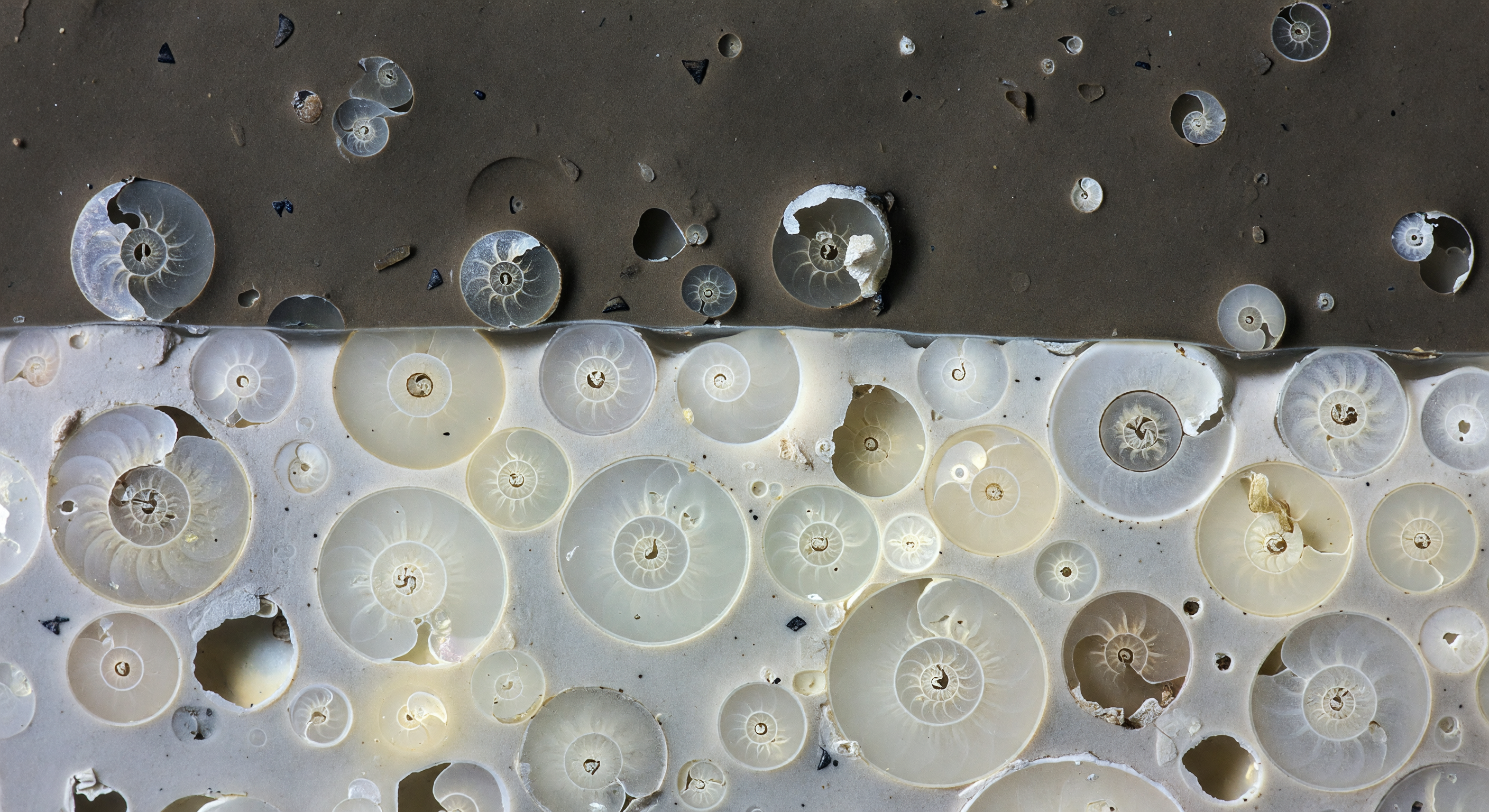
You are pressed flat against a freshly cleaved face of deep-sea sediment like an observer pinned to a cliff of compressed geological time, the cut surface stretching before you in two worlds divided by a single, nearly horizontal line less than a millimeter thick. Below that boundary, the sediment glows pale cream and ivory — a densely packed mosaic of foraminifera tests sliced open at every angle, their internal calcite chamber walls curving in perfect spirals, each foraminal opening a small dark hollow in a crystalline partition, the surrounding matrix a fine white powder of coccolithophore debris that catches the cool light with a faint birefringent shimmer of pale gold and silver where fresh crystal faces were exposed by the cut. Above the boundary, everything shifts abruptly to deep brownish-grey clay, matte and light-absorbing, where fewer foram tests survive and those that remain are ghost versions of their former selves — walls thinned and translucent, sutures widened into open grooves, pore walls ragged where carbonate dissolution retreated the calcite crystal by crystal over thousands of years. Scattered through this darker zone, tiny black triangular shards of phosphatic fish teeth lie pristine and geometrically sharp, chemically inert and utterly indifferent to the dissolution that consumed the carbonates around them, their resistance a quiet record of the ocean chemistry that defined this moment. This boundary is not merely a color change but a preserved threshold in Earth's climate history — the transition from a warm interglacial ocean saturated with calcium carbonate and alive with calcifying plankton, to a colder glacial interval where deepwater corrosivity rose and the seafloor began dissolving what life had built.
Other languages
- Français: Carotte sédimentaire, frontière paléoclimatique
- Español: Cara de testigo, límite paleoclimático
- Português: Face de testemunho, limite paleoclimático
- Deutsch: Sedimentkern, Paläoklima-Grenze
- العربية: وجه نواة الرسوبيات، حد المناخ القديم
- हिन्दी: तलछट कोर, पुरापाषाण जलवायु सीमा
- 日本語: 堆積物コア断面、古気候境界
- 한국어: 퇴적물 코어 단면, 고기후 경계
- Italiano: Faccia del carotaggio, confine paleoclimatico
- Nederlands: Sedimentkernvlak, paleoklimaatgrens