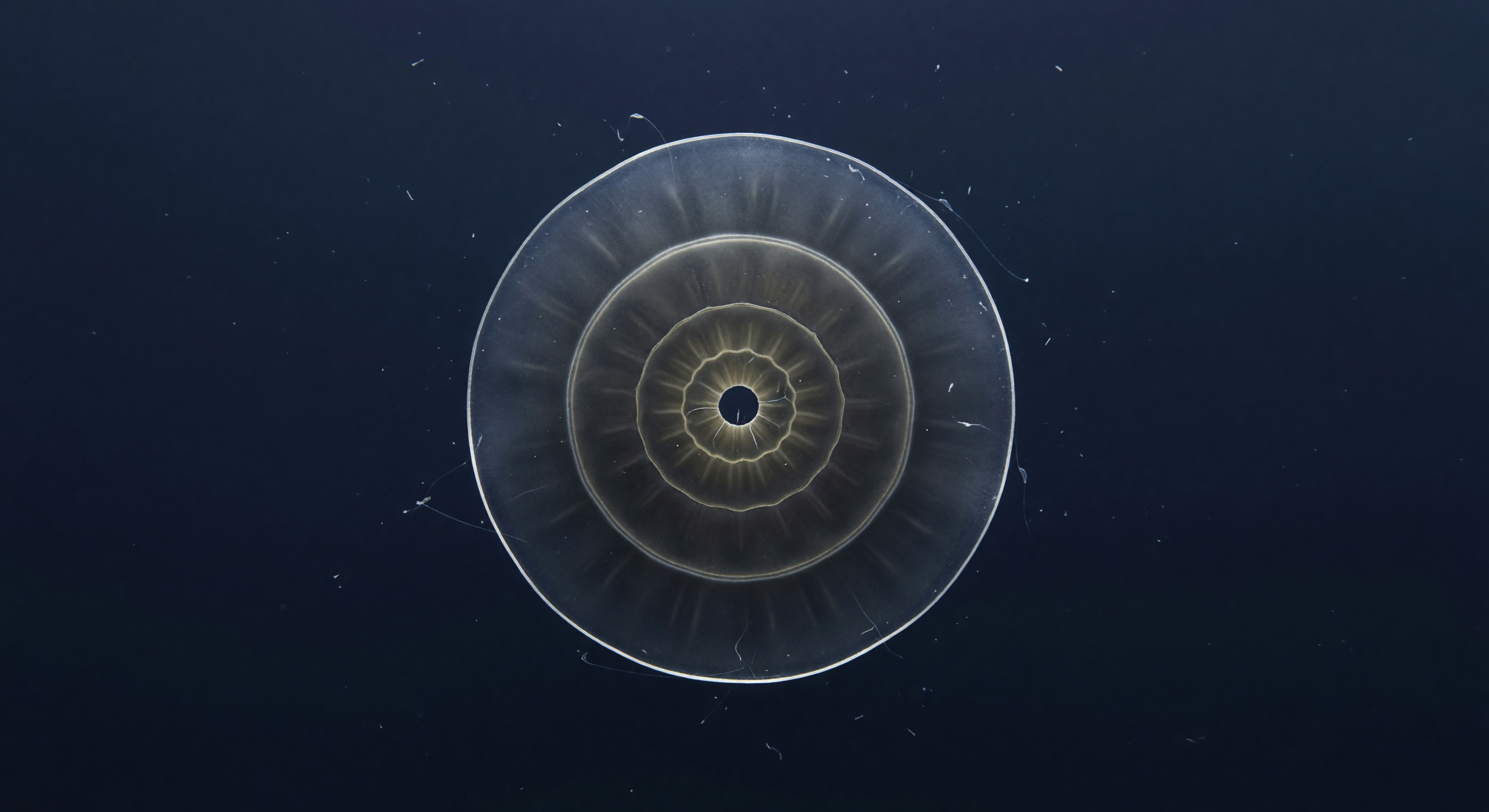
You float in near-absolute darkness at two hundred metres depth, suspended in water so cold it registers as physical pressure against every surface, the light above you reduced to a faint blue-grey luminescence that barely separates the vertical from the horizontal. Before you, resolving slowly from the indigo gloom, is a disc of frosted calcite roughly the apparent size of a dinner plate held at arm's length — Globorotalia menardii, oriented ventral face toward you, its tightly wound trochospiral architecture of overlapping chambers reading as gently lobed arcs pressed into smooth hyaline walls the colour of old bone, the boundaries between chambers marked by backward-curving depressed sutures that darken toward the central umbilical pit, itself a small circle of absolute black from which two or three hair-fine reticulopodial strands extend into the surrounding cold, barely visible except where the ambient blue catches their refractive edges. Around the entire equatorial rim of the compressed biconvex test runs the organism's defining structure: a continuous keel of calcite so thin and crystallographically pure it approaches transparency, projecting perpendicular to the disc like the blade of a tool, and where the sparse downwelling light strikes it at grazing incidence it ignites into a single unbroken ring of cold blue-silver radiance — the sharpest edge in an otherwise edgeless world. This keel is not ornament but engineering, a peripheral reinforcement that stiffens the test against hydrostatic pressure at depth and likely functions as a hydrodynamic stabiliser during the slow passive sinking and rising that carries these organisms through the water column across their entire life cycle, their calcite chemistry encoding, layer by layer, a record of the temperatures and carbon isotope ratios of waters that no instrument existed to measure when these animals were alive.
Other languages
- Français: Globorotalia Carénée, Thermocline Froide
- Español: Globorotalia Aquillada, Termoclina Fría
- Português: Globorotalia Quilhada, Termoclina Fria
- Deutsch: Gekielte Globorotalia, Kalte Thermokline
- العربية: غلوبوروتاليا المعولة، ثرموكلاين بارد
- हिन्दी: कीलयुक्त ग्लोबोरोटालिया, शीत थर्मोक्लाइन
- 日本語: 竜骨状グロボロタリア、冷たい水温躍層
- 한국어: 용골형 글로보로탈리아, 냉수 수온약층
- Italiano: Globorotalia Carenata, Termoclino Freddo
- Nederlands: Gekielde Globorotalia, Koude Thermoklien