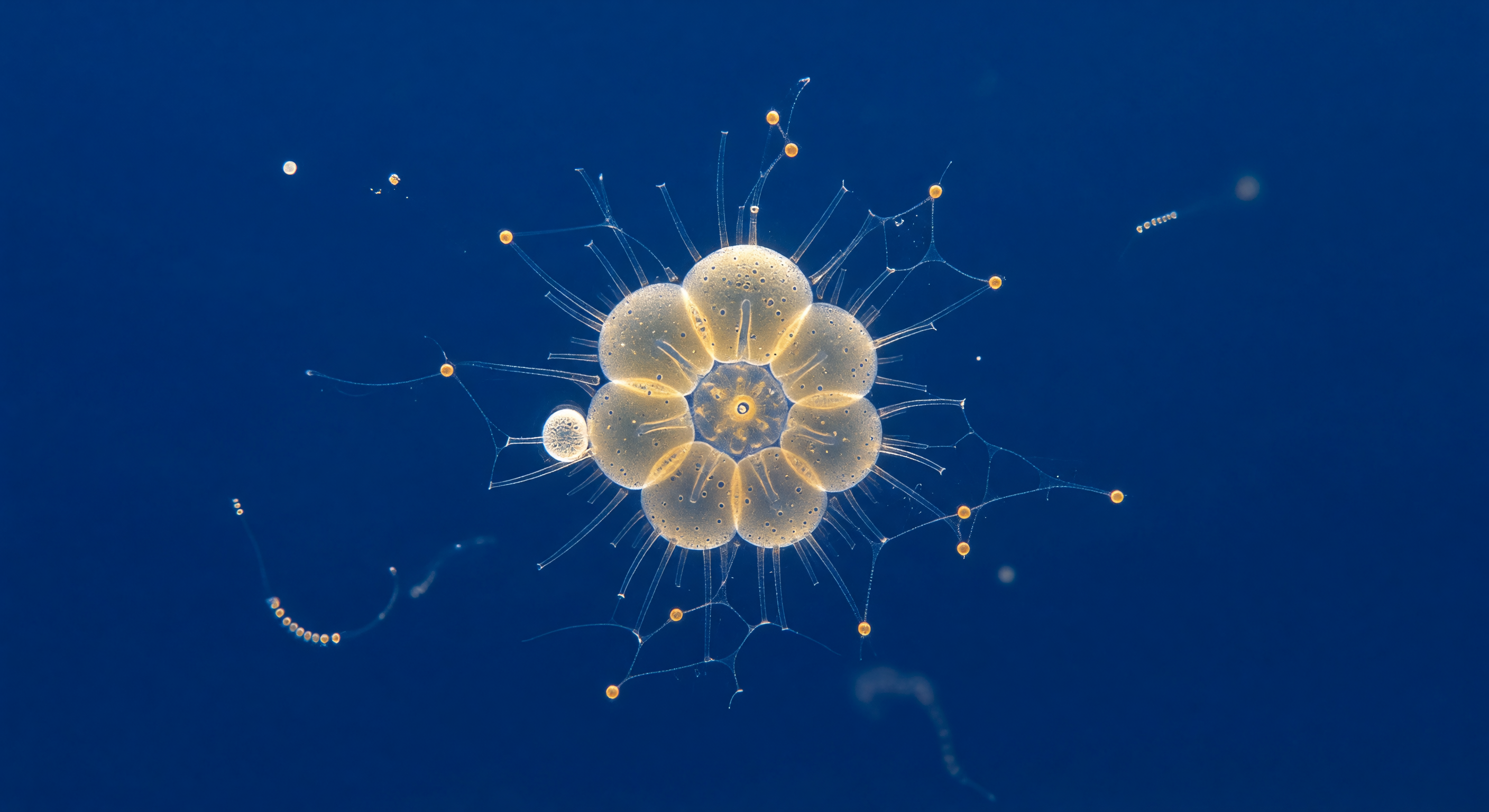
Suspended at eye-level with a single living *Globigerinoides ruber*, you face a luminous amber lantern floating against an infinite cobalt void — four globular calcite chambers arranged in a low trochospiral whorl, each wall translucent enough that diffuse tropical sunlight seems to radiate from within the mineral itself, and the finely perforated surface gives the test the texture of polished stone riddled with microscopic wells. From its aperture and spine bases, monocrystalline calcite needles radiate outward in every direction — water-clear and nearly invisible except where they refract the down-welling light into drifting arc-shaped caustics, three hundred micrometers of glass-thin mineral vibrating at the threshold of perception. Between these spines, a gossamer reticulopodial network spreads into the surrounding seawater as barely-visible silver-blue threads that branch, anastomose, and dissolve into the ambient blue, their invisible cytoplasmic highways traced only by a slow procession of golden-brown zooxanthellae beads drifting toward the test surface like lanterns carried along a dark river. This single cell — a marine protist whose calcite test will eventually sink through thousands of meters of ocean and persist in sediment for millions of years — occupies the absolute center of a three-dimensional liquid space that extends in all directions to infinity, its mineral architecture simultaneously immaculate and fragile, geometrically absolute against the cold cobalt silence of the photic zone.
Other languages
- Français: Globe Épineux, Zone Photique
- Español: Globo Espinoso, Zona Fótica
- Português: Globo Espinhoso, Zona Fótica
- Deutsch: Stachelkugel, Photische Zone
- العربية: كرة شائكة، المنطقة الضوئية
- हिन्दी: कंटकित गोलक, प्रकाश क्षेत्र
- 日本語: 有刺球体、有光層
- 한국어: 가시 구체, 유광층
- Italiano: Globo Spinoso, Zona Fotica
- Nederlands: Stekelige Bol, Fotische Zone