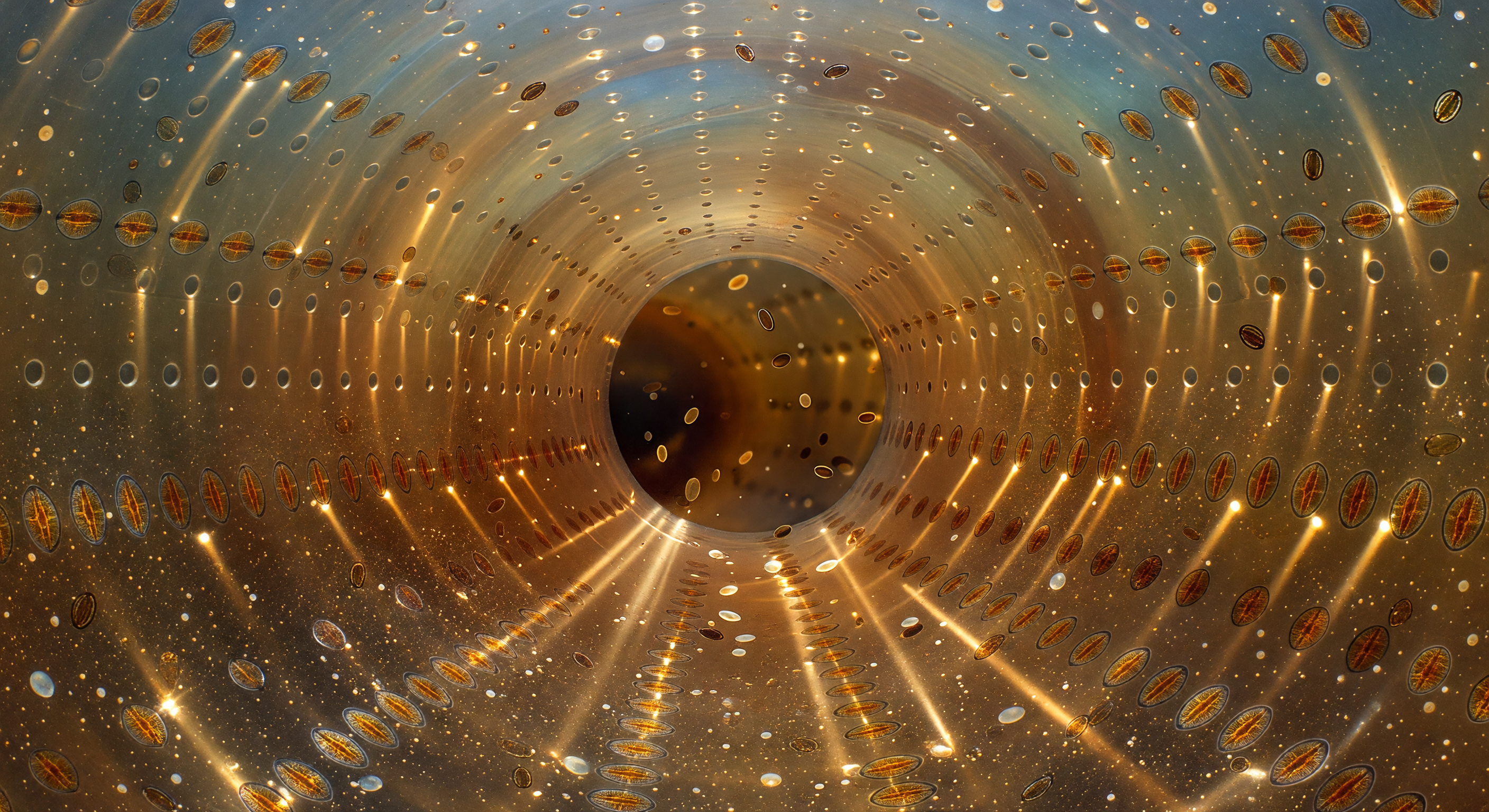
You stand inside the mineral body of a living cell — enclosed within a single chamber of an *Amphistegina lobifera* test, a vaulted cavity of semi-crystalline calcite whose amber-gold walls arch overhead like the interior of a lantern carved from warm honey glass. The walls are perforated by rows of perfectly circular pores, each admitting a needle-thin column of oceanic light that angles across the chamber floor in golden shafts, catching suspended particles in the cytoplasm and making them briefly sparkle as they drift through each beam. Arranged across the chamber floor and mid-space are the diatom symbionts — flattened ellipsoidal cells a few microns long, their deep chocolate-gold chloroplasts ordered in bilateral rows that follow the vault's curvature, their silica frustules returning the pore-light as faint iridescent shimmer along beveled edges, while between them the granular ectoplasm drifts in slow amber suspension, dense with tumbling mitochondria and opalescent lipid droplets. The entire enclosure functions as a photosynthetic nursery: the symbiotic diatoms are sequestered here by the foraminifer, harvested for the sugars their chloroplasts produce under this carefully filtered light, a metabolic partnership sustained within walls of mineral only a few microns thick. Directly ahead, the septal foramen opens as a smooth circular portal cut through the calcite partition — a gravitational focal point drawing the eye into the deeper amber-brown obscurity of the next chamber, the architecture continuing inward through rooms within rooms, each one alive.
Other languages
- Français: Au cœur de la chambre symbiotique
- Español: Dentro de la cámara simbionte
- Português: No interior da câmara simbiótica
- Deutsch: Im Innern der Symbionten-Kammer
- العربية: داخل حجرة المتكافل
- हिन्दी: सहजीवी कक्ष के भीतर
- 日本語: 共生体の室内から
- 한국어: 공생체 방 안에서
- Italiano: Dentro la camera simbiotica
- Nederlands: Binnen de symbiont-kamer