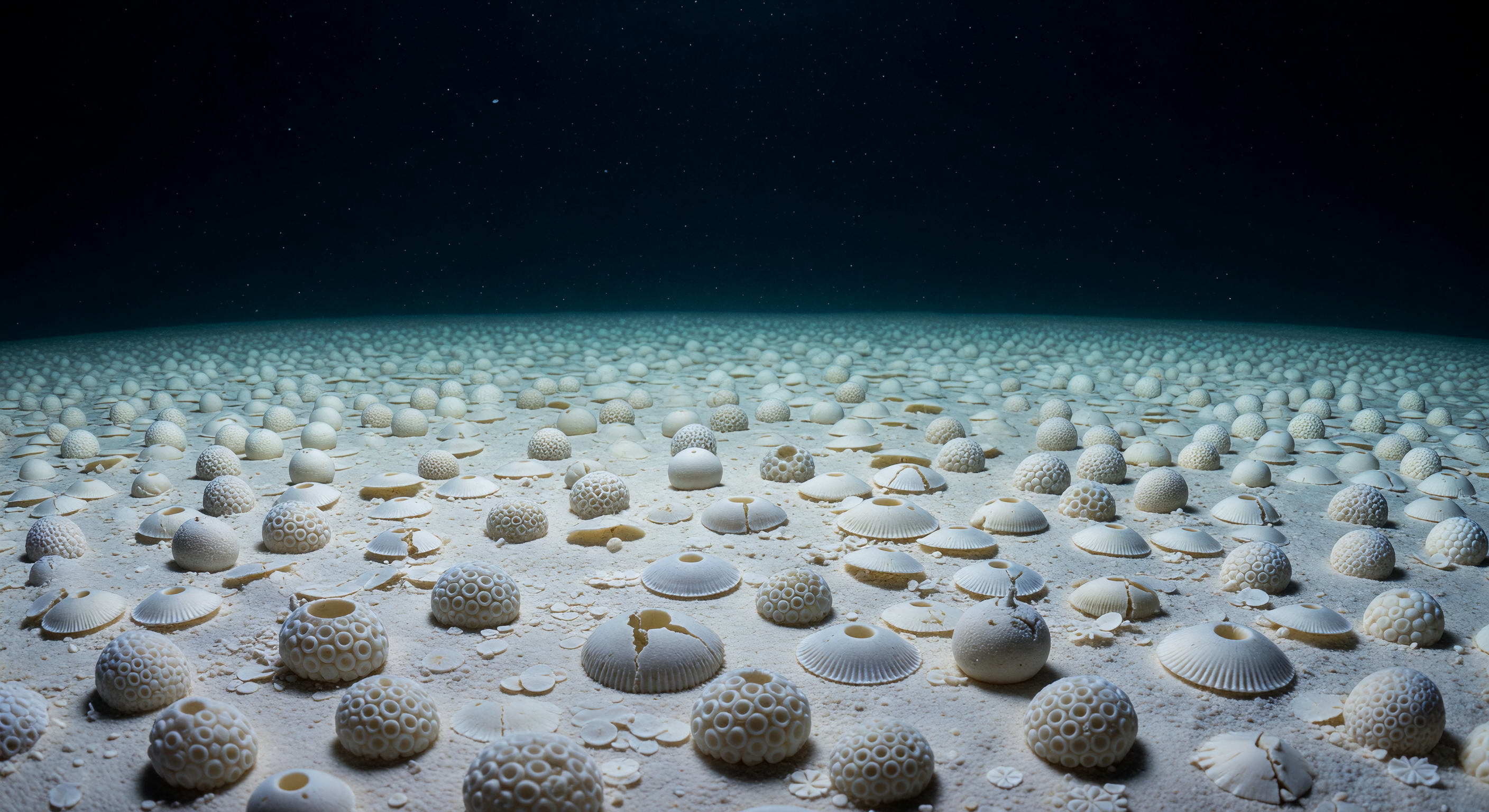
Beneath you, the abyssal seafloor resolves not as mud but as an unbroken mosaic of calcite architecture — thousands of foraminiferan tests pressed together across every visible surface, each one a distinct sculptural object built by a single cell now long vanished, their collective pale ivory luminosity glowing softly against the absolute black of the water column pressing down from above. Globigerina bulloides rise in globose clusters of interconnected spherical chambers, their pore-riddled surfaces giving them a matte, chalky texture; beside them, Globorotalia menardii lies blade-flat, its sharp peripheral keel catching the dim light as a hairline of brighter white, while perfect spheres of Orbulina universa rest like frosted marbles, their broken spine stumps projecting into the water as a faint bristled halo. Every interstice between the tests is packed with coccolithophore debris — the disaggregated calcite platelets of Emiliania and Coccolithus, ground to a near-powder that fills the gaps like white mortar between cobblestones, smoothing the surface into something lunar and self-luminous. This is globigerina ooze: a sediment composed almost entirely of biological calcium carbonate, a million-year archive of dissolved surface-ocean history laid down at a rate of centimeters per millennium, silent and pressurized and cold, every shell a chemical message from a sea surface that no longer exists.
Other languages
- Français: Cimetière de boue globigerina
- Español: Cementerio de limo globigerina
- Português: Cemitério de lodo globigerina
- Deutsch: Globigerina-Schlamm-Friedhof
- العربية: مقبرة طمي الغلوبيجيرينا
- हिन्दी: ग्लोबीजेरिना कीचड़ कब्रिस्तान
- 日本語: 有孔虫軟泥の墓場
- 한국어: 글로비게리나 연니 묘지
- Italiano: Cimitero di fango globigerina
- Nederlands: Globigerina-slib begraafplaats