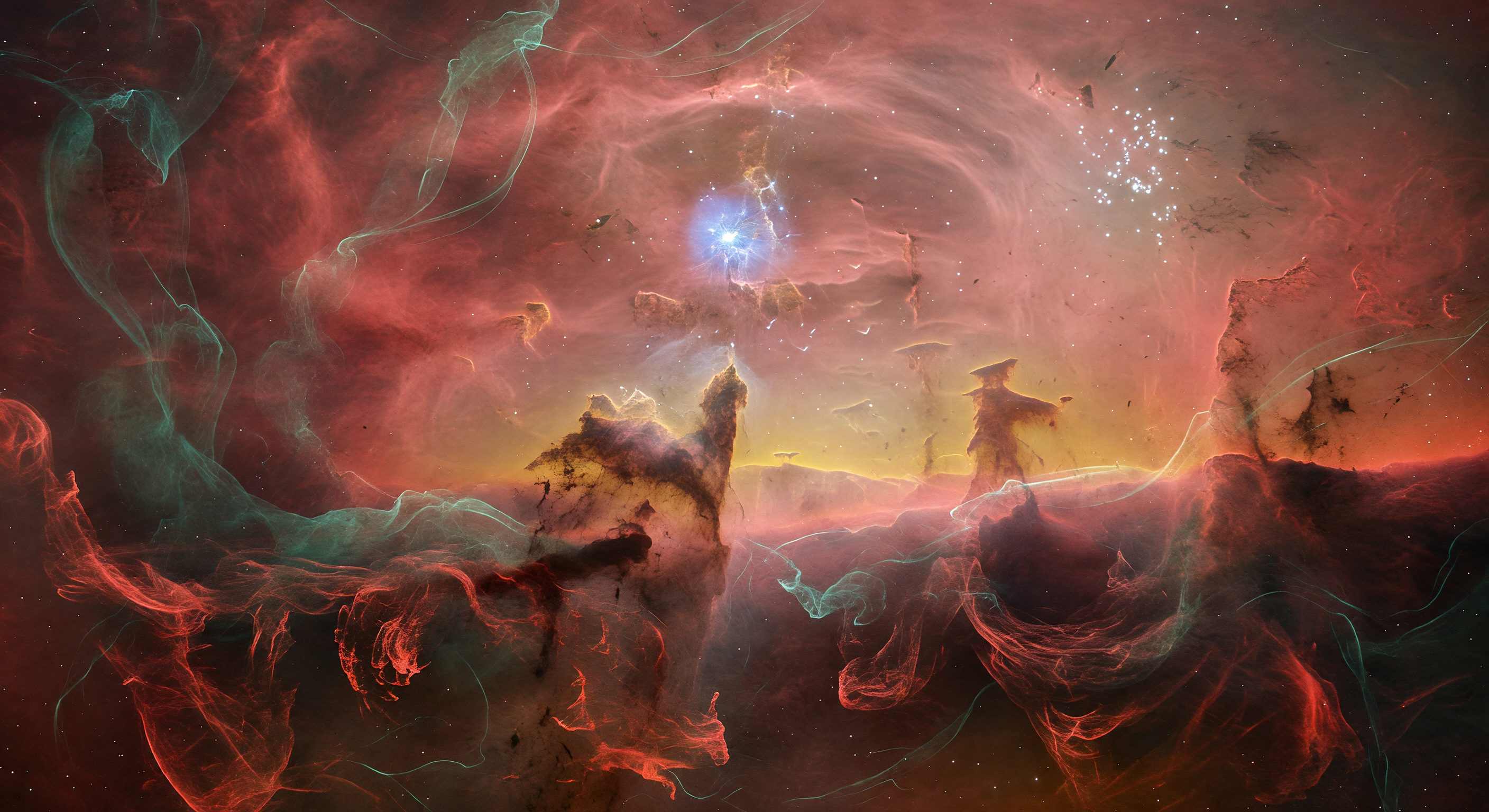
Scientific confidence: High
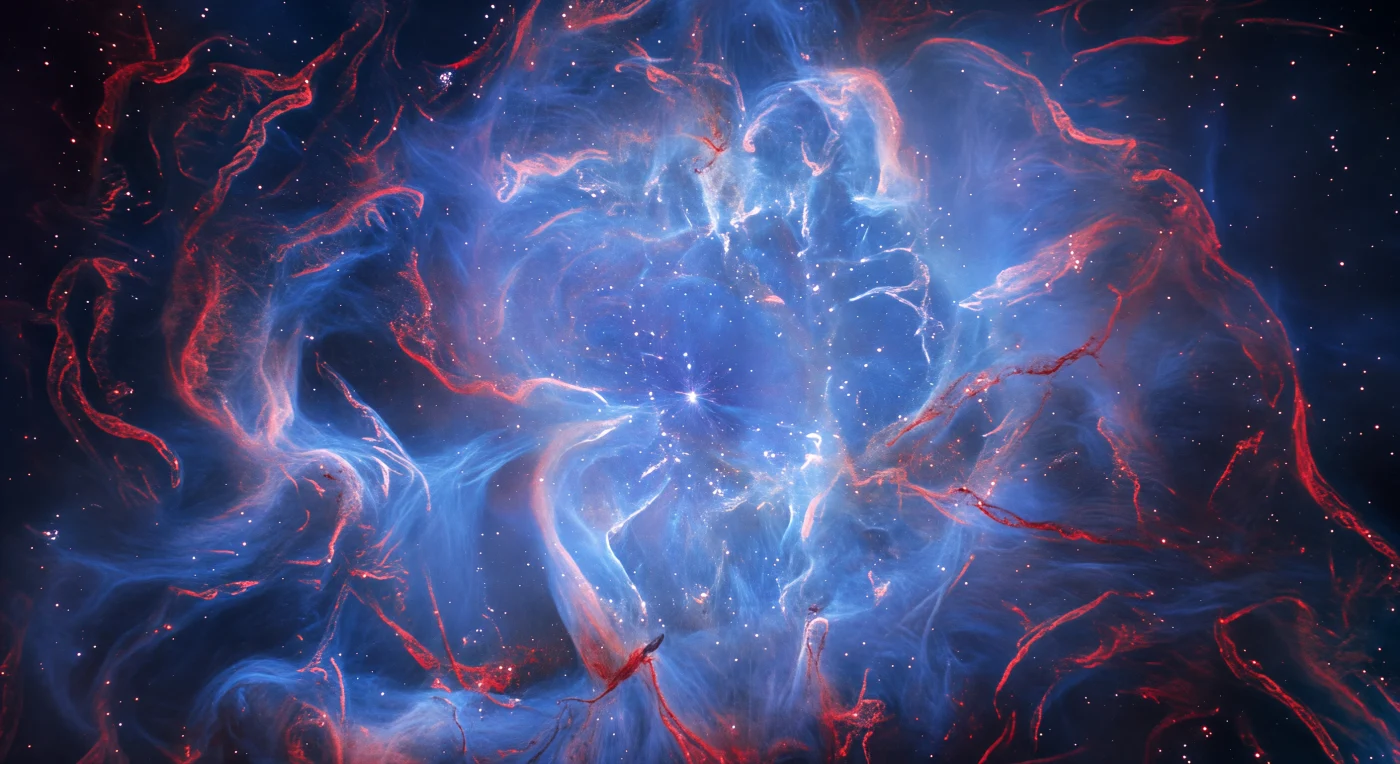
You are suspended inside the Crab Nebula's synchrotron interior, and in every direction the universe has become its own light source — a cold, omnidirectional electric blue that casts no shadows, born not from any star but from relativistic electrons wrung to near-light speed by the amplified magnetic field of a dead stellar core, emitting synchrotron radiation across the full visual spectrum in volumetric gradients that swell and dim like breathing. Threading through this blue immensity in every plane of space, a baroque network of crimson and scarlet filaments ropes and braids and knots into structures that resemble torn biological tissue under tension — these are the actual outer layers of a star that exploded in 1054 CE, still traveling outward at thousands of kilometers per second yet appearing geological in their stillness, their interiors dense with neutral hydrogen, their edges lit in Hα recombination red where ionized gas perpetually reassembles itself. At the precise center of the scene, a point of light pulses with a rapid stroboscopic flicker — the Crab Pulsar, a neutron star roughly the diameter of a city compressed to nuclear density, sweeping twin beams of hard radiation across the nebula interior thirty times per second, each heartbeat sending a subtle ripple of brightening through the surrounding synchrotron haze that washes briefly over the nearest filaments before fading back into the cold blue baseline. Two entirely different physical processes — magnetic synchrotron emission and thermal recombination — occupy the same eleven-light-year volume of space without ever mixing, interpenetrating in absolute contrast: the cold physics of relativity threaded through the warm, biological-looking wreckage of a star's final scream.
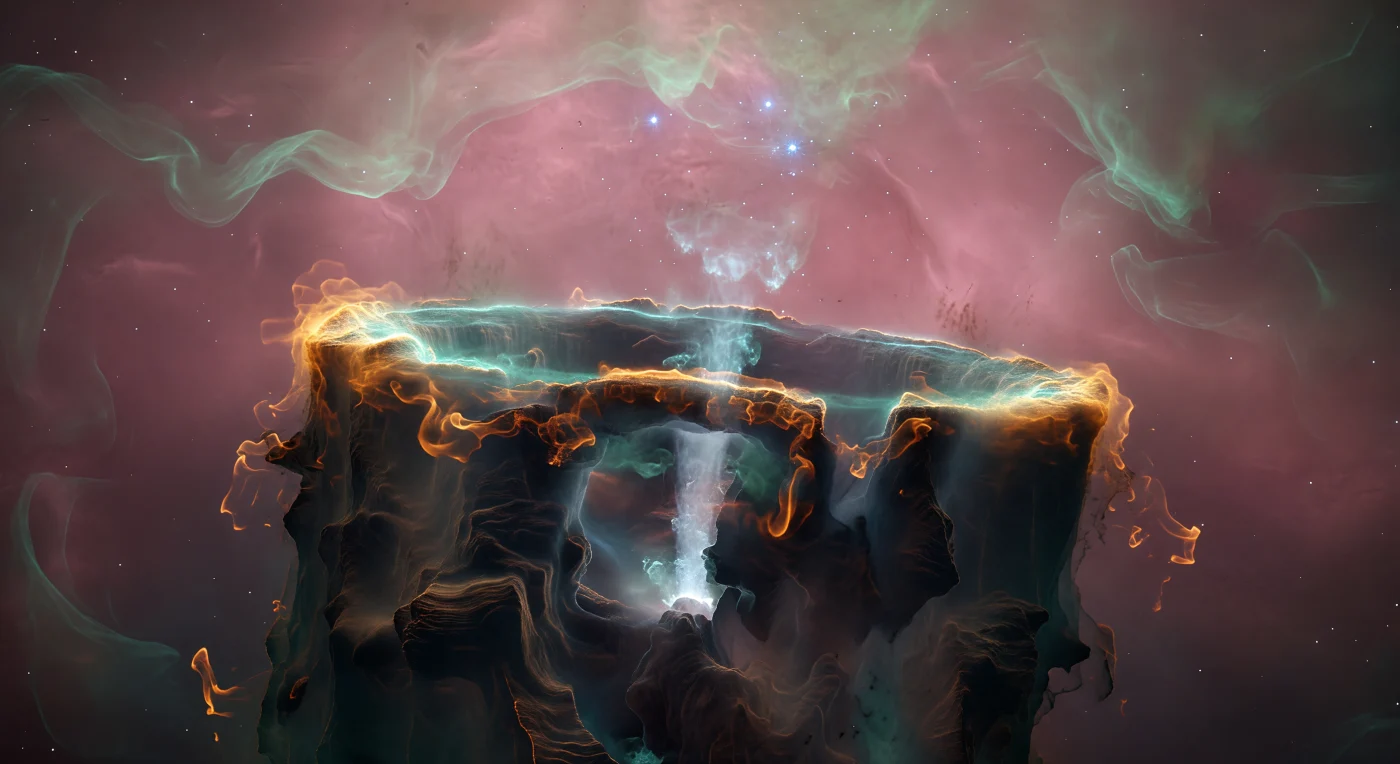
You are suspended at the apex of a molecular pillar whose sculpted crest rears beneath you like the crown of a petrified storm, its surface a dark compression of gas and interstellar dust — charcoal and basalt-brown — that has been accumulating and consolidating for millions of years inside a giant molecular cloud. Directly ahead, photoionization driven by a cluster of OB stars has eaten into the pillar's leading edge with geological patience, carving a fractalized ionization front where molecular hydrogen transitions, in a band barely wider than a cliff's edge, from cold near-black interior through amber and tangerine recombination glow into the surrounding H II plasma; the physics of this boundary — a photodissociation region only light-weeks thick — encodes in color a ten-thousand-year radiative history. From a cleft just below your position, a pale blue-white jet traces the exhalation of an embedded protostar still assembling itself in the pillar's protected dark interior, its outflow punching through the column's crust and fraying into teal wisps that dissolve within a few pillar-widths as the jet's momentum is thermalized by the ambient ionized medium. Above and in every direction beyond the pillar's rim, the H II cavity opens in volumetric magenta-rose — the integrated Hα emission of recombining hydrogen suffusing billions of cubic light-years into sourceless warm light — layered with translucent curtains of turquoise forbidden-line oxygen emission that billow with no wind across a space so vast that the pinpoint blue-white stars responsible for all of this erosion, all of this light, hang in the upper cavity like distant lamps casting hard shadows backward along the pillar's face.
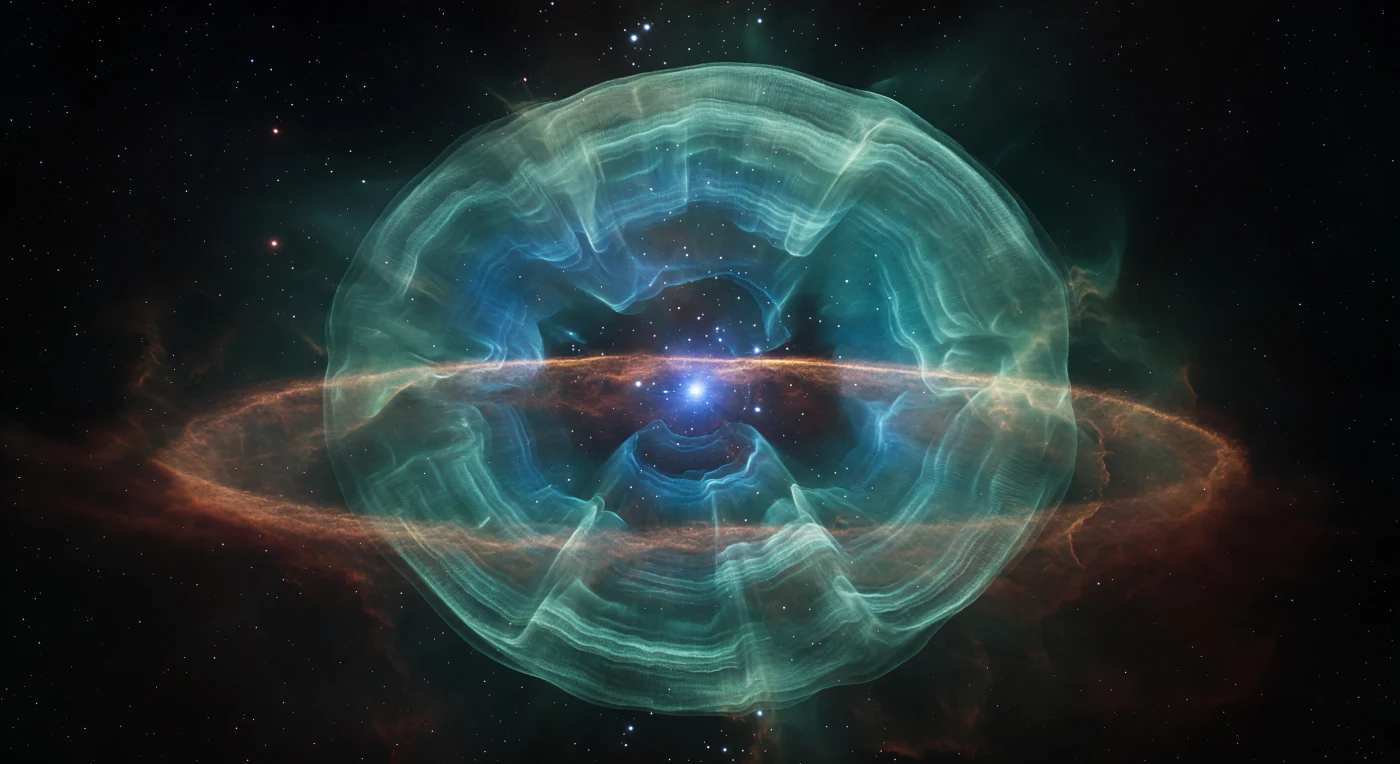
You are suspended inside the polar lobe of a dying star's final exhalation — a cathedral of ionized oxygen arching hundreds of cubic light-years above and below in perfect bilateral symmetry, its walls built not of stone but of stacked forbidden-line emission shells, each concentric skin radiating a fractionally deeper shade of electric teal than the last, from palest aquamarine at the outer rim to an intense cobalt-turquoise near the central axis. The lobes are pinched at the equator by a dense molecular torus of reddish umber and compressed ash, its inner edge peeling apart under the hard ultraviolet assault of an Earth-sized white dwarf burning at 150,000 kelvin — a sourceless kernel of blue-white brilliance that casts no ordinary shadow, only an omni-directional aquamarine ambient that makes the interior feel simultaneously enclosed and boundlessly open. At this scale, the gas you float within is functionally a perfect vacuum — particle densities thousands of billions of times thinner than the air of any world — yet integrated across light-years of depth it resolves into luminous membranes, translucent forbidden-line curtains, and corrugated shell walls ridged where a fast stellar wind overtook slower ejecta ejected millennia before, the entire structure a frozen record of a star's last ten thousand years of self-erasure. Through the open mouth of the far lobe, ancient field stars burn as cold white pinpoints behind teal gauze, their light measurably reddened by the gas column between them and you, calibrating by their very dimness the inconceivable depth of glowing material that now constitutes everything you can see.
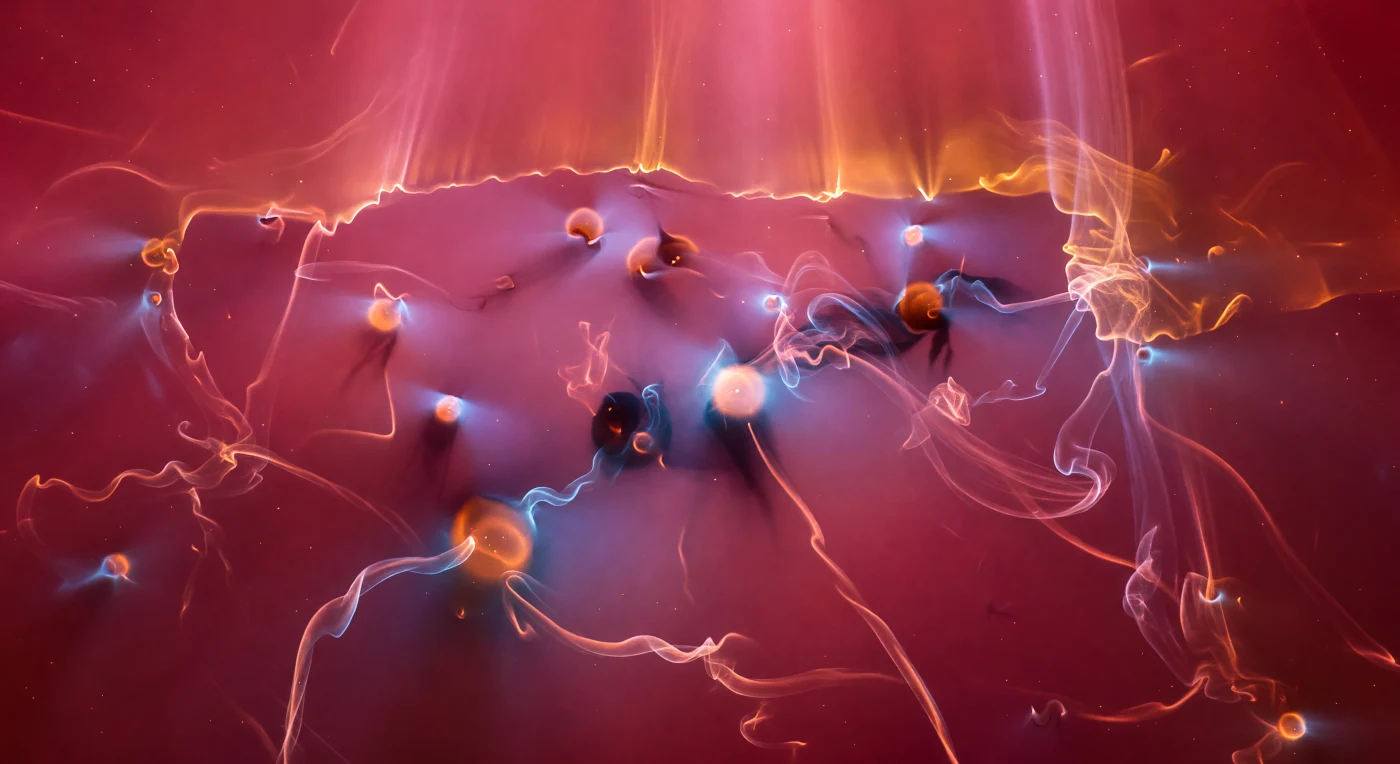
You are suspended inside a volume of gas so rarefied it contains fewer particles per cubic centimeter than the best vacuum chambers on Earth, yet every direction glows with a deep arterial red — the light of hydrogen atoms catching free electrons, recombining millions of times per second across distances measured in fractions of a light-year. Directly ahead, the ionization front rises as a luminous boundary where the physics of the universe changes abruptly: on your side, plasma heated to ten thousand kelvin by the invisible ultraviolet torrent of an O3 star blazing off-frame at perhaps a hundred times the Sun's surface temperature; on the far side, molecular gas so cold it hovers near ten kelvin, its amber-orange photodissociation face bleeding warm fire through the ragged curtain. Dense neutral clumps resist the advancing ionization, their leading edges ablating into thin halos of sulfur crimson and forbidden-line turquoise while casting hard shadow cones back through the translucent Hα fog, crosshatching the entire space with diverging darkness whose penumbrae glow faintly wherever even marginal ultraviolet finds purchase. The front itself is fractally torn — protrusions and re-entrant bays sculpted not by wind in any terrestrial sense but by the differential pressure of radiation, a process unfolding across tens of thousands of years yet frozen here into a single blazing instant of impossible clarity.
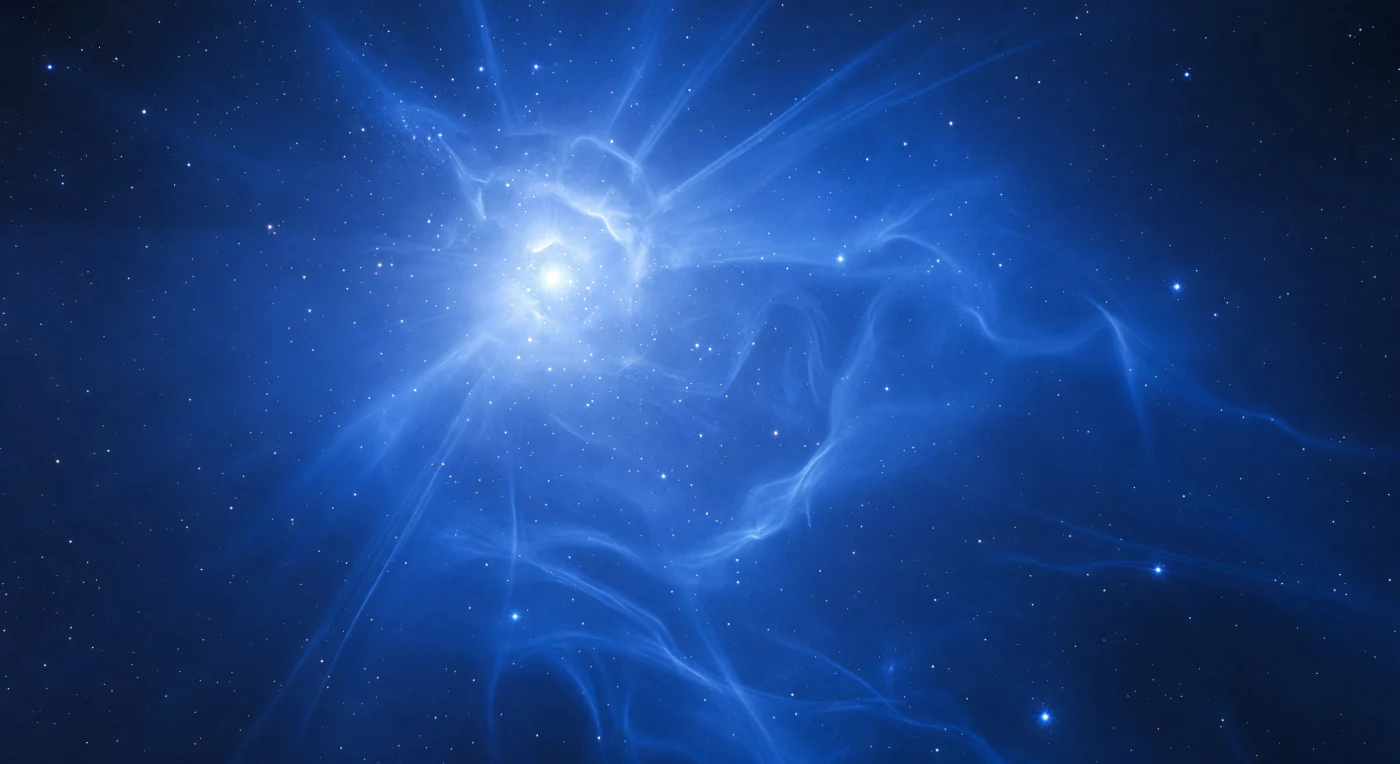
You are suspended inside the three-dimensional interior of a reflection nebula, adrift in an electric-azure radiance that fills every direction with no horizon, no floor, no ceiling — only a volumetric luminous fog of sub-micron silicate and carbonaceous dust grains scattering the short-wavelength photons of a blazing B2 star in every direction simultaneously, so that the light seems to emanate from the space itself. The dominant source burns at the upper left of the visual field with a searingly cold blue-white brilliance, its near-white corona bleeding outward through saturated cobalt and into deep indigo at the scene's farthest margins, where scattered light finally loses its hold and the void reasserts itself. Subtle density filaments coil radially outward from the stellar core, their edges softly defined and their interiors fractionally brighter than the surrounding haze, creating a layered sense of depth that recedes across distances measurable in light-years — structures born from the irregular compression history of a molecular cloud that was drifting and collapsing long before the star at its heart ignited. Background stars pierce the veil as sapphire points, their light shifted perceptibly bluer by the same Rayleigh-analog scattering that colors this entire luminous interior, each one a reminder that the fog you inhabit is not a wall but a window of immense, almost incomprehensible thickness.
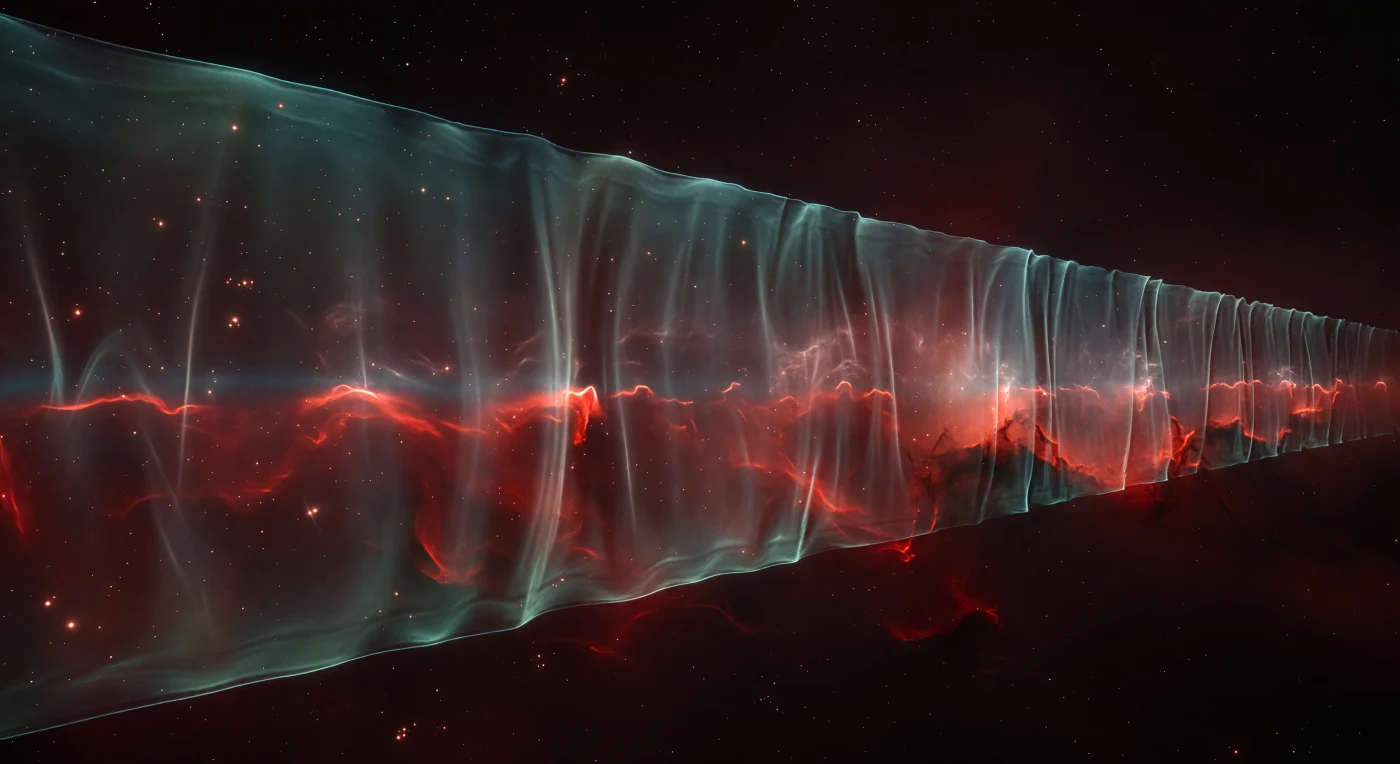
The entire visual field is consumed by a wall of gas that has no beginning and no ceiling — an advancing shock front from a supernova remnant, caught edge-on in the instant before it swallows everything ahead of it. The leading edge burns with forbidden oxygen emission in a razor-thin stripe of electric blue-green, a color with no terrestrial equivalent, produced when gas heated to nearly a million Kelvin radiates through quantum transitions unavailable under any earthly pressure; immediately behind it, hydrogen recombination paints a band of deep arterial crimson, and further back still, a scarlet fringe of sulfur emission marks the trailing margin where denser clumps of gas have lagged behind the front. The curtain is geometrically thin — a few astronomical units through its depth — yet translucent enough that background stars ghost through it as amber-muted points, their light reddened by the intervening column of hot ionized plasma, a haunting reminder that this luminous wall spans hundreds of light-years of sky in every direction. Rayleigh-Taylor instabilities have corrupted the boundary into slow vertical folds, each ridge glowing fractionally brighter where compression peaks, giving the entire structure the quality of living blown glass — a thermodynamic membrane of nuclear chemistry advancing in absolute silence across the dark.
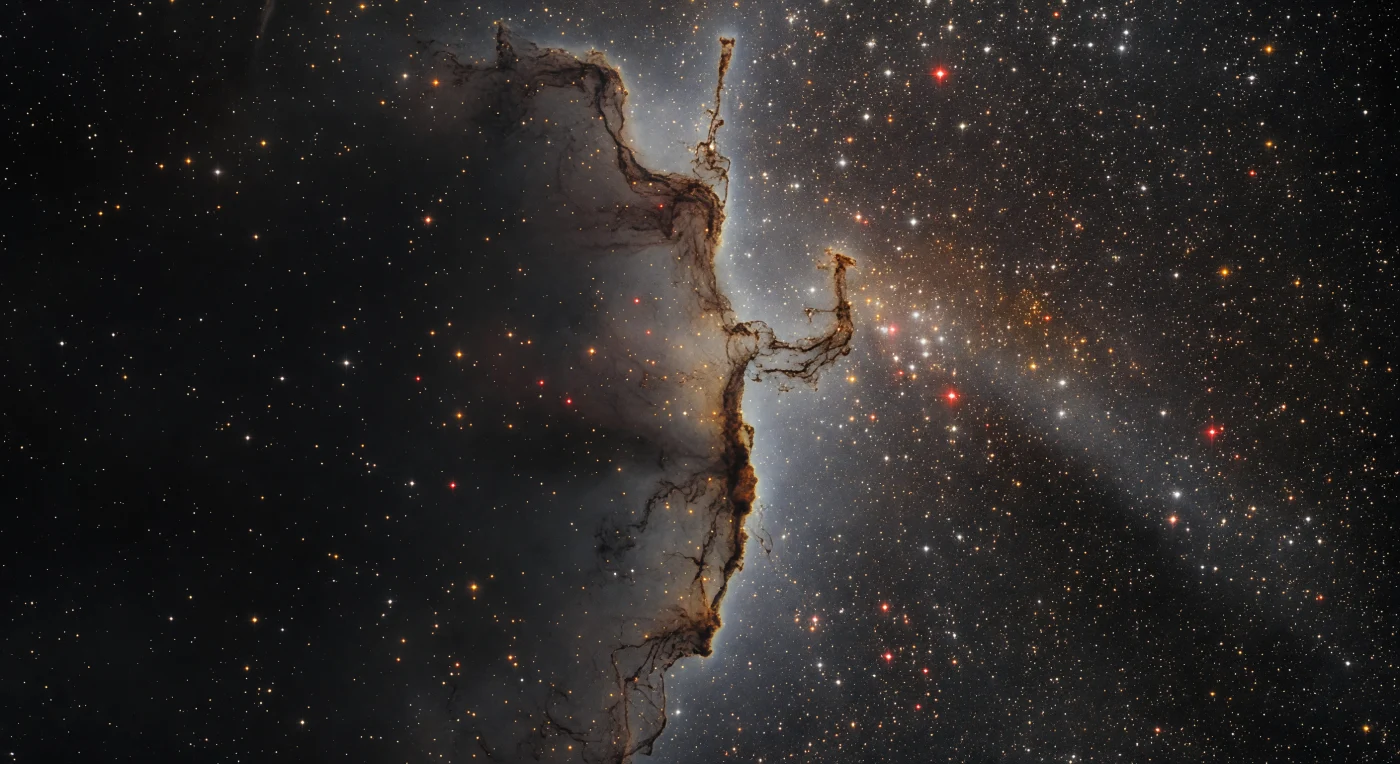
At the razor-edge of Barnard 68, you stand at one of the most absolute boundaries in the local galaxy — a wall not of stone or vacuum but of accumulated molecular dust so dense that thirty magnitudes of extinction swallow starlight whole, erasing photons that have traveled thousands of light-years only to vanish in the final fraction of a light-year. The surrounding galactic star field performs its slow chromatic surrender across the globule's margin: ivory stars shifting to amber, then burnt orange, then blood-crimson, then nothing, each color step a legible record of increasing dust column density as polycyclic aromatic hydrocarbons fluoresce faintly along the outermost tendrils under the attenuated ultraviolet of the interstellar radiation field. The boundary itself is not a smooth surface but a torn and three-dimensional terrain — fine dark filaments curling outward from the main mass like ink threads suspended in still water, their thinnest reaches still permitting the ghost of a deep-red star to bleed through at column densities just short of total opacity. Inside, sealed from starlight and chemistry-altering radiation, cold molecular gas at roughly ten Kelvin collapses in silence across timescales measured in millions of years, building toward the density thresholds where gravity will eventually overwhelm turbulent pressure and ignite a new star — making this dark edge not an ending but the most patient kind of beginning.
![You are suspended inside the Orion Trapezium's Strömgren sphere, immersed in what terrestrial physics would classify as a near-perfect vacuum yet which blazes in every direction with recombination light — a continuous, sourceless rose-red Hα glow permeating a cavity scoured clean by four blue-white O-type stars burning at 40,000 Kelvin each, their combined ultraviolet output so extreme it has pushed dust and neutral gas outward for light-years in every direction, leaving only ionized hydrogen thin enough that a single cubic centimeter holds fewer particles than the best vacuum chambers ever built on Earth. Hanging in the middle distance like offerings suspended in amber, dozens of proplyds — protoplanetary disks caught mid-destruction — display their teardrop anatomy with merciless clarity: charcoal-dark disk hearts silhouetted against the interior glow, each one rimmed on its starward face by a razor-thin ionization front blazing in turquoise [O III] emission where photoevaporative winds compress and re-emit before streaming radially outward in luminous comet-tails pointing away from the Trapezium at dozens of kilometers per second, carrying with them the raw material that might otherwise have built planets. Beyond this field of glowing teardrops, the nebula thickens toward a molecular cloud wall that closes the far distance like a sculpted continent — its illuminated face carved into ridges and crevices by the same radiation eating the proplyds, its lit skin radiating in crimson and seafoam where UV penetrates before being extinguished, the transition from incandescent cavity to cold molecular darkness as abrupt and geological as a coastline seen from the sea.](/img/large/orion-trapezium-proplyd-field.webp)
You are suspended inside the Orion Trapezium's Strömgren sphere, immersed in what terrestrial physics would classify as a near-perfect vacuum yet which blazes in every direction with recombination light — a continuous, sourceless rose-red Hα glow permeating a cavity scoured clean by four blue-white O-type stars burning at 40,000 Kelvin each, their combined ultraviolet output so extreme it has pushed dust and neutral gas outward for light-years in every direction, leaving only ionized hydrogen thin enough that a single cubic centimeter holds fewer particles than the best vacuum chambers ever built on Earth. Hanging in the middle distance like offerings suspended in amber, dozens of proplyds — protoplanetary disks caught mid-destruction — display their teardrop anatomy with merciless clarity: charcoal-dark disk hearts silhouetted against the interior glow, each one rimmed on its starward face by a razor-thin ionization front blazing in turquoise [O III] emission where photoevaporative winds compress and re-emit before streaming radially outward in luminous comet-tails pointing away from the Trapezium at dozens of kilometers per second, carrying with them the raw material that might otherwise have built planets. Beyond this field of glowing teardrops, the nebula thickens toward a molecular cloud wall that closes the far distance like a sculpted continent — its illuminated face carved into ridges and crevices by the same radiation eating the proplyds, its lit skin radiating in crimson and seafoam where UV penetrates before being extinguished, the transition from incandescent cavity to cold molecular darkness as abrupt and geological as a coastline seen from the sea.
![The view from the base of the Cosmic Cliffs inside the Carina Nebula is an encounter with scale that overrides comprehension — a sheer vertical wall of molecular gas rises overhead for several light-years, its surface striated in dark amber, ochre, and mahogany, dense cold hydrogen compressed into ridged columns and overhanging shelves that resemble ancient canyon stone while being something stranger: neither solid nor vapor, but an obsidian-dark molecular mass dense enough to block entire stellar radiation fields. Where the cliff's uppermost rim finally thins enough to meet the ultraviolet blaze of off-frame OB giants, the gas ignites into a continuous fringe of Hα emission — deep crimson-orange spires and ablating towers dissolving upward into incandescent threads — while a thin turquoise and seafoam fringe of [O III] forbidden-line emission marks the precise chemical boundary where neutral molecular gas surrenders to fully ionized plasma. Buried within the cliff's dark interior, dozens of protostars still wrapped in dusty amber cocoons drive thin blue-white jets outward in narrow collimated needles, each one a birth event proceeding in silence perpendicular to the wall — acts of creation unfolding inside what looks, from this vantage, indistinguishable from stone. The intervening space between observer and cliff face is not empty but faintly luminous, threaded with forward-scattered filaments of dusty rose and warm gold that give the scene an atmospheric depth, softening the far curtains of hydrogen glow receding into cosmic black while leaving the cliff's near surface in hard, terrible relief.](/img/large/carina-nebula-cosmic-cliffs.webp)
The view from the base of the Cosmic Cliffs inside the Carina Nebula is an encounter with scale that overrides comprehension — a sheer vertical wall of molecular gas rises overhead for several light-years, its surface striated in dark amber, ochre, and mahogany, dense cold hydrogen compressed into ridged columns and overhanging shelves that resemble ancient canyon stone while being something stranger: neither solid nor vapor, but an obsidian-dark molecular mass dense enough to block entire stellar radiation fields. Where the cliff's uppermost rim finally thins enough to meet the ultraviolet blaze of off-frame OB giants, the gas ignites into a continuous fringe of Hα emission — deep crimson-orange spires and ablating towers dissolving upward into incandescent threads — while a thin turquoise and seafoam fringe of [O III] forbidden-line emission marks the precise chemical boundary where neutral molecular gas surrenders to fully ionized plasma. Buried within the cliff's dark interior, dozens of protostars still wrapped in dusty amber cocoons drive thin blue-white jets outward in narrow collimated needles, each one a birth event proceeding in silence perpendicular to the wall — acts of creation unfolding inside what looks, from this vantage, indistinguishable from stone. The intervening space between observer and cliff face is not empty but faintly luminous, threaded with forward-scattered filaments of dusty rose and warm gold that give the scene an atmospheric depth, softening the far curtains of hydrogen glow receding into cosmic black while leaving the cliff's near surface in hard, terrible relief.
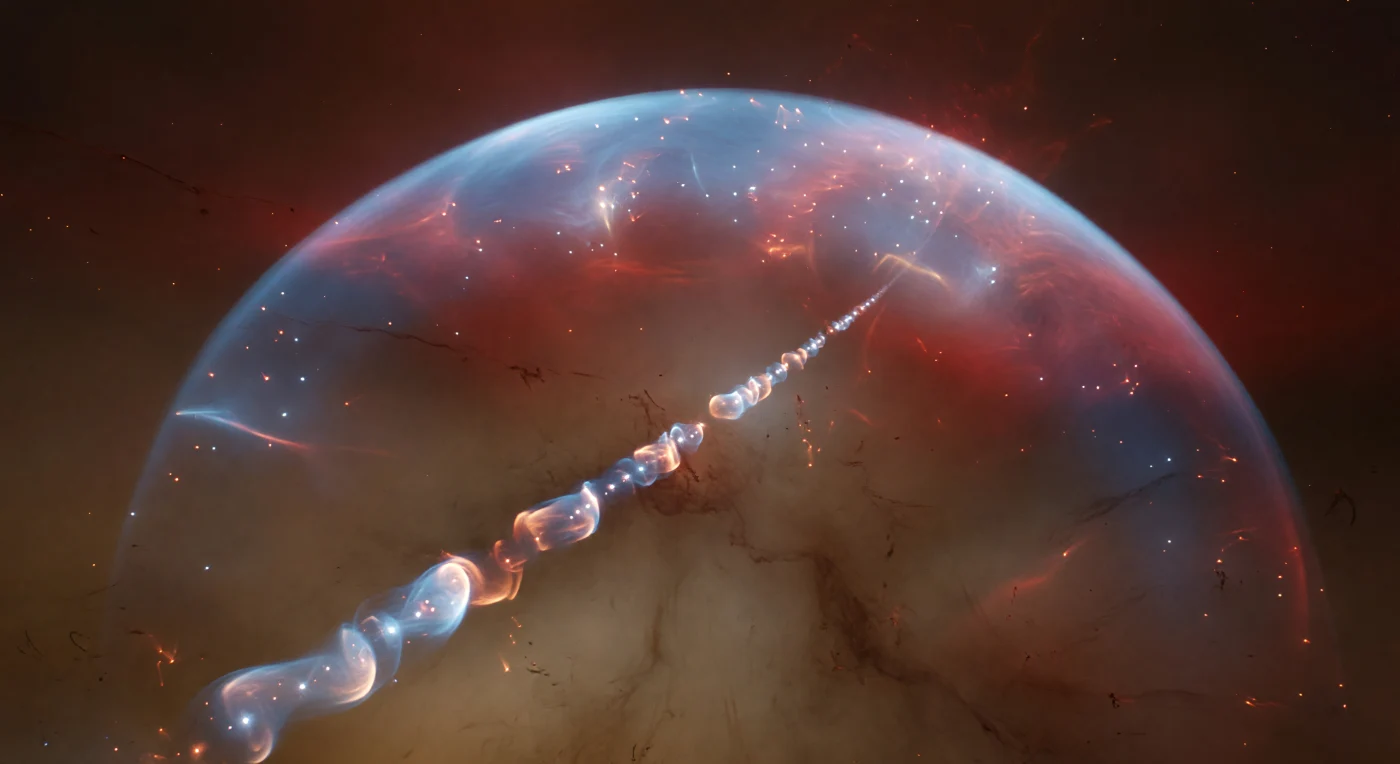
You are adrift inside one of the most violent collisions a newborn star can produce — a Herbig-Haro bow shock, where a supersonic jet of plasma ejected from a deeply embedded protostar slams into the surrounding molecular cloud at hundreds of kilometers per second. Arching from one edge of your field of view to the other, the shock front curves overhead like the prow of a continent-sized wave frozen at the instant of breaking: its leading edge burns blue-white with forbidden oxygen emission from gas heated to tens of thousands of degrees, then grades through aquamarine and saturated crimson hydrogen-alpha before bleeding into deep scarlet sulfur recombination light at the trailing rim — a complete chemistry of shock physics painted across a single luminous crescent. Behind it, a beaded jet column threads back through warm brown-ochre molecular fog with startling geometric precision, each bright knot a miniature working surface in its own right, separated by slightly cooler, redder segments where the plasma has had just enough time to recombine before the next pulse of ejected material arrives and re-shocks it. The entire structure — bow shock, jet, and enveloping molecular fog — spans a volume measured in light-months, yet every element is coherent and directional, the forward hemisphere blazing in cold clinical blue-white while the rearward view dissolves into rust-colored diffuse glow scattered through layers of silicate dust that catch the arc-light and scatter it into faint violet aureoles at the shock's outermost rim.
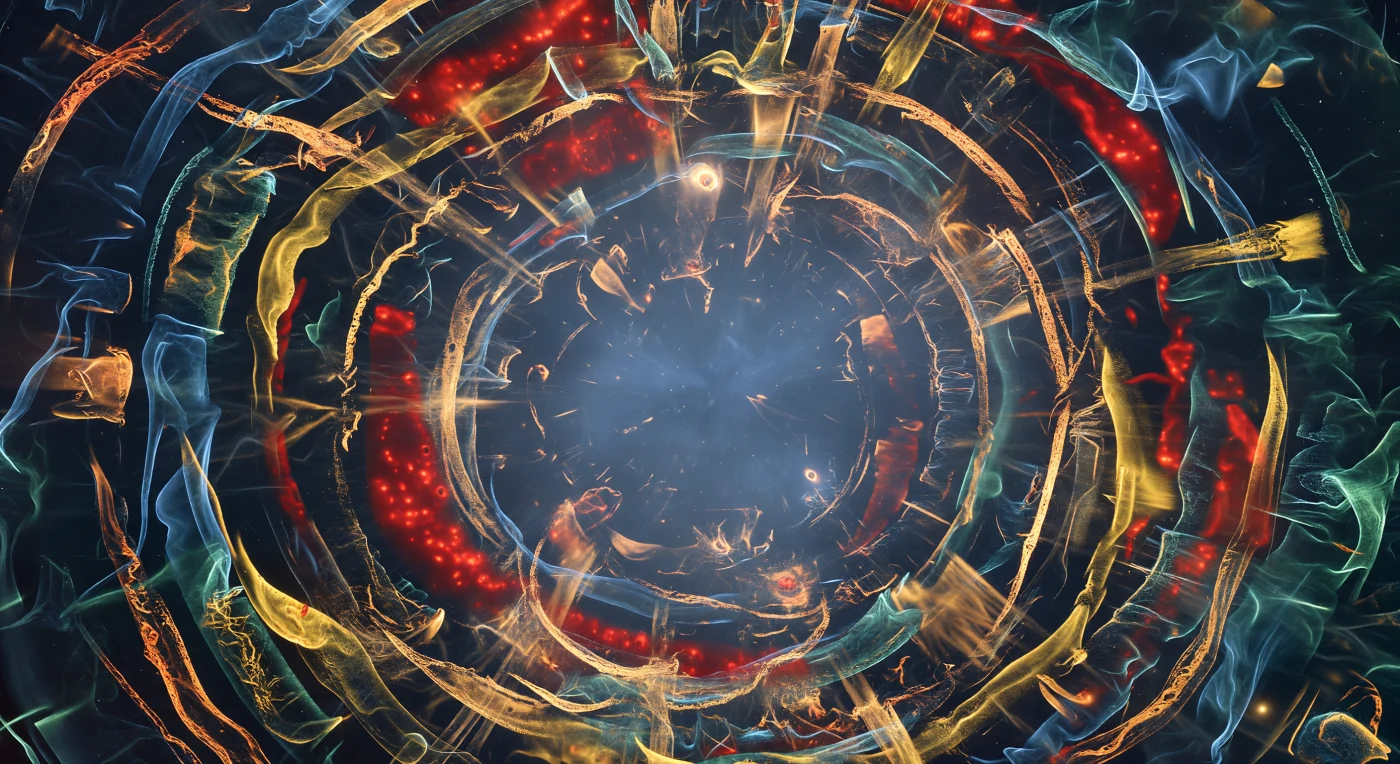
You are suspended within a three-dimensional wreckage of nuclear history, surrounded on every side by chemically segregated light — cold blue-green oxygen and neon filaments billowing outward in Rayleigh-Taylor fingers whose edges are sharp luminous contours rather than gradients, backed by sulfur ribbons burning in deep amber, silicon sheets radiating saturated brick-red, and dense iron knots blazing ahead of everything else in pale copper-gold, each element occupying its own spatial shell defined by where it was forged during the final seconds of a massive star's collapse. This is Cassiopeia A, a supernova remnant roughly ten light-years across, its expanding ejecta the direct product of explosive nucleosynthesis — the very process by which the universe manufactures everything heavier than iron — now radiating its chemical identity as color across a fragmented topology moving outward at thousands of kilometers per second. The interior of the shell dissolves inward toward a sourceless steel-blue synchrotron glow, the electromagnetic signature of relativistic electrons spiraling through the magnetic field left by the annihilated star, marking the cavity where a stellar core once existed. No darkness is present anywhere — each filament is its own emitter, and their combined light fills the interior from every direction simultaneously, so that shadows are absorbed into multicolored luminosity and depth is measured only by the geometric recession of identical glowing structures diminishing across light-years of near-perfect vacuum. You exist inside the still-expanding record of a single stellar death that occurred in the seventeenth century as seen from Earth, now frozen in this instant as layered elemental fire.
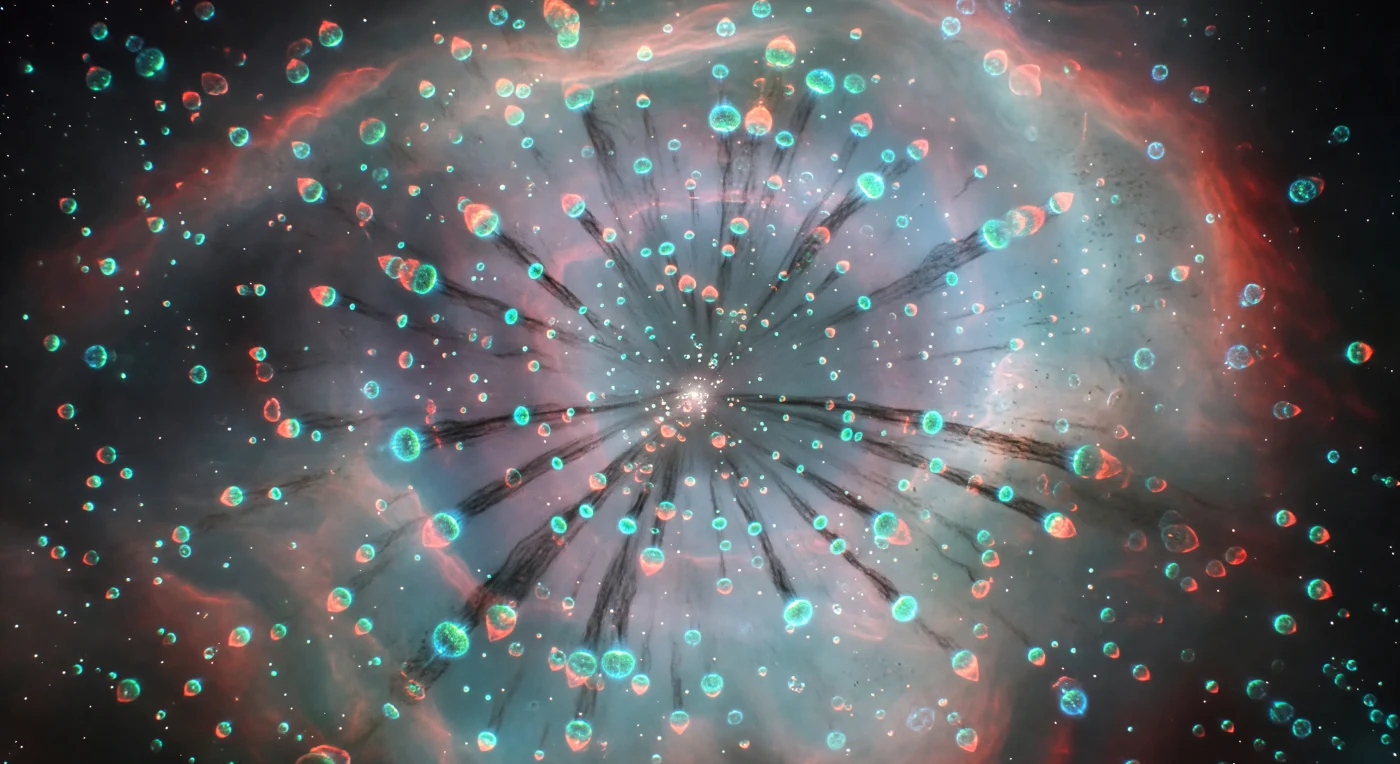
Suspended within the vast shell of the Helix Nebula, the viewer is surrounded on all sides by thousands of cometary knots — dense molecular condensations each roughly the diameter of our entire solar system, their sunward faces blazing in vivid blue-green as the distant white dwarf's ultraviolet radiation strips electrons from oxygen and hydrogen at each knot's ionization boundary. Behind every glowing head, a long dark tail of cold molecular gas extends radially inward, shielded from the ionizing flux and appearing as deep charcoal filaments against the luminous surrounding medium, so that the whole interior resembles a vast bioluminescent membrane — ten thousand comet-shadows all pointing toward the same invisible radiative source. Between the knots, the inter-knot gas is not empty but faintly luminous, threaded with diffuse hydrogen-alpha pink like a recombining mist, giving the space the three-dimensional depth of standing inside an illuminated biological tissue, individual glowing cells resolved at every distance before dissolving into the soft continuous glow of the shell's far wall. The limb-brightened ring of the nebula itself arches above and below as an immense torus, its innermost surface incandescent with ionized helium and oxygen, its outer skin dimming through red and deep crimson where the UV field weakens and neutral hydrogen reasserts itself — the whole structure the evolved remnant of a dying star's final exhalation, dispersing across space over tens of thousands of years.
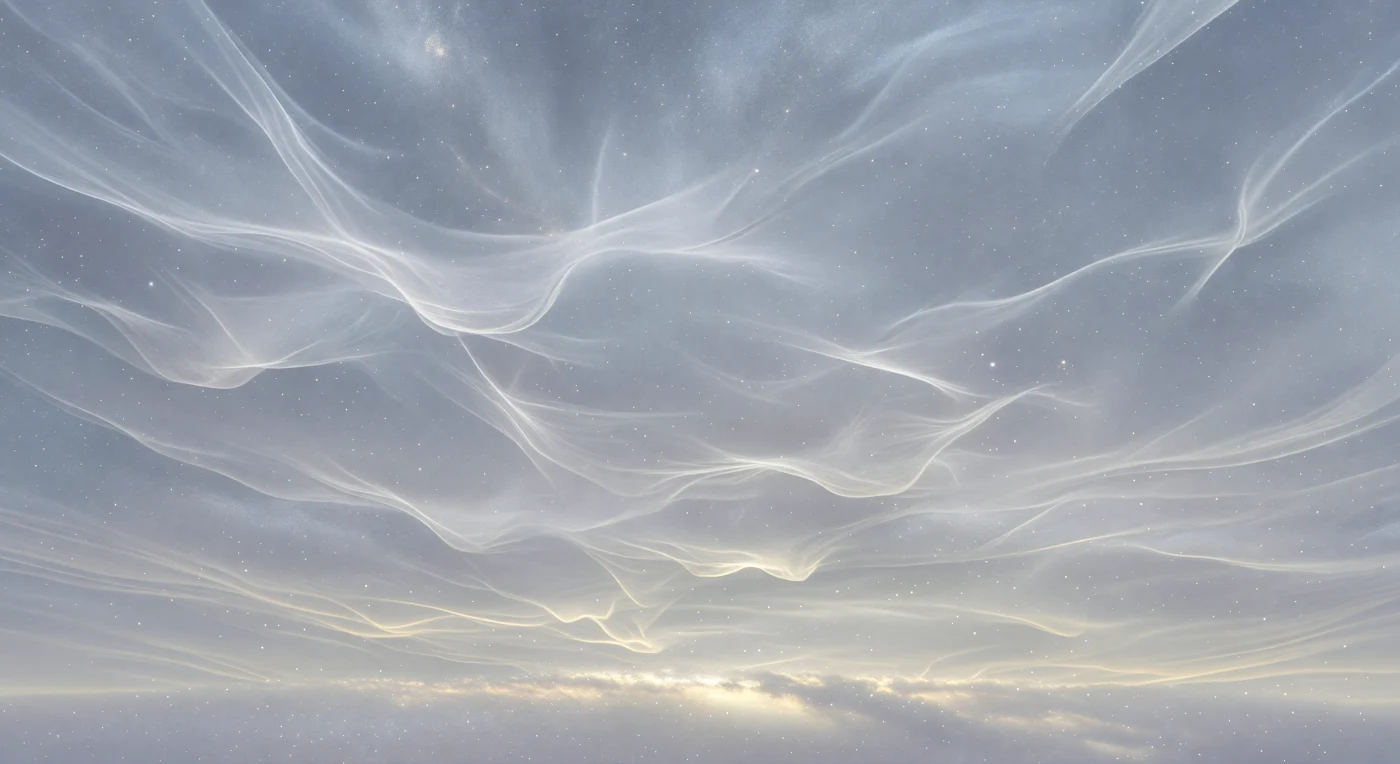
You drift above the Milky Way's disk, suspended within one of the galaxy's most ghostly structures — a vast, high-latitude infrared cirrus cloud stretching thousands of light-years in every direction, woven from dust grains each no wider than a fraction of a micron, silicate slivers and carbonaceous flecks collectively thin enough to be classified as near-vacuum yet dense enough to scatter the integrated light of a hundred billion stars into this sourceless, breathing luminosity. The dominant palette is a cold silver-blue, pooling in the filaments' deepest folds and fading toward pale arctic white where the dust thins to near-nothing, while along the lower field a faint aureole of warm golden-white betrays the galactic disk far below — not a sunrise, but the diffuse photometric glow of the Milky Way's entire stellar population compressed by distance into a continuous amber band. Galactic magnetic field lines have drawn the dust into vast striated curtains that curve with an unhurried geometry, their edges dissolving before the eye can find them, their interiors neither fully opaque nor truly transparent — a medium that exists and does not exist simultaneously, scattering starlight the way a winter fog halos a distant city. The sense of scale accumulates slowly and oppressively: no surface anchors you, only veil receding behind veil, each fractionally dimmer and bluer, the whole assembly a reminder that what reads as gossamer ribbon would require a journey of hundreds of light-years to cross.
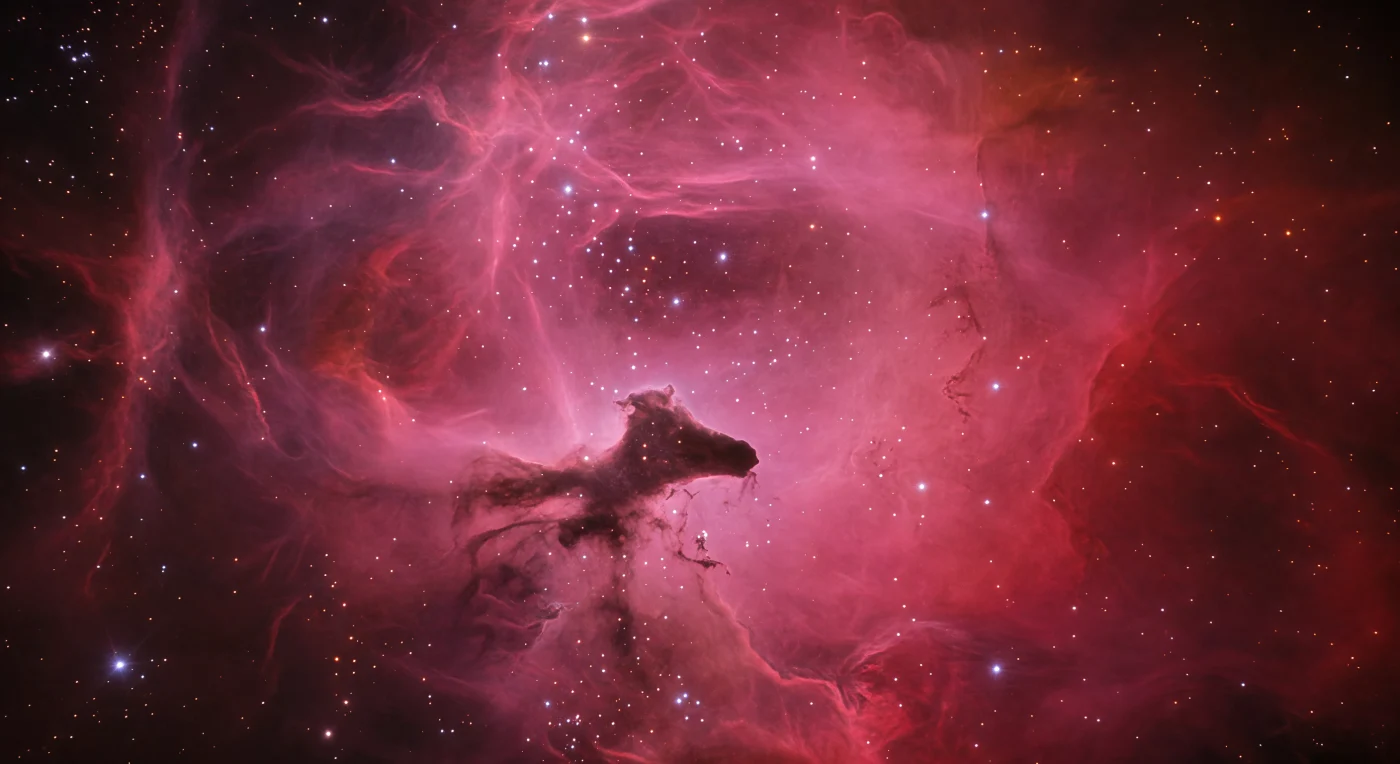
You are suspended inside the luminous body of IC 434, immersed within a vast curtain of ionized hydrogen that glows in every direction with a deep magenta-crimson warmth — not fire, but something closer to the interior of a stained-glass cathedral whose walls extend for light-years in every direction, textured with delicate filamentary streaks of denser gas that bleed from rose to burgundy like watercolor strokes across an infinite canvas. Rising from the base of the frame, the Horsehead Nebula asserts itself as a shape of absolute molecular opacity, a silhouette so thoroughly impenetrable that it reads less like shadow than like something carved from a material denser than thought itself — a cold molecular cloud where hydrogen column densities climb so high that not a single photon survives the crossing. Along its leading mane edge, a faint fringe of pale violet-pink betrays the violence of the interface: photoevaporating gas driven off the cloud's surface by ultraviolet radiation from the massive star Sigma Orionis, tiny tongues of partially ionized material dissolving back into the surrounding H II region at velocities measured in kilometers per second. Stars scattered across the field chronicle the cloud's depth in color alone — foreground pinpoints blazing white-blue, middle-distance suns tinted amber and orange, the outermost survivors reduced to dim rust-red before the dust column finally extinguishes them entirely, a chromatic countdown that makes the molecular cloud's mass feel geological, impassable, and absolute.
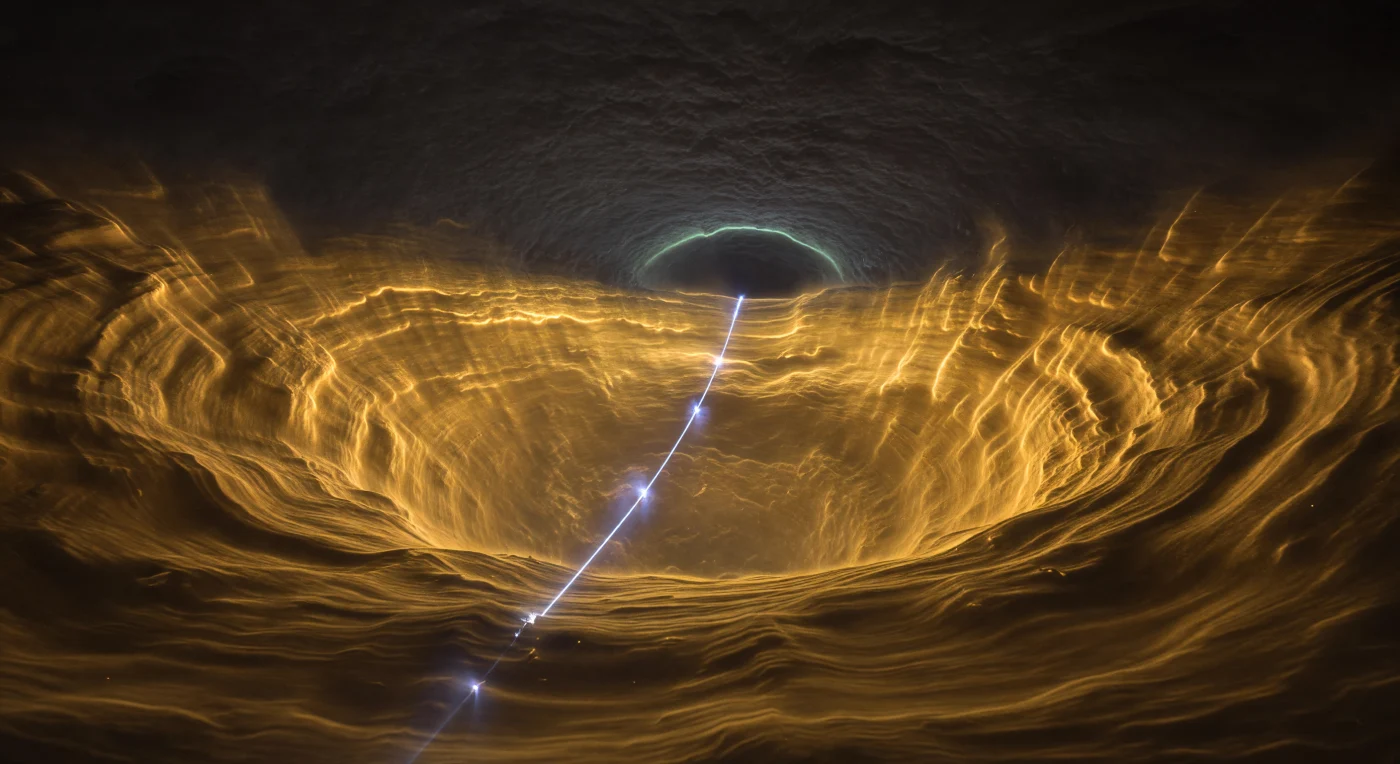
You are suspended inside the hollow core of a young star's first act of violence — a biconical tunnel blown clean through an ancient dark molecular cloud by a wind not yet ten thousand years old. The cavity walls curve away from you in both directions like the interior of an immense horn, pressing inward at distances of hundreds of astronomical units yet reading as architecturally intimate, their surfaces corrugated and scalloped by continuous wind ablation into overlapping ridges and fibrous hollows that glow a deep amber-gold where molecular hydrogen fluoresces under infrared irradiation pumped outward from the hidden protostellar disk buried somewhere beneath the opaque dark below. Threading the central axis of this luminous tunnel runs a razor-collimated jet of ionized iron plasma — blue-white, coherent, and precise — punctuated by standing shock knots where velocity differentials compress the beam into brief flares of electric blue-violet before resolving back into thread, its faint contact scar inscribed against the warm cavity wall marking the boundary between two entirely different physical regimes. At your back, the cavity mouth opens outward into the cold molecular cloud exterior, and at that aperture a bow shock arc glimmers — a thin crescent of pale blue-green emission curved symmetrically around the outflow axis, barely brighter than the surrounding darkness, announcing to the interstellar medium that something enormous and irreversible has just begun.
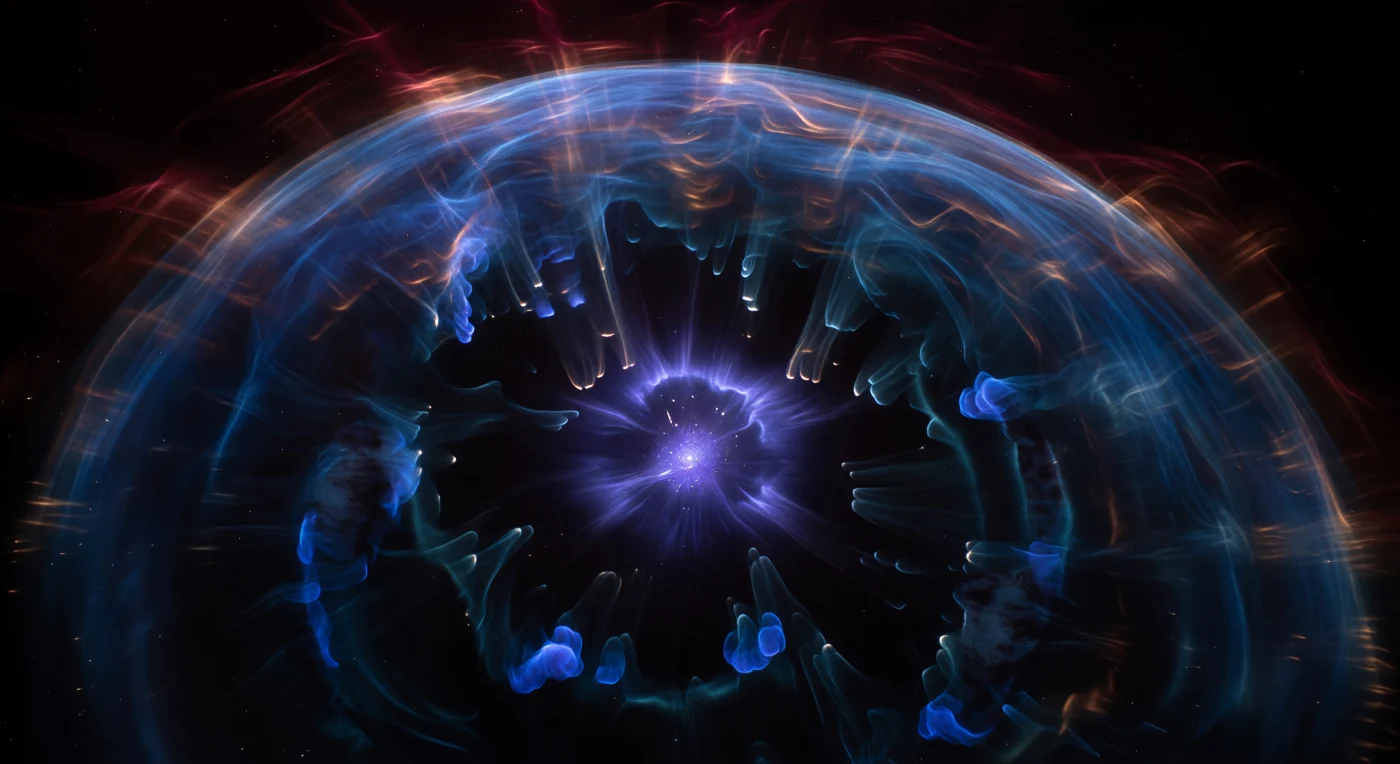
At the center of everything burns a point of blue-violet fire so concentrated it defies the eye's attempt to resolve it — a Wolf-Rayet star radiating at roughly 80,000 Kelvin, its surface temperature alone sufficient to flood the surrounding cavity with hard ultraviolet photons that strip electrons from oxygen atoms and force them into the quantum states responsible for that extraordinary cobalt-teal glow arcing across the entire upper field of view. The space between observer and star is not truly empty: it seethes with plasma heated to ten million Kelvin by the star's wind — a continuous outflow moving at two thousand kilometers per second that has physically excavated this cavity over tens of thousands of years, sweeping surrounding interstellar gas into the compressed shell now visible as layered luminous curtains overhead. That shell's inner face is alive with Rayleigh-Taylor instability fingers, columns of denser material caught in the act of sinking back inward through the lighter hot plasma beneath them, each one rim-lit in pale blue-white where the stellar radiation catches its edge while its interior holds a deeper teal, giving the whole structure the carved solidity of a vaulted ceiling made of gas thinner than any vacuum achievable on Earth. At the bubble's outermost boundary, a diffuse crimson ring of hydrogen-alpha emission marks where the forward shock is still pressing outward into undisturbed interstellar space, the entire panorama spanning light-years of ionized architecture held in dynamic tension between a single star's fury and the inertia of the galaxy around it.
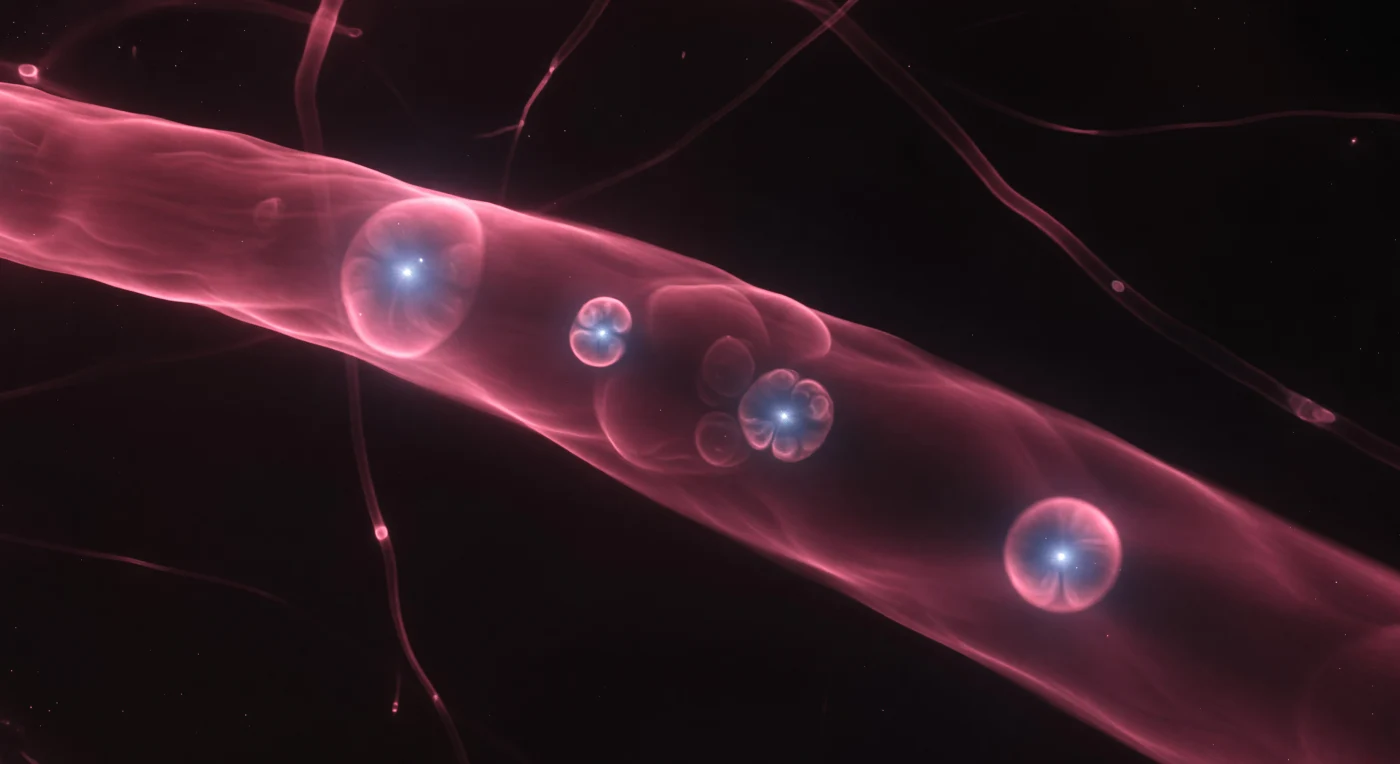
You are suspended within a filament of gas that has never been touched by a metal atom — pure hydrogen and helium stretching in every direction across tens of light-years, its recombination glow an unbroken rose-crimson rendered in a single spectral color, the lone Hα wavelength unmuddied by dust or chemistry, vivid and saturated like no later nebula in the universe will ever be. Three Population III stars blaze at the filament's edge — each a hundred to three hundred solar masses, their surfaces burning above seventy thousand Kelvin — flooding the surrounding gas with hard ultraviolet that carves Strömgren spheres into the plasma, each ionization bubble ringed by a faintly brighter shell where photon flux and recombination rates momentarily balance before giving way to neutral gas beyond. No dust exists to scatter their blue-white light, so the landscape is defined entirely by ionization geometry: brilliant emission where UV penetrates, abrupt darkness where it does not, and behind denser knots of gas, faint elongated shadows stretching away from each stellar point source with almost clinical precision. The three bubbles have not yet merged, but their edges approach, and at the zones of overlap the doubly ionized gas glows fractionally brighter, tracing in real time the geometry of cosmic reionization from inside the event itself. Behind all of this, at distances that register only as the faintest rose tint against the absolute dark, other primordial filaments cross the field obliquely — the embryonic cosmic web, a skeleton of hydrogen and helium that has not yet made a single grain of anything.
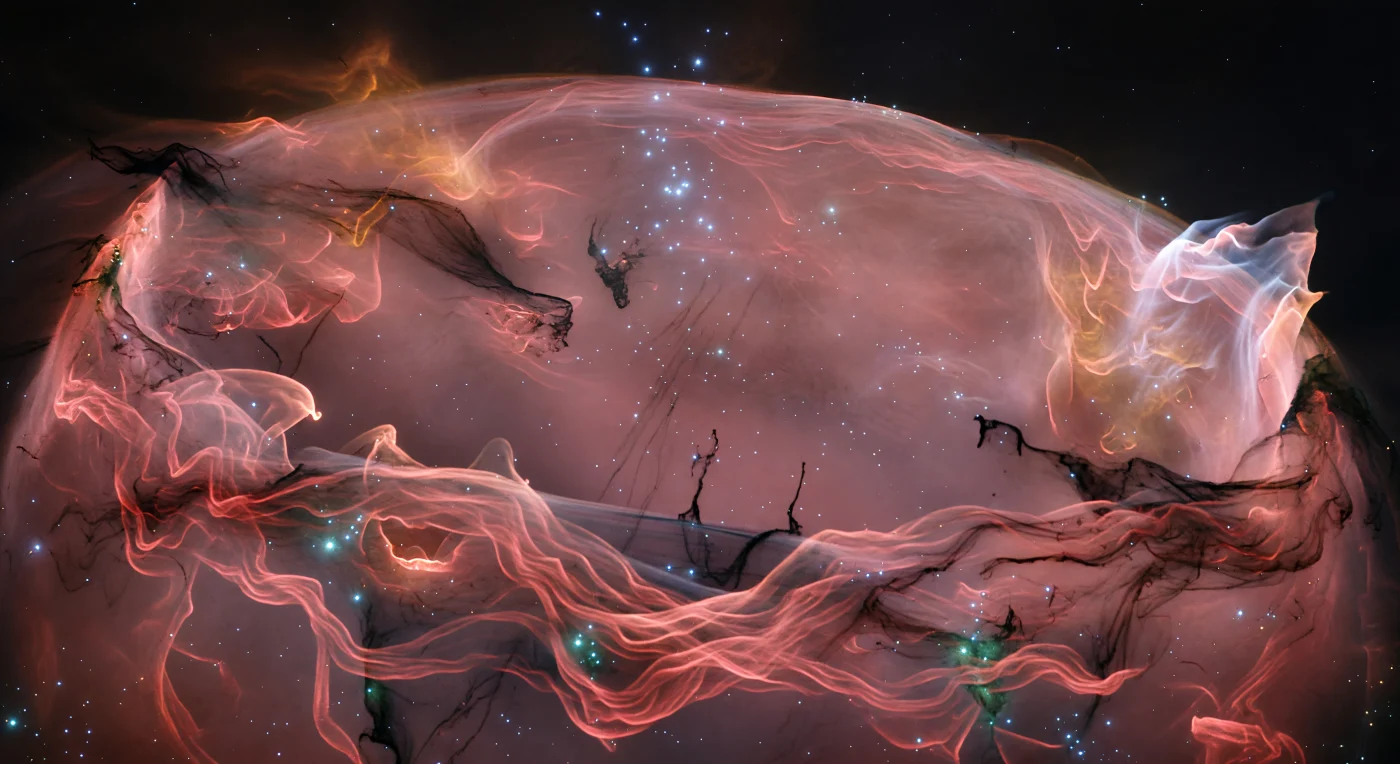
You are standing at the center of a wound that light has not yet finished escaping — a 500-light-year cavity whose walls stretch across every direction like the shattered interior of a cathedral built from plasma, shaped over millions of years by the overlapping deaths of massive stars. The shell before you is not a surface but a ruin: braided filaments of crimson Hα emission lace through collapsed arches and torn membranes, interrupted by cold molecular streamers pushing inward like dark fingers against the luminous curtain, their sunward edges hazing amber where ultraviolet is slowly eating them alive, while hard cyan-green knots of forbidden oxygen emission mark the shock fronts where the blast wave still churns the densest compressions. Dozens of blue-white OB stars drift through the tenuous interior — one particle per cubic centimeter of ionized hydrogen sustaining its faint rose translucence over hundreds of light-years of accumulated depth — their collective ultraviolet output the only reason this cavity glows at all rather than collapsing back into cold dark. At the right edge of everything, the shell is simply gone: a ragged chimney where the superbubble has ruptured entirely, gas streaming upward in luminous sheets of hot white and pale violet into an absolute extragalactic darkness that carries no structure, no warmth, no return — the last membrane between the ignited interior and the void, failed at exactly one point, and through that point, the light pours out forever.