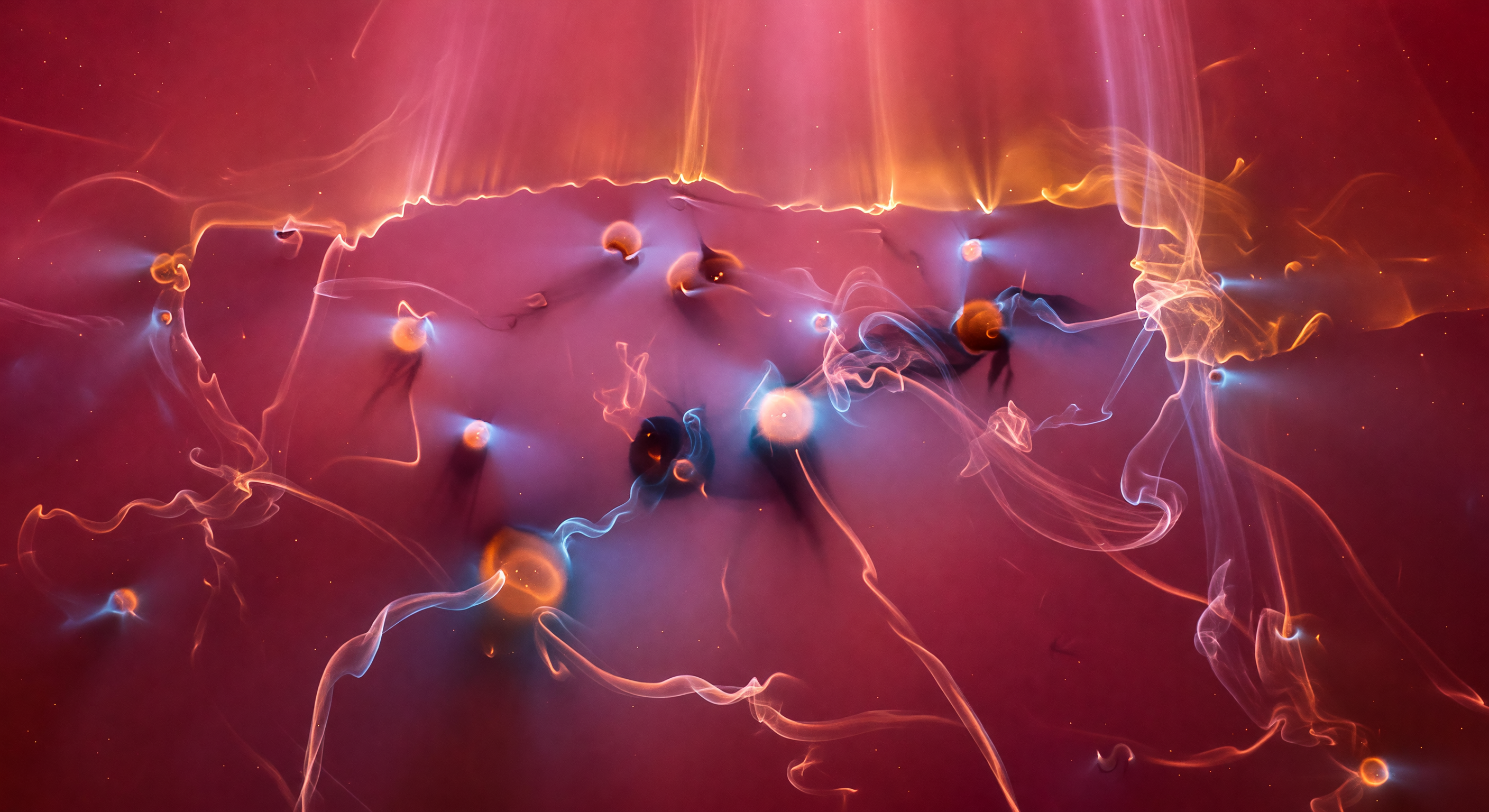
You are suspended inside a volume of gas so rarefied it contains fewer particles per cubic centimeter than the best vacuum chambers on Earth, yet every direction glows with a deep arterial red — the light of hydrogen atoms catching free electrons, recombining millions of times per second across distances measured in fractions of a light-year. Directly ahead, the ionization front rises as a luminous boundary where the physics of the universe changes abruptly: on your side, plasma heated to ten thousand kelvin by the invisible ultraviolet torrent of an O3 star blazing off-frame at perhaps a hundred times the Sun's surface temperature; on the far side, molecular gas so cold it hovers near ten kelvin, its amber-orange photodissociation face bleeding warm fire through the ragged curtain. Dense neutral clumps resist the advancing ionization, their leading edges ablating into thin halos of sulfur crimson and forbidden-line turquoise while casting hard shadow cones back through the translucent Hα fog, crosshatching the entire space with diverging darkness whose penumbrae glow faintly wherever even marginal ultraviolet finds purchase. The front itself is fractally torn — protrusions and re-entrant bays sculpted not by wind in any terrestrial sense but by the differential pressure of radiation, a process unfolding across tens of thousands of years yet frozen here into a single blazing instant of impossible clarity.
Other languages
- Français: Au Cœur du Front d'Ionisation
- Español: Dentro del Frente de Ionización
- Português: No Interior da Frente de Ionização
- Deutsch: Im Wasserstoff-Ionisationsfront
- العربية: داخل جبهة التأين الهيدروجيني
- हिन्दी: हाइड्रोजन आयनीकरण अग्र के भीतर
- 日本語: 水素電離前線の内側
- 한국어: 수소 이온화 전선 내부
- Italiano: Nel Fronte di Ionizzazione dell'Idrogeno
- Nederlands: Binnen het Waterstof Ionisatiefront