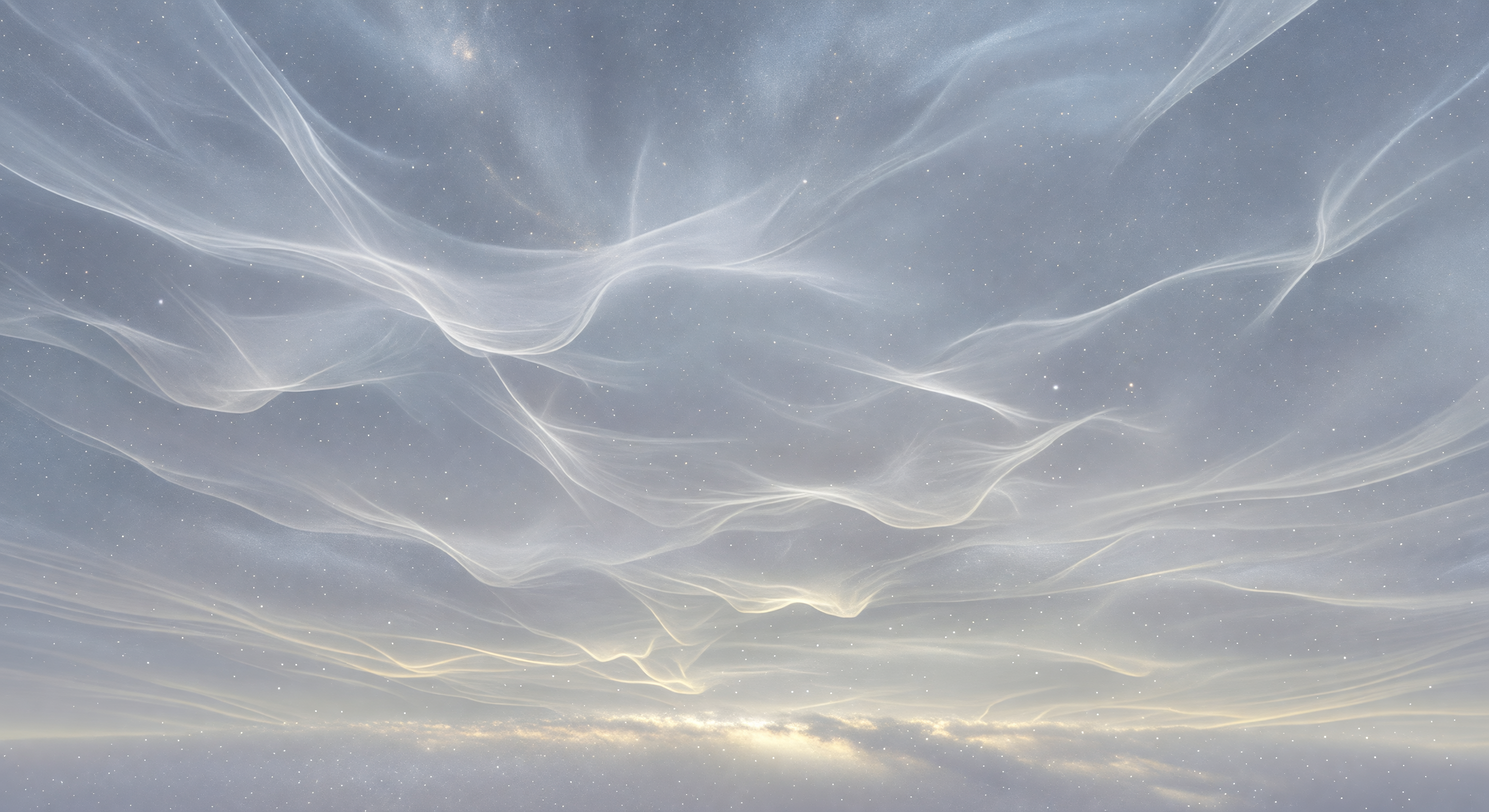
You drift above the Milky Way's disk, suspended within one of the galaxy's most ghostly structures — a vast, high-latitude infrared cirrus cloud stretching thousands of light-years in every direction, woven from dust grains each no wider than a fraction of a micron, silicate slivers and carbonaceous flecks collectively thin enough to be classified as near-vacuum yet dense enough to scatter the integrated light of a hundred billion stars into this sourceless, breathing luminosity. The dominant palette is a cold silver-blue, pooling in the filaments' deepest folds and fading toward pale arctic white where the dust thins to near-nothing, while along the lower field a faint aureole of warm golden-white betrays the galactic disk far below — not a sunrise, but the diffuse photometric glow of the Milky Way's entire stellar population compressed by distance into a continuous amber band. Galactic magnetic field lines have drawn the dust into vast striated curtains that curve with an unhurried geometry, their edges dissolving before the eye can find them, their interiors neither fully opaque nor truly transparent — a medium that exists and does not exist simultaneously, scattering starlight the way a winter fog halos a distant city. The sense of scale accumulates slowly and oppressively: no surface anchors you, only veil receding behind veil, each fractionally dimmer and bluer, the whole assembly a reminder that what reads as gossamer ribbon would require a journey of hundreds of light-years to cross.
Other languages
- Français: Nébuleuse Cirrus Infrarouge Lointaine
- Español: Nebulosa Cirrus Infrarroja Polar
- Português: Nebulosidade Cirrus Infravermelha Polar
- Deutsch: Hochbreitengrad Infrarot Zirrusnebel
- العربية: سديم سيروس الأشعة تحت الحمراء
- हिन्दी: उच्च-अक्षांश अवरक्त सिरस नीहारिका
- 日本語: 高緯度赤外線巻雲星雲
- 한국어: 고위도 적외선 권운 성운
- Italiano: Nebulosità Cirrus Infrarossa Polare
- Nederlands: Hoogbreedte Infrarood Cirrusnevel