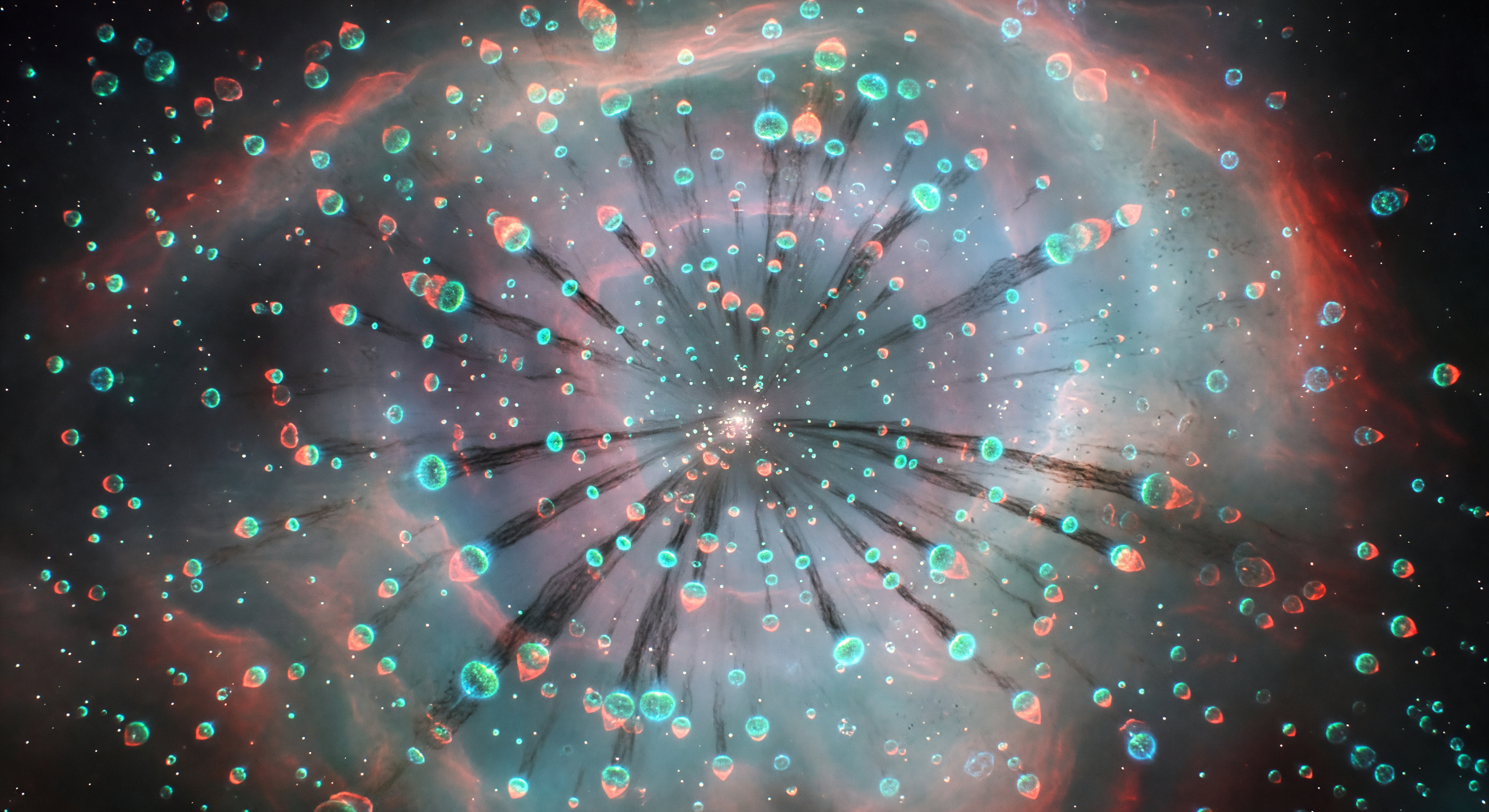
Suspended within the vast shell of the Helix Nebula, the viewer is surrounded on all sides by thousands of cometary knots — dense molecular condensations each roughly the diameter of our entire solar system, their sunward faces blazing in vivid blue-green as the distant white dwarf's ultraviolet radiation strips electrons from oxygen and hydrogen at each knot's ionization boundary. Behind every glowing head, a long dark tail of cold molecular gas extends radially inward, shielded from the ionizing flux and appearing as deep charcoal filaments against the luminous surrounding medium, so that the whole interior resembles a vast bioluminescent membrane — ten thousand comet-shadows all pointing toward the same invisible radiative source. Between the knots, the inter-knot gas is not empty but faintly luminous, threaded with diffuse hydrogen-alpha pink like a recombining mist, giving the space the three-dimensional depth of standing inside an illuminated biological tissue, individual glowing cells resolved at every distance before dissolving into the soft continuous glow of the shell's far wall. The limb-brightened ring of the nebula itself arches above and below as an immense torus, its innermost surface incandescent with ionized helium and oxygen, its outer skin dimming through red and deep crimson where the UV field weakens and neutral hydrogen reasserts itself — the whole structure the evolved remnant of a dying star's final exhalation, dispersing across space over tens of thousands of years.
Other languages
- Français: Coque de nœuds cométaires d'Hélix
- Español: Corteza de nodos cometarios Hélice
- Português: Concha de nós cometários Hélix
- Deutsch: Helix-Nebel Kometarknoten Hülle
- العربية: غلاف عقد مذنبية سديم حلزون
- हिन्दी: हेलिक्स नेबुला धूमकेतु गाँठ कोश
- 日本語: らせん星雲彗星状ガス殻
- 한국어: 나선 성운 혜성 매듭 껍질
- Italiano: Guscio di nodi cometari della Elica
- Nederlands: Helixnevel komeetknoop schil