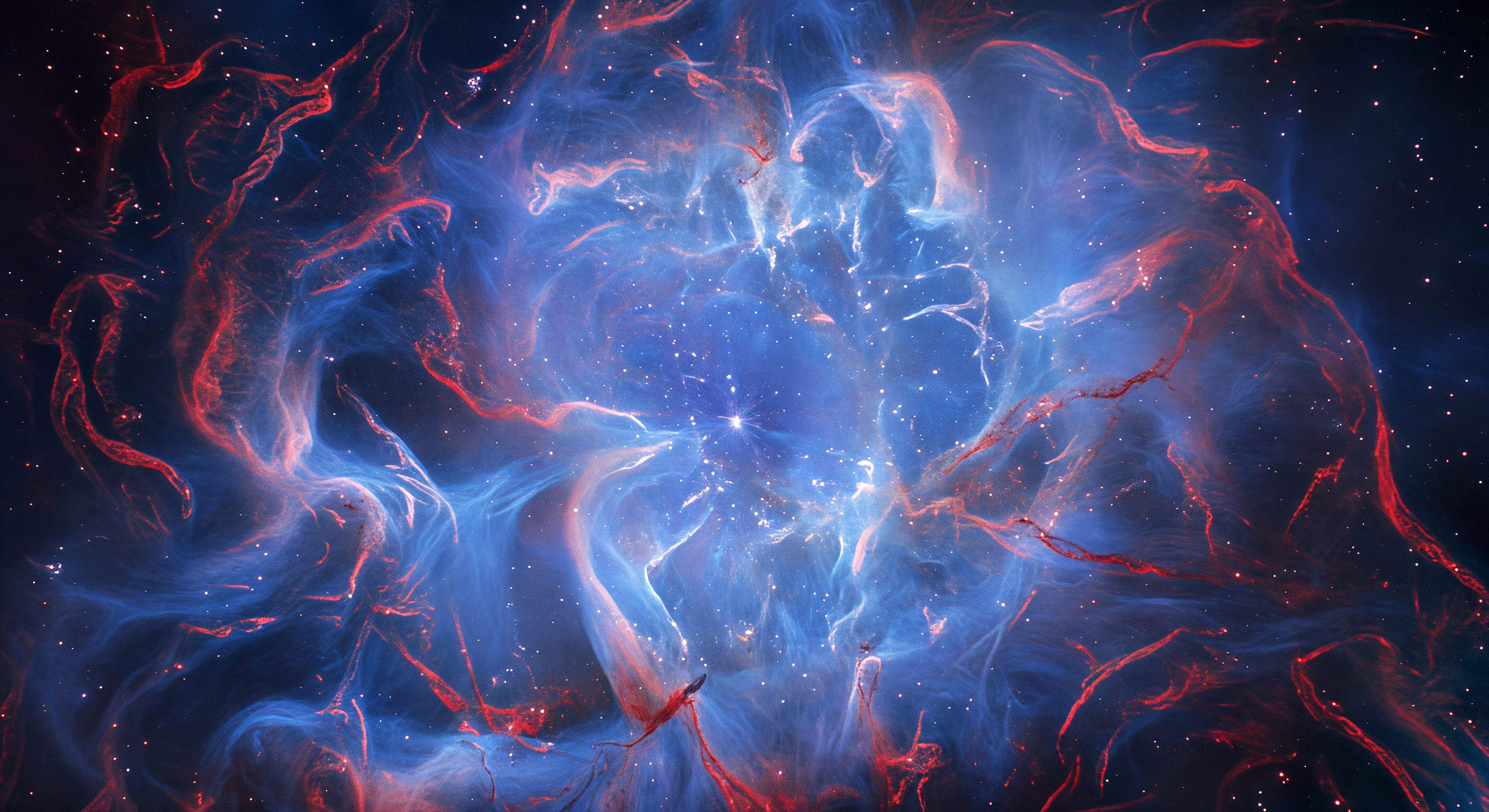
You are suspended inside the Crab Nebula's synchrotron interior, and in every direction the universe has become its own light source — a cold, omnidirectional electric blue that casts no shadows, born not from any star but from relativistic electrons wrung to near-light speed by the amplified magnetic field of a dead stellar core, emitting synchrotron radiation across the full visual spectrum in volumetric gradients that swell and dim like breathing. Threading through this blue immensity in every plane of space, a baroque network of crimson and scarlet filaments ropes and braids and knots into structures that resemble torn biological tissue under tension — these are the actual outer layers of a star that exploded in 1054 CE, still traveling outward at thousands of kilometers per second yet appearing geological in their stillness, their interiors dense with neutral hydrogen, their edges lit in Hα recombination red where ionized gas perpetually reassembles itself. At the precise center of the scene, a point of light pulses with a rapid stroboscopic flicker — the Crab Pulsar, a neutron star roughly the diameter of a city compressed to nuclear density, sweeping twin beams of hard radiation across the nebula interior thirty times per second, each heartbeat sending a subtle ripple of brightening through the surrounding synchrotron haze that washes briefly over the nearest filaments before fading back into the cold blue baseline. Two entirely different physical processes — magnetic synchrotron emission and thermal recombination — occupy the same eleven-light-year volume of space without ever mixing, interpenetrating in absolute contrast: the cold physics of relativity threaded through the warm, biological-looking wreckage of a star's final scream.
Other languages
- Français: Intérieur synchrotron nébuleuse du Crabe
- Español: Interior sincrotrón nebulosa del Cangrejo
- Português: Interior síncrotron nebulosa do Caranguejo
- Deutsch: Krebsnebel Synchrotron Inneres
- العربية: داخل سديم السرطان المتزامن
- हिन्दी: केकड़ा नीहारिका सिंक्रोट्रॉन आंतरिक
- 日本語: かに星雲シンクロトロン内部
- 한국어: 게성운 싱크로트론 내부
- Italiano: Interno sincrotrone nebulosa del Granchio
- Nederlands: Krabnevel synchrotron interieur