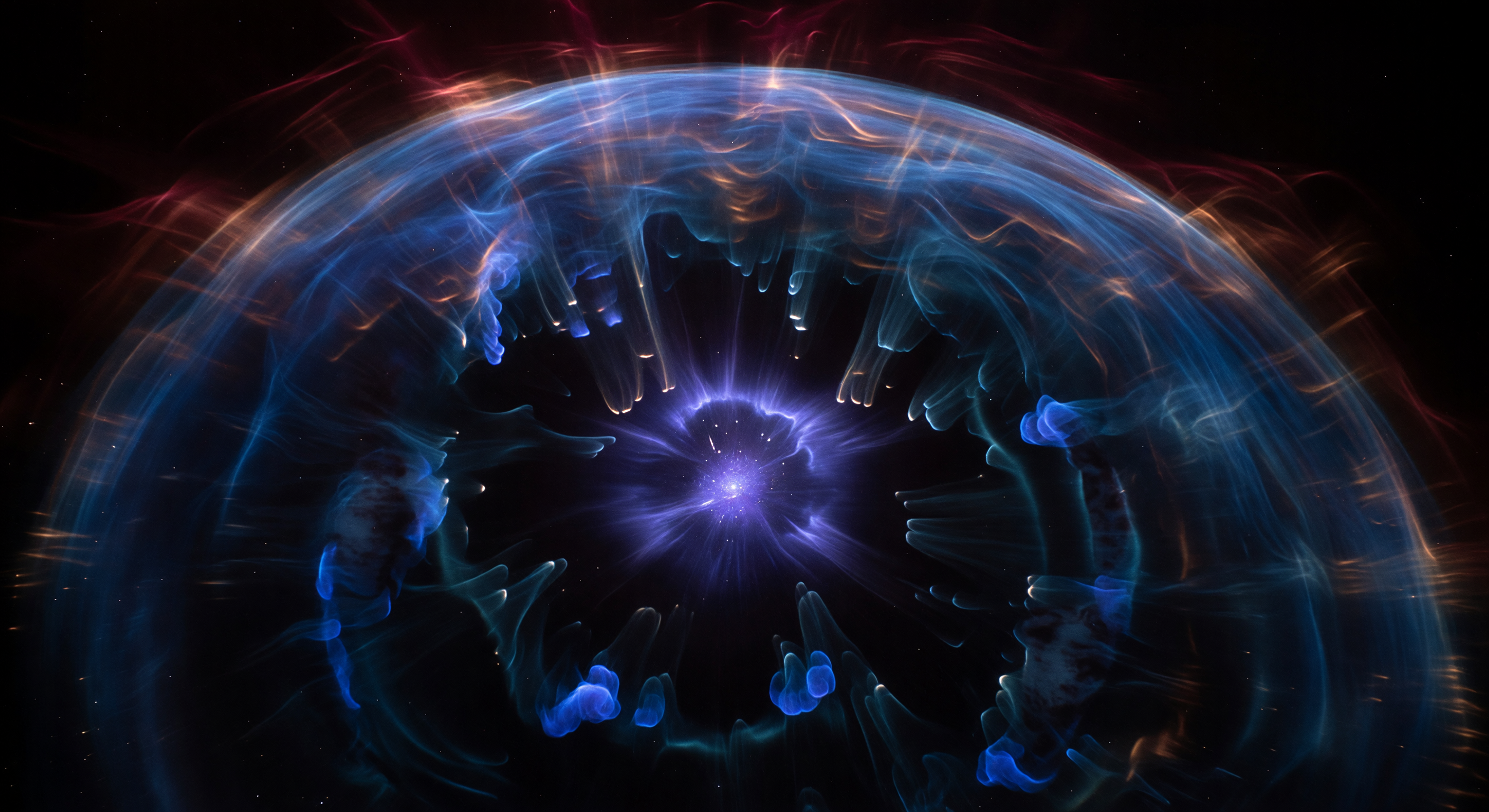
At the center of everything burns a point of blue-violet fire so concentrated it defies the eye's attempt to resolve it — a Wolf-Rayet star radiating at roughly 80,000 Kelvin, its surface temperature alone sufficient to flood the surrounding cavity with hard ultraviolet photons that strip electrons from oxygen atoms and force them into the quantum states responsible for that extraordinary cobalt-teal glow arcing across the entire upper field of view. The space between observer and star is not truly empty: it seethes with plasma heated to ten million Kelvin by the star's wind — a continuous outflow moving at two thousand kilometers per second that has physically excavated this cavity over tens of thousands of years, sweeping surrounding interstellar gas into the compressed shell now visible as layered luminous curtains overhead. That shell's inner face is alive with Rayleigh-Taylor instability fingers, columns of denser material caught in the act of sinking back inward through the lighter hot plasma beneath them, each one rim-lit in pale blue-white where the stellar radiation catches its edge while its interior holds a deeper teal, giving the whole structure the carved solidity of a vaulted ceiling made of gas thinner than any vacuum achievable on Earth. At the bubble's outermost boundary, a diffuse crimson ring of hydrogen-alpha emission marks where the forward shock is still pressing outward into undisturbed interstellar space, the entire panorama spanning light-years of ionized architecture held in dynamic tension between a single star's fury and the inertia of the galaxy around it.
Other languages
- Français: Intérieur de Bulle de Vent Stellaire
- Español: Interior de Burbuja de Viento Estelar
- Português: Interior da Bolha de Vento Estelar
- Deutsch: Inneres der Sternwind-Blase
- العربية: داخل فقاعة رياح نجمية
- हिन्दी: तारकीय पवन बुलबुले का आंतरिक भाग
- 日本語: 恒星風バブルの内部
- 한국어: 항성풍 거품 내부
- Italiano: Interno della Bolla di Vento Stellare
- Nederlands: Binnenste van Sterrenwindbel